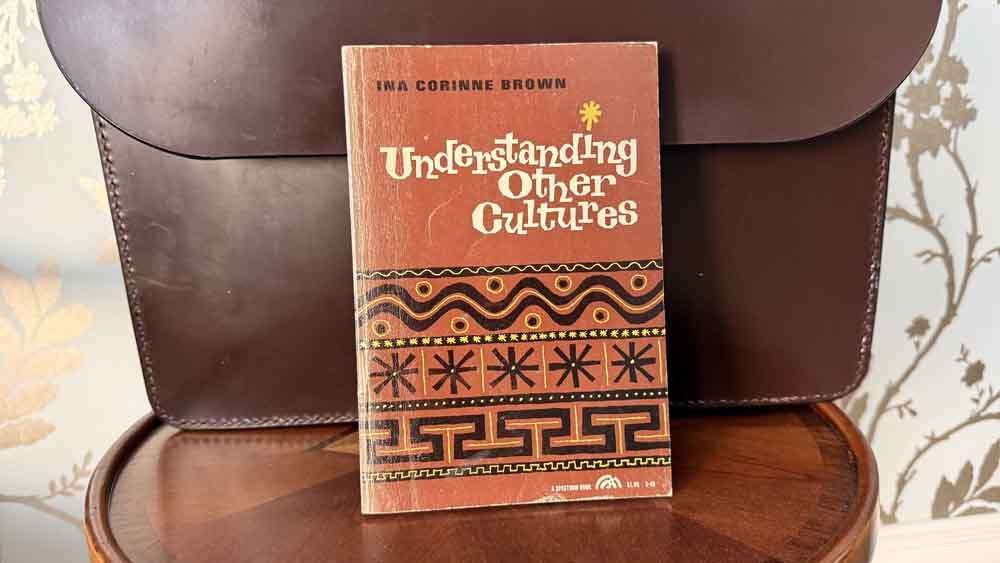
Few books reveal the architecture of their moment as honestly as Ina Corinne Brown’s Understanding Other Cultures. Published in 1963, at a hinge point between the old anthropological order and the discipline’s coming upheavals, it is part corrective, part artifact. Brown wrote it to dismantle prejudice — and largely succeeded. She also wrote it from inside a set of assumptions she could not entirely see, which is what makes it worth reading now with both admiration and a steady critical eye. The book rewards exactly the kind of careful, uncomfortable attention it urges its readers to give to other people.
Who Brown Was, and Why That Matters
Ina Corinne Brown was not a figure the academy tended to produce in large numbers. Born in 1896, she spent decades as professor of social anthropology at Scarritt College in Nashville, eventually becoming a special lecturer at Peabody College and Fisk University — Fisk being a historically Black institution, a meaningful professional association for a white Southern academic in that era. She had crossed Central Africa with a single companion in 1929–30, covering roughly 1,700 miles from the Congo’s mouth to what is now Kenya by boat, train, hammock, and foot. She had interviewed Gandhi. She had interviewed Toyohiko Kagawa, the Japanese pacifist theologian. By the time she wrote Understanding Other Cultures, she had spent forty years accumulating the kind of knowledge that comes from actually going places and talking to people rather than theorizing about them from a safe institutional distance.
That biography matters for how we read the book. Brown was not performing tolerance as a trend; she had built it from experience. Understanding Other Cultures was adopted as required freshman reading at the University of Texas and used in Japanese university classrooms to teach English — two facts that suggest it occupied an unusual position: serious enough for academic use, accessible enough to function as a general-audience introduction. It was, in the most honest sense, a book written to change minds.
What Brown Gets Right: The Radical Ordinariness of Cultural Relativism
The book’s central argument — that no culture’s practices can be judged by the standards of another without distortion — was not universally accepted in 1963. It remains imperfectly absorbed today. Brown makes the case with the quiet force of accumulated example rather than ideological hammering, which is the right method for a skeptical reader.
She walks through kinship systems, marriage customs, religious ritual, economic exchange, concepts of time, attitudes toward the body, and the functions of magic within communities that have no access to scientific explanation. In every case, the move is the same: what looks irrational from outside the system reveals its own internal coherence when you understand what problem it is solving. A practice that seems cruel or absurd to the Western observer is often doing essential social work — managing inheritance, binding alliances, processing grief, stabilizing hierarchies. Brown’s point is not that everything is equally good. Her point is that you cannot evaluate a practice without first understanding its function, and you cannot understand its function without suspending the reflexive certainty that your own system is the natural one.
This is harder than it sounds. It requires recognizing that your discomfort with another culture’s norms is data about you, not about them. Brown states plainly that no culture is inherently destined for greatness — a sentence that would have provoked genuine resistance from a meaningful portion of her readers in 1963. That it reads now as obvious is partly her book’s legacy, and the legacy of the broader anthropological tradition she was synthesizing for a general audience.
She is also persuasive on the question of cultural commonality. All known human societies have developed language, some form of family structure, economic exchange, aesthetic practice, and religious or supernatural belief. The diversity is in the expression; the underlying drives are recognizable across every population ever studied. Brown holds both truths simultaneously without collapsing them: humans are deeply alike and genuinely different, and both facts deserve attention.
Where the Era’s Blind Spots Show
None of this means the book reads cleanly across sixty years. It does not, and being honest about why is part of taking it seriously.
The first and most visible problem is the vocabulary. Brown uses terminology that had already begun to be questioned in the early 1960s — “primitive,” “simple societies,” “simpler cultures,” “non-Western” as a catch-all — with a frequency that modern readers will find jarring. She is aware, to some degree, that this vocabulary is imprecise; she notes at points that the terms anthropologists use fail to accurately classify cultures beyond what the Western academy defined as the “developed world.” But awareness does not equal escape. The language works within the reader, even when the author intends something more generous than the words themselves carry.
The second problem is the position of the observer. Brown consistently positions the Western reader — and implicitly herself — as the one doing the understanding, the one extending tolerance to practices that differ from their own. The cultures under examination are objects of study rather than subjects of perspective. Their members are described; they do not speak. This is not a failure of malice; it is a failure of method, and it was nearly universal in anthropology at the time. But it produces a book that, despite its humane intentions, retains the basic structure of the outsider’s gaze: a knowing center looking outward at interesting peripheries.
This matters because the outsider’s gaze is not neutral even when it is sympathetic. The act of cataloguing another group’s marriage customs, kinship terms, and magical beliefs — however carefully, however charitably — still treats that group as a subject rather than a voice. The book tells the reader how to think about other cultures; it does not let other cultures think about themselves within these pages. Clifford Geertz, writing in The Interpretation of Cultures just a decade later, would push toward a more dialogic anthropology — one that acknowledged the interpretive act, the position of the interpreter, and the limits of what one person’s gaze could ever capture. Brown is standing at the edge of that shift without quite crossing into it.
The third issue is a subtler one. Brown’s cultural relativism is rigorous when applied to marriage practices or religious rituals, but it softens perceptibly when the subject is race. Her earlier work included books explicitly on race relations, and her convictions on racial equality were genuine and, for her time and place, courageous. But the book’s treatment of race as a category still operates within a framework that understood race relations primarily as a moral and educational problem — a matter of prejudice to be corrected through better information — rather than a structural one. The systemic dimensions, the way institutions rather than just attitudes produce inequality, lie mostly outside the book’s frame.
The Question of the Gaze, Applied to Brown Herself
It would be too easy to stop at these criticisms. The more interesting move is to apply Brown’s own method to Brown: to ask what her book was solving for, what social work it was doing, what coherence it had within its moment.
Written in 1963 — the same year as the March on Washington, the assassination of Medgar Evers, and the publication of Baldwin’s The Fire Next Time — Understanding Other Cultures was an academic’s attempt to arm ordinary readers against the ideological machinery of racial and cultural hierarchy. The fact that it used terminology now considered inadequate should not obscure what it was doing with that terminology: insisting, in plain language aimed at college freshmen and general readers, that no group of human beings is naturally inferior, that the strangeness of another culture’s practices reflects your unfamiliarity rather than their failure, and that the habits your own society treats as natural are, in fact, contingent choices among many possible ones. That was not a small thing to say in 1963. In some quarters, it is still not a small thing to say.
The book’s limitations are the limitations of anyone trying to work against the assumptions of their era while still living inside those assumptions. No one writes from outside history. The best a thoughtful person can do is push against the edges of what their moment can see — and Brown, who walked across Central Africa and interviewed Gandhi and taught at Fisk and told her readers that cultural value is not objectively measured, pushed hard.
How to Read It Now
Understanding Other Cultures is worth reading if you are interested in the history of anthropological thought, in how ideas about tolerance and cultural difference were packaged for general audiences at mid-century, or in what serious liberal humanism looked like before it had to contend with its own structural critiques. It is not worth reading as a current guide to cultural difference; for that, you want something more recent and more attentive to power — Geertz’s The Interpretation of Cultures, or Ruth Benedict’s Patterns of Culture for historical depth, or Wade Davis’s field writing for the experiential texture Brown herself brought to her life but only partially brought to her prose.
Read it, as Brown would have wanted every cultural encounter read: with curiosity first, judgment held slightly in reserve, and the awareness that your discomfort with its language is itself information about where you are standing.
What the book finally demonstrates — not just argues, but demonstrates by existing — is that the capacity for cultural empathy has always been available to whoever wanted to exercise it. The information was always out there. The question, as it always is, was whether people were willing to do something with it.
You Might Also Like
Sources
- Brown, Ina Corinne. Understanding Other Cultures. Prentice-Hall, 1963. Available on Amazon
- Vernon, Walter N. “Brown, Ina Corinne.” Handbook of Texas Online, Texas State Historical Association. https://www.tshaonline.org/handbook/entries/brown-ina-corinne
- Geertz, Clifford. The Interpretation of Cultures. Basic Books, 1973. Available on Amazon
- Goodreads reader discussion: https://www.goodreads.com/book/show/34522507-understanding-other-cultures
- WorldCat record: https://www.worldcat.org/title/understanding-other-cultures/oclc/374957