
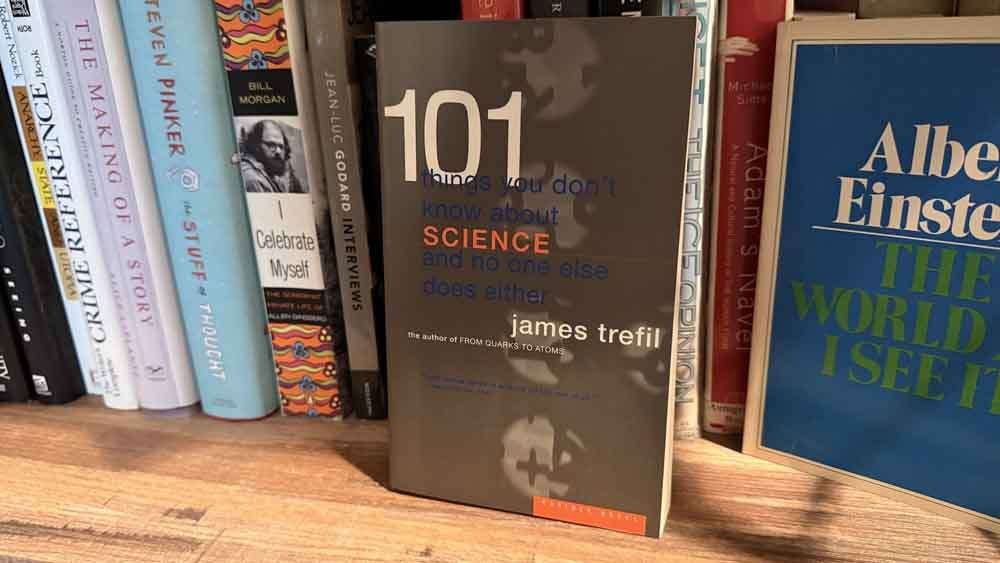
What a scientist doesn’t know is more interesting than what he does. That’s not a provocation — it’s the operating premise of James Trefil’s 101 Things You Don’t Know About Science and No One Else Does Either, a book that manages to be both a celebration of human knowledge and a ruthlessly honest inventory of its limits. Published in 1996 and still worth your time in 2026, it is one of the more quietly radical books in popular science — not because it overturns anything, but because it reminds you, on almost every page, that the map is not the territory, and that most of the territory is still unexplored.
The Man Behind the Book
James Trefil holds a Ph.D. in physics from Stanford and spent decades as Robinson Professor of Physics at George Mason University. He has authored or coauthored more than thirty books, with the consistent mission of making rigorous science legible to people who didn’t go to graduate school for it. That mission could easily produce condescension — the kind of slow, hand-holding prose that implies the reader is fragile. Trefil doesn’t do that. He is opinionated, direct, and willing to plant a flag even when the ground is uncertain. That quality, more than his obvious command of the material, is what makes this book worth reading.
101 Problems, No Easy Answers
The book is structured as 101 short essays — three pages each, organized into eight chapters that move from the physical sciences through biology, medicine, cosmology, evolution, and technology. The first chapter, titled “The Top Ten Problems in Science,” sets the tone immediately. The opening entry: Why is there something rather than nothing? That’s not a soft opener designed to ease the reader in. That’s Trefil telling you exactly what kind of book this is — one that refuses to pretend the hard questions have been answered just because the easy ones have.
The ten problems he selects for that first chapter include the origin of life, the nature of consciousness, the living brain, gene therapy, and the unification of quantum mechanics with general relativity. Seven of the ten concern the human body and mind, which reflects both Trefil’s instinct for what matters to lay readers and a genuine truth about where the frontier of science actually sits. We know an enormous amount about particle physics and very little about why a neuron firing in one configuration produces the sensation of red versus the sensation of sorrow.
The Structure of Not Knowing
What elevates this above a simple science survey is Trefil’s consistent attention to why these questions remain open — not just that they do. He is careful to distinguish between questions that are open because we lack the technology to answer them (how many exoplanets have the right conditions for life?), questions that may be unanswerable in principle (what existed before the Big Bang?), and questions where we have the tools but not yet the framework (consciousness, aging, the origin of complex life from simple chemistry).
This is a philosophically meaningful distinction that most science writing blurs or ignores entirely. Trefil doesn’t. He understands that the shape of our ignorance tells us something about the shape of the problem. Dark matter is unknown because we can only detect it by its gravitational effects on things we can see — a very specific kind of blindness. Consciousness is unknown because we don’t even have consensus on how to define it, let alone measure it — a completely different kind of blindness. Grouping those two as simply “things science hasn’t figured out yet” misses everything important.
It’s worth reading this alongside the Heritage Diner blog’s own exploration of The Boltzmann Brain Paradox, which covers exactly the kind of territory Trefil gestures toward — what happens when the math of a well-established theory produces conclusions that seem to violate common sense. Trefil’s book is the broader canvas; the Boltzmann Brain is one of the more vertiginous corners of it.
A Time Capsule That Still Teaches
The book was published in 1996, and that matters. The Human Genome Project was midway through its work; Trefil pegs the number of human genes at roughly 80,000, which we now know is closer to 20,000–25,000. The Y2K problem earns its own section. Mars is discussed without reference to the meteorite ALH84001, which by 1996 had already sparked serious debate about whether it contained microfossils from ancient Martian life.
Reading those sections now is not a reason to dismiss the book. It is a reason to appreciate it more. Watching a smart, careful scientist reason about open questions in real time — including some he turned out to be wrong about — is more instructive than reading a cleaned-up retrospective account of how we got from A to B. Trefil shows you how a frontier looks while you’re standing on it, which is different from how it looks in a textbook written after the frontier has moved. That is genuinely educational in a way that correctness alone cannot be.
The questions that have aged best are the ones that remain stubbornly open: consciousness, the origin of life, dark matter, dark energy, the unification of physics. The book published in 2026 covering these topics would not look dramatically different in its central chapter headings. That’s either humbling or encouraging, depending on your disposition.
What Trefil Gets Right About Wonder
There’s a specific kind of science writing that communicates information without communicating awe — the kind that explains how a black hole works without ever making you feel the strangeness of the concept. Trefil avoids this. He writes about quasars, about the aging process, about the deep structure of DNA, with the evident fascination of someone who has spent a career being surprised by the universe and hasn’t worn it out yet. The Publishers Weekly review noted that explaining quasars in a few pages was no small feat; what they meant, I think, is that Trefil manages to convey not just the facts but the scale of the weirdness — which is the thing that actually makes you want to learn more.
That instinct — to protect the reader’s sense of wonder rather than collapse it into a taxonomy of facts — is the quality that separates good popular science from mere science communication. Trefil has it. He understands that the goal is not to fill you up but to make you hungry.
For anyone who has already read into evolution and genetics, the extended phenotype framework covered in this blog’s piece on The Extended Phenotype pairs naturally with the evolution and biology sections of Trefil’s book. Trefil opens the door; Dawkins walks you all the way through it.
Who Should Read This
Anyone who is curious but not credentialed. Anyone who suspects that the science they learned in school was a heavily edited highlight reel. Anyone who wants to understand not just what scientists know but how they know it and — more importantly — what they have admitted they don’t. The three-page essay format is demanding in the best way: Trefil cannot hide behind length. Every essay has to earn its place, and most of them do.
The book is a snapshot of 1996, but its real subject is permanent: the outer edge of the knowable, and what it feels like to stand there. That edge has moved in thirty years, but it hasn’t disappeared. It never does. Every answer generates at least two new questions, which is either the great tragedy or the great promise of the scientific enterprise, depending on how you read it. Trefil reads it as a promise, and after 330 pages in his company, so will you.
You Might Also Like:
- The Boltzmann Brain Paradox: When Statistical Physics Predicts You Shouldn’t Exist
- The Extended Phenotype: How Your Genes Build Structures Beyond Your Body
Sources:
- Trefil, James S. 101 Things You Don’t Know About Science and No One Else Does Either. Mariner Books, 1997. Amazon | Barnes & Noble
- Library of Congress / George Mason University faculty profile: Clarence J. Robinson Professor of Physics designation confirmed via multiple published sources.
- Publishers Weekly review of 101 Things You Don’t Know About Science and No One Else Does Either, 1996.
- The New York Times Book Review (Bill Kolata), via Amazon editorial review archive.
- Goodreads community reviews: https://www.goodreads.com/book/show/186702
- Human Genome Project gene count revision: National Human Genome Research Institute. “Human Genome Project FAQ.” https://www.genome.gov/human-genome-project/Completion-FAQ