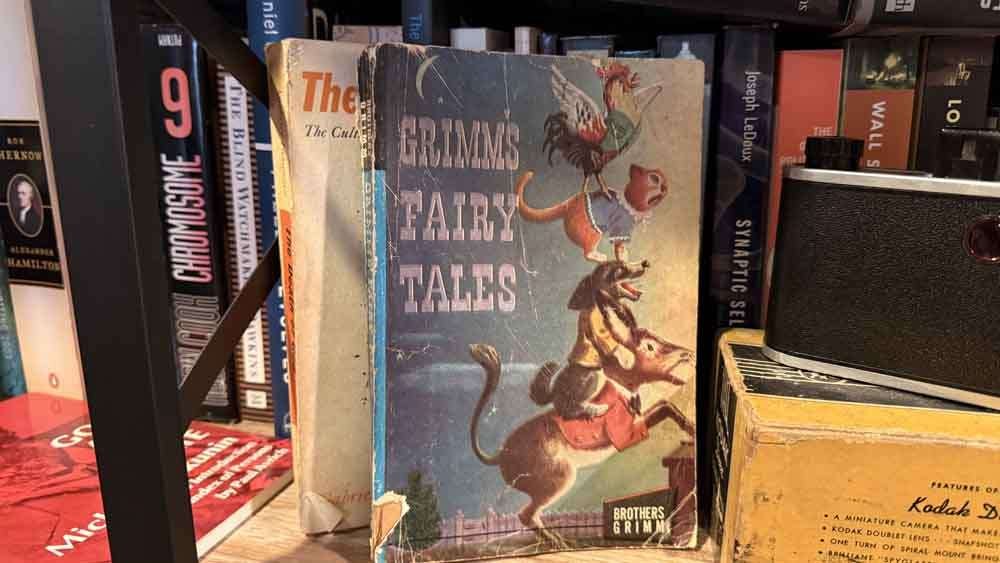
Every culture that has ever existed has told stories to its children at night. Not to entertain them — or not only to entertain them. The stories were instruction manuals. They were operating systems. They encoded, in the most adhesive format the human brain has ever produced, the rules for surviving a world that was trying to kill you. Grimm’s Fairy Tales — the Kinder- und Hausmärchen collected and published by Jacob and Wilhelm Grimm beginning in 1812 — is not a children’s book. It is a phylogenetic record. It is a two-hundred-year-old snapshot of what ideas were robust enough, urgent enough, and sticky enough to survive centuries of oral transmission before anyone thought to write them down.
That is what makes reading the unvarnished Grimm collection such a disorienting experience. You open expecting magic and sentimentality and you find instead a cold, almost clinical instruction set. Trust no one with power over you. Stepparents are dangerous. Beauty and goodness often coexist, but so do beauty and malice. Resourcefulness saves lives. Cruelty is punished — but not reliably, not automatically, and only after the protagonist has already suffered for it. These are not Disney lessons. They are survival lessons, deposited into the cultural bloodstream so long ago that tracing their origins is like trying to find the source of a river that has been running underground for millennia.
The Meme Before the Word Existed
Richard Dawkins introduced the concept of the meme in The Selfish Gene in 1976 — a unit of cultural information that replicates, mutates, and competes for survival in human minds the same way genes compete for survival in biological organisms. The analogy was provocative and productive. What it helped explain, among other things, was why some ideas persist and others vanish. A meme that is useful to its host — that helps the person carrying it navigate reality more effectively — tends to spread. A meme that is merely pleasant, or merely clever, tends to dissolve.
Fairy tales are among the most durable memes in recorded human history. A 2016 study published in Royal Society Open Science by folklorist Sara Graça da Silva and anthropologist Jamshid Tehrani used phylogenetic analysis — the same methodology biologists use to map evolutionary relationships — to trace the origins of fairy tale archetypes. Their findings were startling. Some stories, including variants of Beauty and the Beast and Rumpelstiltskin, appear to predate the Proto-Indo-European language split, which linguists date to roughly 4,000 BCE. These stories are not medieval. They are older than most of human civilization’s written record. They survived because the ideas they carried were too useful to let die.
The Grimm brothers understood this instinctively, even if they lacked the vocabulary for it. They described their project as an attempt to trace the essence of cultural evolution — to demonstrate how natural language, stemming from the needs, customs, and rituals of common people, created authentic bonds and helped forge communities. They called their collection an Erziehungsbuch, an educational manual. They meant it literally. These were not decorative stories. They were load-bearing.
What the Stories Actually Teach
Read the tales without sentimentality and a coherent curriculum emerges. The pedagogy is harsh, the world it describes is unforgiving, and the lessons are precise.
Hansel and Gretel teaches resource management under conditions of family betrayal — the stepmother who abandons children to the forest is not a metaphor, she is a documented historical reality in a medieval Europe where food scarcity made extra mouths genuinely dangerous. Little Red Riding Hood encodes a warning about predatory deception so foundational it shows up in nearly every human culture. Cinderella — one of the oldest of all the tale types, with more than three hundred documented variants globally — teaches patient endurance and the danger of kin competition. Rumpelstiltskin is a lesson about the binding power of promises made under duress, and the consequences of desperate bargains. Snow White maps the danger posed by narcissistic authority figures with disproportionate power.
None of this is accidental. Harvard folklorist Maria Tatar has argued that it is precisely this generational transmission that gives folk tales their important mutability — tales travel from region to region, absorbing local texture while preserving their structural core. The version you grew up with is a dialect of something much older. The grammar underneath never changes because the grammar is what the story is actually about.
The Brothers Grimm Were Archivists, Not Authors
One of the most persistent misunderstandings about the Grimm collection is the assumption that Jacob and Wilhelm invented what they recorded. The truth is more interesting. They were librarians in a world on the edge of industrialization, watching oral tradition get swallowed by print culture and urbanization. Their stated mission was exactness — to get the substance of the stories down as they received them, without embellishment. In practice, they fell short of that ideal; Wilhelm in particular refined the language across seven editions between 1812 and 1857, smoothing the rougher edges to appeal to a growing bourgeois readership. But the structural DNA of the tales remained intact because it was too deeply rooted in lived experience to edit away.
Their informants were not, as myth has it, German peasants gathered around fires. They were largely educated, literate acquaintances who had themselves received the tales from anonymous, often illiterate sources. The collection traveled upward through social strata, accumulating polish, before it was frozen in print. What UNESCO recognized when it added the Kinder- und Hausmärchen to its Memory of the World Registry was not a charming artifact of German culture — it was a document of something that belongs to everyone, a cross-cultural substrate that predates nations, predates the printing press, predates almost everything we associate with literary tradition.
Darkness as Feature, Not Bug
The violence in the original Grimm tales has been sanitized so thoroughly by two centuries of adaptation that many readers encounter genuine shock when they read the source material. The Cinderella stepsisters have their eyes pecked out by doves at the wedding. The evil queen in Snow White is forced to dance in red-hot iron shoes until she dies. Bluebeard’s murdered wives hang in a locked chamber. A disobedient child has her hands cut off. A witch is pushed into an oven and burned alive, to the satisfaction of the narrative voice.
These are not failures of taste. They are accurate reports from a world where consequences were bodily and irreversible, where cruelty was a real feature of domestic and social life, and where the appropriate response to evil was not therapeutic dialogue but decisive action. The darkness was the lesson. Children who grew up hearing these tales were being calibrated for a reality their parents actually lived in. When the Victorians softened the stories and Disney further transformed them into aspirational fantasies, they were encoding a different kind of lesson — one suited to a world of relative safety and abundance. Both versions are instructional. Only one of them is honest about what the world can be.
Why the Book Still Holds
Reading the full Grimm collection today — in a competent translation that resists the urge to sanitize — is an exercise in listening to a very old, very serious conversation about what it costs to be human. The book does not comfort. It calibrates. It reminds you that the world has always contained wolves who speak kindly, that beauty is not innocence, that promises bind whether or not you understood what you were agreeing to, and that goodness, while worth pursuing, is not a guarantee of safety.
These ideas survived because every generation that tested them against reality found them true. They spread memetically because they were useful — because the mind that absorbed them was more likely to navigate danger than the mind that had not. The Grimm brothers did not create this. They caught it in amber. What you hold when you read their collection is not literature in the decorative sense. It is compressed survival intelligence, worn smooth by thousands of years of human hands.
That is worth reading slowly.
You Might Also Like:
- Thus Spoke Zarathustra by Friedrich Nietzsche — The Book That Rewired My Understanding of Everything
- Steppenwolf by Hermann Hesse
- The Darwin Wars by Andrew Brown — A Review
Sources
- Graça da Silva, Sara, and Jamshid J. Tehrani. “Comparative Phylogenetic Analyses Uncover the Ancient Roots of Indo-European Folktales.” Royal Society Open Science, 2016. royalsocietypublishing.org
- Zipes, Jack. “How the Brothers Grimm Saved the Fairy Tale.” National Endowment for the Humanities, 2015. neh.gov
- Tatar, Maria. Quoted in “Brothers Grimm.” Wikipedia. en.wikipedia.org/wiki/Brothers_Grimm
- Dawkins, Richard. The Selfish Gene. Oxford University Press, 1976. amazon.com
- “The Fairytale Language of the Brothers Grimm.” JSTOR Daily, December 2024. daily.jstor.org
- “The Grimm Fairy Tales — From Popular Oral Tradition to the World.” deutschland.de, December 2025. deutschland.de