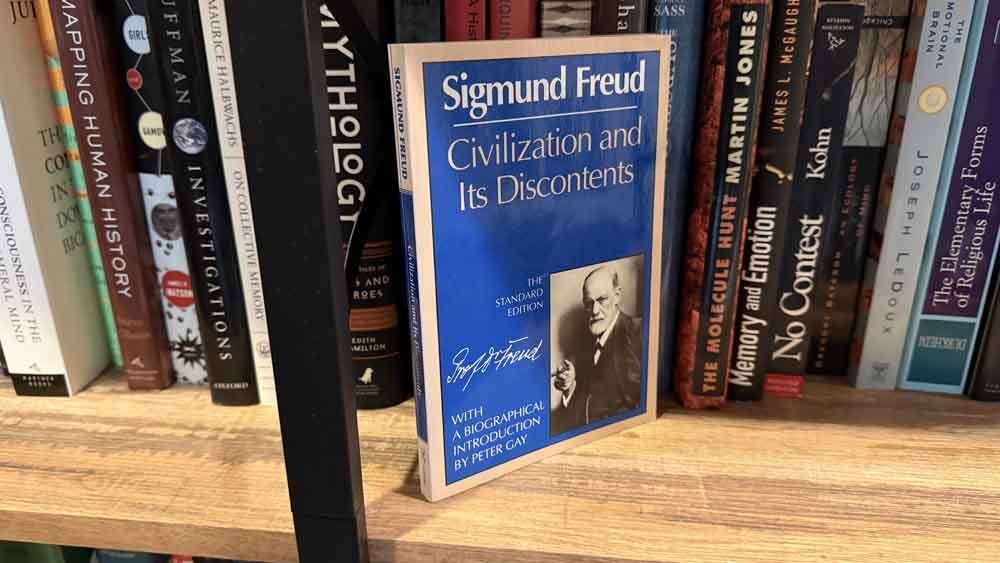
Freud finished Civilization and Its Discontents in 1929. Within four years, the National Socialists had taken Germany. Within a decade, his books were being burned in the streets of Vienna — the city he had spent a lifetime dissecting — and his four sisters would eventually die in concentration camps. He had spent the final pages of that slim volume warning, with the measured dread of a diagnostician who already knows the prognosis, that civilization’s capacity for organized violence had grown faster than its capacity for self-restraint. He was right in a way that no prophet wants to be right.
That is the thing that hit me hardest on my most recent reading of this book. Not the psychoanalytic machinery — the death drive, the oceanic feeling, the superego as civilization’s enforcer — but the quality of his attention. The quality of a man watching something he loves beginning to come apart, and refusing to lie about what he sees.
The Central Argument, Stripped Down
The book’s core is a paradox: civilization, the very structure that makes human life bearable, is also the primary source of human suffering. We build cities, laws, art, and institutions because raw instinct — aggression, libidinal hunger, the impulse toward domination — would otherwise tear us apart. But the price of that containment is neurosis. The instincts do not disappear when they are suppressed. They compress. They turn inward, calcify into guilt, anxiety, and the particular misery of people who have sublimated so thoroughly that they can no longer name what they are mourning.
Freud calls the mechanism a “renunciation of instinct.” Civilization asks each person to surrender a portion of their primal drives in exchange for security and social belonging. The problem is that this transaction is never fully transparent. We make the trade without being told the full cost, and we spend the rest of our lives vaguely aware that something has been taken from us without ever being certain what it was.
This is not a pessimistic book in the cheap sense — not fatalistic, not nihilistic. Freud is too precise for that. He is more like a structural engineer who loves a bridge and is explaining exactly which load-bearing elements are under the most stress. The love and the analysis coexist without contradiction.
Where Nietzsche Left Off
If you have read my piece on Thus Spoke Zarathustra, you will know that Nietzsche got to many of these tensions first — the conflict between the Apollonian and Dionysian, the corrosive effect of slave morality on vitality, the way social norms domesticate the human animal at considerable cost. But where Nietzsche wrote in fire and metaphor, Freud wrote in clinical prose with a scalpel. He was not interested in what humanity could be. He was interested in what it was and why it hurt.
The specific advance Freud makes over his predecessors is the move from individual psychology to collective psychology. By 1929, he had spent four decades in private practice watching the same structures — repression, displacement, projection, the return of the repressed — play out in individual patients. What Civilization and Its Discontents argues, with quiet audacity, is that these same mechanisms operate at the civilizational scale. Nations repress and displace just as neurotics do. Cultures project their internal conflicts onto external enemies. The collective superego — Freud’s term for the moral codes that societies impose on their members — generates guilt just as the individual superego does, and that guilt seeks expression.
Written in 1929, this reads less like psychology and more like a field manual for the century that followed.
The Death Drive and the Wager
The book’s most unsettling passage comes near the end, where Freud introduces what is essentially a wager. On one side: Eros, the life instinct, the drive toward union, connection, civilization itself. On the other: Thanatos, the death instinct, the pull toward dissolution, aggression, and ultimately annihilation. Freud frames the whole of human history as the contest between these two forces, and he does not tell you who wins.
He wrote that the fateful question for the human species is whether, and to what degree, Eros will make itself the master of its counterpart. What makes this extraordinary is not the framing — it is the timing. A man writing in Vienna in 1929, watching nationalism harden across the continent, watching the postwar peace unravel with almost mechanical inevitability, chose not to reassure. He chose to state the question plainly and leave it open. That kind of intellectual honesty is rarer than it should be.
Richard Dawkins, whom I reviewed in my piece on The God Delusion, operates from a very different framework — evolutionary biology rather than psychoanalysis — but arrives at a structurally similar discomfort: the mechanisms that produce human behavior were not designed with human happiness in mind. The drives are old. The civilization trying to contain them is new, fragile, and perpetually under negotiation.
What a Century of History Does to the Text
Reading Civilization and Its Discontents now, in 2026, is a different experience than reading it would have been in 1960, or even 1990. The twentieth century gave Freud’s most pessimistic passages an empirical weight he could not have anticipated. The Holocaust, Hiroshima, the Gulag — these were not aberrations in the civilizational project. Freud would have recognized them as the project’s shadow, the suppressed material returning in its most catastrophic form.
What surprises me most, rereading the book at this particular moment, is how contemporary the diagnostic feels. The specific political pathologies he describes — the mass regression to tribal identity, the need for an enemy onto whom collective guilt can be projected, the authoritarian who offers release from the burden of individual responsibility — are not historical curiosities. They are the operating system of most major political movements of the last decade, on every side of the spectrum. Freud’s superego-laden, neurotic, perpetually discontented civilization is not a historical condition. It is the condition.
The philosopher Herbert Marcuse, writing three decades after Freud in Eros and Civilization, pushed back on this point, arguing that the renunciation of instinct Freud described was not a universal feature of civilization but a specific feature of capitalist civilization — that the surplus repression demanded by the market was not necessary for social life but only for the perpetuation of a particular economic order. It is a compelling argument. But even if Marcuse is right about the historical specificity, Freud’s underlying structural insight holds: that the mechanisms of suppression and return operate at the civilizational scale, and that when they do, the results are not subtle.
The Guilt We Cannot Name
The concept I keep returning to — the one that feels most alive — is civilizational guilt. Freud argues that as civilization becomes more sophisticated, the demands of the collective superego intensify, and the guilt of its members increases accordingly. Not guilt for specific transgressions. Guilt as a background condition, a low-frequency hum that most people experience as anxiety, vague dissatisfaction, or the persistent sense that something is expected of them that they are failing to provide.
There is a kind of customer I recognize from twenty-five years of running a diner — someone who sits down, orders carefully, eats well, and leaves dissatisfied in a way they cannot articulate. Nothing was wrong. Everything was technically correct. But something they were hoping the meal would provide — comfort, connection, the feeling of being at home — was somehow not delivered, because a plate of food was never going to be able to deliver it. Freud would say that the dissatisfaction precedes the meal. That it precedes almost everything.
That is not a comfortable idea. It is also, I think, true.
Freud’s Limits and Why They Don’t Diminish the Book
There are fair criticisms to make. Freud’s metapsychology — the death drive especially — has not fared well empirically. The specific hydraulic model of instinct, in which drives build pressure until they find release, has been largely replaced by more nuanced accounts of motivation in contemporary neuroscience and psychology. His construction of femininity, present here as in all his work, is badly dated. And the move from individual psychology to civilizational diagnosis, however compelling rhetorically, is not rigorously established — it is a metaphor extended very far, and at some point metaphors strain.
Sartre, whom I spent time with recently in my review of No Exit, would have disagreed with the determinism implicit in Freud’s framework — the sense that the structures of suppression and return are not chosen but given. For Sartre, bad faith is always a choice. For Freud, it is an architecture. Both positions illuminate something the other misses.
But these limits do not diminish what the book does. Civilization and Its Discontents is not a scientific paper — it is a work of diagnosis and synthesis by a man at the end of a long career, looking at the civilization he lived in and saying, as clearly as he could, here is what I think is happening and here is what I think is at stake. The clarity is the achievement. Most intellectuals in 1929 were still capable of optimism. Freud was not performing pessimism. He was reporting what he saw.
Why This Is the Most Mature Book Freud Wrote
The Interpretation of Dreams made his reputation. The Ego and the Id built the structural model. But Civilization and Its Discontents is where everything Freud learned about the human animal converges into a single, unflinching argument about what we have built and what it costs. It is a short book — fewer than a hundred pages in most editions — but it is dense in the way that old-growth timber is dense: not complicated exactly, but carrying a great deal of weight per inch.
It is also, in its way, a deeply personal book. Freud was seventy-three when he wrote it, already ill with the jaw cancer that would eventually kill him. He had no reason to be reassuring and no patience for it. The result is one of the most honest pieces of social criticism written in the twentieth century, by someone who understood, better than almost anyone else alive, exactly how much the mechanisms of self-deception — individual and collective — could accomplish, and exactly where they broke down.
Read it slowly. Read it with the century that followed it in mind. It will not make you feel better. That is precisely the point.
You Might Also Like:
- No Exit by Jean-Paul Sartre — The Play That Diagnosed Modern Life Before Modern Life Knew It Was Sick
- Thus Spoke Zarathustra by Friedrich Nietzsche — The Book That Rewired My Understanding of Everything
Sources:
- Freud, Sigmund. Civilization and Its Discontents. Trans. James Strachey. W. W. Norton & Company, 1961. (Original: Das Unbehagen in der Kultur, 1930.)
- Gay, Peter. Freud: A Life for Our Time. W. W. Norton & Company, 1988. https://wwnorton.com/books/9780393312133
- Marcuse, Herbert. Eros and Civilization: A Philosophical Inquiry into Freud. Beacon Press, 1955. https://www.beacon.org/Eros-and-Civilization-P385.aspx
- Strachey, James, ed. The Standard Edition of the Complete Psychological Works of Sigmund Freud, Vol. XXI. Hogarth Press, 1961.
- Bakan, David. Sigmund Freud and the Jewish Mystical Tradition. Princeton University Press, 1958.
- The Freud Museum London: https://www.freud.org.uk/