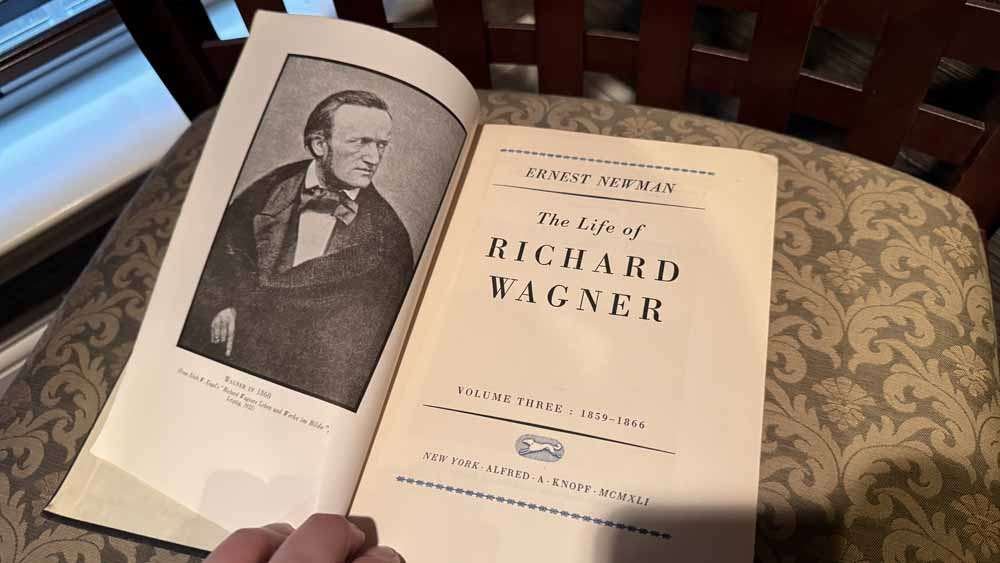
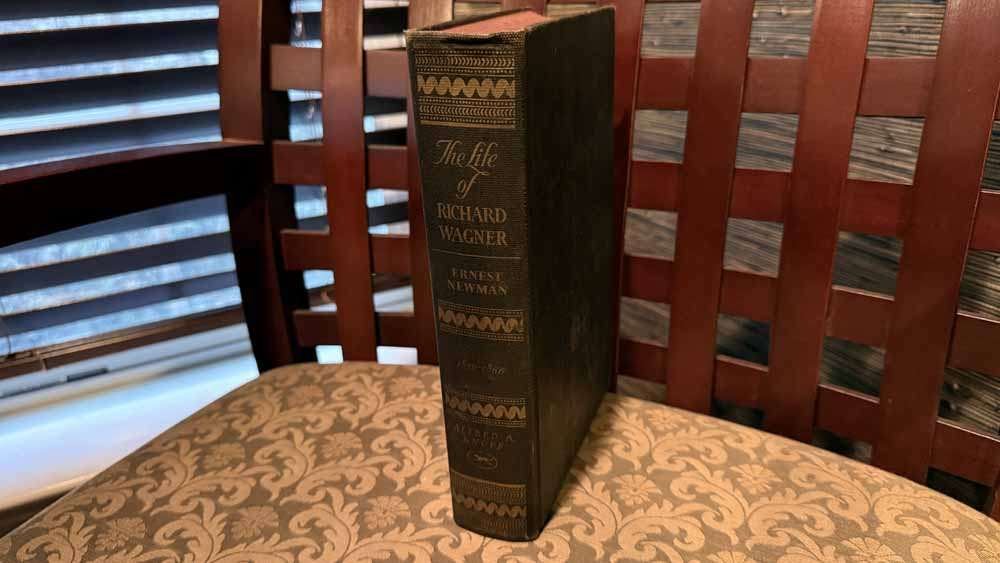
Few figures in the history of Western art invite such contradictory feelings as Richard Wagner. To love his music is to be implicated in a kind of moral ambiguity that never fully resolves. He was, by nearly every account, a thief, a seducer, a borrower who never repaid, an anti-Semite, a self-mythologizer of operatic proportions — and the composer of some of the most emotionally devastating music ever written. Ernest Newman’s monumental four-volume The Life of Wagner, published between 1933 and 1947, is the biography that finally holds both of these truths in one hand without flinching from either.
Newman spent over two decades assembling this work. It runs to nearly 2,500 pages across its four volumes. By any measure, it is one of the most thorough acts of biographical scholarship in the English language — a project so total in its ambition that it mirrors, in a strange way, Wagner’s own pathological commitment to the Gesamtkunstwerk, the total work of art. Newman was not a hagiographer. He was a critic — the longtime music critic of the Sunday Times — and he brought to this biography a forensic intelligence that neither idolized its subject nor reduced him to his worst qualities.
A Man Who Could Not Be Separated from His Work
The central problem Wagner poses, and the one Newman refuses to sidestep, is the question of whether a life and an art can truly be separated. This is not an academic question. It has a sharp edge, especially now, but Newman was grappling with it decades before it became fashionable to cancel artists retroactively. His answer, worked out over thousands of pages rather than a single thesis statement, is essentially: no, they cannot be separated — but neither does one cancel the other.
Wagner’s anti-Semitism was not incidental. His essay “Das Judenthum in der Musik,” published pseudonymously in 1850 and then under his own name in 1869, was vicious in its specificity. Newman does not minimize this. But he also refuses to use it as a master key that unlocks and explains everything else. The music existed in a different register from the polemics, and Newman was too honest a thinker to pretend otherwise. What he gives us instead is the full psychological portrait — the insecurities, the grandiosity, the genuine visionary capacity — that produced both.
I’ve been thinking about this question since I first picked up Nietzsche seriously, and Thus Spoke Zarathustra was in part a document written in the wreckage of Nietzsche’s friendship with Wagner. Nietzsche worshipped him, then broke from him with the disgust of a man who realized he had been worshipping a mirror. The falling out was one of the most intellectually consequential breakups in modern thought, and Newman renders it with the weight it deserves.
The Architecture of Obsession
What strikes you reading Newman is how Wagner’s monstrousness and his greatness emerged from the same psychological source — an absolute inability to be deterred. Wagner wanted total control of every element of his productions: the libretto, the score, the staging, the acoustics of the theater itself. He designed Bayreuth. He specified the seating arrangement, the pit depth, the angle of the stage. This was not mere ego — or it was ego in service of something larger. He believed, correctly as it turned out, that the theatrical conditions of his time were inadequate to the music he was writing. So he built new conditions.
That same uncompromising drive operated equally in his personal life, where it produced ruin after ruin. He conducted an affair with Mathilde Wesendonck while living in her husband’s house as a dependent guest. He borrowed money he had no intention of returning from people who could not afford to lose it. He wore silk and kept servants when he was technically bankrupt. He was — and Newman renders this with clinical clarity — a man who had decided, somewhere in his foundational psychology, that the ordinary rules of reciprocity and obligation did not apply to him because his work was too important.
This is worth sitting with. Because on some level, the work vindicated him. Tristan und Isolde, Parsifal, the Ring cycle — these are not the products of a well-adjusted man who paid his debts on time. They came from someone who had restructured his entire existence around a single imperative. Newman doesn’t celebrate this. But he also doesn’t pretend it’s a coincidence.
Newman’s Method
Part of what makes this biography so valuable is Newman’s command of the sources. He read everything available in multiple languages, tracked down correspondence that had never been published in English, and was meticulous in correcting the myths Wagner himself had planted in his own autobiography, Mein Leben. Wagner was an unreliable narrator of his own life by design. He understood, long before the concept entered common usage, that controlling your own story was a form of power. Newman dismantles that narrative with the patience of a craftsman, piece by piece, without ever losing sight of the larger portrait.
The structure of the biography is roughly chronological but digressive in the best sense — Newman will pause to analyze a compositional technique, situate a work in its political moment, or trace the intellectual debts Wagner owed to Schopenhauer and Feuerbach. Reading it is like having a long conversation with someone who has thought about nothing else for twenty years. It demands patience, but it rewards it at every turn.
There’s a comparison worth making here to Dawkins’ thinking about how a work propagates beyond its maker — explored in The Selfish Gene. Wagner’s music became a meme in the most precise sense: a replicating unit of culture that passed through generations, infected political movements, inspired other composers, and continued reshaping the world long after the man who made it had exhausted everyone around him and died. Newman understood this without that particular vocabulary. He was tracking the same phenomenon.
The Unresolved Question
Newman never arrives at a clean verdict because there isn’t one. Wagner remains, at the end of four volumes, unresolved — which is the only honest outcome. The same forces that drove him to exploit and harm people drove him to create works of extraordinary beauty and philosophical ambition. You don’t get to separate them cleanly and keep only the parts you want.
This is not a comfortable conclusion. But it is the correct one. The biography earns it by refusing the shortcuts — neither collapsing into admiration nor into denunciation. What Newman gives you, finally, is the full weight of a life: everything it cost, everything it produced, and the uncomfortable proximity of the two.
If you’ve ever found yourself moved by music that you also know carries a troubling freight — if you’ve felt the dissonance of loving something made by someone you couldn’t respect — Newman’s Life of Wagner is the most serious engagement with that problem I’ve ever read. It won’t resolve the dissonance. But it will make you understand it more deeply. And sometimes that’s the more honest thing.
Sources
- Newman, Ernest. The Life of Wagner, 4 vols. Alfred A. Knopf, 1933–1947. https://www.amazon.com/Life-Richard-Wagner-4-volume/dp/0521290317
- Wagner, Richard. Mein Leben (My Life). https://www.gutenberg.org/ebooks/48980
- Wagner, Richard. “Das Judenthum in der Musik” (1850/1869). Available via historical archives.
- Magee, Bryan. Wagner and Philosophy. Penguin Books, 2001. https://www.amazon.com/Wagner-Philosophy-Bryan-Magee/dp/0140295194
- Köhler, Joachim. Richard Wagner: The Last of the Titans. Yale University Press, 2004. https://www.amazon.com/Richard-Wagner-Last-Titans/dp/0300102577