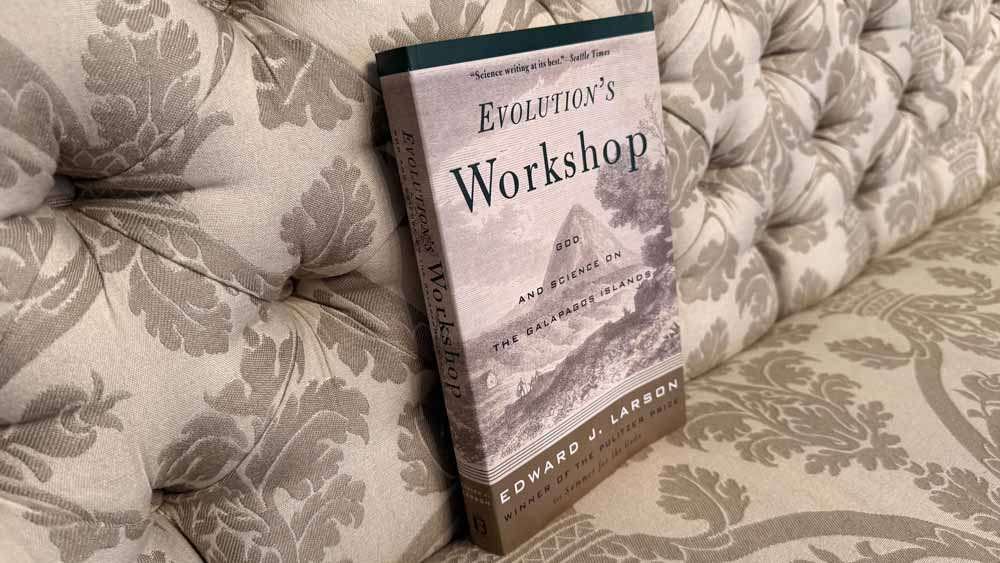
Isolation is the oldest teacher. Long before Darwin ever set foot on the Galápagos, those volcanic outcroppings six hundred miles off the Ecuadorian coast were already doing what great pressure and solitude always do — forcing adaptation, stripping away the noise, revealing structure. It is fitting, then, that a place defined by isolation became the crucible for the idea that changed how we understand all life on Earth. Edward J. Larson’s Evolution’s Workshop is the story of that place and that idea, and how the two became inseparable.
Larson is a Pulitzer Prize-winning historian — his 1998 prize came for Summer for the Gods, a meticulous account of the Scopes Trial — and he brings a legal scholar’s instinct for evidence to the history of science. His training is unusual: a law degree from Harvard, a doctorate in the history of science from Wisconsin, and a dual appointment in history and law. That combination matters here, because Evolution’s Workshop is not a science book. It is a history of how a place accumulated meaning — how an archipelago of black rock and strange creatures became the most symbolically loaded geography in the history of ideas.
Before Darwin, The Islands Were a Theological Problem
What Larson does particularly well is recover the pre-Darwinian Galápagos, the islands as they appeared to Pacific explorers, buccaneers, and 16th-century clerics still working inside a framework of natural theology. The giant tortoises baffled them. The marine iguanas — those prehistoric-looking creatures that dive into the surf and graze on underwater algae — seemed to break every intuition about the order of creation. If God had placed each species in its proper habitat, suited to its role in the great chain of being, what exactly were these animals doing here, on desolate islands hundreds of miles from the mainland, clearly related to mainland species but behaving in ways no mainland creature did?
The honest theological answer, which some explorers arrived at and quickly stepped back from, was that no satisfying answer existed. The Galápagos were, in this sense, an epistemological trap long before Darwin walked into it. Larson takes this seriously. He does not treat the pre-scientific observers as simply wrong-headed; he shows them as people for whom the available conceptual vocabulary genuinely could not accommodate what they were seeing. That is a harder and more interesting thing to argue.
What Darwin Actually Saw — And What He Did With It
The Beagle arrived in the Galápagos in 1835. Darwin was twenty-six years old. The famous story — that he noticed different finch species on different islands and had his eureka moment on the spot — is largely myth, and Larson dismantles it carefully. Darwin was actually a mediocre field ornithologist by his own admission; he failed to label which island many of his bird specimens came from, a mistake that later frustrated his analysis. The real work happened afterward, back in London, when ornithologist John Gould examined the specimens and told Darwin he had been looking at a closely related group of species — not the diverse assortment of birds Darwin had assumed. It was that news, arriving months after the voyage, that sent Darwin back to his notes and began the long process that would eventually become On the Origin of Species.
I have written before about Darwin’s great book — what it did and did not claim, and how easily it gets misread as a sudden inspiration rather than the product of decades of obsessive, methodical work. Larson adds a geographical dimension to that story that I had not fully appreciated before. The Galápagos were not simply the place Darwin visited; they were the problem that would not leave him alone, the set of facts his existing theory could not metabolize. Isolation — the islands’ defining condition — was the key. Cut a population off from the mainland long enough, subject it to different local pressures, and you get divergence. The finches, the tortoises, the iguanas: each island had shaped its own version of a shared ancestor. Darwin eventually grasped that isolation was not a curiosity of these particular islands. It was a universal mechanism, playing out across every separated population on Earth.
The Gilded Age Expeditions and the Institutionalization of Science
One of the book’s great pleasures is the chapter covering the Gilded Age expeditions of the late 19th and early 20th centuries, when wealthy American and European patrons essentially funded floating research stations. These were extraordinary operations: gigantic private yachts, black-tie dinners every evening, rough-and-ready collecting expeditions by day. The California Academy of Sciences sent an expedition in 1905-06 that spent over a year in the archipelago and collected nearly 80,000 specimens, including approximately 266 giant tortoises — a figure that today reads as staggering given the subsequent collapse of tortoise populations. Science and destruction arrived together, as they often do.
Larson uses these expeditions to trace how the Galápagos became institutionalized as a site of scientific authority — how the islands went from being a place Darwin had visited to being the place where evolutionary theory was made legitimate, tested, and extended. The founding of the Charles Darwin Research Station in 1964 was the culmination of this process: a permanent scientific presence, backed by international conservation organizations, turning the archipelago into something close to a living laboratory with protected status. That transition from symbolic site to managed institution is one of Larson’s subtler arguments, and it rewards attention.
The Creationists Arrive
No account of the Galápagos after the mid-20th century can avoid the science-religion conflict, and Larson does not try. Evolution’s Workshop gives serious treatment to the efforts of creation scientists to use the Galápagos as a counter-argument — to reframe the same evidence that supported evolution as evidence for design or special creation. The argument, put plainly, was that the irreducible complexity of Galápagos ecosystems pointed toward intention rather than mechanism. Larson is fair to these voices without crediting their methodology; as a historian of the Scopes Trial, he knows better than most how durable this conflict is, and how little either side typically moves the other.
What makes this section valuable is less the doctrinal debate — which has been covered exhaustively elsewhere, including in Richard Dawkins’ work, some of which I have written about on this blog — than the way Larson frames it geographically. The Galápagos became a proxy war because they had become the origin myth of modern evolutionary science. To attack the islands’ meaning was to attack the theory’s foundation. In that sense, the creationists understood something real about the symbolic weight of the place, even if they drew the wrong conclusions from it.
Isolation as Method, Not Just Circumstance
The thread running through all of this — from the theological confusion of early explorers to the modern conservation crisis — is what isolation actually does. Not just to finches and tortoises, but to ideas. The Galápagos forced a kind of clarity because there was nowhere else to look. No competing species from the mainland swamped the signal. No historical noise from adjacent populations confused the data. What you had was a natural experiment of extraordinary purity: here is what happens when a small founding population is left alone, subjected to local conditions, for thousands of generations.
The same logic, in a quieter way, applies to the book itself. Larson has isolated one place and followed it through time with unusual discipline. He resists the temptation to make Evolution’s Workshop into a broad survey of evolutionary theory — there are other books for that, including his own Evolution: The Remarkable History of a Scientific Theory. Instead, he keeps returning to the islands, to the specific texture of volcanic rock and strange creatures and the humans who kept arriving and leaving and arguing about what it all meant. The restraint pays off. By the end, the Galápagos feel less like a location and more like a lens — one that clarifies what science actually is when it is being practiced honestly: a sustained, often contentious, occasionally brilliant attempt to understand a world that did not ask to be understood.
Worth Reading
Evolution’s Workshop is not a book for readers new to evolutionary theory. Larson assumes a working familiarity with natural selection, speciation, and the basic arc of Darwin’s argument. But for anyone already comfortable with those ideas and curious about how a place becomes an idea — how geography shapes intellectual history — it is a deeply satisfying read. Larson writes with the clarity of someone who has spent a career translating complex scientific and legal arguments for non-specialist audiences, and it shows. The prose never condescends and never loses itself in jargon. The 64 pages of endnotes signal the scholarship underneath; the narrative on top makes it easy to forget they are there.
The book is also, quietly, an environmental argument. The final sections deal with the growing threat from ecotourism and introduced species — the irony that the fame the Galápagos earned from Darwin has made them increasingly difficult to preserve. Larson handles this with measured concern rather than polemic. The islands have been resilient, he notes, and conservation measures have had real effect. But the pressure is real, and the symbolic weight of the place makes its degradation a particularly legible kind of loss. If we cannot protect the laboratory where we first learned to read the mechanism of life, what exactly are we protecting?
You Might Also Like
- On the Origin of Species by Charles Darwin: The Book That Changed Everything We Thought We Knew About Life
- The Selfish Gene by Richard Dawkins — The Book That Unlocked Darwin for Me
- The Extended Phenotype: How Your Genes Build Structures Beyond Your Body
Sources
- Larson, Edward J. Evolution’s Workshop: God and Science on the Galápagos Islands. Basic Books, 2001. https://www.amazon.com/Evolutions-Workshop-Science-Galapagos-Islands/dp/0465038107
- Hachette Book Group — Publisher page: https://www.hachettebookgroup.com/titles/edward-j-larson/evolutions-workshop/9780465038114/
- Metanexus Institute review of Evolution’s Workshop: https://metanexus.net/review-evolutions-workshop-edward-j-larson/
- Barnes & Noble editorial description: https://www.barnesandnoble.com/w/evolutions-workshop-edward-j-larson/1100923104