Somewhere in the booth by the window, a regular has been telling me the same story for fifteen years. The details shift slightly every time — the year changes, the weather is sometimes rain and sometimes not, the punchline migrates. He doesn’t know he’s doing it. Nobody does. That’s the thing about memory: it doesn’t feel like invention. It feels exactly like truth.
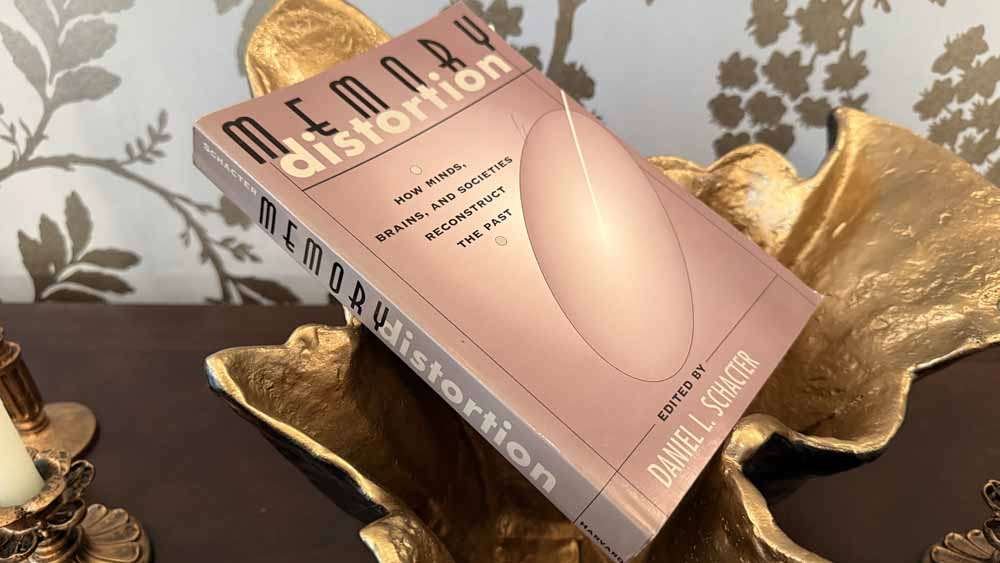
Daniel L. Schacter’s Memory Distortion: How Minds, Brains, and Societies Reconstruct the Past, published in 1995, is a collected volume of scientific essays that Schacter edited and largely anchored — a rigorous interdisciplinary reckoning with one of the most unsettling discoveries in cognitive science: that memory is not a recording. It is a reconstruction. And reconstructions, by nature, are creative acts.
Schacter, a Harvard psychologist who later produced the more accessible The Seven Sins of Memory, assembled here a cast of leading researchers — neuroscientists, cognitive psychologists, historians, legal scholars — to examine the mechanisms and consequences of how we misremember. The result is a dense, occasionally academic read, but one that rewards patience. What Schacter and his contributors reveal is not merely interesting. It is philosophically destabilizing in the best possible way.
The Reconstructive Engine
The central claim of the book is elegantly simple and extraordinarily hard to fully absorb: memory is not retrieved, it is rebuilt. Every time you recall an event, you are not pulling a file from a cabinet. You are reassembling fragments — sensory impressions, emotional residue, contextual cues, and, crucially, your current beliefs and expectations — into something that feels continuous and whole. The past is always being composed in the present.
Schacter draws heavily on the foundational work of Frederic Bartlett, whose 1932 experiments demonstrated that people systematically altered unfamiliar stories when recalling them later, filling gaps with culturally familiar details and smoothing over contradictions. What looked like accurate recall was, in fact, narrative confabulation guided by schema — our mental frameworks for how stories are supposed to go. This wasn’t pathology. It was the normal operation of a normal mind.
This connects to something anyone who has spent decades listening to people talk about their lives will recognize immediately. The regulars at the diner don’t lie to me. They believe every word they say. But the story of how they met their spouse, or the deal they made in 1987, or the summer the nor’easter hit — these have been retold so many times that they’ve been polished into legend, the rough corners of reality sanded down, the inconvenient parts dropped. The story has become more coherent than the event ever was. Memory, Schacter argues, is fundamentally a storytelling organ.
The Seven Precursors
Memory Distortion predates Schacter’s later, more famous taxonomy of memory errors, but this volume is where the intellectual architecture gets laid. The contributors collectively map the terrain of how memory fails: through the simple fading of detail over time, through interference from similar experiences, through suggestion and social pressure, through emotional state at the time of encoding, through the contaminating influence of later information.
That last mechanism — retroactive contamination — is among the most troubling. Elizabeth Loftus’s work on eyewitness testimony, referenced throughout, showed that simply asking a question in a particular way could alter what a witness “remembered” seeing. Post-event information bleeds backward into the original memory, overwriting it. The brain does not archive the event and the revision separately. It integrates them into a single, updated record that feels original.
The legal implications are severe, and several essays address them directly. But the personal implications are quieter and, in some ways, more profound. If a conversation I had with my father about opening the diner has been revised by thirty years of subsequent conversations about that decision, what exactly am I remembering? The exchange itself? Or my current understanding of what that exchange meant? The book doesn’t answer this cleanly, because it can’t. The retrieval and the reconstruction are inseparable.
Emotion, Trauma, and the Selective Archive
The volume devotes considerable attention to emotional memory — both the disproportionate vividness of traumatic recall and the paradoxical distortions that trauma can also produce. The amygdala’s role in encoding emotionally charged experiences means that fear, grief, and elation stamp their moments more deeply than neutral ones. This explains the phenomenon of flashbulb memories — the exact moment you heard a piece of catastrophic news, frozen in high resolution while the week around it blurs.
But high resolution is not the same as accuracy. The research presented here complicates the intuitive assumption that the memories we feel most certain about are the most reliable. Confidence, it turns out, is a poor proxy for accuracy. Emotional intensity at the moment of recall can actually introduce distortions, particularly when that emotion reshapes what details feel central to the story we’re telling about ourselves.
This connects to one of the deeper currents running through the book: memory is not just a cognitive function. It is an identity function. We remember in ways that serve who we currently need to be. Uncomfortable episodes get reinterpreted in light of how things turned out. Decisions that looked uncertain at the time get reconstructed as having been obvious. The self has a vested interest in the story of the self — and memory, obligingly, edits toward that interest.
Social Memory and the Stories Groups Tell
Several essays extend the analysis beyond the individual to collective memory — the way communities, families, and entire societies construct and reconstruct shared pasts. Schacter was clearly interested in the ways that the same distorting mechanisms operate at the social scale: how official narratives get simplified, how inconvenient episodes get suppressed, how the same event can be remembered with startling divergence by different groups who all believe they are reporting facts.
The North Shore has its own versions of this. The stories told about how certain stretches of coastline were developed, about which families were here first and what they built, about the boom years and the lean years — these have been told and retold across generations until the telling itself has become the record. That doesn’t make them false. But it means they carry the fingerprints of everyone who has ever passed them along.
The Limits of the Volume
As a collected volume of research papers, Memory Distortion is uneven in accessibility. Some contributions read as technical as journal articles, dense with experimental data and specialist vocabulary. Readers who approach this looking for the narrative fluency of Schacter’s solo work will find it leaner and more demanding. There are also moments where the breadth of contributors produces some repetition — the same foundational findings get reestablished several times from different angles.
But this is also part of the book’s integrity. It doesn’t simplify to a thesis and defend it. It accumulates evidence the way science actually works — convergently, sometimes redundantly, building confidence through replication from different directions. If you want the cleaned-up version, read The Seven Sins of Memory. If you want to see the architecture beneath it, read this.
What It Does to You
The lasting effect of spending time with this material is a productive unease about your own certainties. Not paralysis — the book doesn’t argue that memory is useless or that nothing can be known. It argues, more carefully, that the confidence we feel about our recollections is not a reliable guide to their accuracy, and that the gaps in memory are always filled by something, whether we notice it or not.
For anyone who builds their sense of self from a particular life narrative — and that is more or less everyone — this is uncomfortable. The version of the past we carry is partly constructed. The stories we tell about who we were, what we chose, what we survived, are not transcripts. They are edited highlights shaped by who we currently are, what we currently need, and what we have been told by everyone who shares those memories with us.
The man in the window booth will be back next week. The story will be slightly different again. And it will be completely true.
Sources
- Schacter, Daniel L., ed. Memory Distortion: How Minds, Brains, and Societies Reconstruct the Past. Harvard University Press, 1995. https://www.hup.harvard.edu/books/9780674566750
- Bartlett, Frederic C. Remembering: A Study in Experimental and Social Psychology. Cambridge University Press, 1932. https://www.cambridge.org/core/books/remembering/
- Loftus, Elizabeth F. “The Reality of Repressed Memories.” American Psychologist, 1993. https://doi.org/10.1037/0003-066X.48.5.518
- Schacter, Daniel L. The Seven Sins of Memory. Houghton Mifflin, 2001. https://www.hmhco.com/shop/books/The-Seven-Sins-of-Memory/9780618040193