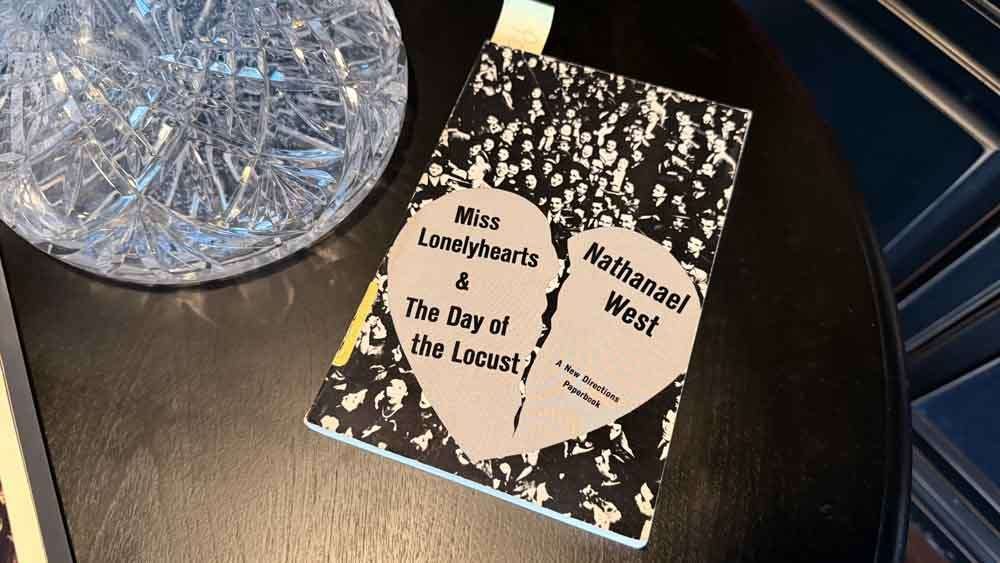
Nathanael West wrote Miss Lonelyhearts in 1933. It is 185 pages. It feels like a fist to the sternum delivered by someone who has already walked away.
The novel follows a nameless newspaper columnist — called only Miss Lonelyhearts — who answers letters from the desperate and the broken for a living. People write to him about crippled husbands. About rape. About a sister born without a nose. They write the kinds of things you don’t say out loud in polite company because polite company would look at the floor. He reads them all. He tries to respond. And somewhere in the trying, he cracks open.
This is not a book about compassion. It is a book about what happens to compassion when it meets the actual weight of human suffering. West was not interested in heroism. He was interested in the grotesque — the specific American grotesque, Depression-era, city-soaked, where the newspapers are full of tragedy and nobody’s hands are clean.
Brooklyn and the Grammar of Suffering
West was a New Yorker, born Nathanael Weinstein in 1903, the son of Jewish immigrants who had done well enough to send him to Brown. He was not writing from the outside looking in at poverty. He was writing from the specific vantage point of someone who knew both worlds — who had seen the inside of a nice apartment and also knew what the streets below it sounded like at two in the morning. That split consciousness is all over Miss Lonelyhearts. The book is drenched in the textures of Depression New York: the bars, the furnished rooms, the parks where the desperate go to sit. Nothing is romanticized. The park trees are described as if they are sick. The people who appear in the letters are not symbols of the working class — they are the working class, in pain, beyond metaphor.
Growing up in Brooklyn myself, the son of Greek immigrants who worked in restaurants their whole lives, I read West differently than I might have otherwise. There is a grammar to how suffering gets processed in immigrant, working-class households — not spoken, just absorbed. You learn early that other people’s pain is real and that there is almost nothing you can do about it. The letters in this novel read like a grotesque amplification of that grammar. West takes the ordinary human helplessness in front of suffering and turns the volume up until it distorts.
The columnist at the center of the story is not a bad man. That is the whole problem. He is a man who feels too much and can do too little, and the gap between those two facts is where the novel lives.
Shrike: The American Grotesque with a Byline
The character who haunts Miss Lonelyhearts more than any other is Shrike — his editor, his tormentor, a man whose entire existence is a sustained act of contempt. Shrike is the novel’s devil figure, and he is wickedly, precisely drawn. He mocks everything: religion, therapy, nature, art, the South Seas, the farm, the intellect. Every possible escape route from suffering, Shrike closes with a joke. He has made cynicism into a theology and cruelty into a performance.
West knew this type. The American media machine had already, by 1933, begun producing them at scale — people whose job was to process and package other people’s pain, who had learned to do it without feeling it, who had turned the distance required for that work into a worldview. Shrike is not a villain from outside the system. He is the system, personified. He is what happens when the institutions that are supposed to mediate human suffering — the press, the church, the therapeutic establishment — calcify into performance.
What West understood, and what still makes the novel sting, is that Shrike is not wrong about any particular thing. Every escape route he mocks is genuinely insufficient. That is what makes him so effective as a character. He is the voice of a reality that has no exits, and he has made peace with it by turning it into entertainment.
The Myth of Saving Anyone
The letters that come to Miss Lonelyhearts are not invented. West based them on actual letters from actual readers sent to actual agony columns. He read hundreds of them while researching the book. What he found was not pathos in the literary sense — not the kind of suffering that arrives dressed up and coherent. He found raw, inarticulate, misspelled desperation from people who had no other audience.
The novel asks one question, quietly and then louder: what do you do with that?
The answer it arrives at is devastating. You cannot save anyone. You may not even be able to save yourself. The attempt to take on other people’s suffering — really take it on, not just process it professionally — breaks the person who attempts it. Miss Lonelyhearts tries Christ. He tries sex. He tries nature. He tries numbness. Nothing holds. By the novel’s end, he has achieved something like religious ecstasy, and it kills him. West stages his death as a grotesque accident, a collision of his messianic delusion with a mundane reality that has no patience for it. The world does not reward the attempt to absorb its pain. It just keeps going.
This is not nihilism, exactly. West is not saying that suffering doesn’t matter or that we shouldn’t care. He is saying something harder: that the myth of the savior — the individual who takes it all on and fixes it — is itself a kind of violence. It produces broken columnists and crucified idealists and it does nothing for the woman with the crippled husband.
A Novel That Arrived Fully Formed
Miss Lonelyhearts is West’s second novel and the one that secured whatever reputation he had in his lifetime, which was modest. He died in a car accident in 1940, the day after F. Scott Fitzgerald. He was thirty-seven. The accident happened in El Centro, California, near the Mexican border. He had run a stop sign. Some people note that this is the kind of death West himself might have written — sudden, absurd, occurring right next to a tragedy that would receive all the attention.
He published four novels in eight years. None of them sold particularly well while he was alive. Miss Lonelyhearts sold around 800 copies in its first run before the publisher went bankrupt. The book was eventually recovered by Edmund Wilson and others who recognized what West had done — which was to compress the entire crisis of American sentimentality and American suffering into a form that read like a nightmare and moved like a punch.
The prose is spare to the point of austerity. West strips every sentence down. He does not linger. He does not explain. He trusts the accumulation of images — sick trees, dead letters, a torn ear — to do the work that another writer might do with ten pages of interior monologue. Reading it next to something like Fitzgerald, who was writing at the same moment, you understand how different their projects were. Fitzgerald mourned a beauty that was passing. West was not sure the beauty had ever existed.
Why It Still Holds
I’ve read books that felt important when I read them and hollow when I tried to return to them. Miss Lonelyhearts is not one of those. It holds because West was writing about something structural — not a particular moment in American life but a particular condition of it. The machinery of mediated suffering has only expanded since 1933. The letters to an agony column have become comments sections, call-in shows, social media feeds — infinite rivers of human pain routed through institutions that commodify it while providing the people sending it just enough acknowledgment to keep them coming back.
Shrike has been replicated a thousand times. He has a podcast now. He probably has several.
And the Miss Lonelyhearts of the world — the ones who actually feel it, who cannot develop the professional callus, who keep trying to respond with their whole selves to a volume of suffering that no whole self can absorb — they are still cracking up in furnished rooms, still trying Christ and sex and nature, still getting shot on the stairs by men they were trying to help.
West gave that tragedy exactly the form it deserved. Short. Ugly. American. Unforgettable.
Sources:
- West, Nathanael. Miss Lonelyhearts. Liveright Publishing, 1933.
- Wilson, Edmund. “The Boys in the Back Room.” New Republic, 1941. https://newrepublic.com/
- Comerchero, Victor. Nathanael West: The Ironic Prophet. Syracuse University Press, 1964.
- Martin, Jay. Nathanael West: The Art of His Life. Farrar, Straus and Giroux, 1970.
- Herbst, Josephine. “Nathanael West.” Kenyon Review, Vol. 23, No. 4, 1961.