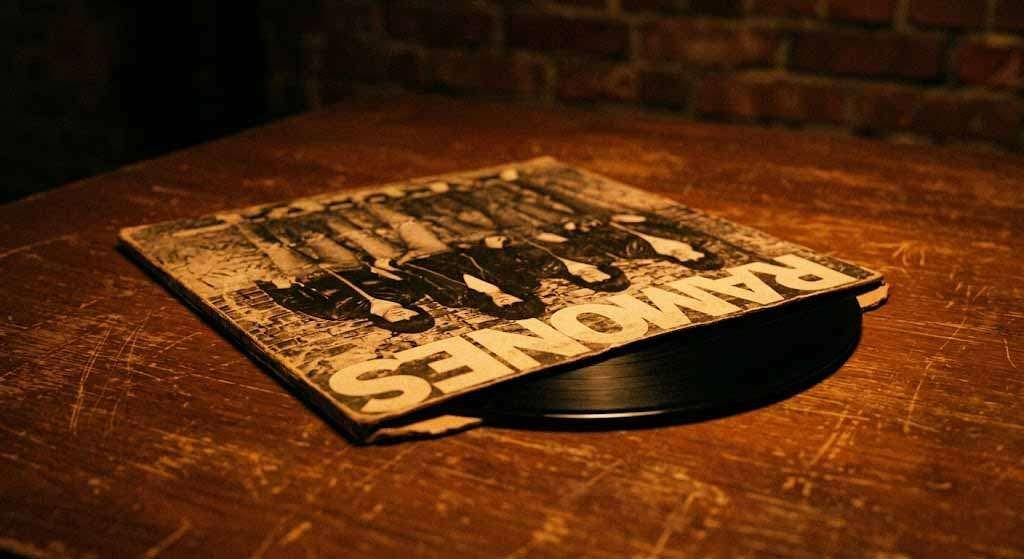
Fourteen songs. Twenty-nine minutes. Zero solos. The album that proved three chords and the truth could demolish a decade of prog-rock excess.
Rock and roll had gotten fat by 1976. Not pleasantly full — fat in the way that signals something has stopped working. The radio was littered with ten-minute keyboard odysseys and guitarists who treated every song like a final exam in technique. Bands were hiring orchestras. Albums were concepts. Everything was important and nothing was fun, and somewhere in the stretch between Woodstock and the bicentennial, the music that was supposed to snarl had learned to recline. Then four guys from Forest Hills, Queens walked into a studio on East 28th Street in Manhattan, and the whole bloated enterprise collapsed in under half an hour.
The Ramones’ debut record is not an album in the conventional sense. It’s a declaration. Nineteen seventy-six is its copyright date, but the music is older than that — it reaches back to the Stooges and the New York Dolls, back to the raw distorted nerve of early rock before craft and commerce got hold of it. What makes the record remarkable isn’t that it was primitive. Primitive records had existed forever. What makes it remarkable is that the primitivism was a choice — deliberate, disciplined, and, if you read it right, almost philosophical.
Forest Hills to the Bowery: Where This Music Came From
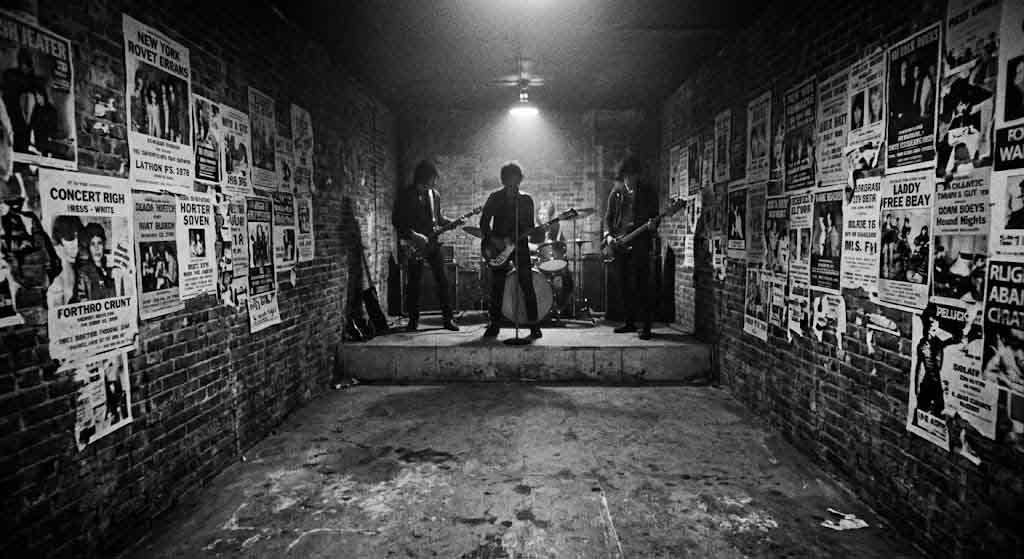
The four of them — Joey, Johnny, Dee Dee, and Tommy — were not poor kids from nowhere. They were suburban New York boys who had absorbed everything that was happening downtown and decided to strip it down to the chassis. The CBGB scene at 315 Bowery was their proving ground, and by 1975 they were playing thirty-minute sets that contained twenty songs. The pace was intentional. Songs ended before you could get bored. Songs began before the previous one had fully dissolved in the air. Their audience wasn’t critics yet — it was a handful of regulars in a bar that smelled like a damp basement and served food nobody touched.
What CBGB provided was a kind of permission. The club’s owner, Hilly Kristal, had originally intended the venue for country, bluegrass, and blues — hence the initials. What he got was Patti Smith and Television and eventually the Ramones, a convergence of artists who had nothing in common except that they were done waiting for the mainstream to catch up. When the Ramones hit that stage, the music wasn’t reaching toward something. It already knew what it was.
I’ve written here before about Brooklyn’s pull — the way the borough functions as both origin story and ongoing argument for a certain kind of New Yorker. The Ramones carried Forest Hills in their bones even when they were playing the most deliberately anti-suburban music imaginable. The tension is part of what makes the record interesting. These weren’t street kids. They were kids who chose the street because the street was the only place honest enough to hold what they wanted to say.
The Sound and What It Cost
Thomas Erdelyi — Tommy Ramone — produced the record with Craig Leon. The two of them had roughly $6,400 and seventeen days, and they spent both as efficiently as possible. The guitar tone is distorted but not muddy. The drums hit hard and stay mostly on the beat with a rigidity that, at the time, critics mistook for sloppiness and that we now understand was precision. The bass is audible, which was not a given in 1976, and it locks in with the kick drum in a way that makes the whole record feel like something physical.
Joey Ramone’s vocals are the secret weapon that doesn’t announce itself. He sounds like a kid from Queens who grew up on British Invasion records — which is exactly what he was — and the combination of that Beach Boys harmonic instinct with lyrics about sniffing glue and lobotomies created a tonal dissonance that was genuinely new. Nobody had put those things together before. You don’t notice how strange it is until you’re halfway through the record and realize you’ve been singing along.
The production decision that mattered most was the decision not to do things. No reverb washing over the guitars. No synthesizer filling the space between chords. No studio trickery to make anything sound bigger than it was. What you hear on the record is approximately what the Ramones sounded like in a room. That was the whole point.
Blitzkrieg Bop and the Two-Minute Manifesto
The record opens with “Blitzkrieg Bop” and you understand everything in the first ten seconds. The count-in — Hey ho, let’s go — is one of the most effective album introductions in the rock catalog. It does what a great first line of a novel does: it tells you the speed, the register, and the stakes all at once. The song runs two minutes and twelve seconds and contains more forward momentum than most bands sustain across an entire record.
What critics at the time didn’t know how to process was that “Blitzkrieg Bop” was structurally correct. It wasn’t a song that failed to be longer — it was a song that knew exactly when it was finished. The three chords aren’t a limitation; they’re a frame. Painters talk about constraint as a generative force. The Ramones understood this instinctively, even if they wouldn’t have used that language.
The album sustains that energy through “Beat on the Brat,” “Judy Is a Punk,” and “I Wanna Be Your Boyfriend” — which is, slightly unexpectedly, a genuine pop song, sweet and direct in the way the early Beatles were sweet and direct. The range within the narrow parameters is part of what separates this record from its imitators. The Ramones could write a love song, a horror-movie joke, a political sneer, and a piece of pure noise and fit them all into the same 29 minutes without the record feeling incoherent.
What They Killed and What They Saved
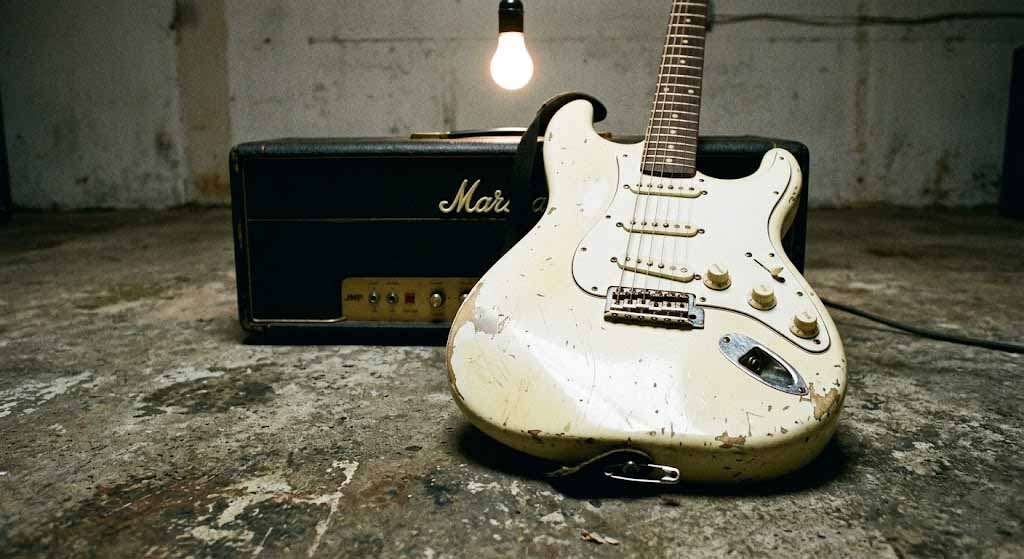
The guitar solo is almost entirely absent from this record, and the absence was understood immediately as a statement. By 1976, the guitar solo had become the primary currency of rock status — the moment when a musician demonstrated his credentials to the audience and to history. The Ramones rejected the transaction. Not because they couldn’t play — Johnny Ramone was a technically consistent rhythm guitarist who had developed a downstroke-only style that produced its own kinetic energy — but because the solo represented everything they were against: the cult of the individual genius performer, the elevation of craft over connection, the creeping professionalism that had turned rock and roll into a job.
This was, at its core, a democratic act. The Ramones were saying that the music belonged to anyone who could feel it, not just to people with the patience to learn scales and the money to buy a Gibson Les Paul. That message got transmitted directly to a generation of kids in England and America who had something to say and not much technical ability to say it, and within two years you had the Sex Pistols and the Clash and a hundred bands in bedrooms who understood that three chords were enough.
What they saved was urgency. Rock music, stripped of virtuosity, had to earn its keep through feeling, and the Ramones had more of that than almost anyone working in 1976. The songs are short because they had to be — because anything longer would have been padding, and the Ramones had no patience for padding. Every second of every song on this record is load-bearing.
Why It Still Matters
The record sold about 10,000 copies in its first year. Critical reception ranged from baffled to dismissive, with a handful of important exceptions — Lester Bangs at Creem understood it, and British music press picked it up faster than the American mainstream. The industry looked at the Ramones the way the restaurant industry looks at a place that refuses to serve brunch: deeply suspicious that something valuable is being left on the table.
It took decades for the full weight of the record to settle into the culture. The Rock and Roll Hall of Fame inducted them in 2002, which is the kind of institutional approval that the Ramones would have found hilarious and slightly mortifying. By that point the record had influenced virtually every punk and post-punk band in existence, had been cited by Kurt Cobain as a foundational text, and had demonstrated something that the music industry still hasn’t fully absorbed: that limitation can be generative, that simplicity is a choice not a failure, and that the energy you bring to three chords can outlast anything a twelve-piece orchestral rock ensemble puts together in a $500,000 studio.
Joey Ramone died in 2001, DeeDee in 2002, and Johnny in 2004. Tommy Ramone, the last surviving original member, died in 2014. The four of them were gone within thirteen years of each other, which feels like a sentence from a book about a subject larger than music. What they left behind was a 29-minute record that is, in its own way, structurally perfect — an argument made entirely in sound that the most powerful thing you can do with a stage, a few chords, and something to say is to get on with it.
Get on with it. The clock is running.
You Might Also Like
- The Economics of Live Entertainment: What the Live Nation Antitrust Trial Means for Independent Venues
- Mt. Sinai vs Brooklyn: Suburban vs Urban Living in New York
Sources
- Thomas, B. (2016). The Ramones: An American Band. St. Martin’s Press. https://www.stmartins.com
- Heylin, C. (1993). From the Velvets to the Voidoids: A Pre-Punk History for a Post-Punk World. Penguin Books.
- Ramones debut album recording notes, Sire Records, 1976. https://www.sirerecords.com
- CBGB history and venue archives. https://www.cbgb.com
- Rock and Roll Hall of Fame — The Ramones inductee page. https://www.rockhall.com/inductees/ramones
- McNeil, L. & McCain, G. (1996). Please Kill Me: The Uncensored Oral History of Punk. Grove Press. https://groveatlantic.com