Start with the document trail. That’s the first rule of any investigation worth its ink. You go to the ledgers, the manifests, the shipping logs, and you follow the money until the picture comes clear.
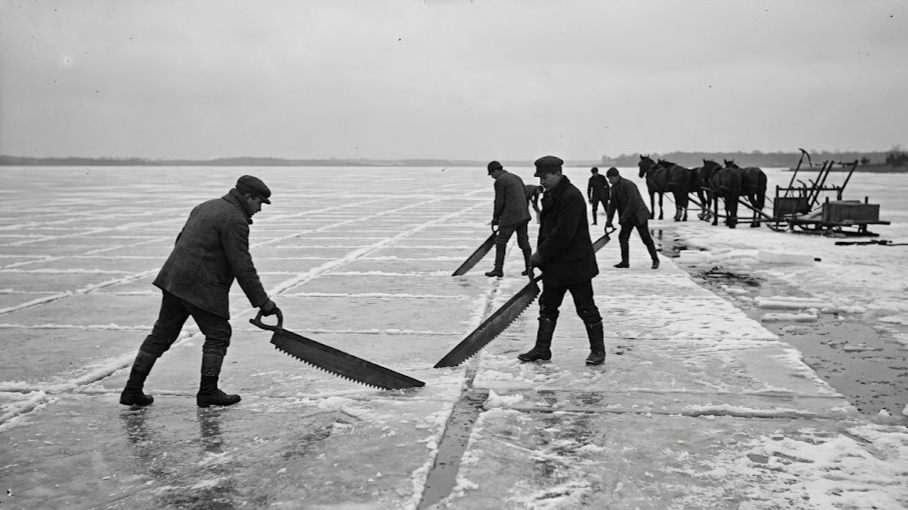
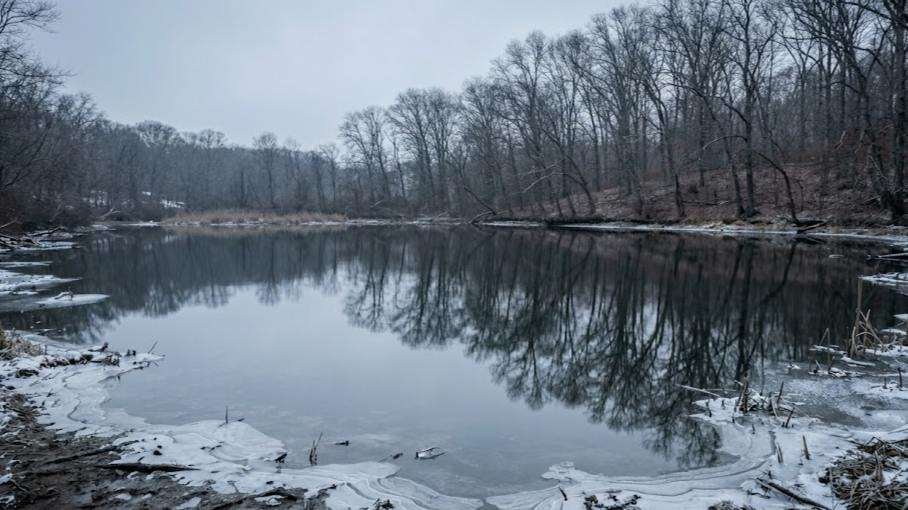
What the documents show, when you run them down, is something most people who live out here on the Island have no idea about: that the ponds and tributaries of the North Shore were, for decades before the turn of the twentieth century, part of a supply chain that kept New York City’s food from rotting. Hotels on Fifth Avenue packed their iceboxes with it. Butcher shops in the Bronx and Brooklyn hung their sides of beef above it. Saloons all over lower Manhattan poured it into glasses that men with nowhere else to go nursed through July afternoons. Before any of it got to the city — before the ice men made their rounds with their leather-shouldered tongs and their horse-drawn wagons — someone had to go out onto a frozen pond in Nassau County in January, score the surface into a grid, and cut.
This is the story of who those men were, what they were cutting, and who ultimately decided their industry was worth more to them dead than alive.
The Anatomy of a Harvest
The mechanics of ice harvesting were remarkably precise for an industry most people think of as rough labor. First, the surface of the pond had to be cleared of snow — V-shaped plows dragged behind horses, leveling the field. Then came the measuring: an auger bored through at intervals to test thickness, because the ice had to run at least five inches deep before men and equipment could move safely on it. Less than that and you were putting your horses through the surface.
Once thickness was confirmed, the field was marked into a checkerboard. An iron point etched the guidelines, and then the horse-drawn ice plow came through, its toothed blade carving parallel grooves. A second pass cut across the first. What remained was a vast, glittering mosaic of rectangular blocks, each typically running about twenty-two by thirty-two inches, scored nearly two-thirds of the way through. Long handsaws finished the cut.
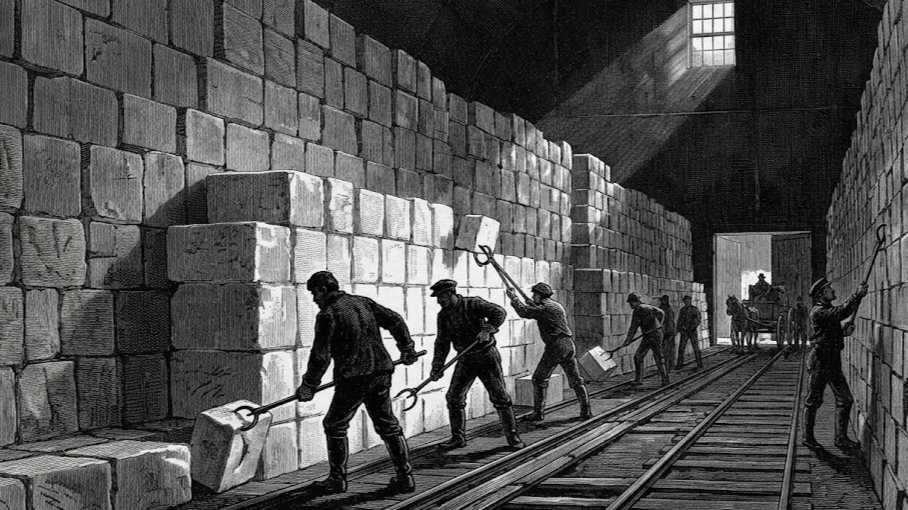
Then came the breakout. Men with breaking bars and long-handled chisels freed individual cakes, while others with pike poles pushed them along open water channels toward shore and the waiting conveyor elevators. At a well-run operation — and the operations on Long Island’s North Shore were well-run — a steam-powered elevator could move four hundred to five hundred tons of ice per hour into the storage house. One man fed the chain; fifteen to twenty others stacked inside, building the pile as high as the mechanism allowed.
The storage houses themselves were engineering achievements in their own right: double-walled structures packed with sawdust, which acted as insulation and kept the ice viable into summer and sometimes beyond. In a good year, a single house could hold enough ice to supply a neighborhood for months.
This was not primitive labor. It was a precisely coordinated seasonal industry, and the North Shore of Long Island — with its inland ponds, its proximity to New York Harbor, and its reliable winters — was positioned to feed the city’s appetite for cold.
What the Brooklyn Daily Eagle Reported
Dig into the Brooklyn Daily Eagle archives, held now in the Library of Congress Chronicling America database, and you find the ice trade covered with the same matter-of-fact regularity as grain prices or shipping schedules. Ice was news. Ice was infrastructure. The arrival of a warm December sent editors scrambling to calculate how thin the fields would run; a good cold January was cause for optimism in the industrial pages.
What you also find, tracking those records through the 1880s and into the 1890s, is a picture of a fragmented industry becoming a consolidated one. Long Island had, for most of the nineteenth century, dozens of independent ice operations — family concerns and small local companies that sold to city dealers who in turn sold to the hotels, the restaurants, the butcher trades. The system was inefficient and competitive. Prices fluctuated. Some operators ran surplus; others ran short. It was a market in the actual sense of the word.
Then Charles Wyman Morse came into it.
The Paper Trail Leads to Charles Morse
Morse’s name appears in the business press of the 1890s with increasing frequency, and never by accident. He was a Maine man — born in Bath in 1856, the son of a tugboat operator — who arrived in New York in the 1880s and identified the ice trade the way a certain kind of businessman identifies any inefficient market: as a problem to be solved by ownership.
His first move was the formation of the Consolidated Ice Company in 1897. His second was the acquisition, piece by piece, of the Hudson River Valley’s most productive ice fields. His third — the one that closed the circle — was the 1896 absorption of the Knickerbocker Ice Company, which held the rights to Rockland Lake, a spring-fed 256-acre lake whose clean water produced what was then considered the best commercial ice in the region. The Knickerbocker operation, at its height, owned dozens of steamboats and seventy-five ice barges, and employed three thousand workers. When Morse took it, he took all of that with it.
By 1895, his agents had already bought out nearly all of New York, Brooklyn, and Long Island’s independent ice companies. The regional map of ice production — which had included Long Island’s North Shore operations among its active nodes — was being redrawn with one name at the center.
By the time the Consolidated Ice Company became the American Ice Company, Morse effectively controlled the ice supply of one of the largest cities in the world. The trade press had another name for it: the Ice Trust.
The Price Hike and the Political Scandal
The document that makes the Ice Trust’s story legible isn’t a business ledger — it’s a newspaper story. On May 1, 1900, the American Ice Company attempted to double the retail price of ice across New York City. The previous year, the city had paid twenty-five cents per hundred pounds. Morse proposed fifty cents.
The move should have been straightforward. He controlled the supply. He owned the distribution. What was there to stop him?
What stopped him was the New York Journal and Advertiser, which obtained records showing that Charles Morse had not achieved his monopoly entirely through market mechanisms. He had obtained, through the machinery of Tammany Hall, special privileges that had allowed the American Ice Company to lock out competitors from city pier access. In exchange, Mayor Robert Van Wyck — the first mayor of the consolidated five-borough New York City — had been awarded a substantial stake in the ice trust’s holding company, the Ice Securities Company. Tammany Hall’s boss, Richard Croker, held a similar position.
The press had a word for this arrangement too, and it was not a polite one.
The resulting scandal — documented in the contemporary press and referenced in federal antitrust proceedings that followed — became one of the more vivid examples of what the Gilded Age looked like when its mechanisms were exposed to daylight. Mayor Van Wyck appeared before Justice William Jay Gaynor in 1900 to deny that he had conspired with Morse. The denials failed to persuade. Van Wyck was not reelected. Morse himself, having extracted an estimated twelve million dollars from the enterprise through stock manipulation of the Ice Securities Company, moved on to other ventures in shipping and banking.
Jonathan Rees, in his book Refrigeration Nation (Johns Hopkins University Press, 2013), documents how the consolidation of the natural ice trade was part of a larger pattern: the capture of food supply infrastructure by corporate trusts in the years before meaningful antitrust enforcement. The ice trust was not an anomaly. It was a template.
By 1906, the American Ice Company was found by a New York attorney general’s investigation to have deliberately controlled its Maine ice fields to reduce the harvest, creating artificial scarcity and driving up summer prices. The profits on that maneuver were documented at seventy-one percent.
What Happened to the Men on the Ice
The men who worked the winter harvests on Long Island’s ponds — the cutters, the stackers, the drivers — don’t appear much in the surviving corporate records. They appear in the labor census, in town histories, in the occasional Eagle item about a good season or a warm spell. What the Ice Trust’s consolidation meant for them is not a story that got written down with the same care as the stock manipulation.
What the record suggests is this: as Morse absorbed the independent Long Island operations, the seasonal labor arrangements that had supported those communities were absorbed too — or ended. The monopoly that controlled prices also controlled wages. The flexibility of a fragmented market, which allowed local operators to negotiate terms with local workers, disappeared into a corporate structure that had no particular interest in any specific workforce.
This is the part of the ice trade’s history that Jonathan Rees’s research makes visible: not just the monopoly’s effect on consumers, but its effect on the labor that made the harvest possible. The men who went out onto the frozen ponds in January were not shareholders in the American Ice Company.
The End of the Industry
The ice trust did not survive its own ambitions. Charles Morse moved on. Antitrust scrutiny increased after 1906. And mechanical refrigeration — artificial ice, made in factories independent of the weather — was already making the entire natural harvest obsolete.
By the 1920s, household refrigerators were becoming affordable to working families, not just the wealthy. The iceman’s route — daily delivery, the block in the icebox, the drip pan that needed emptying — was being replaced by a machine that ran in the corner of the kitchen. The Quogue Ice Company on Long Island’s South Shore ceased production in 1925. Similar operations across the North Shore followed.
The ice houses themselves often outlasted the harvests. When the Knickerbocker operation’s facilities at Rockland Lake were finally demolished, in 1926, a fire broke out in the sawdust-packed walls — and, by some accounts, smoldered for over a year.
What burned with those walls was more than timber and insulation. It was the physical infrastructure of an industry that had, for half a century, connected Long Island’s frozen winters to New York City’s appetite — and that had been swallowed by a trust, stripped of its independence, and rendered redundant by technology before anyone who depended on it had time to adapt.
What the Ledgers Leave Out
I grew up in Brooklyn. I spent my childhood hearing stories from my father — a Greek immigrant who built a life in this country with his hands — about work that was real, physical, seasonal, and honest. The ice harvest, before Morse and before Tammany Hall made it into a financial instrument, was that kind of work.
The ponds are still there. Some of them. Cold Spring Harbor still holds its water between the hills. The North Shore ponds that fed tributaries into the harbor area are still on the maps. What’s gone is the memory of the men who went out onto them in January with their augers and their pike poles, who built the ice houses and loaded the barges and sent the city’s food supply its cold currency for the summer.
Somewhere in the Nassau County historical society collections, in the boxes that haven’t been fully cataloged, there are probably ledger pages that list their names. I’d like to know them.
Sources: Jonathan Rees, Refrigeration Nation (Johns Hopkins University Press, 2013); Brooklyn Daily Eagle archives, Library of Congress Chronicling America database (loc.gov/collections/chronicling-america); Wikipedia, “Knickerbocker Ice Company”; Wikipedia, “American Ice Company”; Reed College Economics Department, “The New York City Ice Trust” case study; South Street Seaport Museum, “The Business of Cold” (southstreetseaportmuseum.org); Quogue Historical Society / South Shore Press, “Ice Harvesting: A Frozen Piece of History”; Ephemeral New York, “American Ice Company” archives (ephemeralnewyork.wordpress.com); “From Frozen Pond to New York City Table: The Legacy of Ice Harvesting at Rockland Lake,” Nyack News & Views (2024).