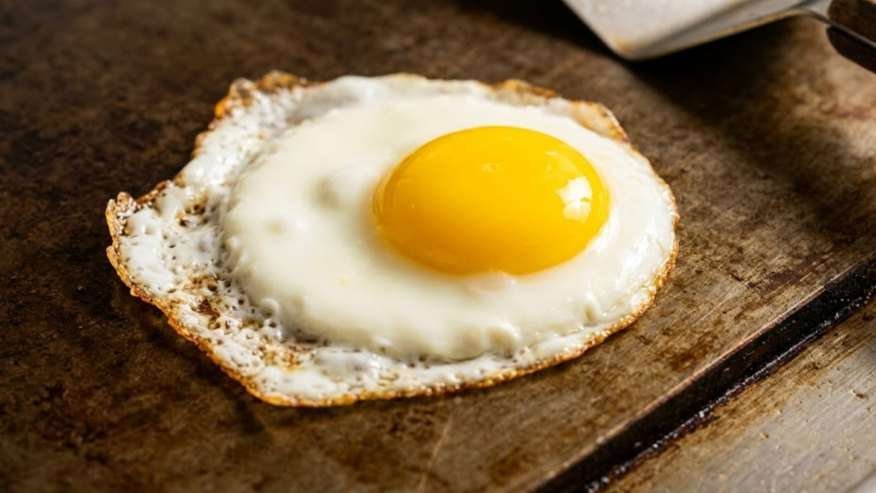
The fried egg is the diner’s simplest item and its most technically demanding. This is not a paradox — it’s a property of the cooking surface.
A flat-top commercial griddle runs between 350 and 400 degrees Fahrenheit during a breakfast rush. Most diner operators set theirs around 375. Egg white proteins begin denaturing — unfolding from their coiled structure and forming new bonds — at 144 degrees Fahrenheit. Egg yolk proteins begin denaturing at approximately 149 degrees. Full coagulation of the white occurs somewhere between 149 and 158 degrees; the yolk sets anywhere from 149 to 158 degrees, depending on composition and cooking speed.
The gap between where a diner griddle operates and where a properly cooked fried egg exists is roughly 220 degrees. The short-order cook’s entire skill set, for this one item, is managing the consequence of that gap.
What Happens to a Protein at 375 Degrees
When egg white hits a flat-top at 375 degrees, the proteins at the contact surface denature almost instantaneously. The speed matters. At moderate temperatures, protein denaturation proceeds in a controlled way — the molecules unfold gradually, form new cross-links, trap water, and produce a soft, tender texture. At high temperatures, the process accelerates so fast that the proteins bond tightly and squeeze out water rather than holding it. The result is rubbery, dry, overcooked egg white: the texture you get when someone walks away from the griddle for thirty seconds too long.
The American Egg Board’s technical documentation on protein coagulation notes that a number of variables affect the outcome beyond temperature alone — the rate of heating, the salt content of the cooking surface, the thickness of the white, and whether fat is present as a buffer. All of these matter on a commercial flat-top. A well-seasoned griddle section with residual fat from previous cooking insulates the egg slightly, slowing the initial heat transfer. This is one reason short-order cooks care about which section of the flat-top they use for eggs. A freshly scraped, bare section cooks hotter and faster at the contact surface. A seasoned section cooks more controllably.
J. Kenji López-Alt’s The Food Lab (Norton, 2015) addresses fried egg cookery in detail, noting that the chalazae — the thicker, ropelike strands of egg white that anchor the yolk in the center of the raw egg — have a higher coagulation temperature than the surrounding white, around 180 degrees Fahrenheit. This is the pale, slightly gelatinous ring you sometimes see around the yolk of a sunnyside egg where the chalazae are still setting while the rest of the white is done. Many home cooks think this means the egg is undercooked. It means the chalazae are finishing. The cook who knows this doesn’t add more heat. The cook who doesn’t adds heat, and tips the yolk.
The Window
A properly cooked sunnyside egg has three distinct zones: a fully set white, a liquid yolk, and an intact yolk membrane. The full white and the liquid yolk require different temperatures. The coagulation window for achieving both simultaneously on a hot griddle is measured in seconds, not minutes.
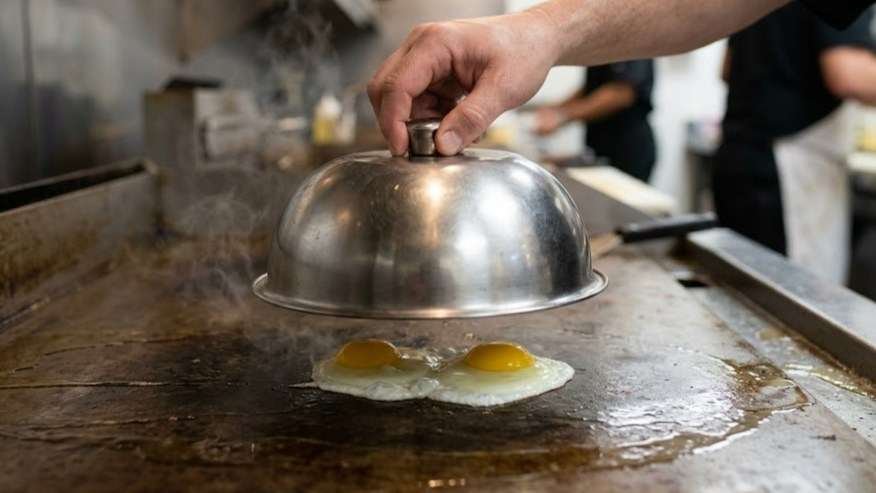
Timing on a diner flat-top is a function of surface temperature, basting technique (covering the egg with a dome traps steam, which cooks the top of the white without flipping — the standard diner method for sunnyside up), fat volume, and egg temperature at the moment of crack. A refrigerator-cold egg dropped onto the same griddle as a room-temperature egg will behave differently. The cold egg lowers the surface temperature momentarily, buying more time before the white seizes. Experienced short-order cooks account for this unconsciously.
The dome technique basts the egg in its own steam without contact heat on the yolk. Steam at atmospheric pressure is 212 degrees — hot enough to set the top of the white and warm the yolk toward serving temperature without crossing into the yolk’s coagulation range if the timing is right. This is why you see short-order cooks drop a cover over eggs and pull it in under a minute. The cover is doing controlled, indirect heat work.
Remove the cover too early and the white surface remains underdone — translucent and wet-looking, with a raw albumen texture. Remove it too late and the yolk surface skins over: a matte, dulled membrane forms where there should be a glossy, liquid pool. A skinned yolk indicates overcooking. It will still be liquid underneath but the surface texture has changed.
Seasoned Steel vs. Non-Stick Inserts
Commercial flat-tops are typically carbon steel or chrome steel surfaces. Both can be seasoned — built up with layers of polymerized fat over repeated use — and both transmit heat differently. A seasoned steel surface cooks eggs with slightly more control than a bare one, with a narrower gap between surface heat and the egg’s internal temperatures, and the residual fat acts as a continuous buffer.
Some diners have introduced non-stick insert sections for egg cookery. The argument for them is cleaner release, less fat required, and easier cleanup. The argument against them, from a cooking standpoint, is heat transfer. Non-stick coatings are poor conductors of heat compared to bare steel. They produce a more insulated cooking environment, which means longer cook times for the same surface temperature, which means more total time on heat, which means the window for a properly cooked egg actually narrows in practical terms even if it seems more forgiving. A short-order cook who learned eggs on seasoned steel and switches to non-stick has to recalibrate.
The practical outcome, on the plate, is that non-stick-cooked eggs at diner speed often have slightly more uniform, slightly drier whites than steel-cooked eggs. The steel egg, cooked fast with a seasoned surface and the right amount of fat, has a lacy, crisped edge on the white and a tender interior. The non-stick egg tends toward more uniform texture throughout. Neither is definitively wrong. They are different products made in different ways.
The Diner’s Most Revealing Item
For a kitchen audit, I’d order eggs every time. Not because eggs are the hardest thing a diner makes — they’re not. But they are the item that most directly measures whether a short-order cook is thinking or just reacting. The flat-top tells the egg what to do. The cook decides when to listen.
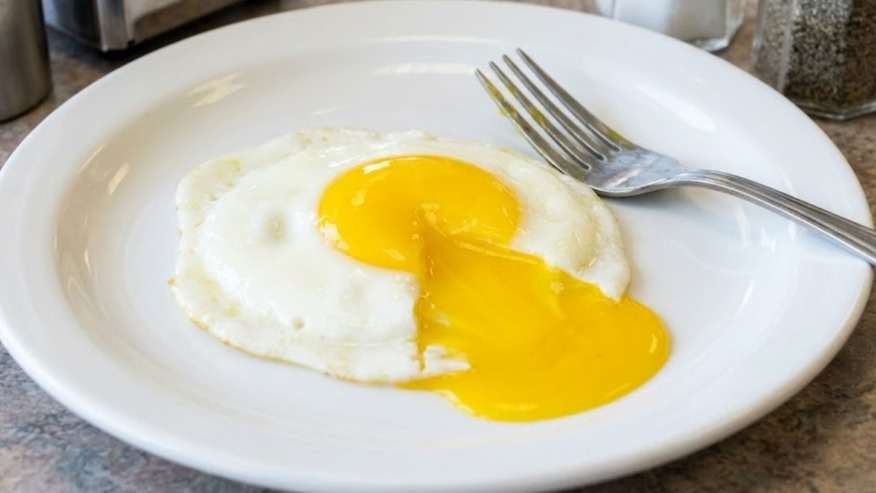
A sunnyside egg pulled at the right moment, with a set white and a yolk that runs when you break it with a fork, is the product of someone who knows what 375 degrees does to a protein and has made this decision correctly enough times that it doesn’t require conscious calculation anymore. The yolk catches the light. The white is tender without being gelatinous. The edge is slightly crisped. This is a cooked egg, which sounds like an obvious thing to say, until you’ve eaten enough wrong ones to understand what right means.
For a sense of what this looks like on a full plate, I walked through the complete diner breakfast assembly in How to Build the Perfect Diner Breakfast Platter — Step-by-Step Assembly Guide. The egg is the centerpiece. Everything else supports it.
A well-made fried egg takes under two minutes from crack to plate. It cannot be held, reheated, or approximated. It has to be made correctly the first time, every time, in a kitchen that is running tickets at a rate that does not allow for contemplation. The cook who consistently delivers it is doing something the temperature physics of the situation argue against. That’s not simple. It just looks simple from the other side of the counter.
You Might Also Like:
Crispy Griddled Corned Beef Hash with Fried Eggs and Potatoes
Classic Greek Omelet with Feta, Tomatoes, and Caramelized Onions
Sources
- American Egg Board, “Coagulation/Thickening”: https://www.incredibleegg.org/professionals/manufacturers/real-egg-functionality/coagulation-thickening/
- Harold McGee, On Food and Cooking: The Science and Lore of the Kitchen (Scribner, 2004)
- J. Kenji López-Alt, The Food Lab: Better Home Cooking Through Science (W. W. Norton & Company, 2015)
- Eggy Guru, “The Science of Cooking an Egg”: https://eggyguru.com/2016/06/20/the-science-of-cooking-an-egg/
- Science of Cooking, “Cooking Eggs Sous Vide”: https://www.scienceofcooking.com/eggs/cooking-eggs-sous-vide.html
- Institute of Food Science and Technology, “Protein Coagulation”: https://www.ifst.org/lovefoodlovescience/resources/protein-coagulation