There’s a question nobody at the restaurant table asks: where did this fish come from before it arrived here? Not the ocean in the abstract. Not “locally sourced” as a marketing phrase. The actual route — from water to dock to truck to kitchen — and who ran each step of it.
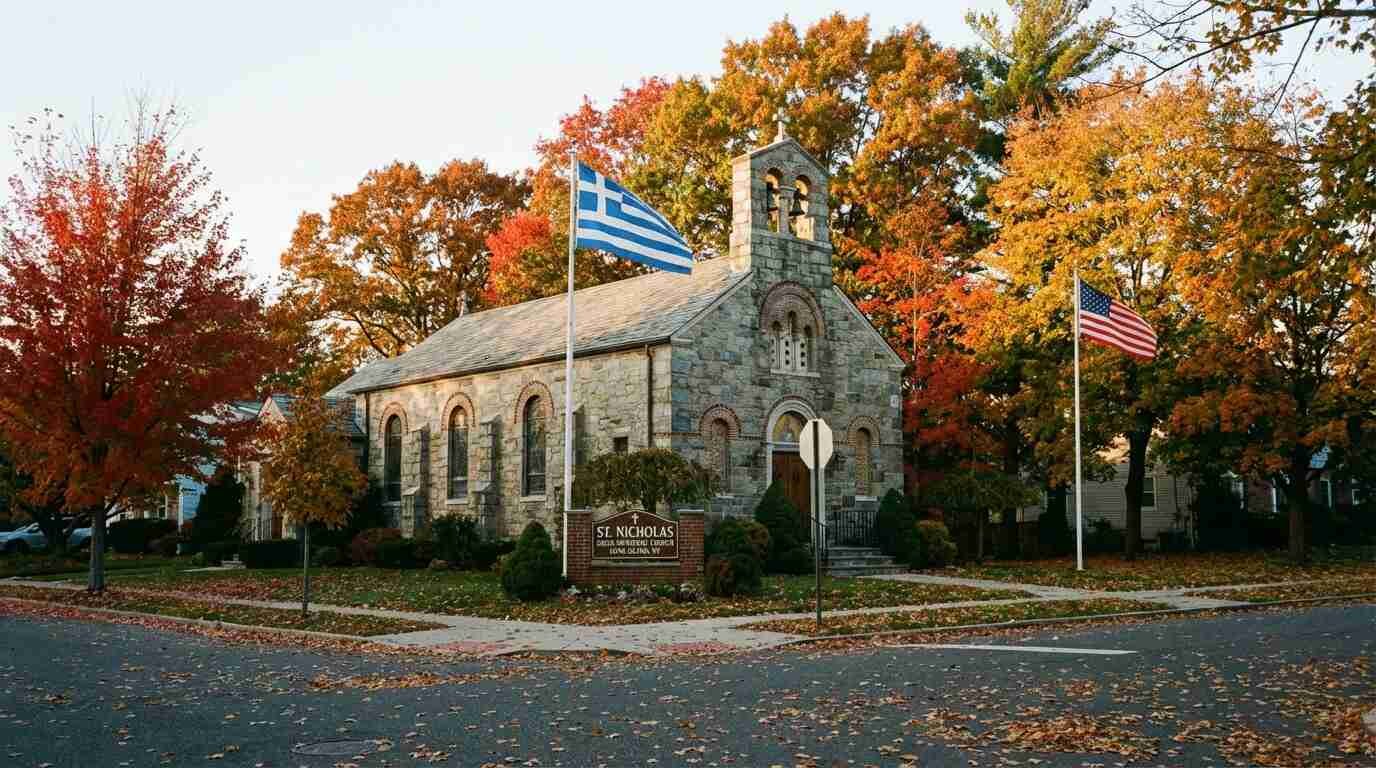
On the North Shore of Long Island, that route has been shaped for generations by a pattern that mirrors what happened in kitchens, behind diner counters, and in produce warehouses up and down the Eastern Seaboard: Greek immigrant families built the infrastructure, worked the margins, and stayed invisible while the restaurants up front took the credit.
Long Island Sound Was Once a Working Sea
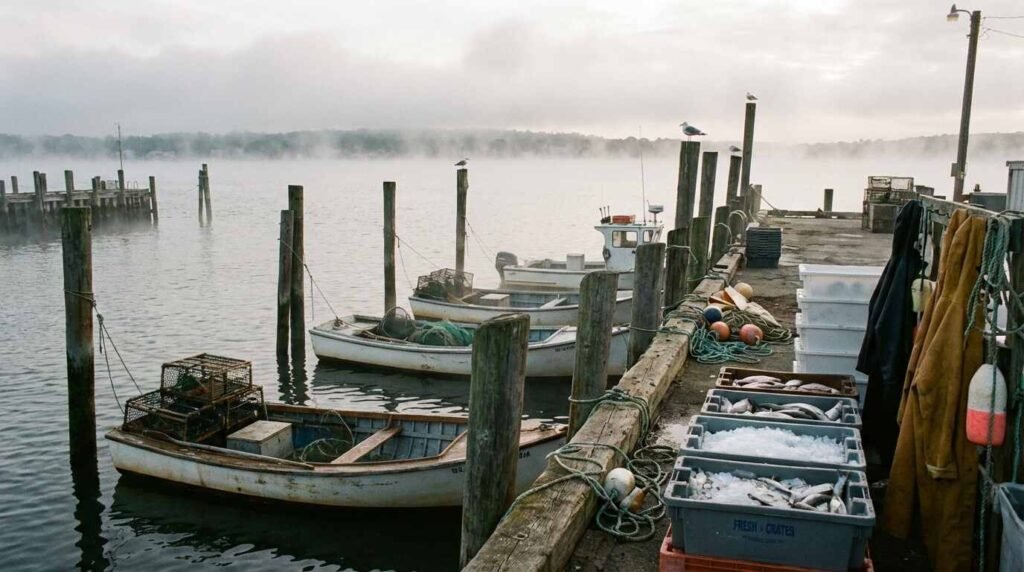
Before it became the backdrop for summer houses and paddleboard rentals, Long Island Sound was one of the most productive inshore fisheries on the East Coast. The waters of the Sound were teeming with marine life in the 1950s and ’60s — stripers regularly running 50+ pounds, lobster by the thousands, vast schools of moss bunker keeping the food chain healthy and productive. The North Shore’s sheltered harbors — Port Jefferson, Northport, Cold Spring Harbor — gave commercial fishermen natural staging points. The geography wasn’t incidental. It was the whole reason those communities existed.
Port Jefferson in particular sits at the widest point of the Sound’s crossing, with a natural deep-water harbor that has supported maritime industry since the Mather family’s shipbuilding empire in the 19th century. By the 20th century, that same harbor was handling a more modest but no less real trade: fresh fish coming off small commercial boats and moving into the wholesale supply chain that fed restaurants from Port Jeff to Stony Brook and beyond.
What that trade never had, unlike the Italian fishing communities of Fulton Market or the Portuguese baymen of the South Shore, was a chronicler. Nobody wrote it down.
The Greek Wave and the Food Chain
The pattern of Greek immigrant involvement in the food supply chain isn’t a coincidence or a stereotype — it’s economics and timing working together. Greek immigrants arrived seeking better economic opportunities than their homeland could provide, settling in urban areas where they formed tight-knit communities and opened small businesses. In the restaurant world, Greek ownership became dominant enough that it’s estimated 500 out of 800 diners in New York City are Greek-owned. But restaurants were only one node in a larger network. The supply chains feeding those restaurants — produce, dairy, fish — were often built and operated by the same communities.
Greeks were a close-knit community, often more so than other immigrant groups, preferring to work with family members and cousins and other people from the old country. That’s how they were able to get a stronghold on the business. That observation comes from Richard Gutman, author of American Diner Then and Now, speaking specifically about diner ownership — but the same network logic applied to provisioning. If you own three diners and you have a cousin who’s a commercial fisherman working the Sound out of Port Jefferson, you don’t call a seafood distributor. You call your cousin.
What the North Shore’s Fishing History Actually Shows
The documented commercial fishing history of Long Island’s North Shore is sparser than the South Shore’s — the South Shore had the oyster industry’s infrastructure and the institutional records that came with it. Dutch immigrants played an essential role in Long Island’s oyster expansion, and over time Portuguese immigrants in Port Washington became renowned for their skills in eeling and clamming, while various immigrant groups added to the cultural and economic diversity of the region’s maritime economy. The North Shore’s version of this story was smaller in scale and less formally organized.
What the NYS DEC commercial fishing license records and the Long Island Commercial Fishing Association’s documentation show is a persistent presence of small-boat commercial fishing operations in Port Jefferson and the surrounding Three Village area. These were never factory-scale operations. They were family-scale — a boat, a license, a buyer relationship, and the kind of word-of-mouth network that doesn’t generate press releases.
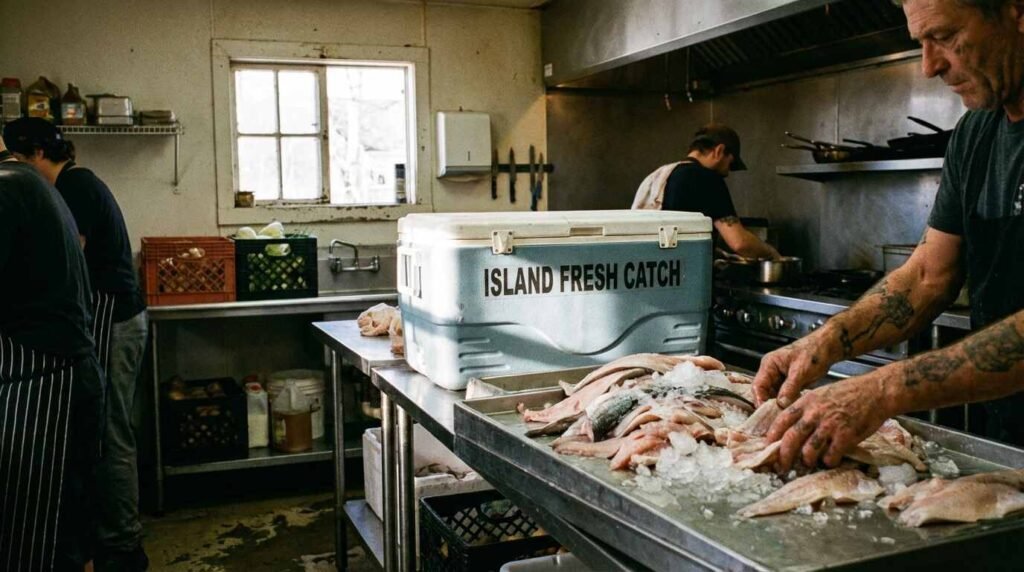
The fish that came off those boats — fluke, striped bass, bluefish, porgies, sea bass — fed directly into the restaurant supply chain of the North Shore corridor. Not always through formal distribution. Often through relationships. A restaurant owner who grew up speaking the same language as a fisherman’s family, who trusted the product because he knew the hands that caught it, who didn’t need an invoice to know the fish was fresh because it was dropped off that morning.
That kind of informal supply chain is invisible in food media precisely because it doesn’t announce itself. It has no PR operation, no farm-to-table branding, no James Beard nomination. It just works.
The Supply Chain That Food Media Missed
The North Shore restaurant scene has been written about in Newsday, in regional food guides, in endless Yelp threads — but always from the front of the house looking in. The sourcing relationships, the wholesale operations, the men who showed up at the kitchen door at six in the morning with a cooler — those stories don’t make the food section.
Fishing continues to be an important industry on Long Island, especially at Huntington, Northport, Montauk, and other coastal communities of the East End and South Shore. What that sentence elides is the distribution layer between the catch and the plate. Someone organized that distribution. On the North Shore, for a significant part of the mid-to-late 20th century, Greek-American families were often that someone — leveraging the same community networks, trust relationships, and family labor models that built the diner industry.
Richard Gutman’s observation about Greek diner owners bears repeating in this context: the preference for working with family and community members wasn’t insularity — it was a rational competitive advantage. When you’re operating on thin margins in a perishable-goods business, trust is infrastructure. A handshake from a cousin who fishes the Sound is worth more than a contract with a distributor you’ve never met.
What This Means When You Order the Fluke
There’s a version of North Shore dining that the menus present: seasonal, local, fresh. Sometimes that’s marketing language applied to fish that arrived on a truck from the Hunts Point Market in the Bronx. Sometimes it’s real — and when it’s real, it often traces back to a small-boat commercial fisherman operating out of a North Shore harbor, connected to the restaurant by a relationship older than either of their current addresses.
I grew up in the restaurant business. My family came from Greece, ran a kitchen, built something out of nothing on a coastline that didn’t particularly welcome them at first. I know what those supply chain relationships look like from the inside. They look like phone calls at 5 AM. They look like a guy showing up with something better than what you ordered. They look like trust that accumulates over years and never needs a contract.
The fluke on your plate at half a dozen Port Jeff restaurants has a history the menu won’t give you. That history runs through cold water, immigrant hands, and the kind of loyalty that doesn’t make it into any database but outlasts the businesses that depend on it.
The Three Village Historical Society archives have pieces of this. The DEC licensing records have fragments. What they don’t have — what may not exist in any document — is the full picture of how a fishing community became a supply chain became a culinary culture. That story lives in the memory of the people who built it, which means it’s running out of time.
You Might Also Like
- The Wooden Leviathans of Port Jefferson: The Mather Family’s 19th-Century Shipbuilding Empire
- The Greek Diner Owners of Long Island: An Immigrant Story Told in Coffee and Eggs
- Nantuckets — 9 Traders Cove, Port Jefferson, NY 11777