
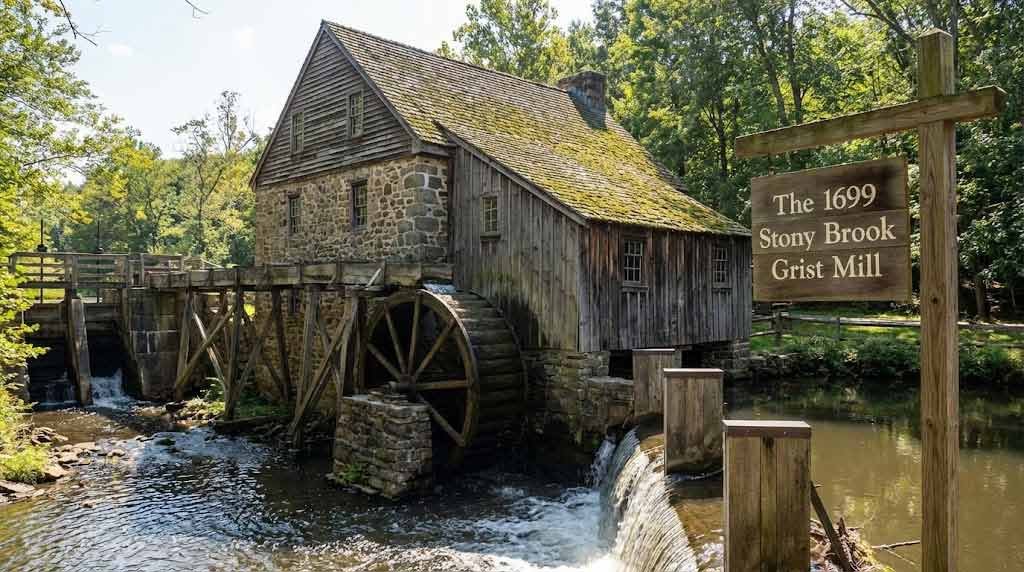
Before there was a Route 25A threading the Long Island North Shore together, before the Long Island Rail Road dropped passengers at quaint stations, before Ward Melville transformed a Depression-era hamlet into what the American Institute of Architects would one day recognize as the first planned shopping center in the country — there was a stream, a dam, and a turning wheel. That wheel, set in motion on the banks of what the Setalcott people called Cutsgunsuck, or “brook laden with small stones,” became the economic and social heartbeat of early European settlement on this stretch of Long Island’s North Shore. The 1699 Stony Brook Grist Mill is not simply a relic preserved under glass. It is the original infrastructure of civilization on this coast — a hydraulic machine, a marketplace, a town hall, and an agrarian engine all folded into one timber-framed structure that still turns today.
A Stream, a Proposal, and the Birth of an Economy
The Setalcott tribe had long understood the power of the stream that coursed through the land they called Wopowog. When European settlers arrived in the mid-seventeenth century and purchased the territory in 1655, they recognized that same potential through a different lens — one shaped by the realities of colonial subsistence farming. Before the Stony Brook Grist Mill was constructed, the Setauket mill, built in 1665, was the closest in proximity, but still required the inconvenience of traveling. Stonybrookvillage For farmers hauling heavy sacks of wheat and corn over uneven terrain, that inconvenience was not merely a nuisance — it was a genuine constraint on productivity and community life.
On January 27, 1699, Adam Smith, the son of Smithtown founder Richard “Bull” Smith, brought forth an idea to construct the Stony Brook Grist Mill at a town meeting. Stonybrookvillage The proposal passed, but Smith — savvy enough to understand the leverage he held — paused construction. Seeking personal profit for his part in constructing the mill, Smith agreed to continue to build the dam on the condition he be allowed one-tenth toll on wheat, and one-eighth toll on corn and rye. The town agreed, and in that same year the mill was erected completely. Stonybrookvillage It was a negotiation that would define the mill’s character for the next three centuries: a private enterprise in permanent service to the public good.
The toll system itself was not unique to Stony Brook — it was standard practice across colonial New England and the mid-Atlantic settlements. In most of New England, this toll was one-sixteenth of the grain brought to the mill. The owners of early 19th-century New England grist mills were usually rather prosperous men. Salisburyhistoricalsociety Adam Smith understood this math. He built not just a mill, but a franchise — one that his family would control for over a century.
The Engineering of Hydraulic Power in 1699
To appreciate what Adam Smith commissioned that year, one must set aside the pastoral imagery of a picturesque waterwheel and understand what colonial-era grist mill construction actually demanded. In colonial times, a gristmill was one of the most complex technological systems around. The millwright who could build it was one of the most skilled craftsmen in the colonies. He brought to the task the skills of a carpenter, joiner, mason, stone cutter, blacksmith, wheelwright, hydraulic engineer, and surveyor. There were no kits or parts available, so almost every part of the mill was made by the millwright from raw materials at the site. Movingnorthcarolina
The process at Stony Brook followed the same hydraulic logic that powered mills across the colonial world. The millstones were powered by the water from the millpond across the street. The water flowed under the street to the wheel, turning a series of gears and wheels. Visithistoriclongisland What sounds simple in a single sentence represents a cascade of precision engineering decisions: the height and angle of the dam, the dimensions of the sluice gate, the pitch and weight of the wheel paddles, the gear ratios connecting wheel to millstone, and the tension tolerances of every wooden shaft in between. If the mill was not built right, it was not going to work — a huge investment lost. George Washington’s Mount Vernon
The millstones themselves were the crown jewels of the operation. At Stony Brook, these eventually became a matched pair of French buhrstones — five feet in diameter and weighing a ton each — prized across colonial America for their hardness and consistent grind. The principle of the mill is this: the stream is dammed, then water passes into the sluice, which is then released to turn the large wheel, which sets in motion a surprisingly complex set of gears, which in turn spins the French buhrstones. Gothic Horror Stories The result was flour. And flour, in 17th-century Long Island, was currency.
Grain as the Language of Commerce on the North Shore
Grain was essentially the life-force of the common person during the 17th and 18th centuries on Long Island. Grain became a bartering item — colonists began to engage in commerce with neighbors to the north in Connecticut and to the west in Manhattan. Each annual harvest of wheat, corn, and grain was dedicated to sustaining a family, as well as slaves and servants. In this way, Stony Brook became part of a larger Atlantic Trade economy. They sold the grain for cash or traded it for commodities such as sugar or tobacco. Stonybrookvillage
This integration into the Atlantic Trade economy is a critical detail that elevates the Stony Brook mill beyond local history into the broader story of colonial American commerce. Long Island’s geographic position — flanked by Long Island Sound to the north and the Atlantic to the south, with New York Harbor a manageable sail to the west — made it a natural node in the network of goods flowing between New England, the mid-Atlantic colonies, and the Caribbean markets that were opening dramatically in the latter half of the 17th century. The Caribbean markets opened up in the 1670s. Colonial mills had enough sustenance for the people there, so they looked for new markets. Early exports to the Caribbean of flour and cornmeal started, and they brought back rum and molasses. George Washington’s Mount Vernon
What moved through the Stony Brook mill, in other words, was not merely local grain for local bread. It was a traded commodity in a mercantile system that stretched from Suffolk County to Bridgetown, Barbados. The mill pond was not a scenic amenity — it was an industrial reservoir.
The 1751 Rebuild: Resilience Written in Old-Growth Timber
In 1750, the dam broke, flooding the mill during a heavy storm. But not all was lost. Amongst the shambles of the building were the original beams, which were used to rebuild the mill in 1751. Stonybrookvillage This detail — the salvaging of original timber to frame the replacement structure — speaks to a colonial pragmatism that has no equivalent in the disposable economy of the present. The rebuilt mill was not a replica. It was a continuation, the original skeleton wrapped in new walls, which is why the structure standing at 100 Harbor Road today can claim an unbroken material lineage back to the very year Adam Smith first turned that wheel.
The Stony Brook Grist Mill is listed on the New York State and National Register of Historic Places as an outstanding example of post and beam Dutch-style frame construction and is a designated site on the New York State Revolutionary War Trail. iLoveNY The Dutch-style framing designation is significant — it places the mill within the architectural vocabulary of the Dutch colonial tradition that dominated early New York settlement, a reminder that Long Island’s North Shore absorbed cultural and technical influences from the Dutch presence in New Amsterdam that later became Manhattan.
The mill is unique in that it has two bolting machines that separate the fine flour for baking from the coarse flour for animal feed. No other mill on the Island has this much original equipment. Gothic Horror Stories That singular completeness — original machinery intact, operational sequence preserved — is what makes Stony Brook’s grist mill not merely the oldest but arguably the most instructive surviving mill in New York State.
The Mill in War: Feeding the British Occupation
The Revolutionary War arrived on Long Island not as distant thunder but as direct occupation. After the British victory at the Battle of Long Island in August 1776, Crown forces established firm control over the island and held it for the duration of the conflict. The mill at Stony Brook did not sit idle during this period. During the Revolutionary War, grains ground at the mill fed British soldiers. iLoveNY
This detail sits uncomfortably in the narrative of a region that also produced the Culper Spy Ring — perhaps the most consequential intelligence network of the American Revolution, operating out of Setauket, just miles from the mill. Abraham Woodhull, Anna Strong, and Caleb Brewster passed British troop movements and supply chain intelligence to George Washington while, simultaneously, the mill that had sustained their own families for three generations was grinding flour for the occupation force. The mill did not choose sides. It ground grain. That neutrality — or perhaps that vulnerability — is itself a form of historical testimony about what it meant to live under military occupation on the North Shore.
Following the war, the mill was a symbol of prosperity. By 1850, schooners carrying up to 100 tons of grain would unload at the mill. In addition, the mill was used for sawing logs into lumber. Gothic Horror Stories Commerce resumed. The wheel turned.
From Wine to Wheat Flour: The Mill’s Victorian and Progressive Era Lives
The mill’s story did not fossilize after the Revolution. It evolved with every generation that operated it, demonstrating a flexibility of purpose that modern observers might not expect from a single-function industrial structure. During the late 1800s, a vineyard was planted on the island in the Mill Pond. Catawba grapes were pressed and fermented in the Stony Brook Grist Mill, bottled in Brooklyn and sold at a nearby tavern. Wmho The mill’s hydraulic power, originally calibrated for grain, was redirected toward viticulture — proof that the infrastructure itself was more durable and adaptable than any single commercial use case.
The man behind the winemaking venture was Edward Kane, a Brooklyn brewer who brought a continental sensibility to the operation. His miller, Alois Kopriva, who emigrated from Poland, played the violin and entertained guests with gypsy music. Kopriva was also an advocate for women’s right to vote. Wmho The mill had become, by the late 19th century, something closer to a cultural salon than a purely industrial space — a place where music played, politics were debated, and the boundary between craft and community dissolved entirely.
Then came the early 20th century and a turn back toward the mill’s grain-processing roots. Miller Schaefer specialized in milling natural wheat, producing “health food” that gained popularity nationwide, with shipments reaching customers in 42 states. Wikipedia At a time when industrial roller milling was standardizing and bleaching the American flour supply, Stony Brook’s stone-ground whole wheat was a counter-narrative — a regional, artisanal product reaching customers from Maine to California who understood that the old methods produced something the factories could not replicate.
Ward Melville, Preservation, and the Mill’s Modern Stewardship
The Stony Brook Grist Mill was acquired by philanthropist Ward Melville in 1947. He subsequently deeded it to the Ward Melville Heritage Organization, which now owns and operates the mill. Stony Brook University Melville’s involvement with Stony Brook was already transformative by that point — as his dream was to create a “living Williamsburg,” Ward Melville envisioned a colonial-style village that would breathe new life into the area. Stony Brook Village The Stony Brook Village Center, completed in 1941, had already been recognized as the first planned shopping center in the country. The mill was not an afterthought in Melville’s vision — it was the anchor, the proof of authenticity, the 300-year-old object that gave the carefully designed colonial streetscape its historical credibility.
Today, the mill operates under the care of the Ward Melville Heritage Organization and is open to the public for guided tours with a miller or tour guide, and a Country Store from 1pm to 4pm on Sundays, April through October. Wmho The mill sits at 100 Harbor Road in Stony Brook village, just off Main Street, accessible from Route 25A — the very road that follows the old King’s Highway once traveled by British soldiers and Culper spies alike.
What the Turning Wheel Still Says
Stand beside the Stony Brook mill pond on a Sunday afternoon in October and watch the wheel move. The water does not know about the Revolution, the Brooklyn brewer, the health food shipments, or Ward Melville’s real estate ambitions. It follows the channel cut for it in 1699 and does what it has always done. The gear teeth catch. The millstones turn. The flour falls.
Three hundred and twenty-five years of North Shore commerce, warfare, agriculture, and community life have turned on that basic hydraulic transaction. The Stony Brook Grist Mill is not a monument to what has passed. It is an argument — still operational, still audible, still grinding — that the things built with the greatest care for the longest purpose are the ones that outlast every economic cycle, every occupying force, and every generation of new neighbors who arrive convinced that what came before them can be improved upon or replaced. Some things, the wheel suggests, simply need water, weight, and time.
Visit: Stony Brook Grist Mill, 100 Harbor Road, Stony Brook, NY 11790 | Ward Melville Heritage Organization | Guided tours Sundays, April–October, 1–4 PM | Admission: $4 adults, $2 children | Cash only