
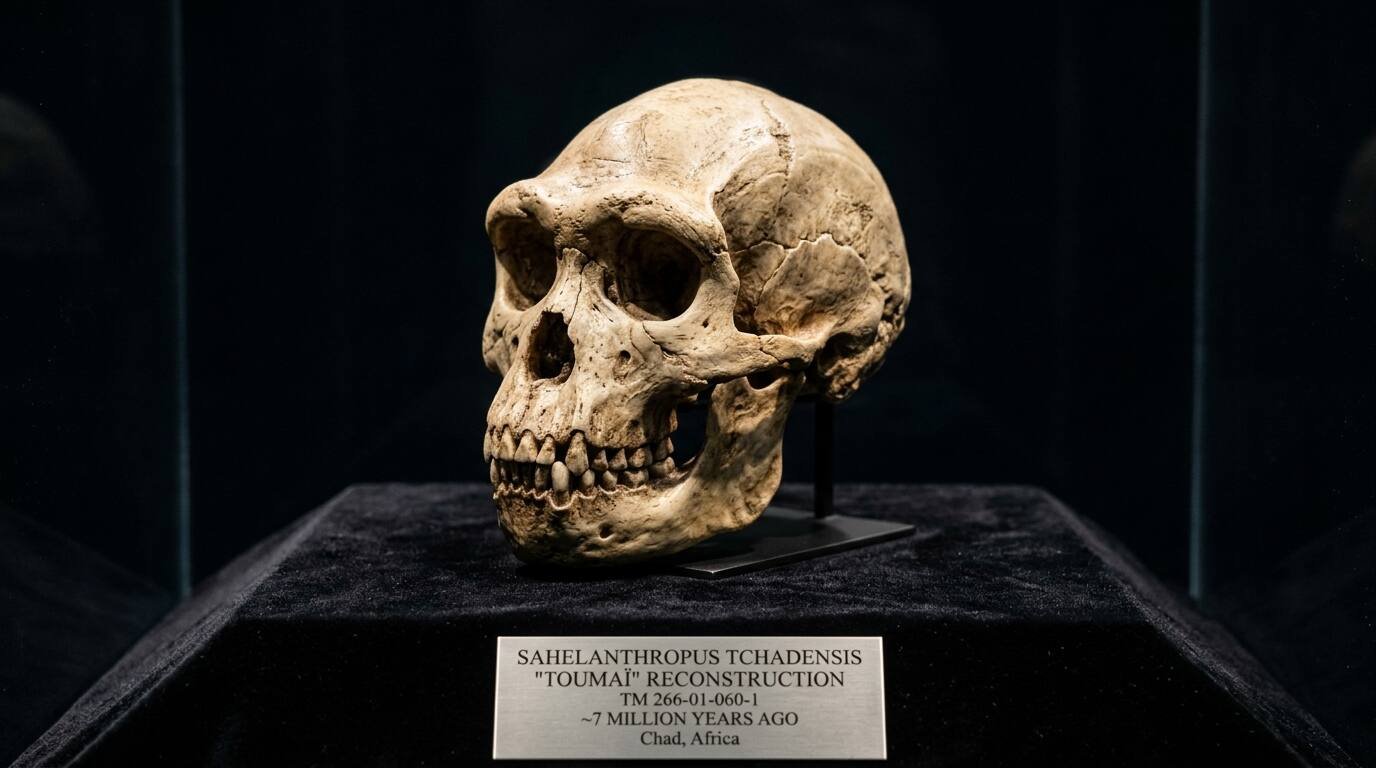
Somewhere between six and seven million years ago, in what is now the Djurab Desert of northern Chad, a primate died. It was, by the evidence available, an animal that occupied a position on the evolutionary tree very close to the point where the lineage leading to chimpanzees and the lineage leading to humans diverged. Its skull, discovered in 2001 by a team led by Michel Brunet of the University of Poitiers, was named Sahelanthropus tchadensis and given the informal name Toumaï — “hope of life” in the local Goran language.
What Toumaï’s skull suggested about the origins of the human lineage was significant enough to generate immediate scientific debate. What a femur found in the same sediment layer, by the same team, in the same year — and not published for twenty-one years — would eventually suggest about bipedalism has generated something considerably more fraught.

Why the Date Matters
Before Toumaï, the oldest reasonably well-dated hominin fossils came from East Africa, primarily the Ethiopian Afar region. Ardipithecus kadabba dated to approximately 5.8 million years ago. Orrorin tugenensis from Kenya dated to approximately 6 million years ago. The fossil record thinned dramatically beyond that — partly because of preservation bias, partly because the fossil-bearing formations of East Africa are better characterized and more systematically excavated.
Toumaï’s skull, dated at 6 to 7 million years ago using biochronological analysis of associated fauna and, subsequently, by cosmogenic nuclide dating of the sandstone layers, pushed the earliest known potential hominin back by at least a million years. More provocatively, it came not from the East African Rift Valley — the conventional birthplace of human evolution — but from Chad, more than 2,500 kilometers to the west.
The geographic displacement challenged what had been a relatively settled assumption: that early hominins were East African because that was where the climate and landscape changes associated with bipedalism occurred. If Toumaï was genuinely a hominin, and genuinely that old, the origin story became considerably more complicated.
The Skull’s Diagnostic Features
Paleoanthropologists assess hominin status through a constellation of morphological features. For Toumaï, the most diagnostic were the position of the foramen magnum — the opening at the base of the skull through which the spinal cord passes — and the canine morphology.
In quadrupedal great apes, the foramen magnum sits toward the rear of the skull, angled downward and back. In bipedal hominins, it migrates toward the center of the skull base, allowing the head to balance atop an upright vertebral column rather than project forward from a horizontal one. Brunet’s analysis of Toumaï’s skull suggested a foramen magnum position more forward and downward than in chimpanzees — consistent with, though not conclusive of, upright posture.
The canine teeth were also reduced relative to chimpanzees, another feature associated with early hominin status. Combined with the brow ridges and facial prognathism that showed a mosaic of primitive and derived features, Brunet’s team argued in their 2002 Nature paper that Toumaï represented the earliest known member of the tribe Hominini — the group including modern humans and our extinct relatives, but not chimpanzees.
Not everyone agreed. Milford Wolpoff and colleagues published a response the following year arguing that Toumaï was not a hominin at all, but likely a female proto-gorilla relative. The debate over the skull has continued at varying temperature ever since.
The Femur and the Twenty-Year Wait
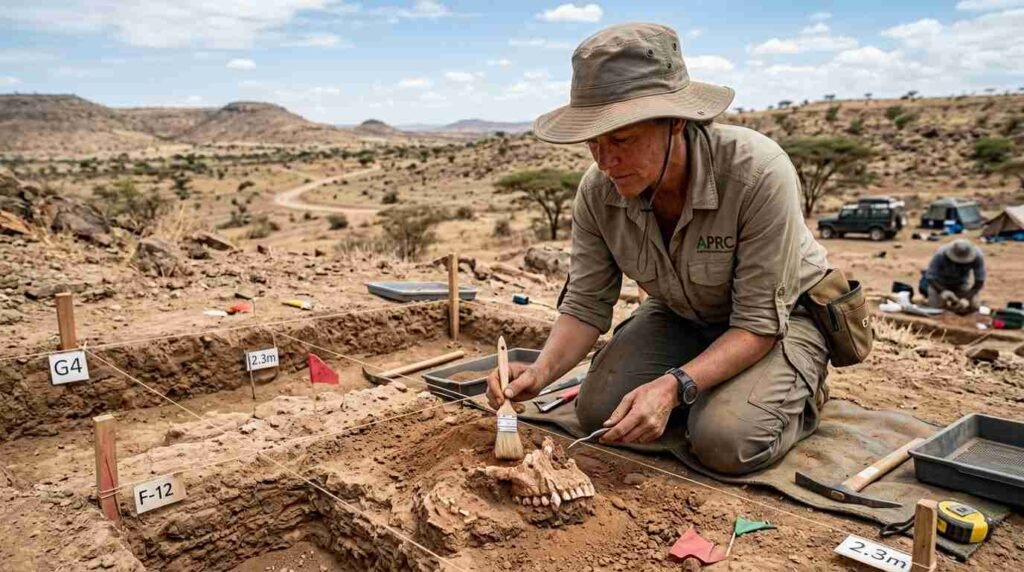
Among the fossils recovered in the 2001 field season by Brunet’s team was a partial femur — a thigh bone. The femur is directly relevant to the question of bipedalism in a way the skull is not: the morphology of the femur reflects how the animal moved. And yet the femur was not included in the 2002 Nature paper describing Toumaï. It was not included in any publication for twenty years.
This omission was the subject of a prolonged and sometimes acrimonious dispute within French paleoanthropology. Aude Bergeret-Deguine, a French researcher who had handled the femur as a student working with the team, argued publicly that the bone was a hominin femur with clear evidence of bipedal locomotion — and that it was being withheld from publication. Brunet’s team disputed the femur’s attribution and its significance. The controversy reached French scientific funding bodies and involved formal complaints.
In 2022, Daver and colleagues — working with fossils under Brunet’s institutional control — finally published an analysis of the femur in Nature. The paper’s conclusions were carefully qualified. The femur showed features intermediate between those seen in great apes and later bipedal hominins. The authors concluded that Toumaï likely practiced some form of facultative bipedalism — capable of walking upright on occasion while retaining significant arboreal locomotion. The femur did not resolve the debate. It restated it at higher resolution.
What Bipedalism’s Origins Actually Tell Us
The question of why bipedalism evolved is, in some respects, more interesting than the question of when. The conventional explanation — that early hominins walked upright to free the hands for tool use — has been largely abandoned by paleoanthropologists. The oldest stone tools appear approximately 3.3 million years ago; Toumaï suggests something like bipedalism precedes that by 3 to 4 million years.
Current hypotheses focus on ecological pressure rather than technological advantage. The late Miocene in sub-Saharan and Saharan Africa was a period of significant climate fluctuation, with forest retreating and more open, mosaic environments expanding. Bipedalism in these environments may have been energetically advantageous for covering longer distances between resource patches, or thermally advantageous by reducing sun exposure relative to quadrupedal posture.
The Daver 2022 paper and the subsequent commentary in the Journal of Human Evolution have added a layer of complexity: if Toumaï was facultatively bipedal at 6 to 7 million years ago, bipedalism was not a sudden evolutionary innovation associated with a specific environment or selection pressure. It was a capability that emerged and was elaborated over millions of years, in environments now demonstrated to extend well beyond East Africa.
You Might Also Like: The Origin of Humankind by Richard Leakey | Horizontal Gene Transfer: Why Darwin’s Tree of Life Is Actually a Tangled Web