First sip of Laphroaig tastes like a hospital burned down near the ocean. Second sip, you start to understand it. Third sip, you’re a convert.
Every person who’s ever opened to heavily peated Scotch has gone through some version of that sequence. The initial reaction is almost always rejection — this is a flavor profile that announces itself the way a diesel engine announces itself, which is to say loudly and without apology. But rejection is just the brain’s first reaction to something genuinely unfamiliar. Give it time. Peat demands patience the same way that most things worth understanding demand patience.
What’s actually in the glass is the result of an extremely specific set of geological, chemical, and craft decisions — decisions that Islay distillers have been making, in their current form, for centuries. The smoke is not a side effect. It’s the point. Here’s what’s happening, from the bog to the bottle.
What Peat Actually Is and Why It Burns Different on an Island
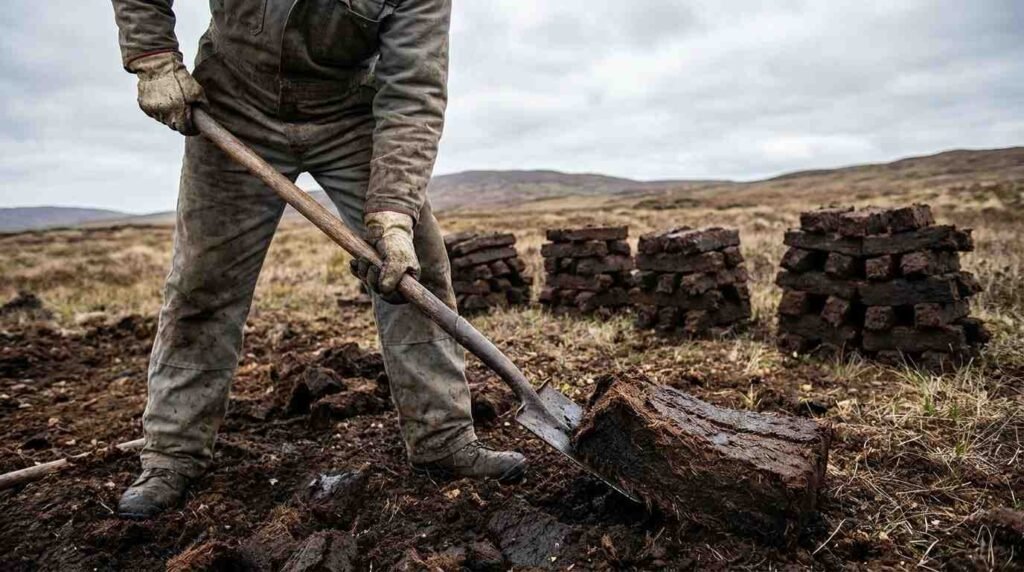
Peat is not coal. People conflate them because both are dark, dense, combustible, and formed from organic material over long periods of time. The difference is degree and duration. Coal is millions of years old; peat is thousands. Coal is compressed to the point where the original plant matter is largely unrecognizable; peat is still, visibly, plant matter — moss, heather, grasses, sedge — compressed and partially decomposed in waterlogged, oxygen-depleted bogs.
Islay’s bogs are coastal. The island sits off the southwest Scottish coast, exposed to Atlantic weather, and its peat is impregnated with marine compounds — iodine, seaweed, brine — that don’t exist in Highland or Speyside peat. This is not a metaphor or a marketing claim. The chemical composition of Islay peat is demonstrably different from peat cut elsewhere in Scotland, and those compositional differences translate directly into different smoke compounds, which translate directly into different flavor profiles in the whisky. The medicinal, iodine character you get in Laphroaig or Ardbeg — the note that is most commonly described as “hospital” or “antiseptic” by first-time drinkers — comes from the coastal peat’s phenolic composition. You cannot replicate it by using Highland peat and hoping for the best. The geology matters. The geography matters.
Peat bogs also form differently at different latitudes and elevations. Islay’s relatively flat coastal terrain produces peat that has accumulated over thousands of years in continuous waterlogged layers, which is why local distilleries can cut it in consistent blocks and burn it predictably. This is why the island’s distilling tradition developed in tandem with the peat tradition — the resource was abundant, consistent, and available in exactly the quantities needed.
The Malting Floor: Where Smoke Gets Into the Grain
Whisky requires malted barley. Malting means soaking the barley in water until germination begins, then stopping germination by drying the grain with heat. That drying stage is where peat enters the picture.
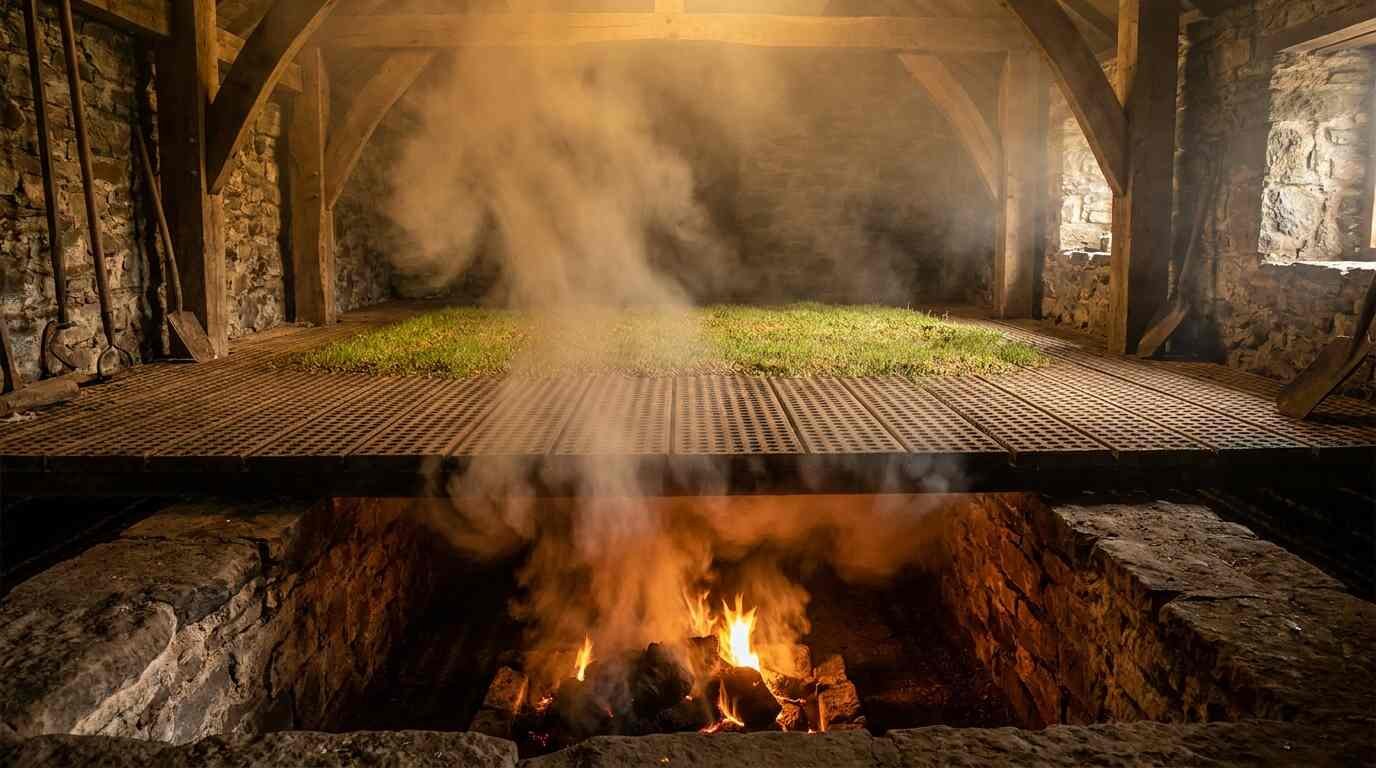
Traditionally, the drying happened on a malting floor — a large room with perforated floors where wet, germinated barley (green malt) was spread and dried over a kiln. If the kiln burned peat, the smoke rose through the perforated floor and into the grain. The phenolic compounds in the smoke — guaiacols, cresols, and other aromatic molecules — are physically absorbed by the wet grain. They bind to the husk and penetrate into the interior. Once in, they don’t come out. They survive milling, mashing, fermentation, and distillation. They emerge in the new make spirit and persist through years of barrel aging.
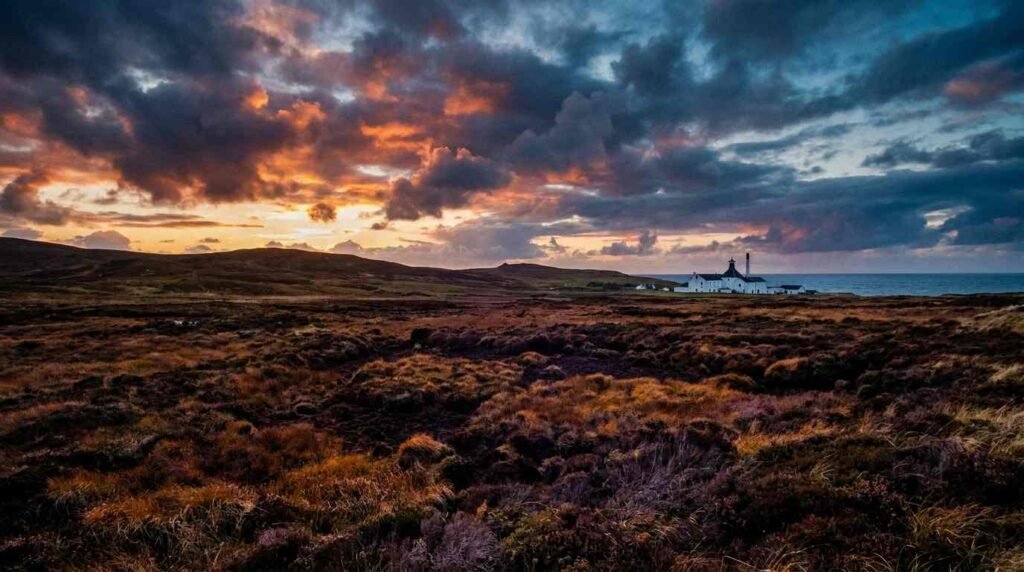
Most Islay distilleries today buy their peated malt from the Port Ellen Maltings on the island — a centralized facility that provides malt peated to the distillery’s own phenol specification. A handful still conduct floor malting on site. Laphroaig operates its own malting floor and uses peat from a specific bog adjacent to the distillery — a source the distillery has used for well over a century, which is part of what makes Laphroaig’s flavor profile so specific and so consistent. The peat at Laphroaig’s bog is coastal, peaty, and has been cut for long enough that the character of the bog itself has become part of the house style. You can’t replicate Laphroaig at a different address, any more than you can replicate a specific vineyard’s expression by moving the equipment to another county.
Phenol Parts Per Million: How Distillers Measure and Control Smokiness
When you see numbers on whisky bottles or in tasting notes — “55 PPM” or “40 PPM” — what you’re reading is phenol parts per million measured in the malted barley, not in the finished whisky.
This distinction matters enormously, and it’s where a lot of educated whisky conversation still goes wrong. The PPM of the malt is the input, not the output. Phenols are large, complex molecules with a high boiling point. They enter the spirit relatively late in the distillation run and are captured or lost depending on where the distiller makes the cuts — the points at which the foreshots (what comes off first) and feints (what comes off last) are separated from the heart of the run. Distilleries using similarly peated malt at the same PPM level can produce spirits with dramatically different smoke levels depending on these decisions.
The clearest example of this is Lagavulin and Caol Ila. Both distilleries source the same peated malt from Port Ellen Maltings, peated to approximately 35 PPM. Lagavulin produces a deeply smoky, rich, full-bodied whisky. Caol Ila produces a lighter, more coastal expression where the smoke is present but considerably less dominant. Same raw material. Different stills, different cut points, different distillation speeds. The production variables downstream of malting are why PPM is a useful indicator and an unreliable predictor.
Current production specifications, as widely published: Laphroaig uses malt peated to approximately 40–45 PPM. Ardbeg uses malt peated to 50–55 PPM. Lagavulin and Caol Ila source malt at approximately 35 PPM. Bruichladdich’s Octomore range — Bruichladdich’s project in extreme peating — has reached 309.1 PPM with the Octomore 8.3 release, the highest level ever recorded on commercially released whisky. A PPM value of 309.1 does not produce a whisky that is six times smokier than Ardbeg. It produces a whisky with a very specific phenolic profile that is, in many expressions of Octomore, more fruity and complex than expected precisely because the distiller is working very carefully with those extreme inputs.
Why Laphroaig, Ardbeg, and Lagavulin Each Taste Completely Different
All three sit on Islay’s southern shore. All three draw on the same coastal peat tradition. And they taste nothing like each other. This is worth explaining.
Laphroaig’s character is medicinal and maritime — iodine, seaweed, antiseptic, with a sweetness that emerges underneath on the finish. The distillery’s distinctive flavors come from its tall copper pot stills, the specific phenolic character of its own bog’s peat, and a maturation regimen that includes a portion of its stock finished in quarter casks. The house style is aggressive and specific. Fans describe it as the most distinctive whisky in the world. Critics have called it acquired. Both characterizations are accurate.
Ardbeg runs hotter and spicier. Its malt is peated to a slightly higher PPM than Laphroaig’s, but the distillate comes off narrower cuts than most Islay distilleries, which means more of the phenolic content makes it into the heart of the run. The flavor profile is smoke and char with a citrus backbone — bonfire, coffee, dark chocolate, and then that lime and lemon note cutting through the back of the palate. Ardbeg 10-Year is the standard against which most peated whisky is now measured.
Lagavulin is the oldest of the three in its current form, producing whisky at its current site since the 1820s. The 16-Year is the flagship — complex, rich, deeply smoky but with a sweetness and weight that Ardbeg and Laphroaig don’t carry. The distillery’s wider pot stills and slower distillation pace produce a fuller-bodied spirit. The 16-Year’s maturation in ex-bourbon barrels adds vanilla and caramel to a phenolic base, creating a whisky that tastes, to many first-time drinkers, like it can’t possibly be this complex and still be from a single place.
Food That Actually Makes Sense Next to Heavily Peated Scotch
The pairing question is where most people give up before they start, because the instinct is to treat heavily peated Scotch the way you’d treat a fine red Burgundy — protect it from food, give it space, let it stand alone. That instinct is wrong.
Heavily smoked food and heavily peated whisky are natural partners because they share a flavor mechanism — both are defined by smoke compounds, and instead of competing, they amplify each other. Grilled fatty fish: mackerel, bluefish, sablefish. The richness of the fish absorbs the phenolic intensity of the whisky the way fat absorbs spice. Smoked oysters, either raw or prepared with a light smoke, align with the marine character of Islay’s coastal peat in a way that makes the pairing feel almost geographically logical. You’re eating and drinking the same island.
Strong, aged cheeses — Comté, aged cheddar, Manchego — work well because the sharp, complex fatty acids in the cheese create a counterpoint that cleans the smoke without eliminating it. The contrast is the point. The smoky finish of the Ardbeg or Laphroaig returns after the cheese clears the palate, reset and clarified.
Dark chocolate, 70% or higher, is the classic single-malt pairing for a reason. The bitterness and tannins in the chocolate mirror the phenolic edge of the whisky without fighting it. A square of good dark chocolate and a dram of Lagavulin 16 is one of those combinations that makes you quietly grateful to whoever figured it out first.
The beer world has also been paying attention. The phenomenon of peated whisky–aged beer — stouts and barleywines finished in Islay casks — has become a legitimate subcategory of craft brewing precisely because the phenolic transfer from barrel to beer produces something genuinely interesting in both directions. The barrel gives the beer smoke. The beer history baked into the wood gives the whisky something to remember.
Islay’s distillers didn’t invent smoke as a flavor. They just understood, over centuries, what smoke could become when you gave it enough time and enough peat bog.
Sources
– Scotch Whisky Association — Technical Production Documentation – Whisky Advocate — Phenol PPM Explained – Distiller Magazine — Does a High Phenol Count Actually Mean a Peatier Scotch? – Whiskipedia — Phenols in Scotch Whisky – Master of Malt — Why PPM Can Be Misleading – Whisky and Wisdom — The Complete Guide to Peat and Peated Whisky – Charles MacLean, Scotch Whisky: A Liquid History (Cassell Illustrated, 2003)