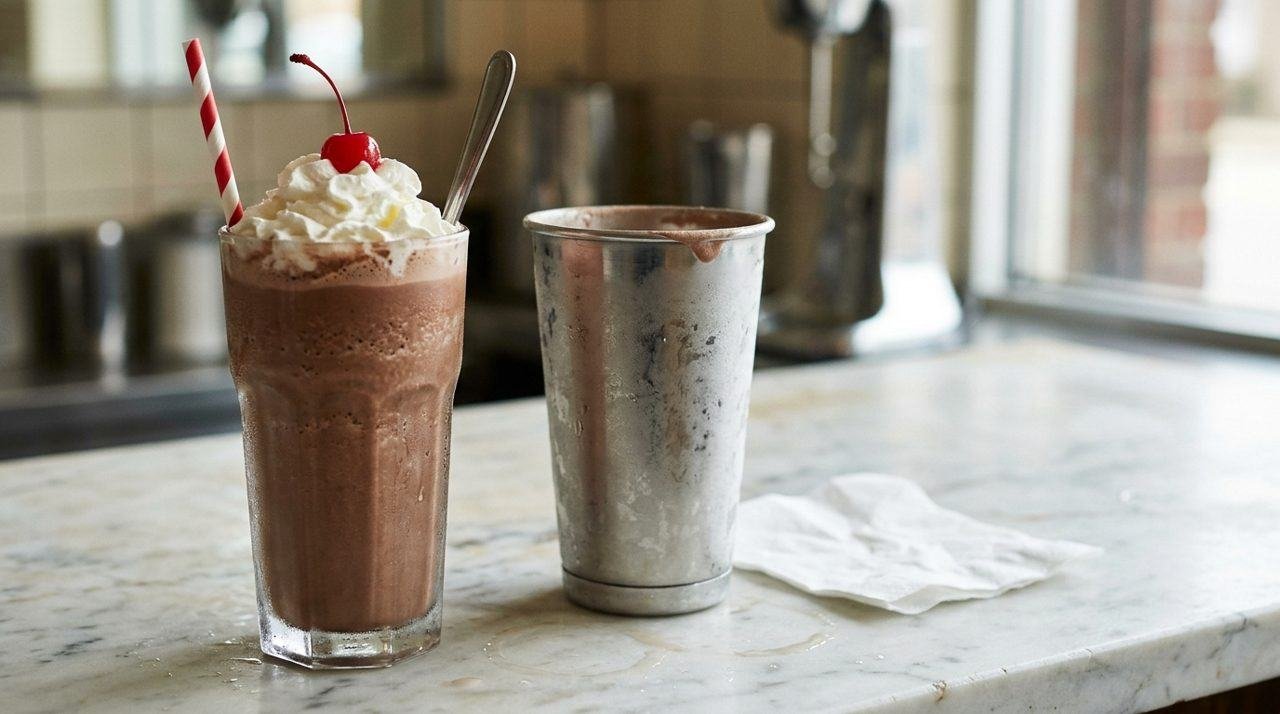
A chocolate malted is a chocolate shake with one extra ingredient, and that ingredient does more than its small quantity suggests. Malted milk powder is a dry blend of malted barley and milk powder, and it brings a toasted, faintly caramel note that sits under chocolate the way a low bass line sits under a melody. Leave it out and the drink is a shake. Put it in and the drink is a malt, the thing the old fountain counters were named for.
The method below leans on Food Network Kitchen’s malted chocolate milkshake for its quantities, borrows thickness advice from diner-focused reporting and from America’s Test Kitchen, and adapts the order of operations to a spindle mixer, the machine that gave the counter malt its texture. The existing counter-method milkshake guide covers the general shake; this one is about the malt itself, and the ratios and habits that keep it from turning chalky or thin.
What Malted Milk Powder Adds
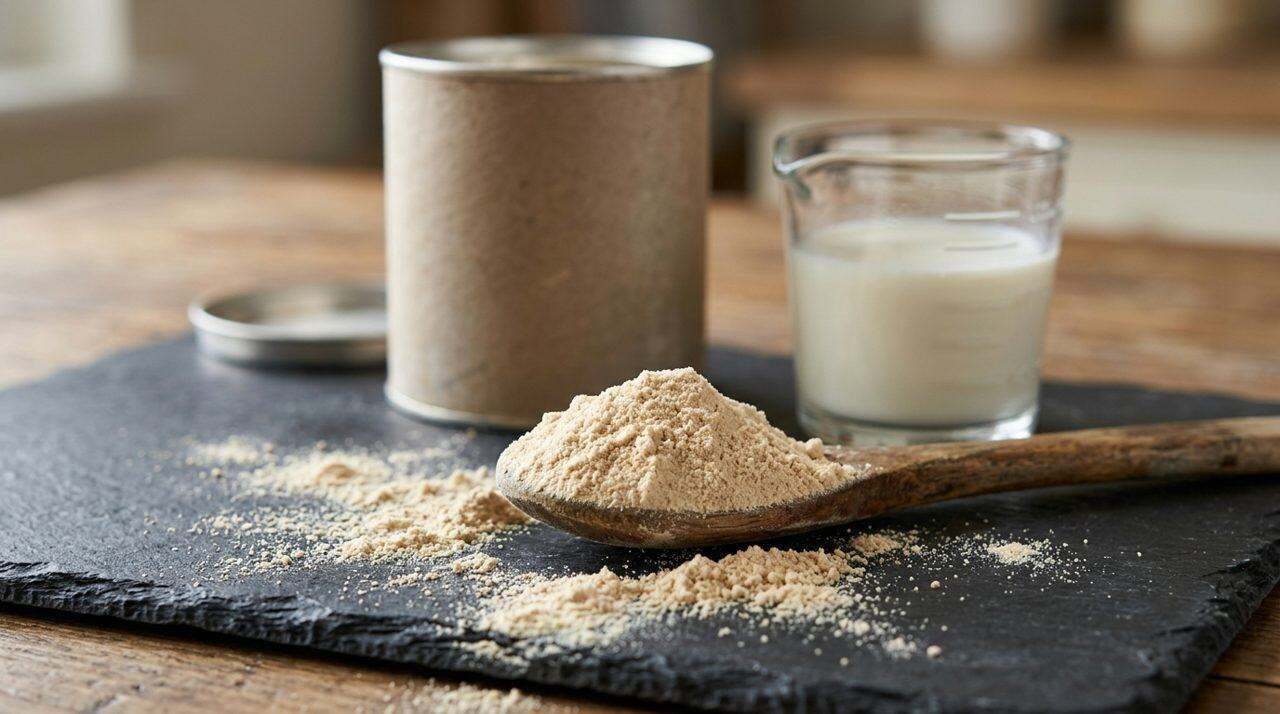
The label on a canister of malted milk powder is short. Tasting Table’s explainer describes it as ground malted barley blended with milk powder, often with chocolate or vanilla flavoring added, and notes that the powdered milk is what separates it from plain malt powder, which is only dried, ground malted barley. The milk makes it richer and smoother, and the same article credits it with caramel-like notes that suit chocolate and vanilla.
That pairing is the whole reason a chocolate malt works. A malt-versus-shake comparison points out that sprouting and drying the barley converts its starches to sugars, and that the finished flavor is nutty, slightly tangy and malty, with a subtle effect on texture. It also says malt deepens chocolate. Chocolate alone can taste flat and sweet; chocolate with malt tastes darker and more rounded, as though the cocoa had been toasted.
The same comparison says malt has only a subtle effect on texture. Thickness is a matter of the proportion of ice cream to liquid; the powder is there for flavor.
The Recipe: Chocolate Malted, 16 Ounces
These quantities follow Food Network Kitchen, whose recipe yields one large 16-ounce shake or two 8-ounce shakes. The topping and the cocoa swap are from the same page. This version is assembled from sourced technique and is not a house recipe of any restaurant.
Ingredients
- 1½ cups chocolate ice cream
- ½ cup whole milk, cold
- ¼ cup malted milk powder
- Optional topping: ⅓ cup very cold heavy cream and 1 teaspoon granulated sugar, whisked to soft peaks
- Maraschino cherry, optional
- Vanilla ice cream version: swap in vanilla ice cream and add 3 tablespoons of natural or Dutch-process cocoa powder with the malt
Method
- Put the serving glass, and the metal mixing cup if a spindle mixer is being used, in the freezer.
- Whisk the cream and sugar by hand in a deep bowl for 30 to 60 seconds, until soft peaks form. Set it aside.
- Combine the milk and malted milk powder and mix until the powder dissolves. In a blender, Food Network Kitchen runs this step on high for 15 to 20 seconds, before any ice cream goes in.
- Add the chocolate ice cream and mix until creamy and thick. In a blender that takes 20 to 25 seconds on high, pushing the mixture down as needed.
- Pour into the chilled glass, top with the whipped cream and a cherry, and serve right away.
The sequence matters more than the clock. Dissolving the powder in cold milk first keeps dry malt from hiding in pockets of ice cream.
Ratios: Where the Sources Disagree
The Food Network proportion is three parts ice cream to one part milk by volume. That sits squarely within what Tasting Table reports diners using: about 2 cups of ice cream to ⅔ cup of whole milk, or 1 cup of ice cream to ¼ cup of milk, which is three-to-one and four-to-one. The same piece adds that some diners use no milk at all unless it is frozen, and that Kewpee Hamburgers in Lima, Ohio, makes frozen malts thick enough to eat with a spoon.
America’s Test Kitchen goes further. Its vanilla milkshake uses 4 cups of ice cream to just ½ cup of milk, an eight-to-one ratio, processed in a food processor with a pinch of salt. The stated aim is a shake that is “sippable through a straw,” and the pinch of salt is there to lift the vanilla.
Those numbers describe a dial rather than a rule. Three-to-one drinks through a straw. Four-to-one needs a spoon for the first inch. Eight-to-one is closer to soft-serve than to a drink, which is fine for a spoon and a bad idea for a paper straw. Where a chocolate malt belongs on that dial is a matter of taste, best adjusted a spoonful of milk at a time.
Chocolate Ice Cream or Syrup
Food Network Kitchen builds the flavor into the ice cream. The classic counter approach is different: according to The Kitchn, the secret to a diner shake is a shot of flavored syrup added while the ice cream and milk are blended. The author calls chocolate shakes made that way “100 percent more chocolatey.” Vanilla ice cream plus chocolate syrup plus malt is a legitimate counter build. It gives a lighter body and a sharper chocolate edge than a drink made from chocolate ice cream, and it lets the malt stand out more.
Softening Ice Cream Without Melting It
Rock-hard ice cream tempts a cook to add extra milk, and extra milk is how a malt becomes chocolate milk with ambitions. America’s Test Kitchen tested several fixes and published the numbers in its guide to softening ice cream.
The refrigerator is slowest and gives the best result: about 30 minutes for a pint. The test is physical. As the article puts it, “If you can press gently in the middle with your finger to create a ¼-inch indentation, it’s ready.” The counter works unevenly; the top half-inch softened in about 15 minutes while the center stayed frozen and the rim began to liquefy.
A warmed knife scores a checkerboard into the pint, one-inch cuts in each direction, and a warmed scoop does the rest. The microwave is fastest and riskiest. At 50 percent power, 10 to 60 seconds with a check every 10, only a thin ring at the edge melts, whereas full power leaves liquid edges around a frozen core.
For a malt the refrigerator method is the one worth the wait, since melted edges thin the shake before the milk is even added.
Working a Spindle Mixer
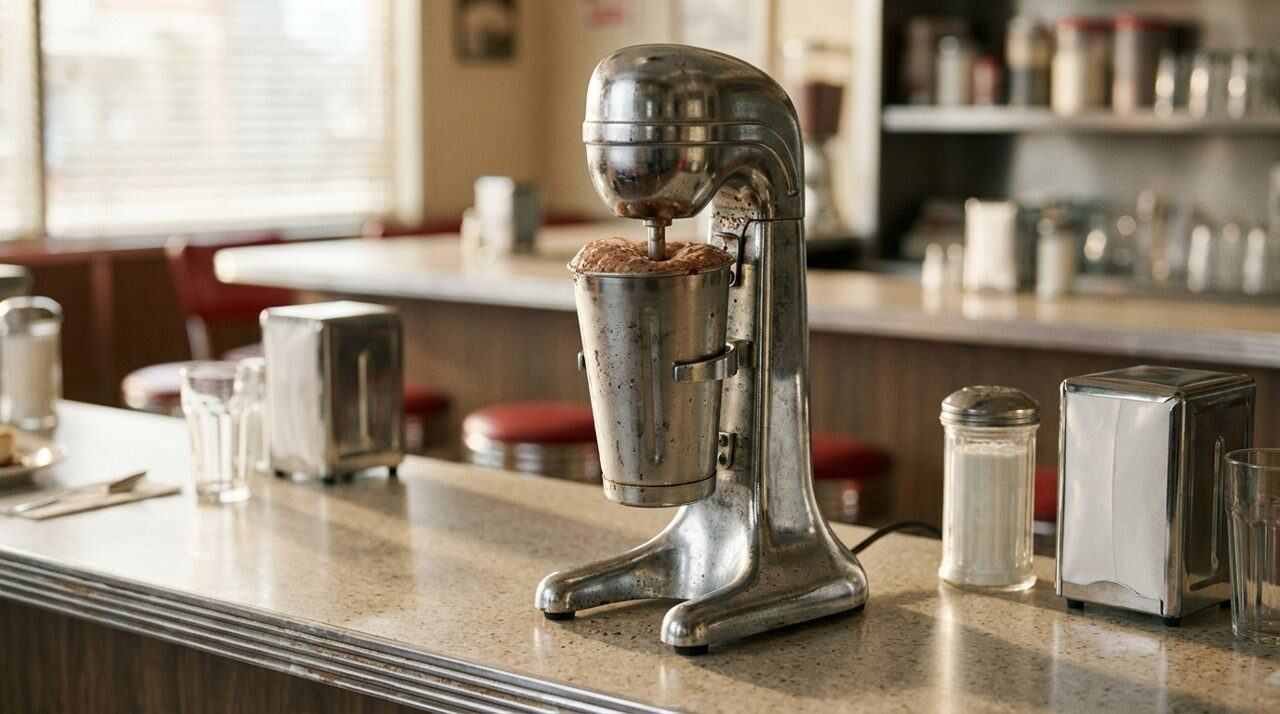
The classic fountain machine is simple. Wikipedia’s milkshake machine entry describes a stand holding an electric motor, a removable flared malt cup that is usually stainless steel, and a vertical rod with a small agitator of wavy metal or plastic at the bottom, submerged in the drink. That is the entire apparatus. Frederick Osius filed the patent in 1910 and it was issued in 1911; his Hamilton Beach company sold the machine as the Cyclone Drink Mixer.
What the agitator does is aeration. Wikipedia’s milkshake history says the spindle-and-agitator design folds air into the drink for a fluffy, smooth result, and the malt-versus-shake comparison reaches the same conclusion about blending in general: air makes a shake light and frothy.
A few habits follow from the design. A metal cup straight from the freezer helps hold the cold. Milk and malt go in first and run briefly to dissolve, the same order Food Network Kitchen uses for a blender. Ice cream goes in second, and the mixer runs until the drink is smooth and has lost its streaks. Stop there. How long that takes depends on the machine, so the cue to watch is texture rather than a timer.
At commercial scale, the idea multiplied. Earl Prince’s Multimixer, built to keep up with demand at his ice cream chain for its thick malts, ran several spindles at once; per the Shaw Local account, wartime manufacturing limits cut later models to five spindles.

Blender and Food Processor Versions
A home kitchen has no spindle, and the blender is the practical substitute. Follow the Food Network sequence exactly: milk and malt first on high for 15 to 20 seconds, then ice cream for 20 to 25 seconds, pushing the mixture down as needed. The container should go in the freezer beforehand if it is metal or thick glass.
America’s Test Kitchen prefers a food processor for its vanilla shake. Its recipe says the processor’s blade size and heat break down ice crystals evenly and efficiently, and it asks for about a minute, scraping the bowl as needed. Paired with its eight-to-one ratio, the result is a stiff shake, which suits a thick malt.
Fixes for a Malt That Went Wrong
Gritty or dusty. The powder probably met the ice cream before it met the milk. Dissolve it in cold milk first.
Thin and foamy. Too much milk or too long on the machine. Add another scoop of ice cream and mix only until smooth.
Flat chocolate. The ice cream is carrying all of the flavor. Add a spoonful of chocolate syrup, following the Kitchn counter habit, or the cocoa swap if vanilla ice cream is all that is available.
Too thick to move. A tablespoon of cold milk at a time, mixed for a few seconds after each addition. A malt should be thick, but the straw has to work.
Serve the malt the moment it is finished, with the spoon and the straw both in the glass. For a lighter drink from the same fountain menu, the site also has a how-to for the New York egg cream.
Sources
- Malted Chocolate Milkshake, Food Network Kitchen
- Why Milkshakes Always Taste Better At A Diner, Tasting Table
- What Makes Malted Milk Powder Different, Tasting Table
- How to Soften Rock-Hard Ice Cream, America’s Test Kitchen
- Vanilla Milkshake, America’s Test Kitchen
- The Diner-Approved Method for Your Ultimate Summer Milkshake, The Kitchn
- What’s the Difference Between a Malt and a Shake
- Milkshake machine, Wikipedia
- Milkshake, Wikipedia
- Sterling royalty (Prince Castle and the Multimixer), Shaw Local