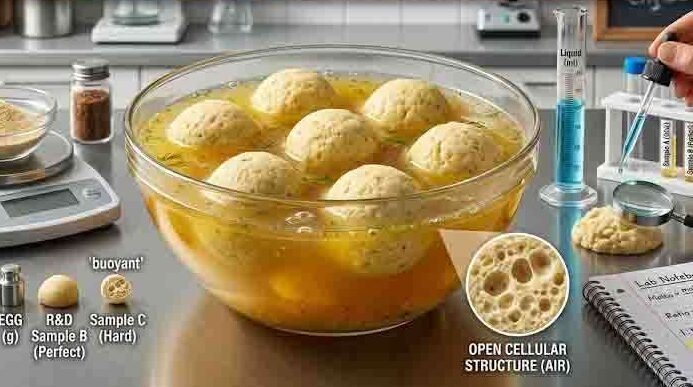
Few culinary debates carry as much cultural weight as the one playing out in Jewish kitchens across Long Island every Passover: floaters or sinkers? It sounds like a preference. It is actually a science problem — one with a very precise answer buried in fat content, hydration ratios, and the physics of starch gelatinization.
The Core Equation: Meal, Fat, and Liquid
The base ratio for a standard batch of matzo balls runs roughly 1 cup matzo meal : 4 large eggs : 3–4 tablespoons fat : ¼ cup liquid. Within that framework, every variable you touch moves the needle between a cloud and a cannonball.
Matzo meal is the backbone — ground unleavened bread that absorbs liquid aggressively. The finer the grind, the smoother the texture and the more even the expansion during cooking. Coarse meal produces denser, grainier dumplings. This is why many serious cooks grind their own matzo boards rather than reaching for pre-packaged meal.
Fat: The Variable That Changes Everything
Your fat choice defines the character of the dumpling before it ever hits the pot. Schmaltz — rendered chicken fat — is the traditional standard, and for good reason. Its higher saturated fat content coats the starch granules more completely than vegetable oil, inhibiting gluten-like bonding in the meal and producing a more tender, open crumb. The result: lighter dumplings with deeper flavor.
Neutral vegetable oil works fine, but the interior texture is slightly less giving. If you want the best of both — flavor and lightness — a 50/50 blend of schmaltz and olive oil is a sound approach used by cooks who’ve been doing this for decades.
The Floater Formula: Aeration and Carbonation
The floater-sinker divide comes down to gas. Light, buoyant matzo balls rise to the top of the pot because steam and CO₂ have expanded the interior while the exterior is still setting. There are three ways to introduce that gas:
Seltzer water replacing part or all of the liquid is the most reliable method. The carbonation begins expanding the moment the batter hits heat, creating an open, airy structure. Soda water delivers the same result. Still water produces a denser core.
Whipped egg whites folded into the mixture introduce mechanical aeration without any leavening agent. Whip to soft peaks, then fold gently — overworking destroys the bubbles and you’re back to sinkers.
Baking powder at a ratio of roughly ½ to ¾ teaspoon per cup of matzo meal offers chemical leavening without the seltzer. It is the most predictable method for consistent results, particularly in larger batches.
For maximum lift, combine seltzer water with a small amount of baking powder — somewhere around ⅛ to ¼ teaspoon per cup of meal — and you have both immediate carbonation and sustained rise as the dumpling cooks through.
Hydration Rest Time: Non-Negotiable
The most common mistake in making matzo balls isn’t the recipe — it’s the clock. The dough needs at least 30 minutes to rest, and for lighter dumplings, upwards of two hours allows adequate time for the dough to hydrate, which leads to greater expansion and lightness. Rushing this step means the meal hasn’t absorbed the liquid fully. The exterior sets while the interior is still dry, and the dumpling cracks or collapses.
The mixture will look wrong — almost soupy — when you first combine it. This mixture will look upsettingly and impossibly loose. It will firm up as it sits and hydrates. After adequate rest, it should have the texture of wet clay — malleable and shapeable. Trust the chemistry.
Cooking: Temperature Is the Last Variable
Drop your formed balls into a full rolling boil, then immediately reduce to a steady simmer. Boiling throughout toughens the exterior. A gentle simmer cooks the interior slowly and evenly, allowing the steam to expand without rupturing the structure.
Cover the pot — lifting the lid releases steam and drops the internal temperature, stalling the expansion cycle mid-cook. Cook for 20 to 30 minutes depending on size. To test doneness, pull one ball and cut it in half. The cross-section should be uniform, pale, and open-textured — not dense or translucent in the center.
The Summary for Your Kitchen
For consistently light, buoyant matzo balls, work from this framework: fine-ground meal, schmaltz as your fat, seltzer water as your liquid, a small addition of baking powder, a full two-hour rest in the refrigerator, and a covered simmer rather than a rolling boil. Every deviation from that framework moves you toward the sinker camp — which is a legitimate preference, just not one governed by this particular conversation.
The beauty of this dish is that four simple ingredients — meal, egg, fat, liquid — produce a spectrum of textures entirely dependent on technique. No shortcuts required. Just precision, patience, and a pot of good chicken broth waiting on the stove.