 275 Route 25A, Mt Sinai, NY 11766



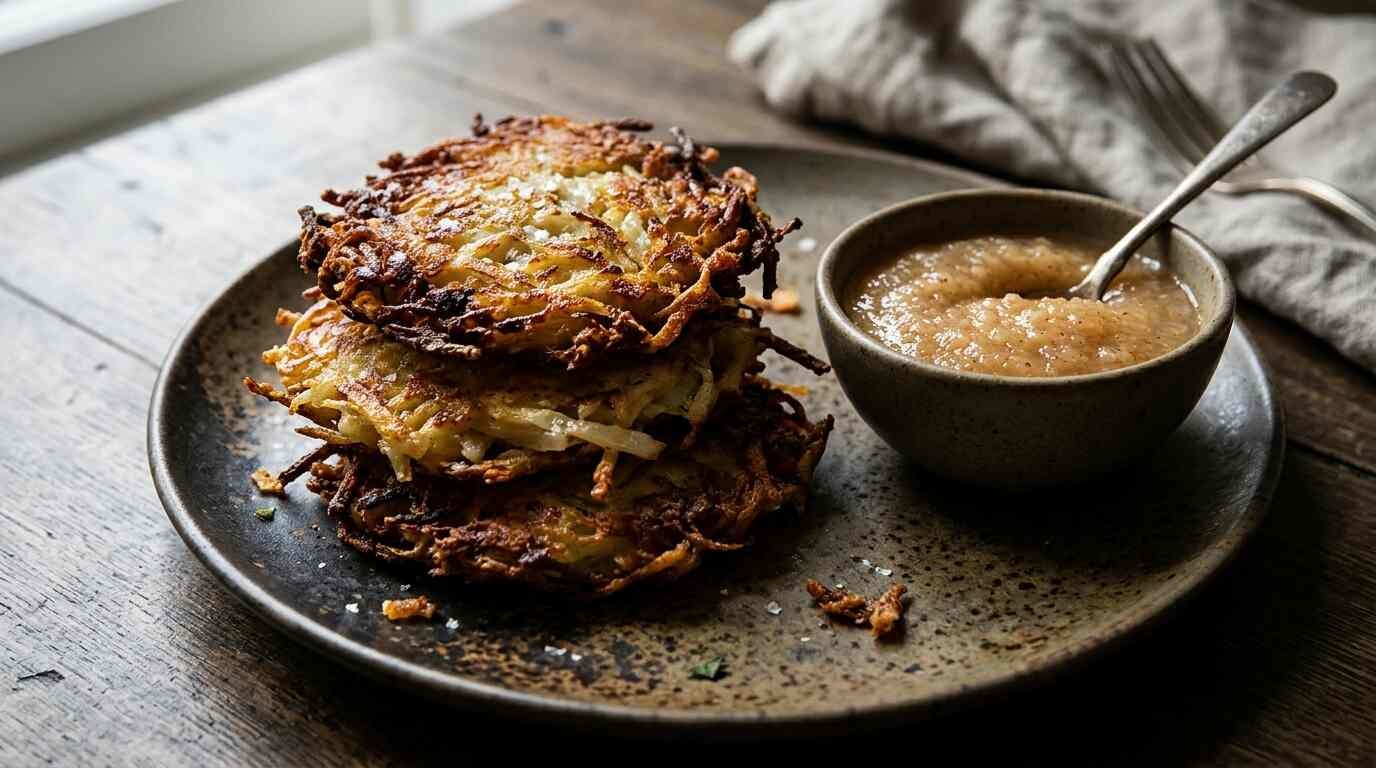
A latke is a shredded-potato pancake, and the whole craft comes down to a contest between water and starch. Water makes a latke gray and limp; starch holds the shreds together and browns into a lacy crust. Every dependable method for crisp latkes, from home kitchens to test kitchens, is a way of removing the one and keeping the other.
The Nosher, “How to Make Perfect Potato Latkes” (YouTube)
Why the water has to go
Moisture is the enemy of the crust
Raw potato is roughly the texture of a wet sponge once it has been shredded and salted. Salt draws liquid out of the shreds, and that liquid pools in the bowl and, worse, stays in the pancake. Real Simple’s tips for crisp latkes gives the reason plainly: water blocks the browning reactions that make food crisp. The same chemistry drives the crust on a diner hash or a seared steak, and it is laid out in more detail in The Maillard Reaction and the Diner Flat-Top.
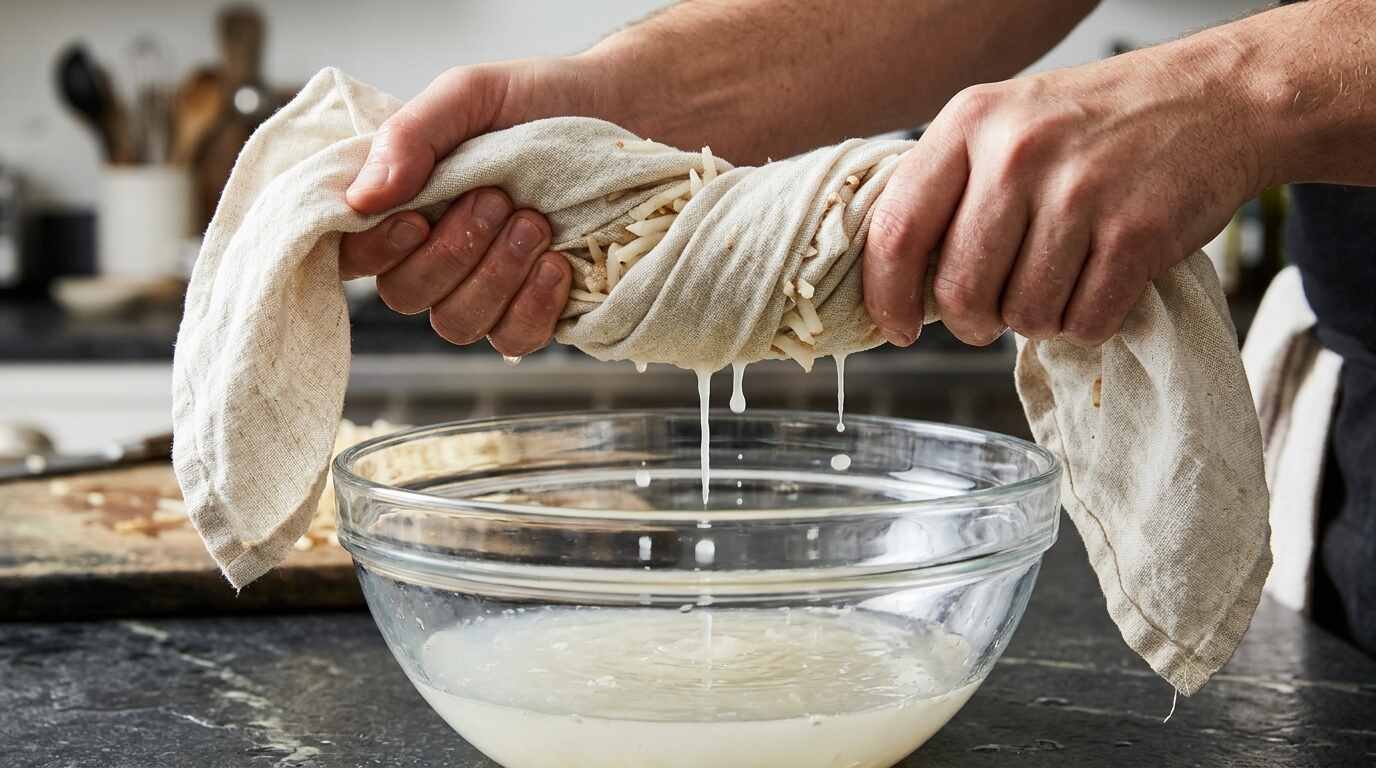
The remedy is a dish towel. America’s Test Kitchen’s crispy potato latkes shreds 2 pounds of unpeeled, scrubbed russet potatoes with 1/2 cup of grated onion and 1 teaspoon of salt, splits the pile in two, and wrings each half in a towel, twisting tightly to drain as much liquid as possible. Real Simple sets the target as shreds that feel dry to the touch. A first wringing that seems finished usually is not; a second twist, with the towel gathered tighter, still produces a surprising trickle.
Russets are the potato in both recipes, and ATK leaves the skins on, which also saves the work of peeling.
The grating question
Box grater or food processor, the large holes in either case. ATK cuts the potatoes into 2-inch lengths to feed a food processor’s shredding disk. Fine grating produces a paste closer to a hash-brown cake, and long, coarse shreds give the latke its ragged, crunchy edge.
The starch at the bottom of the bowl
A free binder, if it is rescued
The liquid wrung from the potatoes is gray and murky, and at the bottom of it sits a pale, dense layer of potato starch. ATK lets the liquid stand at least 5 minutes so the starch settles, pours off the water, and stirs the starch into the batter along with the eggs. Real Simple reports that many cooks do the same, and that its own team found flour or matzo meal works about as well while also soaking up extra moisture. No amount is specified there, so the amount is a matter of judgment: enough to make the shreds cling, not enough to turn the batter into dough.
ATK adds one more step that most home recipes skip. The wrung-out mixture goes into the microwave, covered, for 1 to 2 minutes, stirred every 30 seconds, until just warm. The recipe’s stated purpose is to gel the starches and limit further water release. The warm shreds then spread on a baking sheet to cool for 10 minutes before the eggs and starch go in.
Raw potato discolors quickly once cut. Food Network’s potato latkes addresses this by soaking the grated potato and onion in cold water with 1 teaspoon of sour salt (citric acid) for 5 minutes before squeezing. That recipe carries a note that it has not been tested for home use, so the soak is worth treating as a technique to try rather than a proven one. The simpler defense is speed: grate, salt, wring, mix, fry.
The recipe
Ingredients, adapted from the ATK method
- 2 pounds russet potatoes, unpeeled, scrubbed
- 1/2 cup grated onion
- 1 teaspoon salt, plus more for finishing
- 2 large eggs, lightly beaten
- 2 teaspoons minced fresh parsley
- 1/4 teaspoon black pepper
- Neutral vegetable oil with a high smoke point, such as canola
Method
- Shred the potatoes on the large holes of a box grater or with a food processor’s shredding disk. Toss with the onion and salt.
- Wring the mixture in a clean dish towel, half at a time, twisting hard. Catch the liquid in a measuring cup or bowl.
- Let the liquid stand 5 minutes. Pour off the water and keep the white starch at the bottom.
- Optional, per ATK: microwave the wrung shreds, covered, 1 to 2 minutes, stirring every 30 seconds. Spread on a baking sheet and cool 10 minutes.
- Stir the eggs into the starch until smooth, then fold into the shreds with the parsley and pepper.
- Heat the oil (see the next section). Press 1/4-cup mounds into disks about 1/3 inch thick and lay them in the oil, leaving space between them.
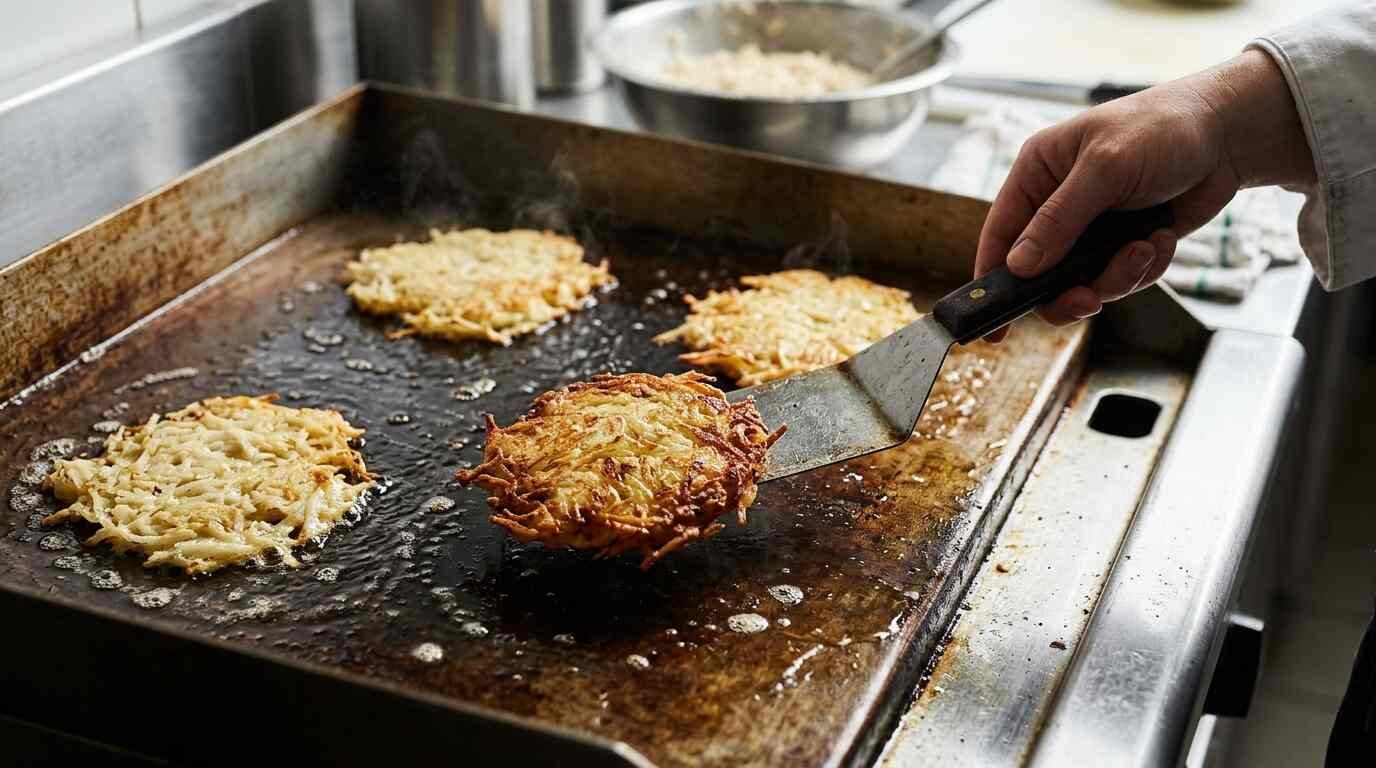
- Fry about 3 minutes per side, until deep gold. Real Simple allows 4 to 5 minutes per side for a darker crust. Flip once, and leave the latkes unpressed after flipping.
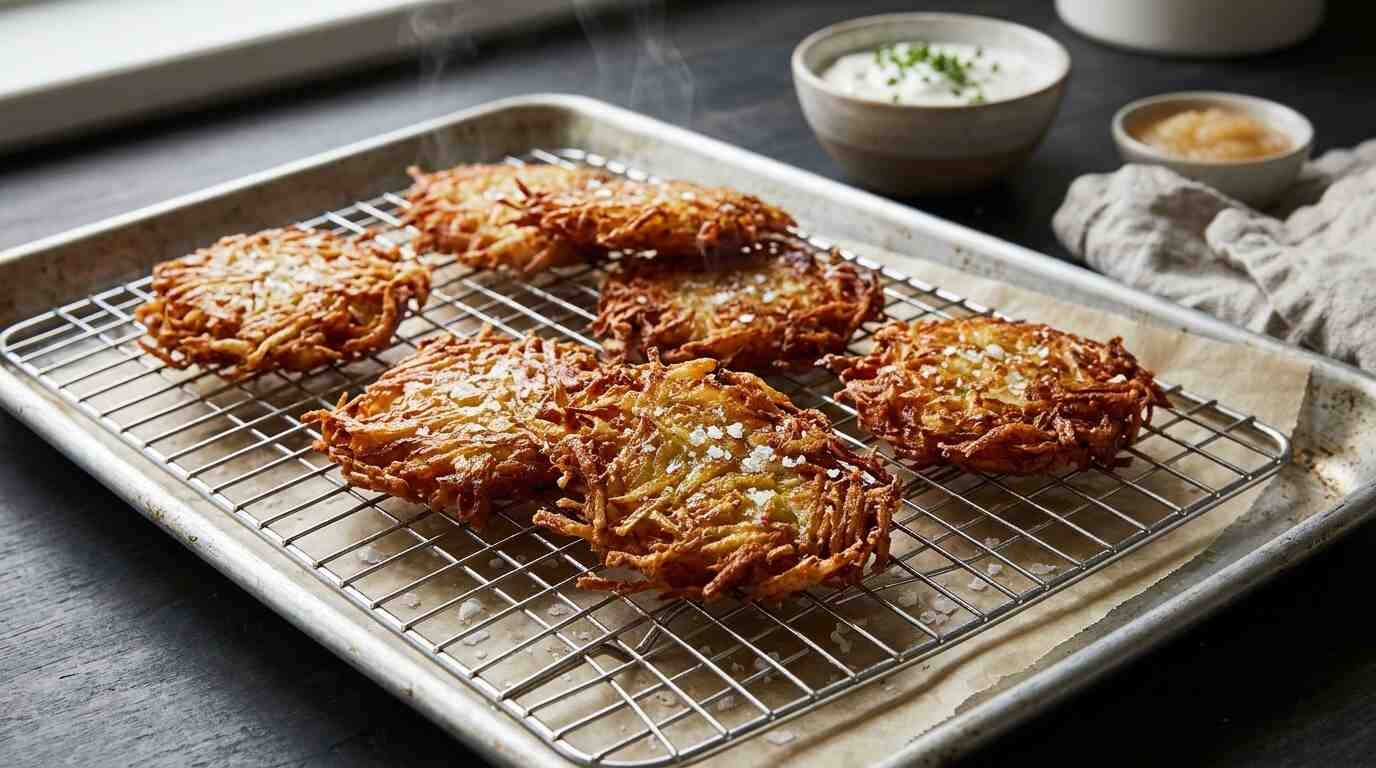
- Move to a wire rack set over a baking sheet, salt lightly while hot, and hold in a 200°F oven until the batch is done.
The disks need to be thin. A thick latke browns outside long before the middle cooks through, and a thin one is nearly all crust.
Griddle, flat-top or skillet, and the oil
Temperature is the one number worth measuring
ATK fries in a 12-inch skillet with a 1/4-inch depth of oil, medium-high heat, aiming for 350°F: the oil should shimmer without smoking, and bubbles should form around the edges of each latke. Between batches, the oil is brought back to 350°F. Real Simple offers a no-thermometer check: heat the pan over medium-high for about a minute, then drop in a small clump of potato; if it sizzles, the oil is ready. It also recommends changing the oil between batches if loose shreds are left behind, because they burn and turn the next round bitter.
A flat-top or electric griddle suits latkes because the broad surface fits many disks at once. Food Network’s recipe pan-fries on a griddle over high heat with a small amount of oil, about 3 minutes per side, though the same recipe is marked as untested for home use, and “high” on a commercial flat-top is a different thing from “high” on a home griddle. A surface thermometer is the dependable way to translate the 350°F figure. Home cooks without a flat-top can look at the Presto 22-Inch Electric Griddle review for the electric alternative.
No source consulted gave a griddle-specific oil depth. The skillet figure of 1/4 inch is a depth of fat for a pan with walls; on an open plate, the practical equivalent is a film generous enough that oil visibly bubbles around each disk, replenished between batches.
Crowding
Spacing matters as much as heat. A JTA how-to on perfect latkes for Hanukkah warns that latkes placed too close together will be soggy. ATK limits a 12-inch skillet to five latkes at a time. Each cold disk lowers the temperature of the oil, and a crowded surface cannot recover.
The same logic runs through the starch-and-heat method used for crispy diner-style home fries.
Keeping latkes crisp until serving
Wire rack, low oven
Paper towels soak up surface oil but hold steam against the underside, and a latke resting on a flat plate softens within minutes. Real Simple sets the cooked latkes on a wire rack inside a baking sheet in a 200°F oven until the whole batch is done, and notes that using several pans at once shortens the wait for the first latkes out. ATK drains on a paper-towel-lined wire rack set in a baking sheet before moving them to the oven.
Make-ahead is possible. ATK says cooled latkes can sit loosely covered at room temperature for up to 4 hours or be frozen for up to a month, and reheats them at 375°F until crisp: about 3 minutes per side from room temperature, 6 minutes per side from frozen. Reheating in an oven on a rack revives a crust in a way a microwave cannot.
Applesauce is the traditional companion, and a pan-fried dish like pan-fried pork chops with applesauce shows how well the fruit cuts through fried fat.
Where latkes came from
Cheese first, potatoes later
The Hanukkah pancake was not always made of potato. According to My Jewish Learning’s account of latke history, Gil Marks, in the Encyclopedia of Jewish Food, traces ricotta pancakes to Italy, from where they spread across Europe. The link between cheese and Hanukkah runs through the Book of Judith, which that article says was tied to the holiday by at least the 14th century. People ate cheese in memory of her bravery.
The earliest written reference to fried pancakes that article cites is a 1322 poem by Rabbi Kalonymus ben Kalonymus, which describes “levivot large and round, the whole size of the frying pan.” Food Republic offers a related version of the story: Jews leaving Spanish-controlled Sicily during the Inquisition brought a fried cheese pancake called cassola to Northern Italy, and Eastern European Ashkenazi cooks first made latkes from buckwheat and rye.
How the potato took over
The two articles disagree on timing. My Jewish Learning says Eastern Europe accepted the potato as a staple only around the mid-1800s, and that crop failures in Ukraine and Poland in 1839 and 1840 drove farmers to plant potatoes against famine; potatoes became cheaper than flour, and potato latkes became the default. Food Republic places the potato’s arrival in the 18th century and says it became a staple after a famine. Both agree on the mechanism: a cheap, abundant crop met a kitchen that, under kosher law against mixing meat and dairy, had reason to move away from cheese.
The word itself is reported by My Jewish Learning as coming from the Slavic “oladka,” a small fried pancake, which derives from the Greek “elaion,” olive oil. Oil is the thread through every version. Both accounts identify frying in oil as the constant, a nod to the Hanukkah oil miracle. In Eastern Europe, rendered fat such as schmaltz was easier to get in winter; the switch to neutral vegetable oil came, according to My Jewish Learning, after Eastern European Jewish immigrants brought latkes to America in the early 20th century.
Hanukkah in 2026
According to Hebcal, Hanukkah 2026 begins at sundown on Friday, December 4, and ends at nightfall on Saturday, December 12. The candle-lighting nights run from December 4 (one candle) through December 11 (eight candles).
Sources
- The Nosher, “How to Make Perfect Potato Latkes” (YouTube): https://www.youtube.com/watch?v=ehLAQzvNNqo
- Real Simple via Yahoo Life, “11 Tips for Perfectly Crispy Latkes, Every Time”: https://www.yahoo.com/lifestyle/10-tips-perfectly-crispy-latkes-201619541.html
- America’s Test Kitchen, Crispy Potato Latkes: https://www.americastestkitchen.com/recipes/7214-crispy-potato-latkes
- Food Network, Potato Latkes: https://www.foodnetwork.com/recipes/potato-latkes-3715421
- JTA, “Watch: How to make perfect latkes for Hanukkah”: https://www.jta.org/2020/12/02/food/watch-how-to-make-perfect-latkes-for-hanukkah
- My Jewish Learning, “The Real History of Potato Latkes Will Surprise You”: https://www.myjewishlearning.com/the-nosher/the-real-history-of-potato-latkes-will-surprise-you/
- Food Republic, “How Latkes Became An Integral Part Of Hanukkah Traditions”: https://www.foodrepublic.com/1436545/history-eating-latkes-hanukkah/
- Hebcal, Chanukah 2026: https://www.hebcal.com/holidays/chanukah-2026
- Heritage Diner, The Maillard Reaction and the Diner Flat-Top: https://heritagediner.com/maillard-reaction-diner-flat-top-why-griddle-browns/
- Heritage Diner, Presto 22-Inch Electric Griddle Review: https://heritagediner.com/presto-22-inch-electric-griddle-review-diner-breakfast/
- Heritage Diner, Crispy Diner-Style Home Fries: https://heritagediner.com/crispy-diner-home-fries-cold-potatoes-hot-pan/
- Heritage Diner, Pan-Fried Pork Chops with Applesauce: https://heritagediner.com/pan-fried-pork-chops-with-applesauce/
Leave a Reply