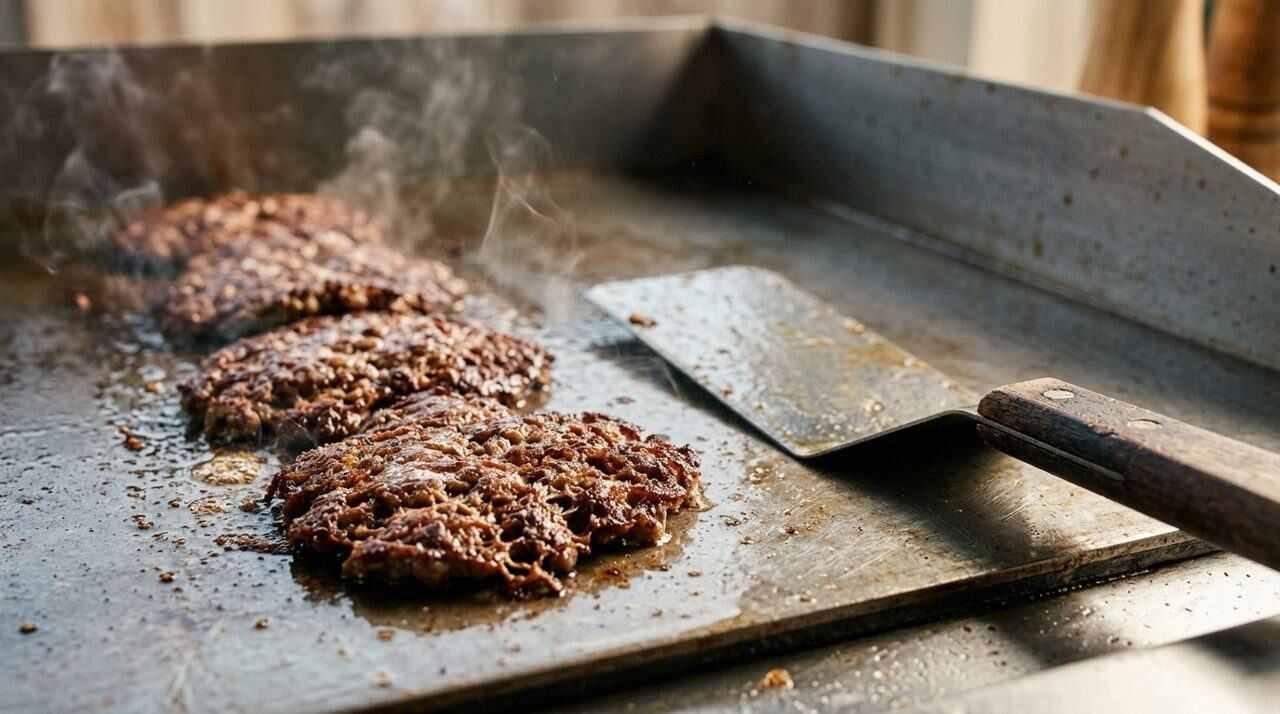
Louis-Camille Maillard, a French scientist, noticed in 1912 that heating a mixture of sugars and amino acids turned it brown and set off a flush of new smells. He was thinking about medicine, not dinner. According to a public radio report on the reaction’s centenary, Vincent Monnier of Case Western Reserve University says Maillard thought the finding would matter for medicine and diabetes and did not immediately recognize its importance for food.
A century later the reaction explains the crust on a hamburger, the bark on a pork chop and the brown edge of a pancake. The place where most Americans have watched it happen is a big steel plate behind a diner counter.
What Maillard found and what Hodge worked out
Maillard identified the reaction but never fully understood how it worked, as the same report puts it. The mechanism arrived in 1953, when John E. Hodge, a chemist with the U.S. Department of Agriculture, explained the chemistry in a paper in the Journal of Agricultural and Food Chemistry. Hodge’s model splits the reaction into three stages, and one cooking-science write-up describes them as initial, intermediate and final, with the last producing brown, nitrogen-containing polymers called melanoidins.
The practical result is hundreds of compounds. A few hundred scientists met in Nancy, France, to mark the reaction’s 100th anniversary, with events there and in Maillard’s hometown of Pont-a-Mousson, about 30 kilometers away, according to the same report. The specific sugars and amino acids in a food decide which aromas arise, which is why, according to Modernist Cuisine, bread, roasted meat and fried fish smell so different. Caramelization is a separate process. As the Maillard reaction entry notes, caramelization is the pyrolysis of certain sugars, while the Maillard reaction needs amino acids.
A lab curiosity that kept its relevance
Food companies use this knowledge to reproduce and preserve flavors, textures and smells in processed products, according to the same report. The reaction also has a less welcome side: under certain conditions in cooking it produces substances including acrylamide and furans, which the report describes as cancer-causing. Those are reasons chefs aim for brown rather than black.
The two numbers that run a flat-top
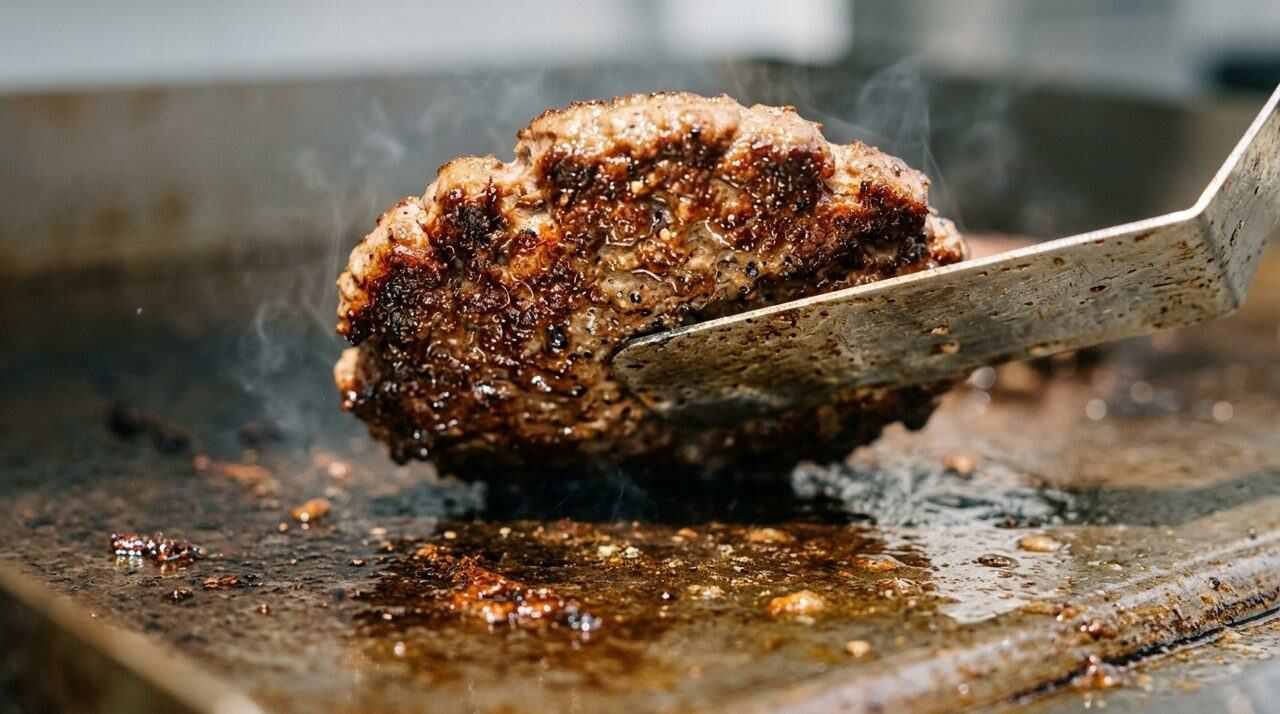
Two temperatures frame the whole business. The entry on searing gives about 150°C (300°F) as the surface temperature needed for a brown crust. At the other end, Modernist Cuisine states that above 180°C (355°F) a different set of reactions occurs: pyrolysis, also known as burning, where bitterness and dark compounds form. The workable window is narrower than it looks, and the Maillard reaction entry says the reaction proceeds rapidly from about 140 to 165°C (280 to 330°F).
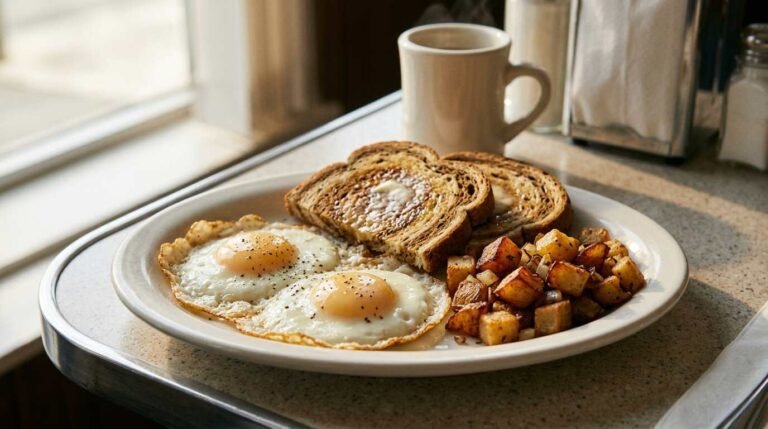
The plate temperature set in a diner during the breakfast rush sits above that window on purpose. In a previous Heritage Diner piece on the diner fried egg, the flat-top is described as running 350 to 400°F, with most diners setting about 375°F. The surface of the plate is hotter than the food’s surface will ever get, because the food is full of water and the plate is not.
Why water is the real limit
Raw meat is mostly water, and water caps the temperature of whatever it soaks. Modernist Cuisine says surface dryness and temperature are the key controls for the reaction rate, and lists blotting, deep frying, very hot griddles and blowtorches among the ways to dry the surface and heat it past the boiling point. The griddle belongs to the list because it dries the food by contact: the steam escapes sideways, and the plate keeps pressing heat into the same spot.
That arrangement also explains why a crowded plate browns badly. Every piece of cold, wet food draws heat out of the steel and releases steam at once. Spacing food apart gives each piece a dry zone to reach.
The mechanics become visible in the smash burger, where the cook presses a ball of beef flat against the steel. One smashburger explainer reports that a griddle’s flat, solid surface lets the meat touch the whole cooking area, so the whole surface browns at once, while grill grates brown only where meat touches the metal and leave grill marks. A second cooking-science article credits pressing with raising meat-to-surface contact, which it says maximizes the Maillard reaction. Both pieces come from retailers of outdoor cooking equipment, so their figures are best read as a general account, not laboratory measurements. One of them cites a Maillard onset near 300°F and a peak between 310 and 330°F on a dry surface, which agrees in outline with the university-grade ranges above.
Wet marinades, alkaline tricks and the plate
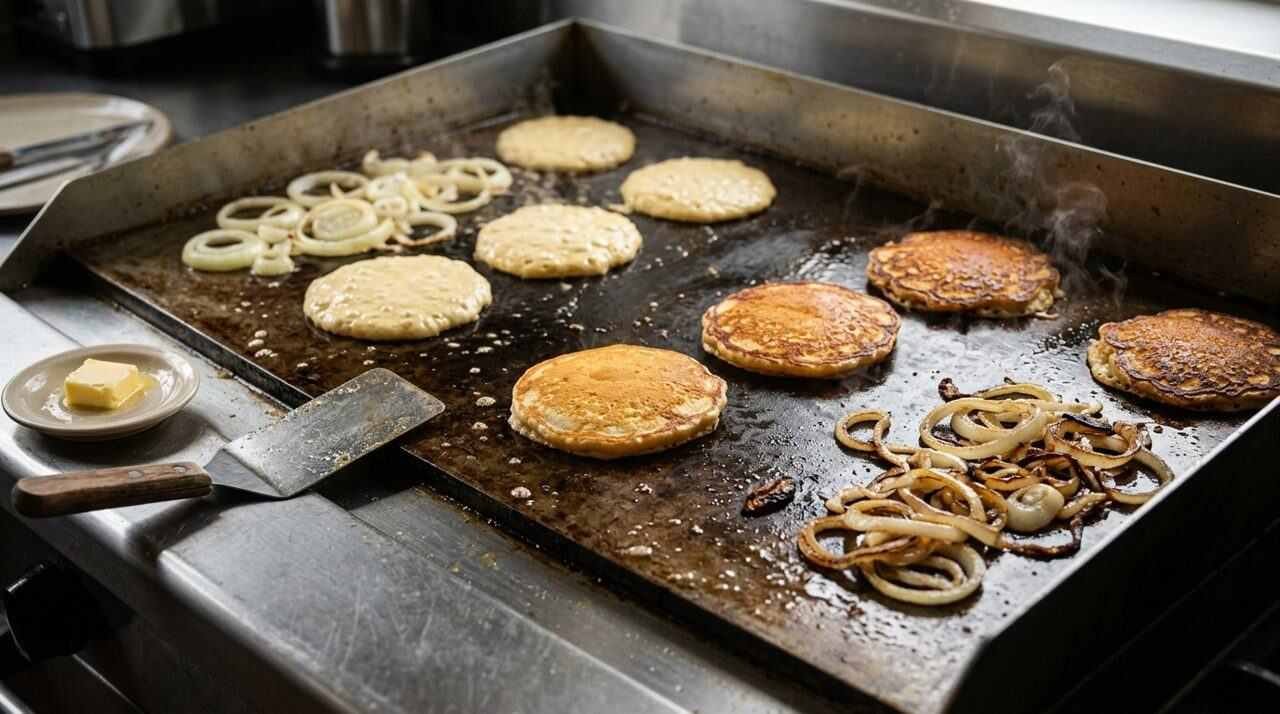
Cooks have found ways around the water problem. Modernist Cuisine notes that adding baking soda raises the pH, which helps the reaction along in pressure-cooked foods, and that Chinese cooks marinate meat or seafood in egg white or baking soda before stir-frying. The Maillard reaction entry gives the chemical reason alkalinity speeds things up: deprotonated amino groups become more nucleophilic, which is also why pretzels are dipped in lye. A flat-top cook rarely reaches for these tricks, since a steel plate at 375°F does most of the work on its own.
What the plate is made of
A commercial flat-top is mostly steel. According to the Wikipedia entry on griddles, most commercial griddles are made of A36 steel, though some use stainless steel or stainless-aluminum composites, and the plate surface may be cast iron, polished or cold-rolled steel, or chrome-finished. Commercial units commonly run 2 to 6 feet wide and 18 to 30 inches deep, and they cook breakfast foods, burgers, steak and chicken on the same plate.
The flat-top has an older relative. The flattop grill entry describes early versions made of clay in Mexico and Central America for cooking corn dough, and says that after the Spaniards arrived the griddles were made of metal and called plancha, meaning metal plate. It also says the steel seasons like cast iron into a naturally nonstick surface. The word griddle itself, according to the griddle entry, appears in 13th-century English and probably comes from Anglo-French gridil, tracing back to the Latin craticula, “small griddle.”
These entries are encyclopedic and lightly sourced, and the pages themselves carry some citation-needed tags, so the dates are best taken as outline rather than precise history.
A short history of the diner plate
The American diner traces its descent from the lunch wagon. A Journal of Antiques account says Walter Scott, a newspaper pressman, began selling food to overnight newspaper crews in the late 1850s and in 1872 started a horse-drawn lunch wagon in Providence, Rhode Island, which the article identifies as the diner’s starting point. Sam Jones opened the first lunch wagon that let customers stand inside, in Worcester, Massachusetts, in 1887, and Charles H. Palmer received the first patent for a lunch wagon design in 1891.
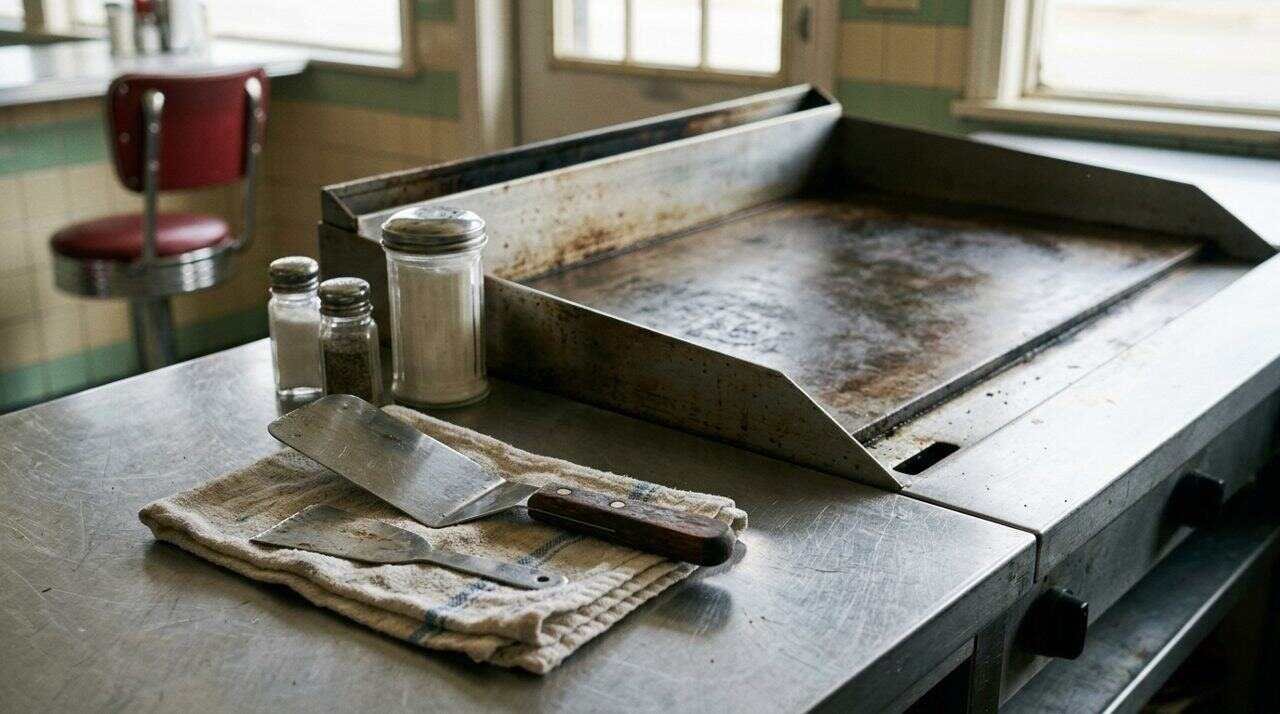
The Henry Ford museum’s collection on the rise of the diner dates the Worcester Lunch Car Company’s start to 1906 and notes that, by the mid-1920s, Worcester was building larger, fully outfitted diners. Its caption for a Connecticut diner of about 1939 says cooks prepared food to order, using grills, ovens, fryers and coffee urns in view of customers. That sentence matters for this story because it names the open, visible cooking that the flat-top made possible. The museum page does not mention a griddle, though, so the documented link here is to the grill and the counter, not to a particular plate.
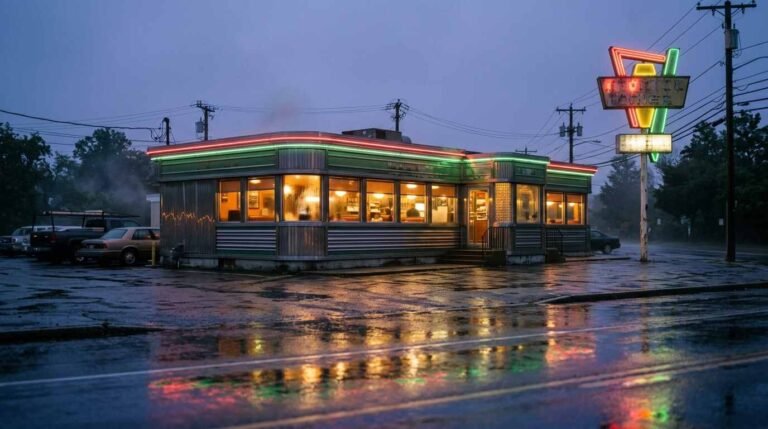
The same account has the buildings changing around the cooking. In 1913 Jerry O’Mahony, a bartender in Bayonne, New Jersey, began building larger, more permanent structures; during the 1920s lunch wagons became diners, a name modeled on Pullman dining cars and in use by 1924; and the 1930s brought streamlined designs with stainless steel, rounded corners and porthole windows. The cooks behind those counters worked in the open, with the customers watching, which is the setting where a visible brown crust became a selling point.
No fetched source dates the first steel flat-top in a diner or names who introduced it, so that origin is left open rather than guessed at.
Reading a crust
A good crust on a flat-top carries evidence of all of this. A deep brown with no black means the surface got past boiling but stayed under pyrolysis. Pale patches where the steak sat in its own juices mean the surface never dried. A crust that tastes bitter points to a plate hotter than the food could handle, or food left too long on it.
One note on the old juices story: if searing does not seal anything in, as the searing entry reports, the crust is there for flavor, and that is reason enough to spend two minutes a side getting it.
At home, an infrared thermometer pointed at the pan is the cheapest way to see the plate temperature before the food goes on, and a cast-iron skillet or a griddle pan over high heat does a fair imitation of the diner’s steel.
Sources
- NPR (via KUNC): 100 Years Ago, Maillard Taught Us Why Our Food Tastes Better Cooked
- Modernist Cuisine: The Maillard Reaction
- Wikipedia: Maillard reaction
- Wikipedia: Searing
- Wikipedia: Griddle
- Wikipedia: Flattop grill
- Mantripping: Perfect Smashburger Technique and Science
- Current Backyard: The Science of the Smashburger
- The Henry Ford: Rise of the Diner, Lunch Wagons Pull Off the Road
- Journal of Antiques: Johnson & Wales Culinary Museum, Greasin’ Up the Griddle
- Heritage Diner: The Diner Fried Egg