 275 Route 25A, Mt Sinai, NY 11766

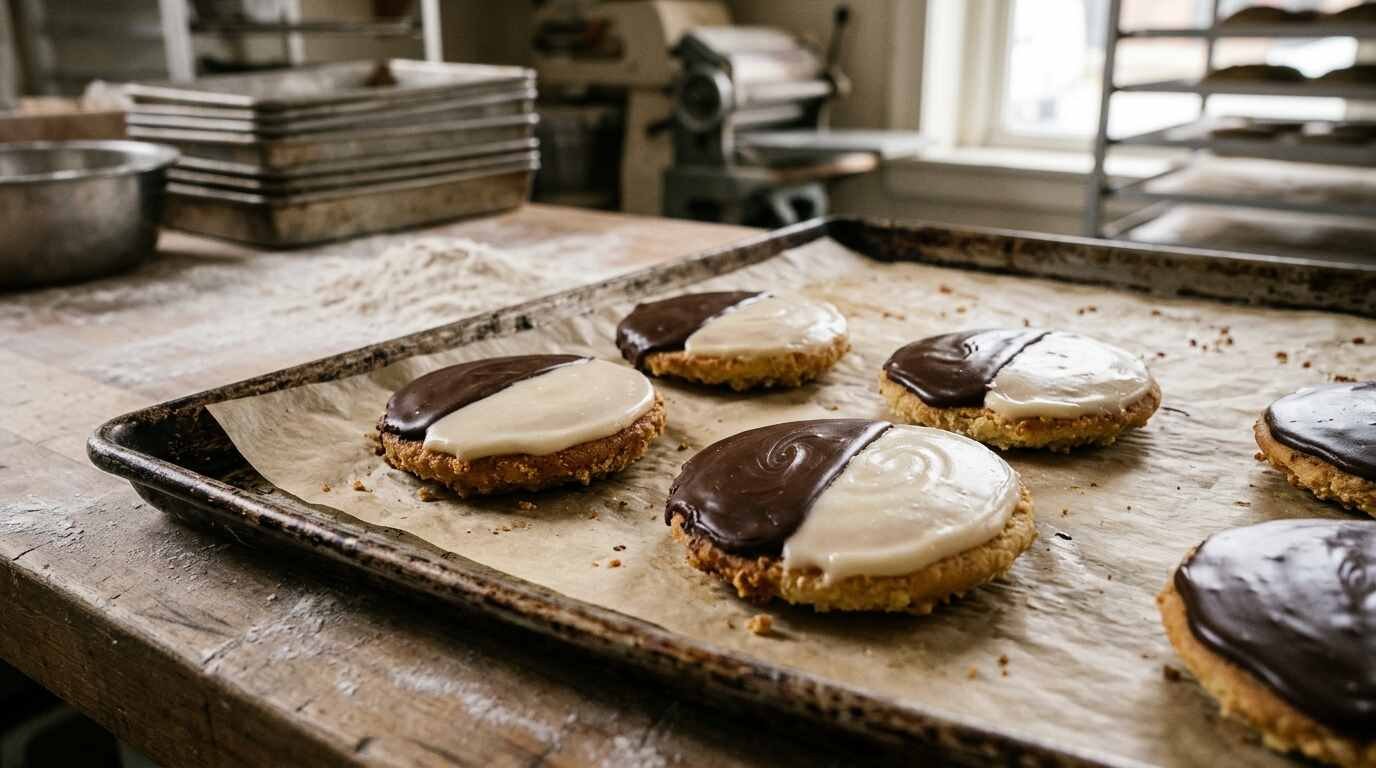
Half vanilla, half chocolate, and technically a cake: the New York bakery staple has two origin stories that do not quite meet.
The black-and-white cookie sits in bakery windows across New York in two flavors of icing and one flavor of argument. Where it started is disputed, whether it is a cookie at all is debated by the writers who cover it, and the version that turns up in Upstate New York is not the same cookie.
Glaser’s, Yorkville, 1902
The most common origin points to Glaser’s Bake Shop. Untapped New York writes that the cookie is believed to have been created at Glaser’s, opened by Bavarian immigrants John and Justine Glaser in Manhattan’s Yorkville neighborhood, and that the bakery closed in 2018 after 116 years.
The Nibble is more cautious. It says a third-generation baker reported that Glaser’s had made black-and-white cookies since the bakery opened in 1902, and calls the bakery “credited with popularizing (if not inventing)” the cookie. The earliest printed reference the article found is that baker’s own testimony, cited to a 1998 New York Times article. The bakery closed on July 1, 2018, when third-generation baker Herb Glaser retired.
So the 1902 date rests on family recollection reported in print nearly a century later. It could be exactly right. It is not a contemporary record.
Utica and the half-moon
Upstate New York has its own version. Untapped writes that many people believe the cookie began as a “half-moon” sold at Hemstrought’s Bakery in Utica, starting in the early 20th century; the original bakery has closed, but the company still sells half-moons. The Nibble reports that Hemstrought’s started baking half-moons around 1925, the first print reference to a half-moon cookie it found.
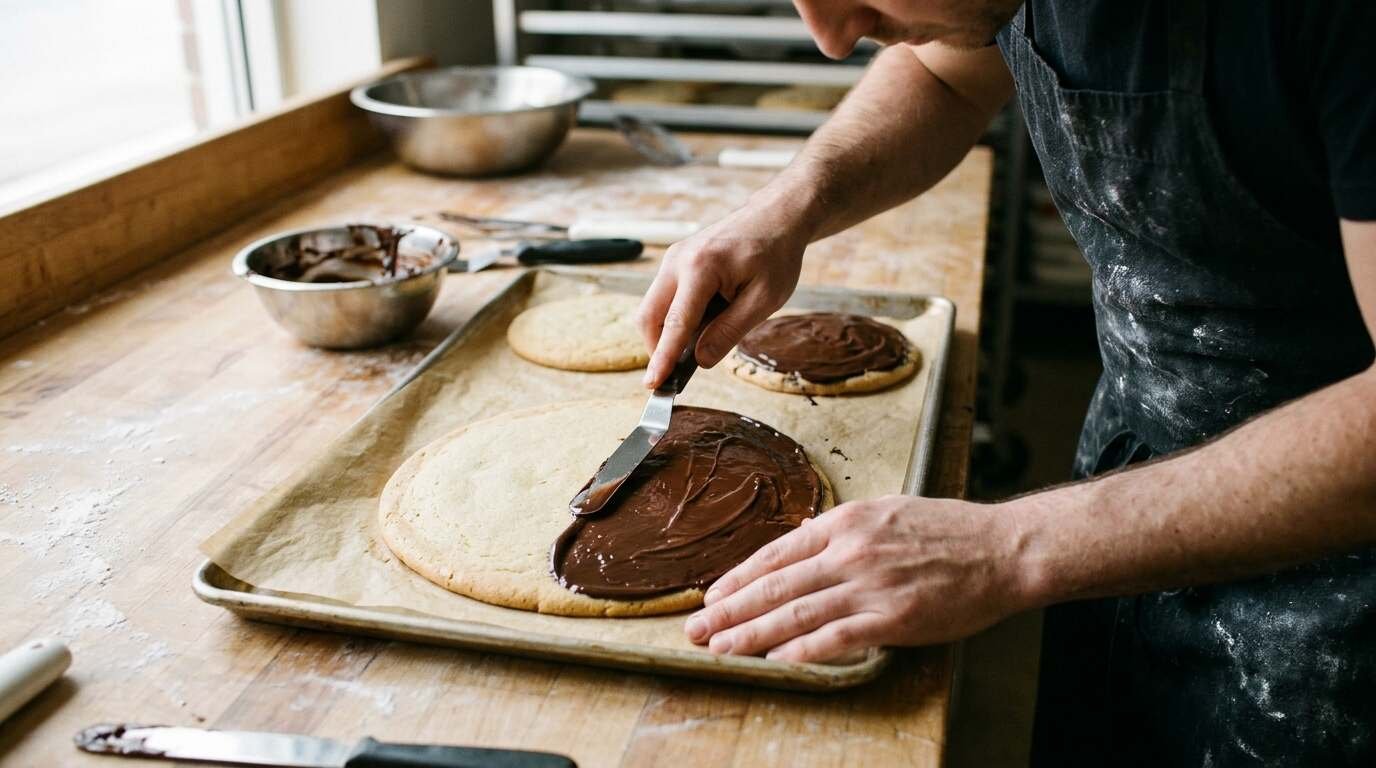
Barry Popik’s entry on the Utica half-moon gives a different date: Hemstrought’s was started by Harry B. Hemstrought in 1920. That 1920 date is for the bakery, not necessarily for the first half-moon.
CBS New York adds a folk lineage. In its account, the Utica half-moon resembled an old Dutch recipe that street carts sold in the city in the early 1900s, and Hemstrought’s Bakery was its well-known home in the 1920s. The same article ties the cookie-cake to European traditions, including medieval roots and a nod to the lunar cycle, and describes the typical half-moon as a chocolate cake base under thick buttercream, chocolate on one side and vanilla on the other. A local baker quoted by Spectrum News offers a contrary view: Utica is known as the origin, she says, but the cookies started in New York City.
Two cookies, not one
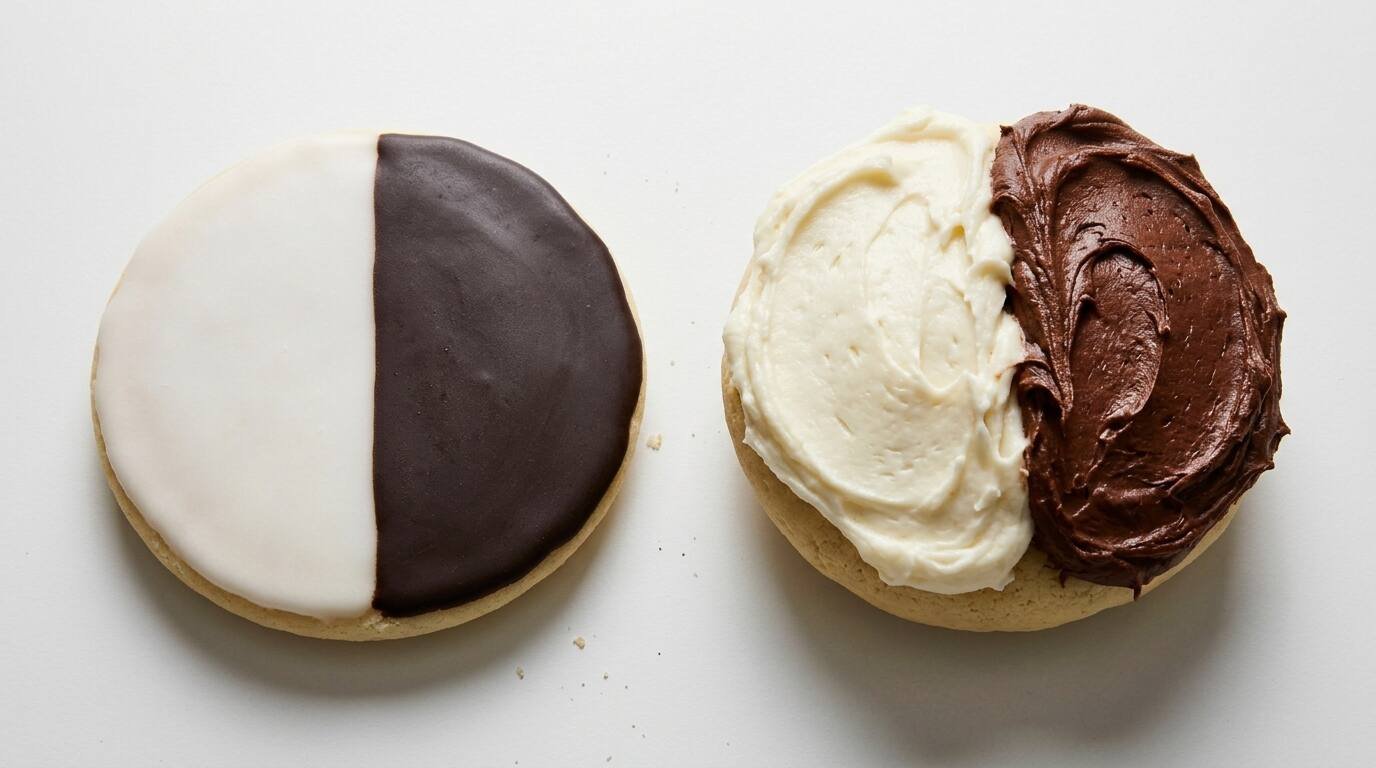
The two cookies are not the same. Per Untapped, black-and-whites are flatter, with a shortbread base and fondant icing, while half-moons are domed, with a cake base and frosting. The Nibble adds that Upstate half-moons usually carry fluffy frosting rather than smooth fondant. Popik’s entry says the typical New York City and Long Island black-and-white has a vanilla cake base with fudge and white icing, so the shortbread description is not universal. He also notes that Hemstrought’s made a vanilla cake base as well as the traditional devil’s food, along with full vanilla and coconut moons.
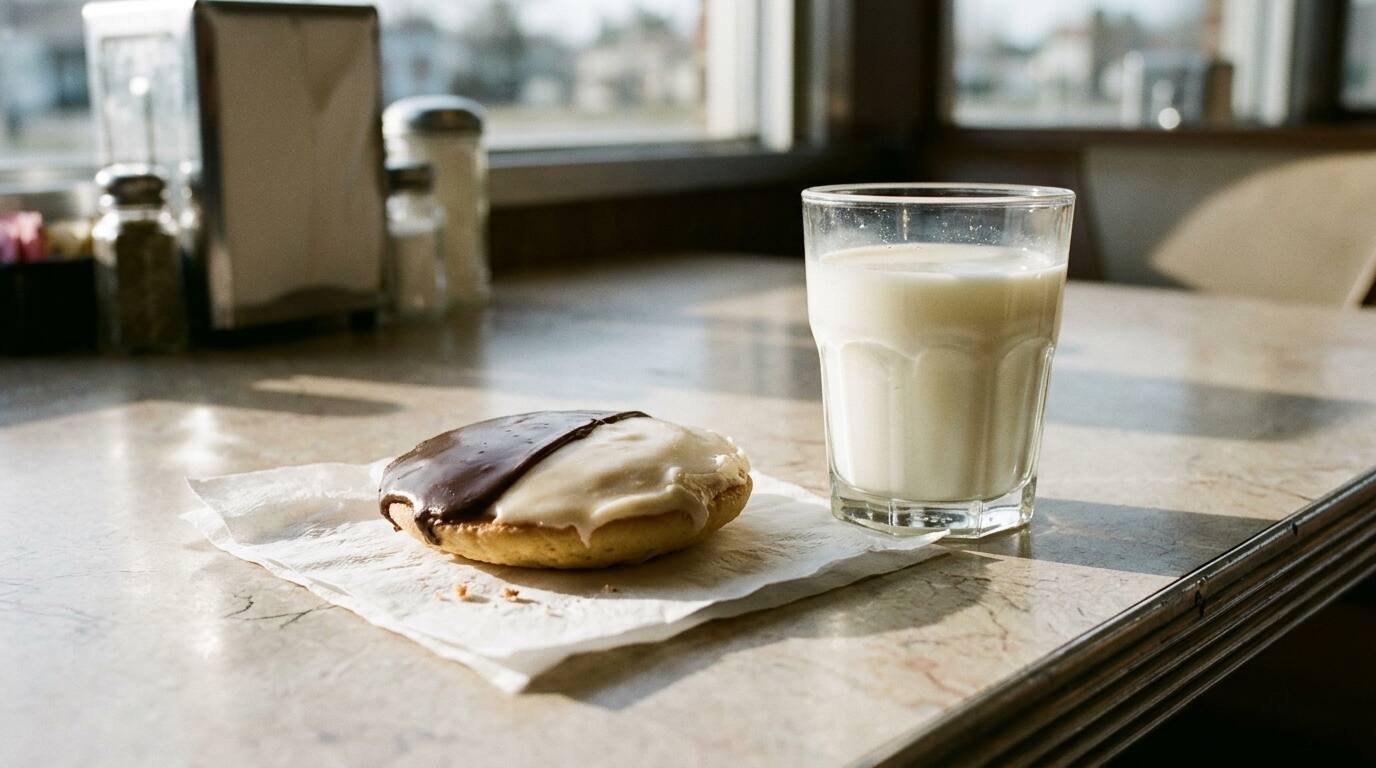
CBS New York is blunt about the split. It says calling New York City’s black-and-whites half-moons is erroneous, and that the two are not synonymous in taste, texture or history. The bakeries it names as places to find the cookie, in the city and upstate, are Gingerbread Bake Shop in New Hartford, Glaser’s, Leske’s Bakery in Brooklyn, Moishe’s Bake Shop in Manhattan and Parisi Bakery in Queens.
A cookie that is really a cake
Writers who cover the cookie return to its category. Untapped says the cookie is technically a cake. It quotes Molly O’Neill calling black-and-whites “broken promises,” floury cakes baked in a cookie style, and William Grimes calling them drop cakes, with batter much like cupcake batter plus a little extra flour.
That puts the shortbread description and the cake description at odds, and both circulate.
The commercial-invention theory
A third account drops the bakery legends altogether. Vice interviewed Stephen Schmidt, a member of the Experts Bureau of the Culinary Historians of New York. Large, soft, cake-like cookies were appearing around the same period, he said, and he does not buy the well-worn origin story. Schmidt calls it “fake-lore” and suspects the black-and-white was a commercial invention that capitalized on trends in the air, among them contrasting color schemes in period interiors. He credits its spread to its cheapness to make and a quick frosting turnaround of about ten minutes. “A fad is like an epidemic,” he told Vice, and the more people are interested, the more people become interested.
The Vice piece also records that Italian-American bakeries in the West Village of the 1950s made oversized versions.
The Forward notes that nobody quite knows why the cookie exploded in popularity, though by the mid-20th century it was everywhere. Leah Koenig, author of The Little Book of Jewish Sweets, tells the Forward that part of the appeal was its ubiquity in Jewish bakeries. The Forward also describes early half-moons as having a domed chocolate cake base with vanilla buttercream and fudge.
The German connection
Germany has a similar cookie. Per Untapped, after World War II American soldiers introduced a version to Germans, which likely inspired the name Amerikaner, though the name may also come from the shape of the Brodie helmets U.S. soldiers wore. Untapped cites Savoring Gotham for another theory, that it comes from the German word for ammonium bicarbonate, and calls that less plausible than simply needing to tell the American cookie from a German one.
The Dutch also come up. Untapped notes that “cookie” comes from the Dutch koekje, meaning little cake, and that Dutch settlers ate similar cakes such as gingerbread. Justin Rivers of Untapped New York argues the Dutch lacked the sugar for the icing, though an earlier forerunner may have existed.
Seinfeld and the unity cookie
The cookie entered pop culture in the “Dinner Party” episode of Seinfeld, where Jerry says “Look to the cookie!” as a reply on race relations, arguing that vanilla and chocolate mix well but racial harmony still eludes. In 2008, per the same Untapped article, Barack Obama nicknamed the cookies “Unity Cookies” on a visit to a Hollywood, Florida deli.
What the record leaves open
The record contains two bakeries, two cookies and one shared German root that is assumed rather than shown. Untapped says the link between Glaser’s and Hemstrought’s is unclear. Dates run from 1902 (a recollection) to 1920 and 1925 (bakery and cookie, in different sources). A cultural historian argues the whole story was a retail fashion. Whether the half-moon is the older form of the black-and-white, or a cousin that grew up in parallel, is not established by anything reviewed here.
Related diner reading: the counter stool and eating side by side and the American diner built to travel.
Sources
- Untapped New York, The Mysterious Origins of the Black and White Cookie: https://untappedcities.com/2020/01/23/the-mysterious-origins-of-the-black-and-white-cookie/
- The Nibble, Black And White Cookie History: https://blog.thenibble.com/2021/09/14/black-and-white-cookie-history-for-national-black-white-cookie-day/
- Barry Popik, Utica: Half-Moon (cookie): https://barrypopik.com/blog/utica_half_moon_cookie
- CBS New York, Iconic Food #7: Black & White Cookie: https://www.cbsnews.com/amp/newyork/news/iconic-food-7-black-white-cookie
- Spectrum News, Half Moon Cookies Make Their Mark in Utica: https://spectrumlocalnews.com/nys/watertown/explore-ny/2015/05/4/half-moon-cookies-make-their-mark-in-utica
- Vice, The Real History of Black and White Cookies: https://www.vice.com/en/article/the-real-history-of-black-and-white-cookies/
- The Forward, An ode to the black and white cookie: https://forward.com/food/474337/an-ode-to-the-black-and-white-cookie
- Eyewitness News ABC7NY, 116-year-old Glaser’s Bake Shop closes in July: https://www.youtube.com/watch?v=sUPv6pbsMZM
Leave a Reply