Malted milk began as a medical product. Its patent describes a food for infants and invalids, built around the idea that a baby without teeth cannot digest raw starch. The powder that now flavors chocolate malts at lunch counters took a few decades to reach the fountain, and the record of how it got there is thinner than the legend.
The record has gaps, and sources disagree on some dates. What follows sticks to what documents, museums and patents actually say, and flags the places where the story is told differently depending on who is telling it.
A Patent for a Baby Food
The brothers behind the product were James and William Horlick. The Wisconsin Historical Society says James was a London pharmacist who had ideas for an improved, wheat-and-malt-based supplement for infants, and who joined William in Racine, Wisconsin, when his prospects in England looked poor. William had been born on February 23, 1846, in Ruardean, Gloucestershire, and first came to the United States in 1869, according to the University of Wisconsin’s Wisconsin 101 profile.
The company dates differ between sources. One Wisconsin 101 page puts the founding of J & W Horlick Company in Chicago in 1873 and the move outside Racine in 1875. The Society’s biographical entry has the brothers in Chicago in 1873 and the firm in Racine in 1876. A second Wisconsin 101 profile, of William, says the brothers founded the firm in Chicago in 1875 and moved to Mount Pleasant, near Racine, in 1877. Different accounts, same neighborhood of years.
The patent is easier to pin down. U.S. Patent 278,967, titled “Granulated food for infants and process of preparing the same,” was filed by William Horlick of Racine on March 9, 1882, and granted on June 5, 1883. It calls the product a food for infants and invalids.
The Mash
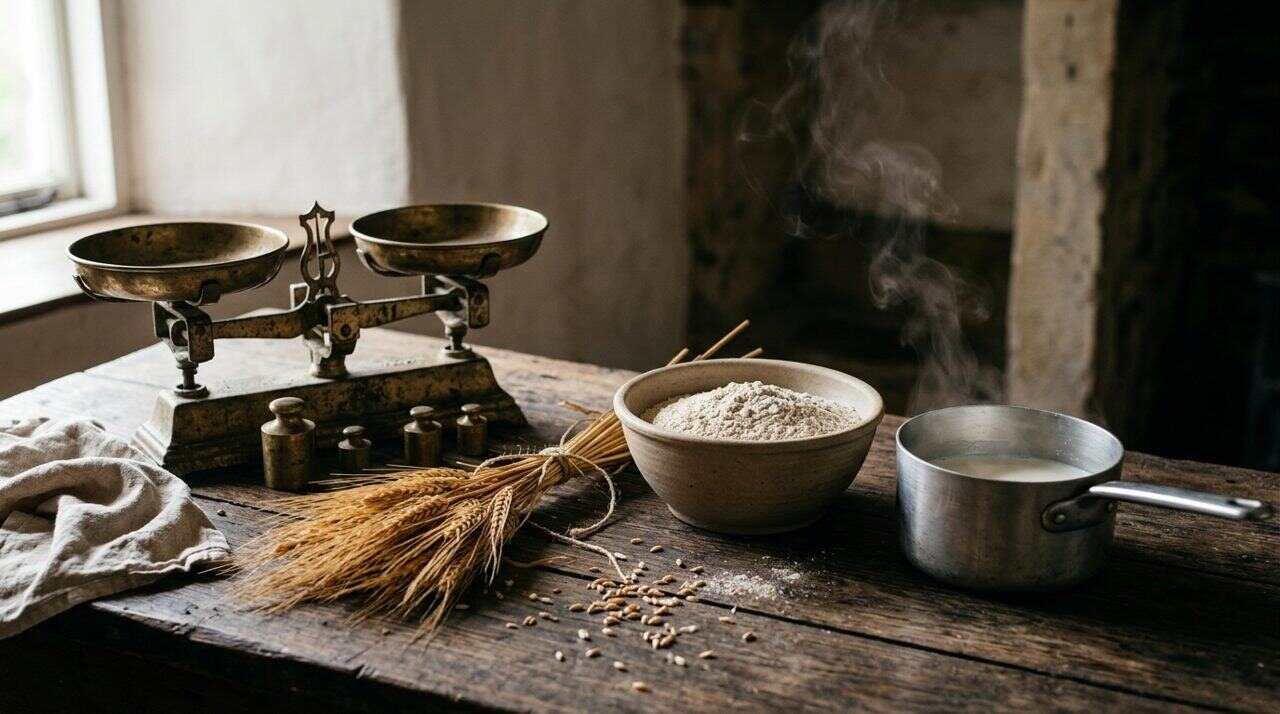
The process in the patent is brewing, more than baking. Equal parts of malted barley and ground wheat or oats are softened in fresh cow’s milk to make a loose mash. The mash is heated gradually to about 150 degrees Fahrenheit and held for roughly half an hour, which lets diastase from the malt turn starch into what the patent calls “dextrine and grape-sugar.” It is then raised to about 170 degrees for around 15 minutes, pressed in bags, strained, and dried in a vacuum pan into a powdered extract that dissolves in water.
The stated reasoning is that infants lack the saliva enzyme that breaks down starch, so malt diastase does that work in advance. Some popular accounts give 1897 as the year malted milk powder was invented, as Wikipedia’s milkshake entry does, but the patent record is more than a decade earlier. The product was sold as a digestive aid long before it was sold as flavor.

Naming It, and Losing the Name
According to Wikipedia’s malted milk entry, the product was first marketed as “Diastoid,” named for the diastatic enzymes, and the company trademarked the name “malted milk” in 1887. The Wisconsin Historical Society’s biography of William Horlick gives 1887 as the year he produced dried milk combined with an extract of malted barley and wheat, registered under the trademark “Malted Milk.”
A trademark on a common-sounding name did not hold. Culinary Lore’s history reports that Horlick’s patent expired in 1900, after which competitors such as Borden and Carnation entered the market. It also reports that a federal court ruled against Horlick in a case involving Elgin Milkine, reasoning that the term “malted milk” had appeared in the original patent, so the name and the formula were public. In 1913, Borden sued Horlick for unfair competition and false advertising, and the courts later dismissed that suit. Around 1917, when Horlick tried to renew its registration, the Patent Office canceled it after Borden intervened.
Culinary Lore adds a caution on the invention itself. It calls it “not at all clear” that Horlick was the first and true inventor, and says Borden alleged in 1913 that Horlick had copied the manufacturing process from a German chemist, a charge the article presents as an allegation rather than a finding. It also notes an earlier powdered milk product, sold around 1865, that mixed with cane sugar and powdered baked wheat. The name Horlick is attached to malted milk the way Ford is attached to the automobile: by scale, marketing and survival, more than by priority.
From the Sickroom to the Pole
The powder was light, did not spoil, and carried plenty of calories, and those three qualities moved it beyond the nursery. The Wisconsin Historical Society’s exhibit lists those reasons for its adoption on expeditions: Robert Peary, Roald Amundsen and Richard Byrd all used Horlick’s malted milk as part of their provisions, and William Horlick donated $30,000 to Byrd’s 1933 to 1934 expedition. A biplane flown in Antarctica was named William Horlick, per the exhibit’s expedition page.
The Antarctic link left a map trace. According to Wikipedia, Admiral Byrd named the Horlick Mountains after the Racine manufacturer, and the Society’s exhibit makes the same point. Wisconsin 101’s company history adds that malted milk tablets went along on Byrd’s second South Pole expedition, and a tin label notes the tablets as a standby in 1914 to 1918 and later. Lifeboat emergency rations from around 1945 are among the museum’s objects.
The advertising pitch followed the use. Horlick’s kept its nineteenth-century claim of being easily digested and added appeals to taste, energy, refreshment, relaxation and fun, as the Society’s exhibit describes. A product that had been medicine in the 1880s was being sold as a pleasure by the twentieth century.
The Drugstore Connection
Here the record turns thin on dates, and honesty about that is more useful than a neat story. Culinary Lore says malted milk was sold in drugstores as powder and tablets, marketed as a food for infants and invalids, and that its place beside pharmacy soda fountains put it in reach of soda jerks, who began making malted milkshakes. It gives no specific dates for this shift and warns that it is “often erroneously reported” that malted milk was invented for soda fountains.
The Wisconsin Historical Society’s exhibit confirms the outcome without giving a date: malted milk became a popular soda fountain drink, and Horlick’s then began adding chocolate to its malted milk products.
The Mixer Legend
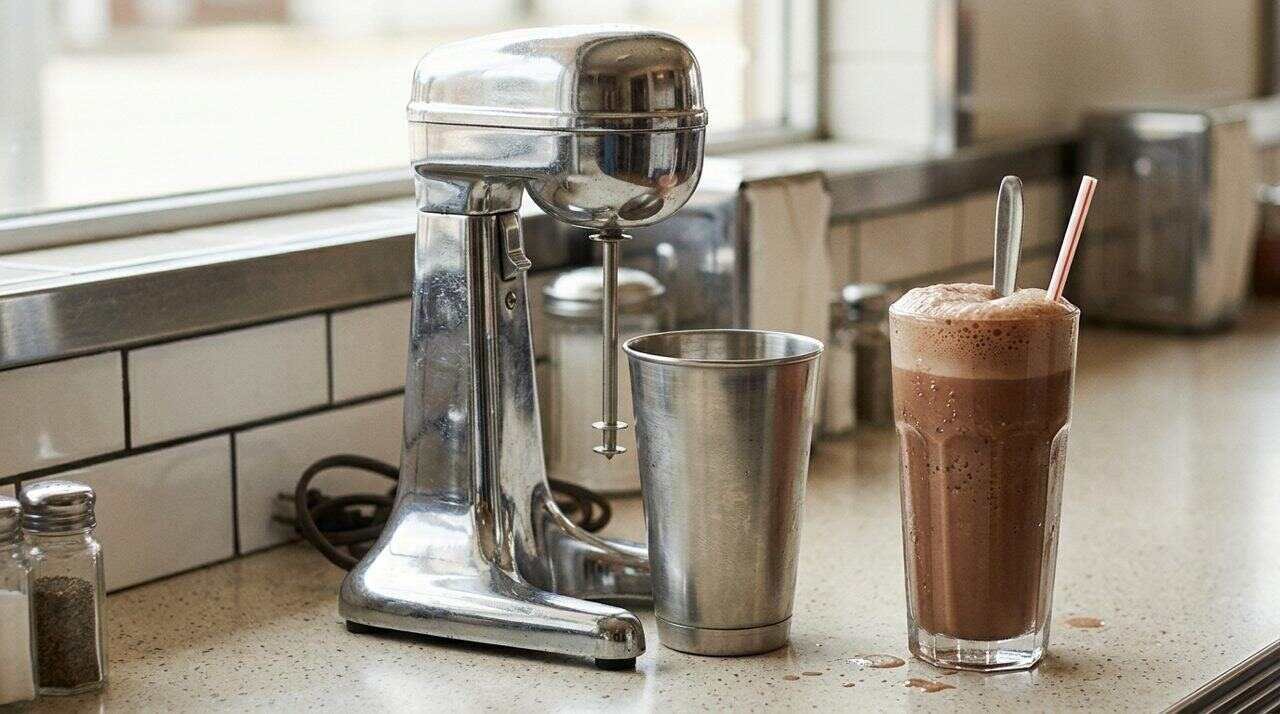
One often-told piece of this story concerns machinery. The Society’s exhibit says William Horlick reportedly asked the young Hamilton Beach Manufacturing Co. of Racine to adapt its small, fast motor for mixing malteds, producing what is said to be the first practical electric drink mixer, patented in 1911, and it presents that as legend rather than verified history. A Society article on a Wisconsin Electric Co. mixer repeats it with the same hedge, “according to legend.” The documented part is the patent: Frederick Osius filed in September 1910 and was issued U.S. Patent 1,005,653 on October 10, 1911, as Wikipedia’s milkshake machine entry records.
The Society also notes that the Wisconsin Electric mixer on display, made in Racine between 1921 and 1928, carries the word Horlick’s on its base. Whoever proposed the partnership, the two Racine businesses ended up sharing a counter.
The Ice Cream Step
Early milkshakes did not need ice cream. Barry Popik’s collected newspaper citations show the word milk shake in print in 1886, in a Macon, Georgia, soda-fountain ad and in Atlanta listings, and an 1885 first appearance for an eggnog-style drink with whiskey. By 1900, the term had come to mean wholesome drinks made with chocolate, strawberry or vanilla syrups.
The malted version with ice cream is attributed to Walgreens. Wikipedia’s Walgreens entry quotes the company line that in 1922 it introduced a malted milkshake, and credits employee Ivar Coulson with modifying the basic malted milk recipe by adding scoops of vanilla ice cream. Tasting Table puts it as Ivar “Pop” Coulson adding two scoops of vanilla ice cream to milk, with chocolate syrup and malted milk powder, at a Chicago Walgreens soda fountain in 1922, and says the chain didn’t invent the milkshake but did invent the malted one. That is a corporate and secondary-press attribution, though, and the Wikipedia entry itself notes that milkshakes and malted milk existed before 1922.
The source quoted for the price puts the shake at twenty cents, and says Walgreens became the place to hang out.
From Fountain to Factory
Once the format was set, the equipment scaled. Earl Prince’s Multimixer, per the Shaw Local history of Prince Castle, was developed to keep up with demand for his chain’s thick malts. Its later five-spindle form came from wartime manufacturing limits. The story goes that Ray Kroc, then selling paper cups, became fascinated with the machine and sold Multimixers to a California restaurant chain run by the McDonald family, which led to a McDonald’s in Des Plaines in 1955. That is the article’s account, and it describes the Multimixer as the seed for McDonald’s.
The Horlick plant in Racine closed in 1975 after nearly 90 years, when its parent company, GlaxoSmithKline, shut it down, according to Wisconsin 101’s company history. The Society holds a Horlick’s 25-pound malted milk canister from 1969 to 1975. Malted milk powder is still sold in drugstores and grocery stores, though the brand names on the shelf have changed, and abroad Horlicks is often sold as a sleep aid.
The Wisconsin Historical Society’s online exhibit is free to read, and it lists museum object numbers, such as #1982.33 for the 25-pound canister, for anyone who wants to ask the museum about a specific piece.
Sources
- That’s Meat and Drink To Me: Wisconsin’s Malted Milk Story, Wisconsin Historical Society
- Wisconsin’s Malted Milk Story (soda fountain and mixer page), Wisconsin Historical Society
- Wisconsin’s Malted Milk Story (expeditions page), Wisconsin Historical Society
- William Horlick, Wisconsin Historical Society
- Wisconsin Electric Co. mixer, Wisconsin Historical Society
- The Father of Malted Milk, Wisconsin 101
- Horlick’s Malted Milk Company, Wisconsin 101
- US Patent 278,967, Granulated food for infants and process of preparing the same
- Malted milk, Wikipedia
- What is Malted Milk? History, Culinary Lore
- The First Milkshake Was Blended At A Walgreens Pharmacy, Tasting Table
- Walgreens, Wikipedia
- Milk Shake (Milkshake), Barry Popik
- Milkshake machine, Wikipedia
- Milkshake, Wikipedia
- Sterling royalty (Prince Castle and the Multimixer), Shaw Local