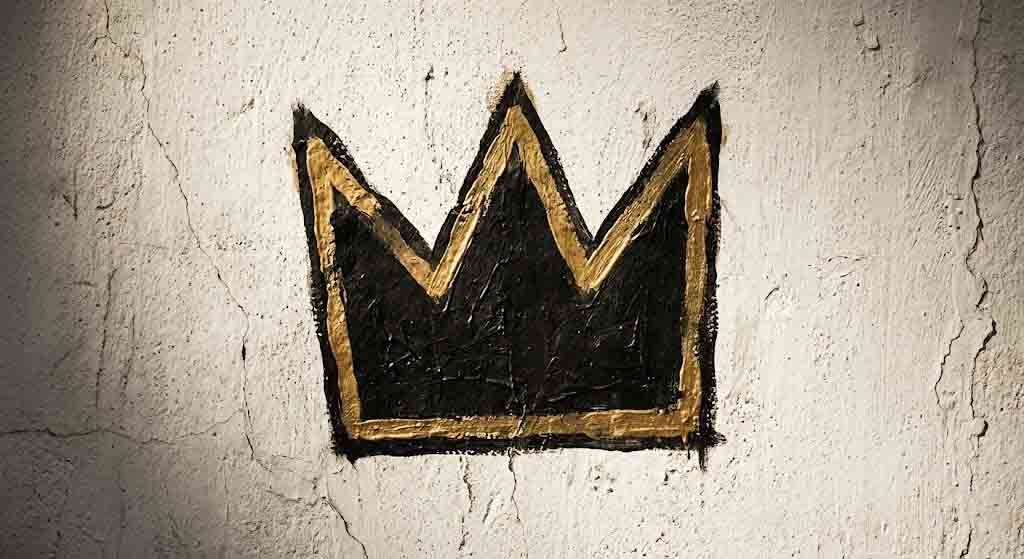
Every art student knows the crown. Three points. Loose, almost careless brushwork. Repeated across hundreds of canvases. Nobody seems to know why it mattered.
The critics who showed up after Basquiat died thought they knew. They called it a symbol of royalty, a challenge to Western authority, a postcolonial statement, a primitive mark that showed the influence of African ritual. They weren’t entirely wrong. But they were answering a question that wasn’t the one Basquiat was asking. They were looking at the crown from the outside. Jean-Michel was making it from the inside — from the street, from Brooklyn, from the skin of a kid who grew up Haitian-Puerto Rican in a city that didn’t know his name and didn’t plan to learn it.
What the Street Already Knew
Before the crown showed up on canvas at Mary Boone Gallery, it lived on walls. Basquiat made his name — literally — as part of the duo SAMO, leaving cryptic tags across Lower Manhattan in the late 1970s. SAMO wasn’t decorating the city. It was claiming it. The tag said: I exist. I was here. You walked past this wall a hundred times and didn’t see me, but I was here.
That is what the crown does. It doesn’t ask permission. It declares.
In street code, the crown wasn’t invented by Basquiat. Graffiti writers across New York were using it before he ever picked up a spray can. In that context, the crown means you’re the king of your name — king of your wall, king of your block, king of the space your tag occupies. It’s territorial and it’s hierarchical and it’s also profoundly democratic in a specific way: anybody can declare themselves king. All it costs is the nerve to do it and the paint to make it stick.
Basquiat understood that code completely. He grew up in the Boerum Hill neighborhood of Brooklyn, educated and multilingual and broke, the son of a Haitian accountant father and a Puerto Rican mother who introduced him to art museums when he was still small enough to be lifted. He got hit by a car at seven years old. His mother brought him a copy of Gray’s Anatomy while he recovered, and he memorized it. He taught himself. He read everything. He drew everything. And when he eventually hit the streets of Manhattan, he hit them with the specific fury of someone who has been both educated and excluded — a combination that tends to produce either bitterness or genius.
With Basquiat, it produced both. The crown was the mark of a man carrying both things at once.
The Egyptian Thread
Here is the piece that most critics gesture at without landing on properly: Basquiat’s crown is not simply a reference to Western monarchy. The three-point structure — the deliberate archaism, the way it refuses the refined silhouette of a European crown — connects more directly to Egyptian iconography than to anything from the House of Windsor.
The atef crown of Osiris, god of the dead and the afterlife, features a tall central point flanked by two ostrich feathers. The pschent, the double crown of unified Egypt, combines the red crown of Lower Egypt with the white crown of Upper Egypt in a stacked formation. Egyptian rulers were divine — the crown didn’t just mark political authority, it marked a person’s status as mediator between worlds, between the living and the dead, between the human and the divine.
Basquiat knew this. He was reading African history, studying ancient civilizations, and pulling that knowledge directly into his work at a moment when Black American artists were largely excluded from the gallery world that dominated New York. The crown in his work is not a metaphor for wanting what white culture had. It is a refusal of that entire frame. He was reaching past European art history to something older, something that predated the hierarchy of Western museums, something that didn’t need a white curator’s permission to be legitimate.
In his 1982 painting Untitled (Crown), the crown floats over a black ground, isolated, uncontextualized, daring you to decide what it means. It’s not adorning anyone. It’s not sitting on anyone’s head. It just exists, sovereign and untethered, which is exactly the point.

The Copyright Symbol and the Anti-Theft Logic
One of the things Basquiat did obsessively was write the copyright symbol — © — next to words, images, and names he wanted to expose as owned. He used it sarcastically, the way a man who’s had things stolen from him uses the law that failed to protect him. The crown operates on the same logic, but in reverse.
The copyright symbol marks what they’ve already taken. The crown marks what can’t be taken.
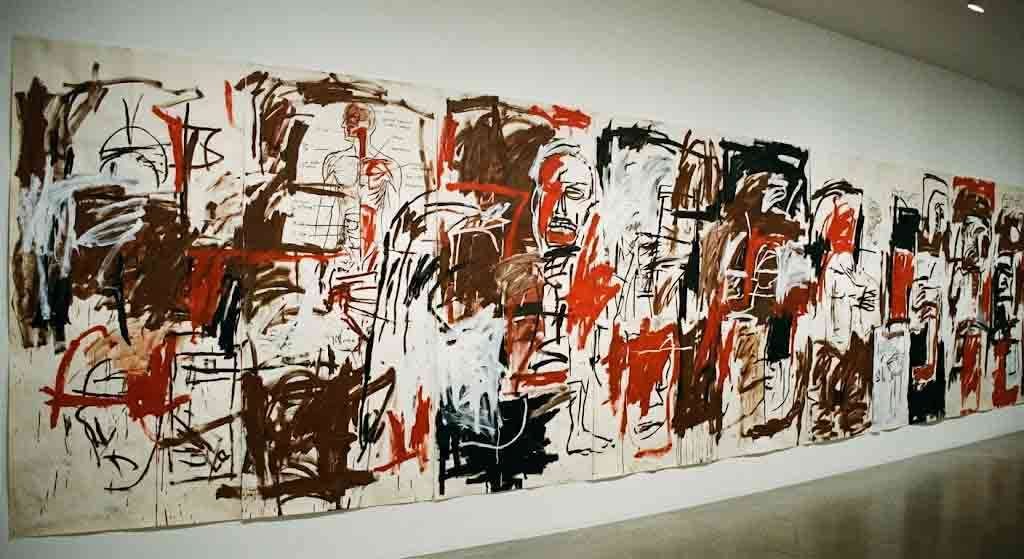
When Basquiat paints a crown over the word NEGRO, or over the face of a boxer, or over the anatomical diagrams he borrowed from Gray’s Anatomy, he’s performing a specific act of protection. He’s saying: this thing you’ve diminished, degraded, or disappeared — I’m putting it under new authority. My authority. An authority that doesn’t answer to the institutions that dismissed it.
This is not protest art in the conventional sense. Protest art accepts the terms of the debate. It stands outside the gate and asks to be let in. Basquiat was not asking. He walked into the gallery world and repainted the walls while the collectors watched, and they paid him enormous sums of money for the privilege of watching him do it, and he still died at twenty-seven, in 1988, of a heroin overdose, and the market for his work exploded immediately after his death in the way markets always do when the artist is no longer around to complicate the story.
The crown outlived him. It’s on T-shirts now. It’s on the cover of every retrospective catalog. The irony would not be lost on him.
What the Crown Said to Other Artists
Basquiat wasn’t working alone. He came up in a world — the early 1980s downtown Manhattan scene — where artists like Keith Haring were also drawing from street traditions and making work that looked nothing like the abstraction and minimalism the art establishment had spent decades canonizing. The two were friends. But their projects were different in a way that the crown illuminates clearly.
Haring’s marks were universal — the radiant baby, the barking dog, the dancing figures — designed to be readable by anyone anywhere. They came from street language but translated into something deliberately borderless. Basquiat’s marks were specific. The crown is not a universal symbol of aspiration. It is a very particular claim made by a particular kind of person about a particular kind of power. The art world wanted to absorb it into universality — he was making a statement about all of us — and Basquiat spent his entire brief career resisting that absorption.
He said it clearly in the few interviews he gave. He was not making art about the Black experience in some abstracted, palatably academic way. He was making art from inside his own head, which happened to be the head of a young Black man from Brooklyn who had read too much to be fooled and had seen too much to be polite about it. The crown is the signature of that particular consciousness. It doesn’t travel without its owner.
The Diner and the Canvas
I’ve stood in front of Basquiat’s work at MoMA and at the Broad in Los Angeles, and what strikes me every time is how physical it is. This is not art you look at from across the room and appreciate. You feel it — the pressure of it, the density of it, the sense of something being forced through the surface from the other side. My parents came from Greece with nothing and built a life working in restaurants because that was the ground they stood on. That kind of energy — the force of someone who knows the system isn’t built for them and decides to build something anyway — I recognize it without needing to explain it.
The crown is that decision made visible. Three points. Loose brushwork. Repeated across hundreds of canvases because once was not enough.
It never is.
Why the Symbol Holds
Thirty-eight years after his death, Basquiat’s work commands auction prices that would have seemed like fiction to the kid who was sleeping in cardboard boxes in Tompkins Square Park while SAMO was making the walls of SoHo speak. The crown is now the most recognized symbol associated with any American artist of his generation. More recognized than a Haring dog or a Warhol soup can, because it carries something the others don’t: it carries grievance and beauty at the same time, and those two things are very hard to hold in one mark without one canceling the other.
He held them. Every time.
The crown didn’t mean he was the greatest. It meant he refused to be invisible. Those are different claims, and Basquiat was too smart to confuse them. He put it on boxers and jazz musicians and African kings and unnamed figures who looked like they’d been walked over by the same system that had walked over him. He put it on the dead as often as the living. He put it on himself, in self-portraits that are among the most psychologically raw works in the American canon, because if the crown meant anything at all, it had to mean something even when you were the one wearing it.
Especially then.
For more on the tension between art and power in the Western tradition, my piece on Rembrandt’s Aristotle with a Bust of Homer gets at something related — the portrait as a site of contested authority. And Jacques-Louis David’s The Death of Socrates is worth reading alongside Basquiat: two artists, two centuries apart, both making work about what it costs to refuse the terms the powerful have set.
Sources
- Hoban, Phoebe. Basquiat: A Quick Killing in Art. Penguin Books, 1998. penguinrandomhouse.com
- MoMA Collection Notes: Jean-Michel Basquiat. moma.org
- Brooklyn Museum Basquiat Archive. brooklynmuseum.org
- Thompson, Robert Farris. Flash of the Spirit. Vintage, 1983. penguinrandomhouse.com
- “Jean-Michel Basquiat: Now’s the Time.” Retrospective catalog, Art Gallery of Ontario, 2015.