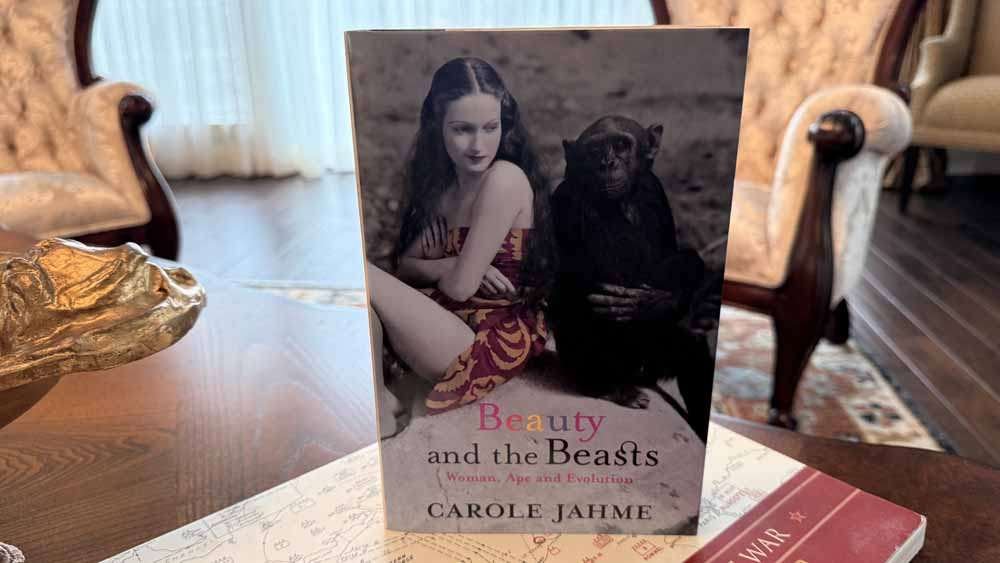
Somebody had to do it. Science needed people willing to sit in the rain for years, watching chimpanzees sort out their politics, and report back without flinching. The answer, it turned out, was mostly women. Carole Jahme’s Beauty and the Beasts: Woman, Ape and Evolution asks why — and the answer opens into something much harder to look at than a rain-soaked chimp.
The book’s organizing question is simple enough: why do women dominate a field built around studying our closest relatives? By 1999, 62 percent of primatologists listed in the World Directory of Primatology were women. Jahme — a primatologist, documentary filmmaker, and Fellow of the Royal Society of Arts — profiles the women who built this discipline, from Jane Goodall and Dian Fossey to lesser-known figures like Jeanne Altmann and Barbara Smuts, and she puts that statistic in front of you and asks what it means. But as you move through this book, the gender question stops being the most interesting one. What becomes harder to ignore is what these women were actually watching — and what it forces us to say about ourselves.
What Louis Leakey Understood
The origin story here is Louis Leakey, the paleoanthropologist who sent three women — Goodall to Gombe, Fossey to Rwanda, Biruté Galdikas to Borneo — into the field to study chimps, gorillas, and orangutans respectively. They became known as Leakey’s Trimates. His reasoning, as Jahme tells it, was that women were more patient, less threatening to wild animals, and more likely to stay. Men, in the prevailing academic pattern of the era, would gather data, write papers, and move on. Women, Leakey suspected, would become embedded.
He was right, and the reasons why cut deeper than personal temperament. Jahme argues that women form genuine emotional bonds with their subjects — bonds that male-dominated science had spent decades treating as methodological weakness. The charge leveled at female primatologists, consistently and explicitly, was that they were too close. Too attached. That their science was contaminated by empathy. But the data they produced — the observations of tool use, coalition-building, infanticide, mourning, and complex social manipulation — turned out to be the most accurate science in the field. The closer you looked, the more you saw. Keeping your distance, it turned out, was keeping you ignorant.
That argument — about proximity and knowledge, about the costs of clinical detachment — runs through the whole book. And it’s worth sitting with, because it is not what mainstream science still celebrates.
What the Apes Were Actually Doing
Here is where Jahme’s book gets difficult to read in the comfortable way you might expect a nature book to be read. When the female primatologists finally got close enough, what they observed wasn’t the noble, peaceful primate world that the pre-Goodall scientific imaginary had assumed. It was messier. More recognizable.
Chimpanzees conduct organized raids on neighboring groups. They kill each other. Males form political alliances with calculated precision, shifting allegiances based on power dynamics that would read coherently in Machiavelli. Infanticide is practiced — by males seeking to bring females back into estrus, by females eliminating rivals’ offspring. Goodall watched and documented chimps at Gombe engaging in what she described in her own writing as a systematic four-year campaign of lethal violence — what researchers came to call the Gombe Chimpanzee War. She has described it as one of the most disturbing things she ever witnessed, not because it was alien, but because it wasn’t.
Jahme doesn’t shy away from this. She covers the bonobo counterpoint, too — the female-bonded, highly sexualized, conflict-defusing species that became something of a political football in 1990s popular science, with commentators lining up to claim chimps or bonobos as the “real” model for human nature, depending on the argument they wanted to make. Bonobos resolve tension with sex. Chimps resolve it with violence. Humans, of course, are capable of both — which is the point the book keeps circling without ever quite landing on directly, but that a careful reader can’t miss.
We share roughly 98 percent of our DNA with chimpanzees. That fact appears in almost every popular science piece about primatology and almost always gets deployed to make us feel elevated — look how close we are to something so remarkable. What Jahme’s book does, quietly and methodically, is flip that proximity around. If 98 percent of our DNA is shared with an animal that commits infanticide, wages war, builds political coalitions, and practices deception — then what exactly are we saying about the 2 percent? What work do we think that tiny fraction is doing?
The Observer Changes the Observed
One of the stranger threads in Beauty and the Beasts is how the sustained intimacy between these women and their subjects bent both parties. Dian Fossey’s story is the most extreme — her devotion to the mountain gorillas of Rwanda became indistinguishable, by the end, from what the book describes as an obsessive identification with them. She was murdered in 1985, almost certainly for her anti-poaching activities, in a story that still hasn’t been fully resolved. But Fossey’s arc isn’t simply a cautionary tale about going too far. It’s also evidence of how transformative genuine proximity can be when you stop treating your subject as an object of study.
Jahme writes about researchers who began structuring their own social behavior around what they’d observed in the field. There is the famous anecdote she recounts about a primatologist whose menstrual cycle fell into sync with the bonobo she’d spent years studying. Whether you read that as charming or unsettling depends on what you believe the boundary between observer and observed should be. Science says there is a wall. These women kept finding that the wall wasn’t there.
The Science They Had to Fight For
What doesn’t get discussed enough in popular accounts of this history is the institutional resistance these women faced. Their methodology was criticized as anecdotal. Their emotional investment was treated as disqualifying. Jane Goodall, who had no formal academic training when Leakey sent her to Gombe, was told by the Cambridge academic establishment that her practice of giving the chimpanzees names rather than numbers was scientifically impermissible. The objection was that naming implied emotional individuation — which implied that the subjects had individual personalities — which was precisely the conclusion the establishment didn’t want to reach.
Goodall held her position. The chimpanzees had names. They also, it turned out, had personalities, long-term memories, politics, and the capacity for something that looked, when you were close enough to see it clearly, like grief.
Publishers Weekly, reviewing the book on release, noted that Jahme “not only knows her science, but has a real knack for making it comprehensible to the uninitiated.” That’s accurate but undersells what she’s doing. The science is accessible, yes. But the argument beneath it is sharper than that — it’s a sustained case for the validity of knowledge that comes from proximity, duration, and relationship rather than from experimental distance. The women in this book weren’t doing science wrong. They were doing science that the prevailing model wasn’t equipped to recognize.
The Captive Mirror
Jahme also covers the lives of apes removed from the wild — those in American Sign Language research programs, entertainment, laboratories, and zoos. The ASL experiments are among the most philosophically disorienting passages in the book. Apes taught to communicate through sign language did something that researchers hadn’t anticipated: they used the signs to lie. They signed about things that weren’t happening, about intentions they didn’t have. One chimp, Washoe, who had been taught ASL from infancy, began teaching signs to her own infant spontaneously, without prompting from researchers.
When an ape uses language to deceive, the question of what separates us from them becomes genuinely uncomfortable. The Extended Phenotype — Dawkins’ argument that genetic influence extends beyond the body into behavior and constructed environment — starts to look very relevant when you watch a chimpanzee build a political alliance or lie to a researcher with borrowed language. We are not the only animals whose behavior reaches beyond the immediate and the instinctual.
Jahme reports the detail that captive apes, given television access, tend to watch it heavily. Their favorite film, cited in the book, is Quest for Fire — the 1981 drama about early humans competing for control of fire. There’s a joke in there somewhere about identification and self-recognition, and Jahme lets it sit without explaining it. That’s the right call.
What the Mirror Is Actually Showing
The discomfort at the center of Beauty and the Beasts is never stated outright, which is probably why the book works as well as it does. Jahme doesn’t close it down into a thesis. She profiles people, describes fieldwork, traces careers, and lets the cumulative weight of what these women found do the philosophical work.
But the weight is real. Primatology didn’t show us a nature divorced from culture — it showed us that the behaviors we consider most distinctly human (political manipulation, coalition-building, violence toward outgroups, mourning the dead, lying, teaching language to our children) are not inventions of civilization. They are very old. They were here before us. They will not be reasoned away.
The question that Jahme leaves the reader with — without asking it directly — is what we do with that. The women who spent their lives in the jungle watching apes came back changed. The science they brought back changed us, too, whether we’ve absorbed it or not. As with Darwin’s own devastating clarity about what patient observation of nature actually reveals, the hardest part isn’t the data. The hardest part is what you do once you’ve seen it clearly and can no longer look away.
Beauty and the Beasts is, on its surface, a book about women in science. Beneath that, it’s a book about what science found when it finally got close enough to look. The findings are not comfortable. They are, however, essential.
Sources
- Carole Jahme, Beauty and the Beasts: Woman, Ape and Evolution (Soho Press, 2001): Amazon
- Carole Jahme, Wikipedia biography: Wikipedia
- Publishers Weekly review: Publishers Weekly
- American Library Association review: via Amazon
- World of Books description and THES review quote: World of Books