Forget the documentary. Forget the GoFundMe. Forget the news cycle that descended on the Bendix Diner in January 2025 when the borough of Hasbrouck Heights taped the doors shut and stuck an “UNSATISFACTORY” sign on the cash register. Strip all of that away — the sentiment, the outrage, the viral TikToks, the celebrity diner enthusiasts weighing in — and what you’re left with is a simpler, harder thing: a blind man running a short-order kitchen on a traffic island between two lanes of one of the most punishing commercial highways in New Jersey, and doing it well, for decades, without a single spill on a customer.
That’s the story. Not the one about inspiration. The one about mechanics.
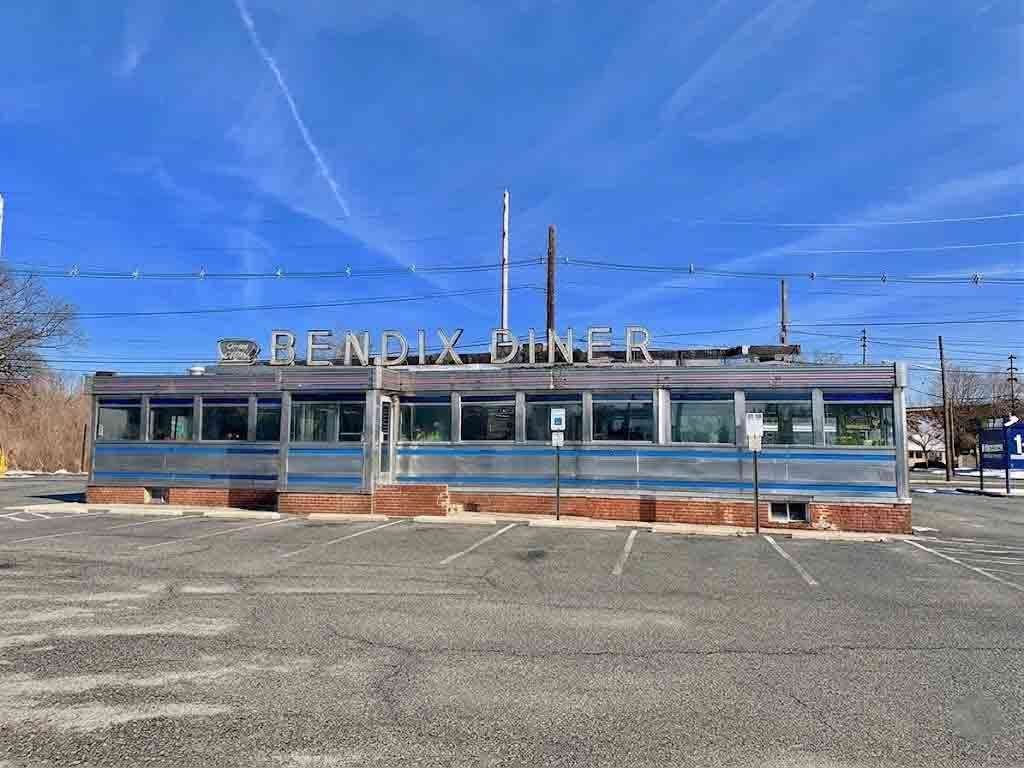
The Bendix Diner sits on a triangular plot between the northbound and southbound lanes of Route 17 in Hasbrouck Heights, Bergen County. Opened in 1947, built by the Master Diner Company of Pequannock, New Jersey, from stainless steel, it was named for the Bendix Corporation, which ran an aircraft parts factory nearby at Teterboro Airport. The borough reverted from the name Teterboro back to its original designation. The diner kept the name. Neon still reads BENDIX above the door. There are worse ways to persist.
The Diakakis family bought the diner in 1985. John began working the floor in the 1990s after graduating from Ithaca College with a degree in psychology and spending time doing stand-up comedy — routines that centered on his blindness, because when you’ve got something that big to carry you might as well make it a punchline before anyone else does. His father Tony suggested he pick up register work to make some extra money. John taught himself everything else.
How You Learn a Room You Can’t See
The standard narrative about blind people who do extraordinary physical things involves words like inspiration and remarkable and usually a television segment with swelling music underneath. John Diakakis has been through enough of those segments to know the gap between how the story gets told and what the story actually is.
What it actually is: repetition. The same path, walked until the feet know it. The same counter length, traced until the hands know where the mugs stop and the register begins. The layout of the Bendix — counter, stools, booths, the line between the service area and the kitchen — is in his body, not his memory. Memory can fail. The body at this level of habituated practice doesn’t fail in the same way. It routes around gaps. It compensates before the mind registers the need.
“I see with my hearing,” John told reporters from the Daily Voice in January 2025. “I’m so in tune and perceptive. Sometimes, I lose it when there’s too much noise because it breaks my concentration. Until you see it, you wouldn’t believe it.”
I believe it. I’ve played guitar long enough to know what it means when your left hand knows the fretboard in the dark — when your fingers find a chord without your eyes going anywhere near the neck, when muscle memory has made the physical layout of the instrument as familiar as the floor plan of your own kitchen. You stop thinking about where the notes are. You start thinking about what you’re playing. The instrument disappears into you.
That’s what John did with the Bendix. The building disappeared into him. The sound of a mug filling with coffee tells him how much room is left. He’s burned himself once or twice on the grill. He’s never spilled on a customer. In thirty years of service and roughly twenty years of ownership, those are the numbers. Count them and tell me what category they belong in.
What Route 17 Puts Through You
Route 17 in Bergen County is not a scenic highway. It is a commercial artery — car dealerships, strip malls, chain restaurants, warehouses, the kind of landscape that exists to process traffic, not receive it. The median strip between northbound and southbound lanes where the Bendix sits is not a romantic location. It is a loud one. It is difficult to photograph. It is more difficult to access than any diner has a right to be, requiring a specific approach from specific lanes that first-timers usually get wrong.
Truckers know it. Truckers have always known it. The Bendix ran 24 hours on Fridays and Saturdays, which means it fed the overnight freight corridor that runs through Bergen County — drivers off the New York State Thruway, down through the George Washington Bridge, cutting south on 17 toward distribution centers in the flats below. That’s not a romantic customer base either. It’s a functional one. People who need to eat, need to be back on the road, need the transaction to be fast and the food to be reliable and the booth to be available without a reservation or a wait list or a hostess who calls your name like it’s a social event.
The highway noise is constant at the Bendix. Traffic on both sides of the building, eighteen-wheelers and commuters and delivery vans, all of it passing close enough to feel through the walls when a big rig goes by. For John, that ambient noise is navigation data and interference simultaneously. It’s the medium through which he reads the room. Too much of it and the signal breaks down.
He was doing it anyway.
The Sound of a Business Running
Filmmaker Anthony Scalia drove past the Bendix his whole life and never stopped. One night in 2016, at 3 AM, hungry, nothing else open, he pulled into the lot and watched his waiter work without making eye contact with anything. He noticed the waiter kept refilling his drink the moment the straw hit the bottom of the glass. He wondered if the man was blind. He made a documentary called Bendix: Site Unseen over the next three years. It won an honorable mention at the New Jersey International Film Festival.
What Scalia caught on film was the operational reality that nobody who talked about the Bendix’s charm had actually described: a man running a complex physical environment entirely through auditory and haptic data, with the same results as someone who could see every inch of it. Not better results. Not worse results. The same results. The food came out right. The coffee didn’t overflow. The orders didn’t get mixed up. The customers got what they ordered.
The Bendix appeared in Jersey Girl (1992), Boys on the Side (1995), The Many Saints of Newark (2021), and commercials with Ray Charles and Michael J. Fox. Jerry Seinfeld stopped in with comedian Barry Marder for Comedians in Cars Getting Coffee in 2012. Jack Antonoff’s band Bleachers shot a video there. Peter Genovese at NJ.com ranked it among the 30 greatest old-school diners in Jersey and wrote that “for a while there, the Bendix Diner may have been the most famous diner on American TV.”
John ran all of it. The productions, the celebrities, the truckers, the 3 AM regulars, the people who came in specifically because they’d seen the documentary. He ran it blind, which is to say he ran it the way he’d always run it, which is to say he just ran it.
The Fire Suppression System That Ended It
The practical end of the Bendix Diner’s current chapter is unglamorous in the way that institutional failure always is. The fire suppression system needed replacement beginning in 2018 or 2019. It’s a cost-prohibitive job in a building with the Bendix’s age and construction — the retrofit work requires contractors willing to take on the specific challenges of a prefab stainless-steel diner on a highway median island. John told reporters he contacted over thirty contractors in two years. None of them agreed to take it on.
His mother — one of the original family owners — fell ill in 2024 and died in November. He worked every day through her illness. He ran the diner through the grief. Then in January 2025, the borough came with the tape.
He owed $100,000 to $120,000 in suppression system repairs. A GoFundMe raised roughly $3,500 in the first forty-eight hours, which is the kind of number that tells you something about the gap between sentiment and practical support.
“I worked every single day up until her services,” John told Patch. “I just felt kind of lost Friday when they came with the tape and everything like that.”
There’s no performance in that sentence. No request for sympathy. Just the precise description of what lost feels like when the thing you poured thirty years into gets sealed with tape while you’re still processing a funeral.
What the Building Holds
As of late 2025, a potential buyer had emerged — Peter Meskouris, co-owner of the Jackson Hole diner in Queens, reportedly interested in acquiring the Bendix and undertaking the necessary renovations. Nothing is finalized. The 1947 prefab stainless-steel structure still sits on its triangular island on Route 17, dark, waiting for whatever comes next.
What comes next is not the point of this. The point is the thirty-year run. The point is a man who learned a building so completely that the building became an extension of his senses, and who ran it — through a full breakfast rush and a lunch counter and a truck stop midnight and a film crew and a famous comedian and a dying mother — without the one sense most people assume is necessary to do what he was doing.
I think about what that kind of knowledge costs. The specific intimacy of knowing a physical space that completely — the distances between stations, the weight of a mug at different fill levels, the sound of a grill that needs cleaning versus one that’s running clean, the way the booth cushions have compressed over forty years in exactly the spots where people put their weight when they sit. That’s not information you carry in your head. That’s information your body carries for you.
Running a diner is already hard. Running one on Route 17 on a traffic island in Bergen County in a stainless-steel box from 1947 is harder. Running one blind, for thirty years, without spilling on a customer, is something else entirely.
The guitar analogy holds — but only partway. When I play in the dark, I’m the only one at risk. Nobody’s hot coffee is in my hands. Nobody ordered eggs and needs to know they’re coming. John was accountable to the customer in ways that the fretboard never asked of me. That’s the harder version. That’s the one that takes the chip on your shoulder and turns it into a discipline.
“You have a chip on your shoulder,” John told New Jersey Monthly. “You want to prove something.”
That’s it. No applause expected. No inspiration porn required. Just a man who wanted to prove something, proved it, and ran a diner until the suppression system gave out.
You Might Also Like:
Heritage Diner Disco Fries: New Jersey Classic with a Long Island Diner Finish | Rum Row and the Freeport Bootleggers: Long Island’s Clandestine War on the Water | Deserve’s Got Nothing to Do with It: Why Unforgiven Is the Greatest American Western Ever Made
Sources
- New Jersey Monthly, “Meet the Blind Waiter Behind the Bendix Diner”: njmonthly.com
- Daily Voice, “Blind Bendix Diner Owner Fights To Save Route 17 Icon,” January 2025: dailyvoice.com
- Patch, “Shuttered Bendix Diner Owner Vows To Reopen”: patch.com
- NJ1015, “Iconic NJ diner on the verge of closing”: nj1015.com
- The Ridgewood Blog, “Iconic Bendix Diner Revival,” December 2025: theridgewoodblog.net
- Retro Road Map: retroroadmap.com
- Bendix: Site Unseen, directed by Anthony Scalia, 2022