Forty-five miles east of Manhattan, beneath the pine barrens of Upton, Long Island, scientists smash gold nuclei together at nearly the speed of light to recreate conditions from a microsecond after the Big Bang. One mile from the Vatican, a Jesuit planetary scientist named Brother Guy Consolmagno studies meteorites and publicly debates whether the God of Scripture could have created a universe 13.8 billion years old. These two worlds collided — not in a laboratory, but in print.
Most people who drive past the Brookhaven National Laboratory exit on the Long Island Expressway have no idea what is happening beneath the scrub oaks. Most Catholics who discuss creation theology with their parish priest have never heard of the Relativistic Heavy Ion Collider. The conversation between these two realities has been conducted almost entirely by specialists and has largely escaped public attention. That’s a failure of translation, because the questions at stake are not small.
What the Collider Actually Does
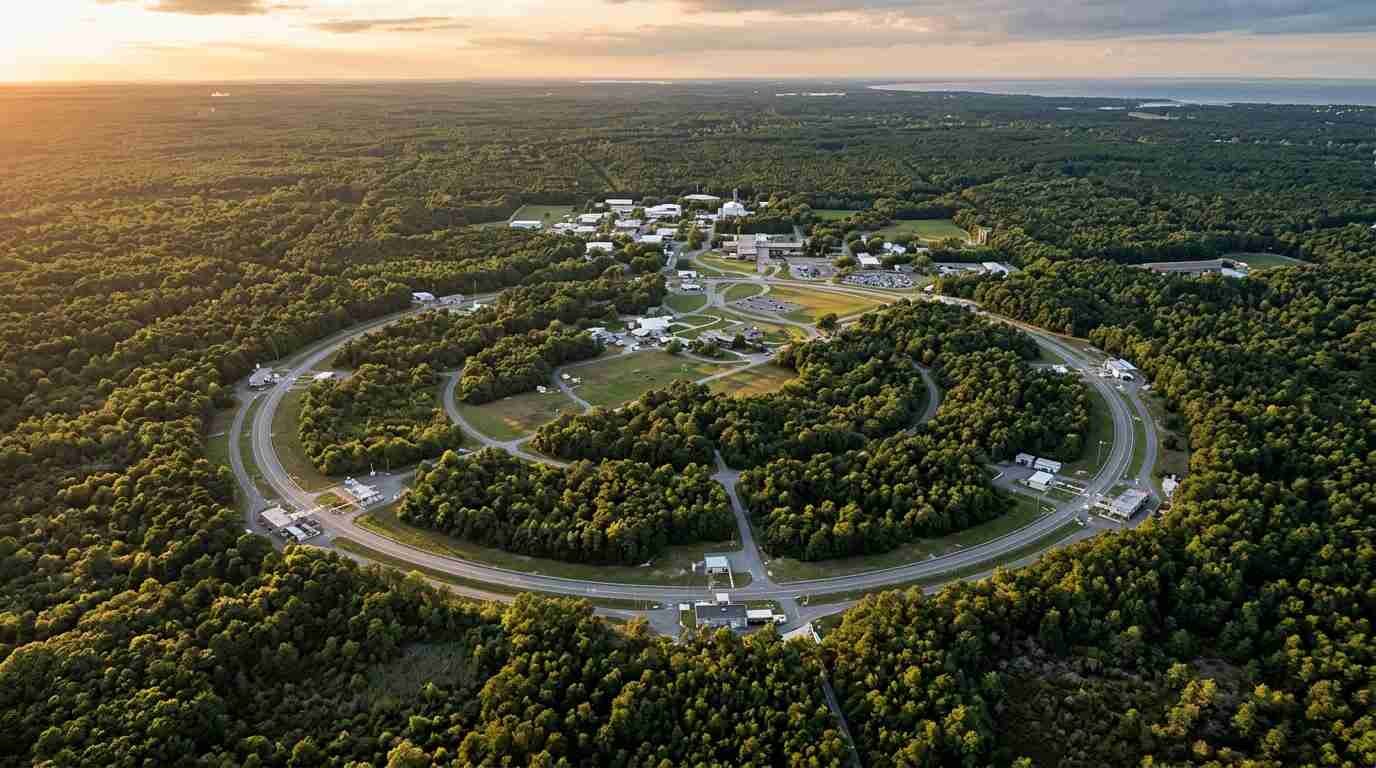
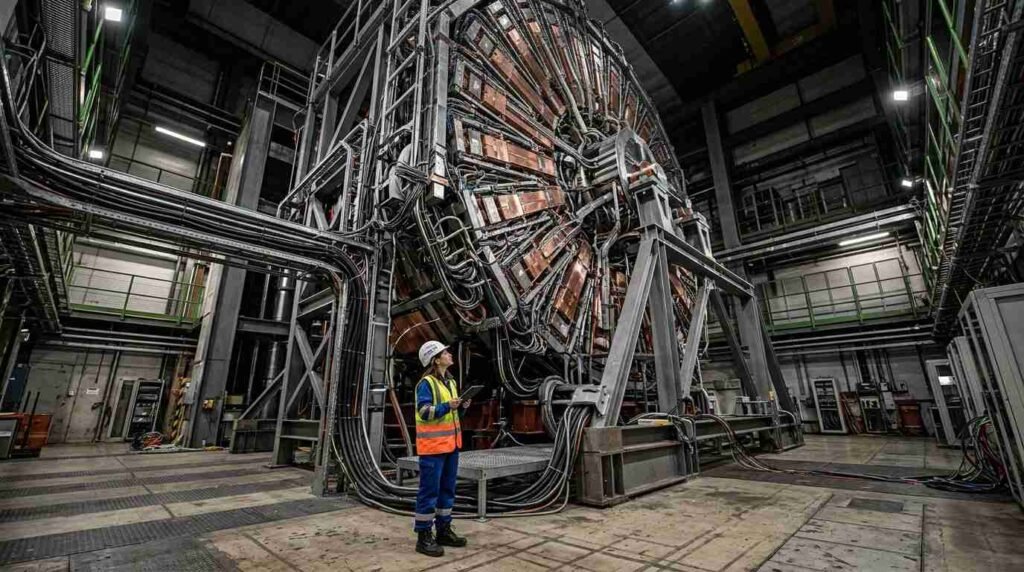
The Relativistic Heavy Ion Collider — RHIC, pronounced “Rick” — is a circular particle accelerator 2.4 miles in circumference buried at the Brookhaven National Laboratory campus in Upton, Suffolk County. It is a facility built on Long Island soil, funded substantially by New York State, and operated as a Department of Energy national user facility. Physicists from around the world come to Upton to smash gold ions together at 99.995 percent of the speed of light.
The purpose is not to produce gold. The purpose is to produce what the universe looked like in the first microseconds after the Big Bang — a state of matter called quark-gluon plasma. Quarks and gluons are the constituents of protons and neutrons. Under normal conditions, they are permanently confined inside those protons and neutrons. In the first microsecond of the universe’s existence, before the cosmos had cooled enough for protons and neutrons to form, quarks and gluons moved freely in a superheated soup of pure possibility.
RHIC recreates that state. In 2005, a landmark series of papers published in Physical Review Letters confirmed that the collisions at RHIC were producing quark-gluon plasma — and producing a substance that behaved less like a gas and more like a perfect liquid, with extraordinarily low viscosity. This was unexpected. It was also extraordinary.
What the physicists at Brookhaven were doing, on a twelve-mile island off the coast of New York, was listening for the echo of creation itself.
The Man Who Answered From Rome
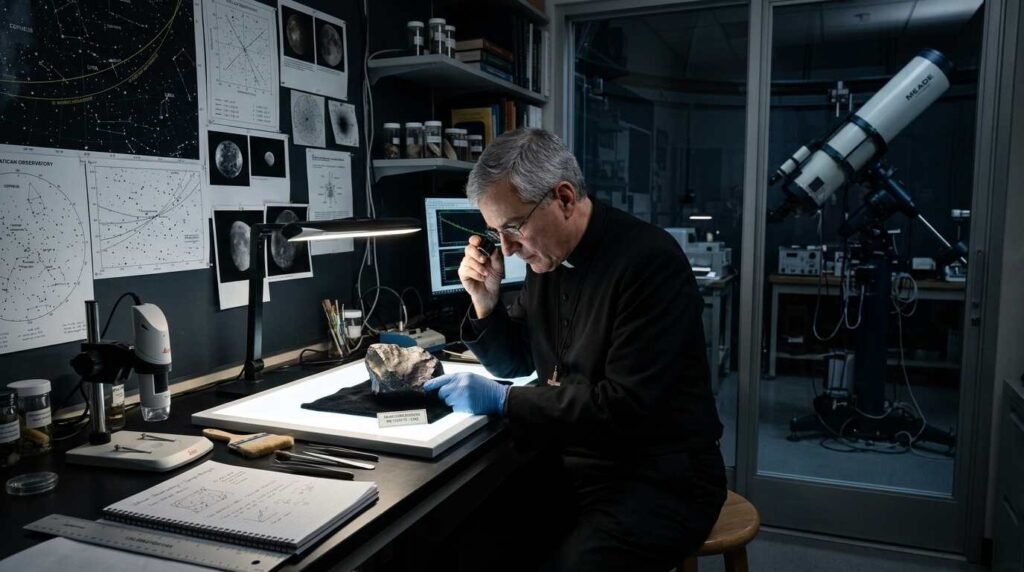
Brother Guy Consolmagno, SJ, is the director of the Vatican Observatory and one of the more unusual public intellectuals working in science today. He has a Ph.D. in planetary science from MIT. He has studied meteorites on every continent, including Antarctica. He was awarded the Carl Sagan Medal by the American Astronomical Society in 2014 for outstanding communication by an active planetary scientist to the general public — named, incidentally, for the very astronomer who represented the secular end of this conversation. He is also a Jesuit brother, bound by vows, who studies the cosmos as an act of religious devotion.
Consolmagno’s books are where the intellectual engagement with physics and creation theology becomes most explicit. In God’s Mechanics: How Scientists and Engineers Make Sense of Religion (2007, Jossey-Bass), he examined how technically trained people integrate scientific reasoning with religious faith. In Would You Baptize an Extraterrestrial? (2014, Image Books), co-authored with Paul Mueller, SJ, he addressed — in conversational dialogue format — the deep questions that particle physics, cosmology, and astrobiology raise for Christian theology.
On the Big Bang and quark-gluon plasma specifically, Consolmagno’s position is careful and documented. He argues that the physics of the early universe, as revealed by accelerators like RHIC, does not confirm or deny religious cosmology — it simply describes physical processes that any metaphysical account of origins must be compatible with. The question “what existed before the Big Bang?” is, he contends, not a physics question. Physics describes the evolution of a universe that already exists. What created the conditions for existence itself is a different kind of question — and not one that the RHIC, for all its gold-ion collisions, can answer.
The Debate That Didn’t Happen in Public
Here is where the Long Island connection becomes philosophically interesting. The physicists at Brookhaven did not, as a matter of institutional practice, engage in public debate with theologians about the implications of their findings. That is not their job. RHIC papers are peer-reviewed and published in Physical Review Letters and similar journals; they concern themselves with viscosity, temperature, and collision cross-sections, not the Book of Genesis.
Consolmagno, working from the other side, was doing the translation work that few physicists would touch. When RHIC confirmed quark-gluon plasma in 2005, the theological press was largely silent. Consolmagno was not. In Would You Baptize an Extraterrestrial? — released nearly a decade after the RHIC results — he addressed the cosmological implications directly: what does it mean for creation theology that we can now experimentally demonstrate the state of matter that existed in the first microsecond of the universe? His answer: it means we know more about how the universe began, not that it began from nothing, and not why it began at all.
The distinction between how and why is the load-bearing beam of his entire argument. Science, Consolmagno maintains, is a supremely good instrument for answering how questions. It is categorically not designed to answer why questions. A particle accelerator can tell you what temperatures were reached one microsecond after the Big Bang. It cannot tell you whether there was a reason for the Big Bang to occur at all.
This is not, it is worth noting, a defensive argument. It is a philosophical argument about the domains of different kinds of inquiry — one that has a long tradition in both analytic philosophy of science and Catholic intellectual history. Karl Popper’s work on falsifiability, which I’ve written about in connection with the demarcation problem, draws a similar kind of line: science is distinguished from non-science by what it can, in principle, test. Questions about why the universe exists are not testable by experiment. They are not, therefore, scientific questions — though they remain genuine questions.
Walt Whitman’s Island
There is something worth pausing on geographically. The Long Island that hosts Brookhaven National Laboratory is the same island where Walt Whitman was born, in 1819, in what is now West Hills in Huntington. Whitman, who heard America singing and catalogued the cosmos with his own particular instrument — the long democratic line, the body electric, the grass as a uniform hieroglyphic — was doing his own kind of physics. He was mapping the connective tissue between matter and meaning, between the observable world and whatever it is that makes the observable world feel significant.
The pine barrens between Upton and the North Shore have not changed much since Whitman’s time. The scrub oaks and pitch pines that surround the Brookhaven campus are the same species that covered this landscape when it was still farmed by families who didn’t know the word “quark.” The accelerator is buried beneath all of that, listening for signals from a microsecond after time began.
I think about Long Island differently now than I did before I understood what was happening at Brookhaven. The North Shore — the stretch of coast from Port Jefferson west through Mount Sinai and beyond — carries its history lightly. The physicists driving out from Manhattan on the LIE don’t tend to stop for eggs and coffee in the North Shore diners before heading to Upton. They probably should. Some conversations need a booth and a cup of something strong before they can begin.
The Carl Sagan Medal and Its Ironies
The American Astronomical Society gave Consolmagno the Carl Sagan Medal in 2014. The irony is layered. Sagan was an agnostic who spent much of his career arguing that the cosmos operates without divine supervision — that the universe is indifferent to human concerns, and that scientific literacy is the only reliable defense against superstition. Consolmagno is a Jesuit who believes the universe was created with intention and that studying it is an act of worship.
The award, named for the skeptic, given to the believer, is its own kind of convergence statement. The AAS was not endorsing Consolmagno’s theology. It was recognizing that his communication of science — the actual physics, the actual data from the actual telescopes and meteorite labs — met Sagan’s standard: the idea that there is nothing about science that cannot be explained to the layman.
Consolmagno has described his scientific work and his religious practice not as parallel activities he keeps carefully separated, but as aspects of a single orientation toward reality — curiosity, wonder, and the willingness to be surprised by what the universe reveals. He has said that science, for him, is a form of prayer: you pay attention to what is actually there, and you let go of what you wanted to find.
Sagan, characteristically, would have recognized that description even if he rejected its theological framing.
The Boltzmann Problem and the Theological Response
The deeper physics problem that RHIC raises — one that Consolmagno engages in his writing — connects to what I’ve explored in my piece on the Boltzmann Brain paradox: the question of fine-tuning. The physical constants of the universe — the strength of gravity, the mass of the electron, the cosmological constant — appear to be set within extraordinarily narrow ranges that permit the existence of matter, stars, planets, and life. A quark-gluon plasma experiment that recreates the Big Bang’s first microsecond demonstrates just how precisely calibrated those constants must be for the plasma to cool into protons, protons into atoms, atoms into stars, stars into the particular kind of world where someone can ask why any of this happened.
Consolmagno’s theological response to fine-tuning is not the “God of the gaps” argument — the claim that wherever science cannot yet explain something, God must be responsible. That argument, he concedes, is bad theology as well as bad philosophy, because science eventually explains things and the God thus invoked keeps shrinking. His argument is different: fine-tuning is not a gap in our knowledge. It is a feature of our knowledge. The fact that the physical constants permit complexity is something physics can measure and confirm. What it means — whether it implies intention — is a question that belongs to a different domain of inquiry.
The Jesuit tradition in which Consolmagno works has been making this argument, in various forms, since the seventeenth century. It produced Gregor Mendel, Georges Lemaître, and the man who first proposed the Big Bang theory — who was, himself, a Catholic priest. The idea that scientific inquiry and religious belief are inherently incompatible is a relatively recent cultural construct that the history of science does not fully support.
None of which resolves the question. It just clarifies what kind of question it is.
What the Accelerator Cannot Tell Us
RHIC has been running experiments since 2000. Its successor upgrade, sPHENIX, began taking data in 2023, studying the quark-gluon plasma at higher resolution. The physics it produces is among the most precise in the world. What happened in the first microsecond of the universe — the temperatures, the matter-antimatter asymmetry, the cooling process that produced protons — is better understood because of what is happening in the pine barrens of Upton, Long Island.
What the accelerator cannot tell us: why anything exists rather than nothing. Why the constants are what they are. Whether the universe has a purpose or is simply a consequence. Whether consciousness, which emerged from that universe after thirteen billion years of cooling and condensing, is a cosmic accident or an expression of something the universe was inclined toward all along.
These are not gaps in physics. They are the edge of physics. They are the point at which the instrument reaches its designed limit and a different instrument must take over — whether that instrument is philosophy, theology, or simply the human capacity to sit with a question that has no current answer.
Brother Guy Consolmagno drives that edge professionally. The physicists at Brookhaven map it from the other side. The conversation between them — conducted in books and journals and the occasional conference, largely invisible to the public on whose island this is all happening — is one of the better intellectual exchanges of the past two decades.
Most New Yorkers missed it. That seems like a correctable error.
You can explore related territory in my pieces on the Extended Phenotype and how science maps life’s structures and the Fermi Paradox and the silence of the cosmos.
Sources
- Brookhaven National Laboratory — RHIC overview: bnl.gov/rhic
- RHIC quark-gluon plasma discovery papers: Physical Review Letters, 2005 (four BRAHMS, PHOBOS, PHENIX, and STAR collaboration papers)
- Guy Consolmagno and Paul Mueller, Would You Baptize an Extraterrestrial? (2014, Image Books) — publisher page
- Guy Consolmagno, God’s Mechanics: How Scientists and Engineers Make Sense of Religion (2007, Jossey-Bass) — publisher page
- American Astronomical Society, Carl Sagan Medal announcement, 2014 — AAS Division for Planetary Sciences
- Vatican Observatory Foundation — vaticanobservatory.org
- Brookhaven sPHENIX upgrade: bnl.gov/sphenix