Start with the smell. Every account of the tanning industry in the historical record, from the factory inspection reports to the Eagle’s industrial surveys to the testimony of workers before the New York State Factory Investigating Commission in the years between 1912 and 1915, starts with the smell. Ammonia and lime. Rot and bark. The sulfurous breath of a vat that had been running for days in August heat. The records describe it as an assault. As something that settled into the walls of the buildings, the clothes of the workers, the streets of the neighborhoods where the tanneries ran.
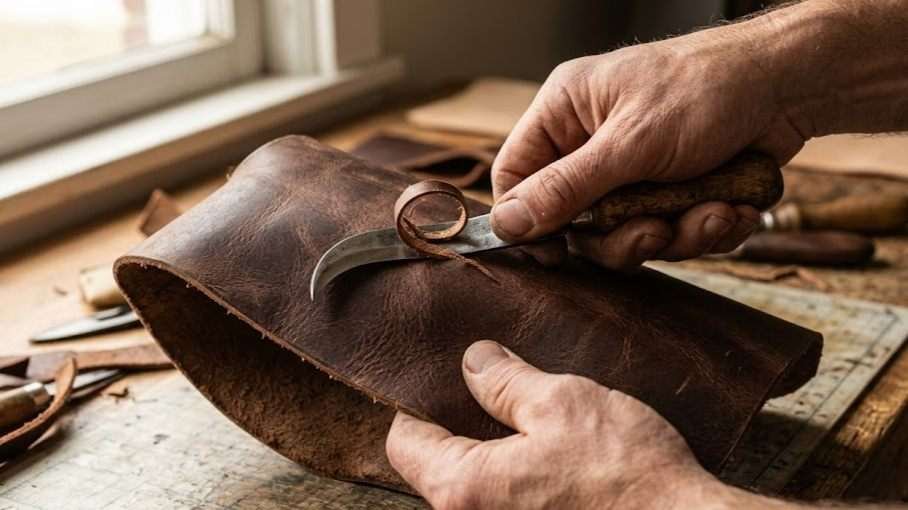
I know the smell differently. I work with leather. I cut it, skive it, saddle-stitch it, burnish it. The smell of a fresh-cut piece of English bridle leather is something I find clarifying — it’s the smell of material with a history, of a substance that was alive and has been transformed into something that will last. But I didn’t come to that relationship through inheritance. The craft I practice at Marcellino NY arrived at my hands through apprenticeship and obsession, not through a family line of Brooklyn tanners. The men who worked the vats in Red Hook and Williamsburg — who ground the bark, scraped the hides, stirred the lime pits — didn’t leave their knowledge in a form most people could find.
This is an investigation into where it went.
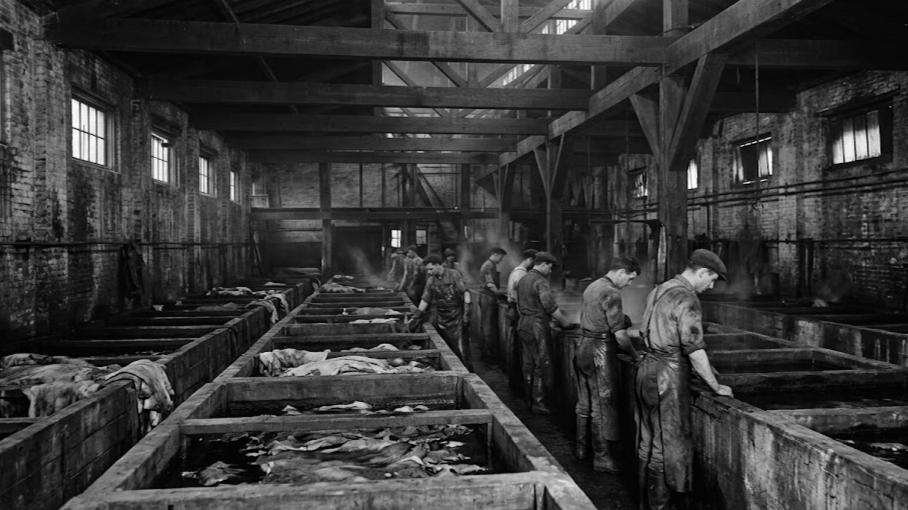
The Original District: Lower Manhattan’s “Swamp”
The paper trail begins south of the Brooklyn Bridge, in what historians of the city know as “the Swamp.” According to the account preserved by Frank W. Norcross in A History of the New York Swamp (Chiswick Press, 1901), an area encompassing Gold, Frankfort, Pearl, Water, and Ferry Streets in lower Manhattan became, beginning around 1790, the first concentrated leather-processing district in New York City. The tanneries had moved there from the earlier Collect Pond location as the city expanded northward, and they brought with them the full infrastructure of the trade: the lime vats in parallel rows open to the sky, the beam houses where hides were scraped, the bark-grinding mills turning by horsepower in the back lots.
Frankfort Street was the Swamp’s northern boundary and its original core. Norcross notes that the principal interest of Frankfort Street lay in the fact that all the first tanneries were constructed there, with curriers — the craftsmen who finished the leather after tanning — living above their shops in the same buildings. These were not factory operations in the modern sense. They were artisan establishments that had merely scaled up.
The Dutch had, in fact, built New York’s first large-scale tannery in 1638, in what became known as New Amsterdam — the site that eventually evolved into the Swamp. By 1800, New York merchants had developed what historians of the leather industry describe as “contract tanning”: a system in which merchants provided financing, negotiated the purchase of raw hides from South America and the Caribbean, and arranged the marketing of finished goods. The tanner — who had once been an independent craftsman — became, under this arrangement, something closer to a specialized technician in the employ of capital.
That transformation, from craft to industrial subcontract, is the first thing the record shows you when you follow the Brooklyn leather story from the Swamp forward.
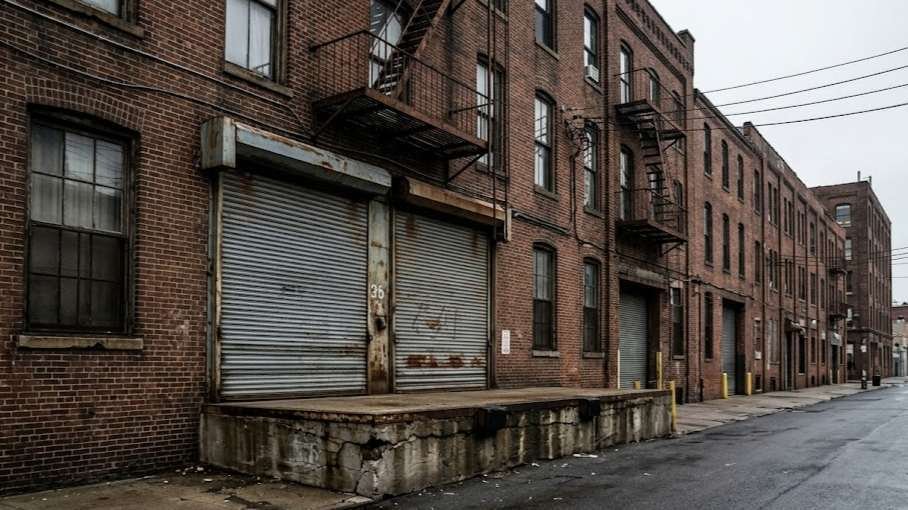
The Move Across the Bridge
As Manhattan developed northward through the mid-nineteenth century, the tanning industry moved — partly by regulation, partly by economics, partly because the operations were too large and too noxious for neighborhoods that were gentrifying around them. The waterfront neighborhoods of Brooklyn — Red Hook, Williamsburg, the area around the Navy Yard — offered what the Swamp no longer could: proximity to harbor shipping for the hides coming from South America, proximity to rail for distribution inland, and land cheap enough for the vat rows and the storage houses.
The Brooklyn Daily Eagle’s industrial directories of the 1880s and 1890s — the industrial survey records that document the borough’s manufacturing footprint in the period before consolidation — show the leather trade operating throughout the South Brooklyn waterfront. Red Hook, as the Brownstoner’s historical research on its streetscape documents, held warehouses packed with raw and finished leather in addition to its grain and cotton operations. The streets around Columbia and Pacific were as likely to be backed by a tannery or a currier’s shop as by a grain warehouse in those years.
What the Eagle doesn’t fully capture — and what the New York State Factory Investigating Commission reports from 1912 to 1915 document in far more granular terms — is the labor picture inside those operations.
What the Factory Commission Found
The New York State Factory Investigating Commission was established in 1911 in the wake of the Triangle Shirtwaist fire, charged with investigating working conditions across the state’s industrial sectors. Its Second Report, submitted to the legislature in 1913 and available through the New York State Library, covers industries well beyond the garment trade — and the tanning and leather-working sectors receive substantial attention.
The picture the commission painted was not reassuring. Tannery work involved prolonged exposure to lime, which destroyed the skin of the hands and forearms if protective equipment — rarely provided — was not used. The vats that held hides in the tanning liquor were open, at floor level, and represented a drowning hazard that the commission noted in at least one case had proved fatal. Ventilation in the beam houses was poor or absent. Workers who ground bark or handled the hides in early stages were exposed to anthrax spores — a documented occupational risk that the commission flagged as inadequately addressed.
The workforce, as the commission’s surveys show and as the immigration records of the period corroborate, was drawn heavily from the immigrant communities that had settled in Williamsburg and the surrounding neighborhoods in the 1880s and 1890s. Irish and German workers who had first built Brooklyn’s industrial waterfront were joined, in the later decades of the century, by waves from Eastern and Southern Europe — Italian, Polish, Russian Jewish, and other communities whose men took the hard industrial jobs that paid enough to establish a foothold. Tannery work paid. It was steady, in a way that day labor on the docks was not. But it extracted a physical cost that the commission’s investigators, for the first time in any official capacity, tried to quantify.
The Brooklyn Historical Society’s manufacturing census records from this period, which document employment figures and production volumes at individual establishments, show tannery operations running with workforces of fifty to several hundred men depending on the scale of the operation. These were not small shops. They were, by any contemporary measure, significant industrial employers in a borough whose economy ran on exactly that kind of work.
The Process in Its Full Reality
Understanding what was lost requires understanding what the craft actually was at the industrial scale.
The hide arrived at the tannery salted, from the slaughterhouse or from the ships that brought South American cattle hides into New York Harbor. The first step was the beam house: the hide went into a lime vat — an alkaline solution of water and slaked lime — for several days, which loosened the hair and softened the skin for scraping. Workers called “beamers” then stretched the hide over a convex wooden beam and removed the hair with a curved knife, a process that required both strength and control. Done wrong, you cut the hide; done right, you had a clean, supple surface ready for tanning.
The tanning itself happened in a series of vats through which the hide moved progressively, from weaker to stronger solutions of tannin — the chemical extracted from ground hemlock or oak bark, boiled into a liquor that reacted with the protein in the hide and converted it to leather. Vegetable tanning of this kind was slow: a full hide could take months in the vat sequence before it was ready for finishing. The men who managed the vat progression — who knew by experience and by smell and by the feel of the leather when it was ready to advance — held knowledge that had been built over years of practice and was transmitted almost entirely through apprenticeship.
By the 1880s and 1890s, chrome tanning — using chromium salts rather than vegetable extracts — was being adopted in larger operations because it was dramatically faster. A hide that took months to vegetable-tan could be chrome-tanned in days. The industrial advantage was obvious. The craft disadvantage was less visible: chrome-tanned leather behaves differently under the hand, responds differently to finishing, ages differently. The shift to chrome tanning accelerated production and helped destroy the conditions under which the older knowledge had any economic value.
The Encyclopedia of U.S. Leather and Leather Products History notes that in 1830, the leather and tanning industry was one of the four leading industries in the United States. By 1860, there were more than five thousand tanneries operating nationally. By 1890, there were fewer than two thousand — the consolidation had already cut the count by more than half. The knowledge that had been distributed across thousands of independent operations was concentrating, and then, as the operations themselves consolidated and mechanized, thinning.
The Consolidation and Its Aftermath
The national pattern that played out in the Catskills and in Pennsylvania’s tanning counties repeated itself in Brooklyn, on a compressed timeline. The United States Leather Company — a national trust assembled in the 1890s that controlled a significant share of American leather production — operated warehouses and facilities in the region. The same forces that drove the Catskill tanneries to decline drove the Brooklyn waterfront operations toward a similar endpoint: consolidation into larger and fewer operations, the replacement of craft labor with industrial process, and ultimately the migration of what remained to locations with cheaper land and less organized labor.
By World War II, when Pennsylvania’s count of tanneries had fallen to fifty-nine, the Brooklyn leather industry had largely completed its own disappearance. What had been a network of industrial operations — running through the South Brooklyn waterfront from Red Hook north through Williamsburg — was gone, leaving behind streets that no longer smelled of anything, and a workforce that had moved into other work or moved out of the borough entirely.
The knowledge problem is the harder one to account for. The men who managed vat sequences, who knew when a hide was ready by feel, who had developed through years of practice the ability to evaluate leather at any stage of its conversion — that accumulated expertise did not get written down in any form that survived the transition. It was craft knowledge, transmitted through relationship, and when the relationships ended, so did the knowledge.
What Persists
I make leather goods. English bridle leather, cut by hand, stitched with waxed linen thread on a saddle stitch that won’t pull apart even if one stitch is cut. The briefcases I build at Marcellino NY take six months from commission to delivery, sometimes longer. I learned this craft the way it has always been learned: by finding someone who knew, and then by practicing until the hands understood what the mind could not fully articulate.
The tanneries of Brooklyn — the operations that ran through Red Hook and Williamsburg in the decades the Factory Investigating Commission investigated — were doing something similar, at industrial scale, with labor that had arrived in the borough without the specific craft and learned it on the job. Some of those men became skilled. Some of them transmitted what they knew to other men, in the back of the beam house or at the vat, in whatever language worked between them — because the tanneries of Brooklyn in the 1880s and 1890s were multilingual operations, the Irish and the Germans and the Italians and the Eastern Europeans working the same vats.
What the tanning pit remembers is not available in any archive I can access. It’s in the hands that touched the hides, and those hands are gone. What survives in the records — the Factory Commission reports, the Eagle’s industrial directories, the Brooklyn Historical Society’s manufacturing census — is the external shape of the industry: the employment figures, the safety violations, the production volumes. The interior knowledge, the craft understanding that distinguished a skilled beamer from a man who would cut every fourth hide — that’s not in the record.
This is what I mean when I say the industry almost didn’t survive. Not the buildings. Not the companies. The knowledge. That’s what was at risk, and that’s what, in the end, we largely lost.
Sources: New York State Factory Investigating Commission, Second Report (1913), available via New York State Library (nysl.nysed.gov); Brooklyn Historical Society manufacturing census records; Brooklyn Daily Eagle industrial directory archives, Library of Congress Chronicling America database; Frank W. Norcross, A History of the New York Swamp (Chiswick Press, 1901), referenced via Public Water project (public-water.com); “Hemlock and Hide: The Tanbark Industry in Old New York,” Northern Woodlands, Summer 2011 (northernwoodlands.org); Encyclopedia.com, “Leather and Leather Products Industry”; Boston Leather Guild, “Leatherworking in New England” (bostonleatherguild.com); “The Industrial History and Transformation of Red Hook,” HelpNewYork.com.