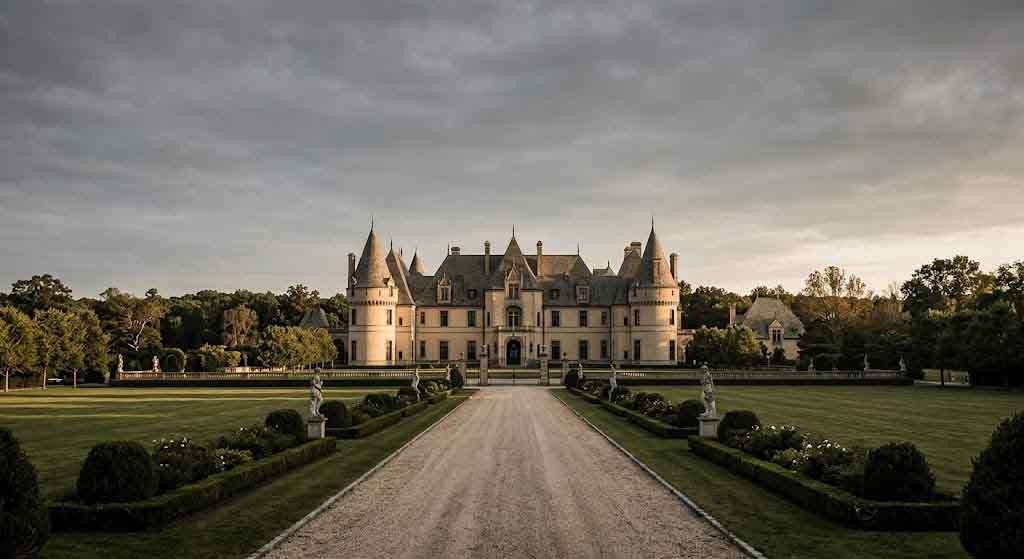
Between 1875 and 1935, over a thousand summer estates were built on Long Island. Financiers, railroad barons, shipping magnates, and investment bankers commissioned architects like Richard Morris Hunt, Delano & Aldrich, and Warren & Wetmore to build them something that announced — unmistakably, permanently — that they had won. The North Shore became known as the Gold Coast. Fitzgerald wrote the novel that made it famous. Hollywood used Oheka Castle as the model for Xanadu in *Citizen Kane*. The mansions were not homes so much as arguments.
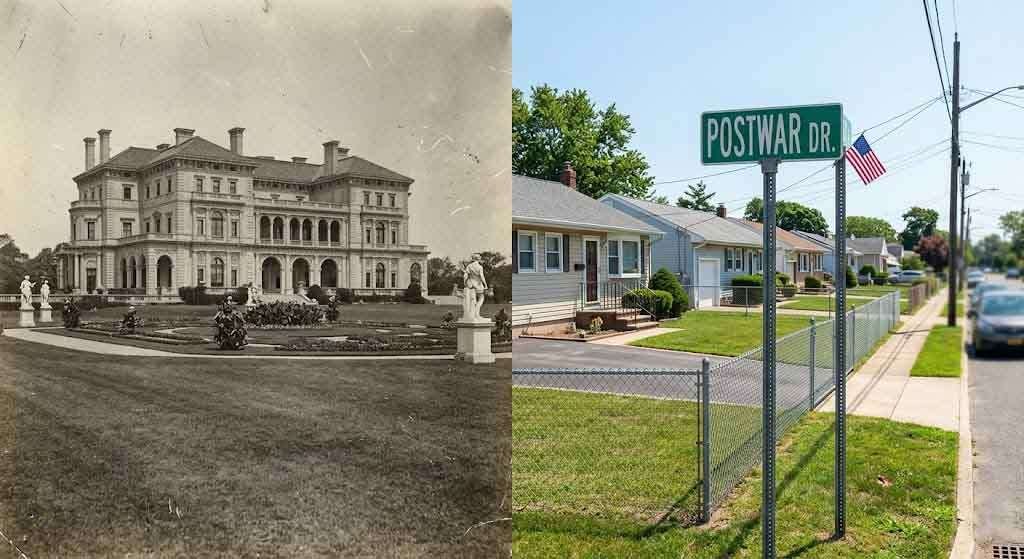
Most of those arguments have since been demolished, subdivided, or repurposed beyond recognition. The North Shore that exists today — with its quarter-acre lots and cul-de-sacs and split-levels — was carved out of those estates in the decades following World War II, not by any grand plan but by the accumulated pressure of property taxes, inheritance disputes, and a middle class that needed somewhere to live. The robber barons built castles. The twentieth century had other ideas.
The Scale of What They Built
To understand what was lost, you have to start with what was there.
Otto Hermann Kahn built OHEKA Castle at an estimated cost of $11 million — roughly $158 million in today’s currency — on a 443-acre plot at the highest point on Long Island in Cold Spring Harbor. The French-style chateau comprised 127 rooms and 109,000 square feet, making it the second-largest private residence ever built in America, behind only the Biltmore. Kahn employed 126 full-time servants. The Olmsted Brothers — the firm established by Frederick Law Olmsted, architect of Central Park — designed his formal gardens.
Down the South Shore, William Kissam Vanderbilt had assembled a 900-acre estate along the Connetquot River in Oakdale. Idle Hour, as he called it, was initially built in 1878 as a hunting retreat and eventually grew to 110 rooms. After the original burned in 1899, Vanderbilt rebuilt it in fireproof brick and concrete at a cost of $6 million, installing what the estate inventory described as 45 bathrooms and a garage capable of holding 100 cars. The grounds included a steamer to ferry guests up and down the river.
These were not outliers. Between 1875 and 1935, over one thousand summer estates consisting of substantial mansions, outbuildings, and extensive landscaped grounds were constructed on Long Island. The names on the deeds were the ledger of American industrial power: Vanderbilt, Morgan, Whitney, Phipps, Guggenheim, Woolworth, Pratt. They built on a scale that presumed permanence.
They were wrong.
When the Tax Bill Arrived
The estates began to fail not from neglect but from arithmetic.
The fortunes that built them were tied up in investments, trusts, and corporate structures that the federal income tax — introduced in 1913 — and the estate tax began to erode. A mansion that cost $11 million to build generated no income. Its grounds required a small army to maintain. As the Gilded Age gave way to the Depression, and the Depression gave way to postwar prosperity with its sharply redistributive tax environment, holding a Gold Coast estate became economically irrational.
After Otto Kahn died in 1934, the estate changed hands several times. In 1948, the Eastern Military Academy purchased Oheka and 23 acres of its property, bulldozed the gardens, and subdivided the rooms. The Cold Spring Hills community was carved out on 256 acres of the original 443-acre estate property. What had been one man’s private landscape became a suburban neighborhood.
Following William Kissam Vanderbilt’s death in 1920, the Idle Hour estate was subdivided, with a lively suburban community growing up around the remaining buildings in western Oakdale. Harold Vanderbilt, who inherited the property, reportedly had difficulty finding a buyer and eventually sold it for $460,521 — a fraction of what his father had spent on the rebuild alone.
The pattern repeated itself across the Gold Coast through the 1940s, 1950s, and 1960s. Estates were sold to schools, religious institutions, and municipalities — the only buyers capable of absorbing them. When those institutions failed or moved on, the land was subdivided. Raymond Spinzia’s meticulous documentation in his research on Long Island’s prominent North Shore families, and the archives of Preservation Long Island, trace this dismantling estate by estate, deed by deed.
A Working-Class Smirk at Dynasty
There is something almost satisfying about watching the fortunes of the very rich compress into quarter-acre lots. The men who built the Gold Coast had extracted their wealth from railroads, mines, and banks — from the labor of people who would never see a house on the Connetquot River, let alone a steamer tied at the dock. That their grandchildren couldn’t pay the property taxes and had to sell the land to someone who turned it into a subdivision has a certain poetic economy.
My family didn’t own any of this land, obviously. My grandparents came from Greece with nothing and built what they could in Brooklyn. But I grew up on Long Island, and there is something clarifying about knowing that the neighborhood where someone’s parents bought a ranch house in 1964 used to be a financier’s personal golf course. The ground remembers what the address doesn’t say.
This is not to romanticize the estates themselves — they were monuments to extraction dressed up as monuments to taste. But the collapse of the Gold Coast is a more complicated story than simple decline. It was a redistribution, imperfect and unplanned, of land that had been hoarded at a scale that required a private army just to keep the hedges trimmed.
What the Preservationists Fought For
Not everyone watched the demolitions without objection. Preservation Long Island — the organization that has spent decades documenting and fighting for what remains of the island’s architectural heritage — has a catalog of Gold Coast losses that makes for difficult reading. Mansions that would be considered national treasures in any European country were razed for the carrying cost savings. Formal gardens designed by the Olmsted Brothers were bulldozed. Libraries, ballrooms, and carriage houses with no structural problems at all were leveled because no one could afford to keep them and no municipality had the will to designate them.
After the Eastern Military Academy closed in 1979, Oheka Castle was abandoned and fell into near total disrepair. It faced demolition until Long Island developer Gary Melius purchased it in 1984 and undertook what became the largest private residential historic preservation project in the United States, requiring a $40 million investment to return the property to its original grandeur.
Oheka survived. Most of its peers did not. Of the thousand-plus estates built before 1935, only a fraction remain in anything like their original form. The rest are memory and subdivision.
What the North Shore Became
The land that the Gold Coast barons assembled — bought up from farmers and fishing families in the late nineteenth century at prices that reflected its agricultural value — was, after 1945, reassembled into a different kind of community entirely. The middle class that the postwar economy produced needed housing. Long Island was close to the city, relatively affordable, and largely undeveloped. The estates were in the way.
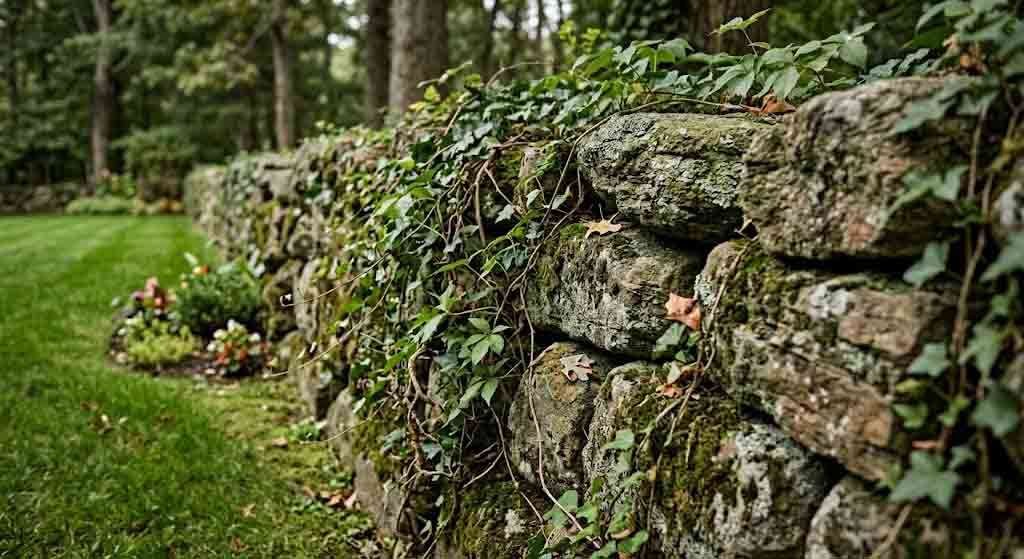
The result is the North Shore that exists today. Old field stone walls that once marked the borders of private estates now run along subdivision streets named after the estates themselves. Mansion-derived place names are everywhere — Idle Hour Boulevard in Oakdale, Oheka’s address on West Hills Road. The physical memory of what was there persists in the landscape even when the buildings are gone.
Today, the North Shore real estate market reflects a second transformation: the modest postwar houses built on those subdivided estate parcels are themselves now expensive, sought-after, and in many cases being replaced by houses of a scale their original builders would have found startling. The cycle of density and aspiration continues.
Paola Meyer, Associate Broker at Realty Connect USA, understands the layers of this market as well as anyone working it today. “Every property on the North Shore has history beneath it,” Meyer notes. “Sometimes that history is visible in a stone wall or a mature tree line that shouldn’t quite exist where it does. Sometimes it’s just in the land records. But the buyers who understand what they’re standing on make better decisions about where they’re going.” You can browse current North Shore listings at heritagediner.com/properties/.
The Land Endures
The Gold Coast is gone in any meaningful sense. The mansions that defined it were too expensive to maintain, too inconvenient to adapt, and too large for any private owner in the postwar economy to justify. The taxes that finished them were, in a certain light, the most democratic thing that ever happened to Long Island — a forced redistribution of hoarded land into a broader community of homeowners.
But something persists. The North Shore’s character — its density of old trees, its harbor-facing bluffs, its stone walls and sunken lanes — is a residue of those estates. The landscape was shaped by men with unlimited budgets and a preference for a particular kind of beauty, and that shaping doesn’t disappear when the deed changes hands. What the robber barons left behind, after the taxman was finished with them, was a set of bones. Long Island built its suburbs on top.
You Might Also Like: – The 1699 Stony Brook Grist Mill: Where Water, Grain, and Commerce Built Long Island’s North Shore – Great Neck NY vs Mt. Sinai NY: When Gatsby’s Gold Coast Meets a Quiet Beach Hamlet – Long Island Real Estate Market Update: Q1 2026
Sources: – Oheka Castle History, Friends of OHEKA, Inc.: friendsofoheka.org – Oheka Castle, National Park Service: nps.gov/places/oheka-castle.htm – Idle Hour Estate, Preservation Long Island: preservationlongisland.org – Spinzia, Raymond E. *Long Island’s Prominent North Shore Families.* Referenced via Preservation Long Island archives. – National Register of Historic Places Nomination, William K. Vanderbilt Estate, Connetquot Library Archives, Oakdale – Oheka Castle, Wikipedia: en.wikipedia.org/wiki/Oheka_Castle – Idle Hour, Wikipedia: en.wikipedia.org/wiki/Idle_Hour – Historic Structures: Oheka Mansion documentation: historic-structures.com
Tags: real estate, north shore, history, long island