Cosme Aguilar never intended to become a chef. Growing up in the mountainous city of Cintalapa, in Mexico’s southernmost state of Chiapas, his first love was auto mechanics — dismantling engines, selling parts, running his own shop by the age of fifteen. But when the money dried up and the pull of New York became impossible to resist, the young Aguilar followed his brother Luis across the border in 1998, landing a midnight porter’s job at a French restaurant in Manhattan. He couldn’t speak English. He had no culinary training. His only real credential was an appetite — one formed by years of drifting between his aunts’ kitchens, eating breakfast three times over before his mother, Doña Blanca, set the family’s weekend feasts into motion. Within a few years, that appetite would become one of the most consequential forces in New York City’s modern restaurant history. Casa Enrique, the Long Island City institution he and Luis opened on March 15, 2012, became the first Mexican restaurant in New York to earn a Michelin star (Michelin Guide, 2014). More than a decade later, with over 3,200 Yelp photos and a James Beard nomination on the shelf, it remains a pillar of what serious Mexican cuisine can be when it refuses to apologize for itself.
As someone who has spent twenty-five years running The Heritage Diner in Mount Sinai — flipping eggs, seasoning cast iron, watching neighborhoods either evolve or dissolve around the places that feed them — I understand the gravitational pull of a restaurant that simply stays. Casa Enrique is that kind of place. Not trendy. Not ironic. Not chasing the next food media cycle. Just a white-walled room in Hunters Point where a man who was once mistaken for a janitor now serves mole that makes grown critics go silent mid-sentence.
The Aguilar Brothers and the Architecture of a Dream
The origin story of Casa Enrique reads like something Cormac McCarthy might draft if he spent a year in Queens. Cosme arrived in New York with nothing but a connection to Luis, who was already working front-of-house at a French restaurant. When the chef noticed how fast and precise Cosme’s hands were — a muscle memory carried over from years of electrical repair work — he pulled the porter out of the overnight cleaning shift and planted him on the line. Cosme’s formal training was entirely French: Le Gamin, then Café Henri, the Long Island City bistro he would eventually run as executive chef alongside business partner Winston Kulok (Celebrate Jacques, 2025).
But Luis had a different vision. He pitched the idea of a Mexican restaurant — one that would serve the family recipes they grew up with in Chiapas, the dishes their mother made before she passed away when Cosme was just seven years old. Cosme resisted initially, telling his brother he was more comfortable with French technique. Luis pressed the point with a line that now carries the weight of prophecy: “Let’s make Mexican food because we are Mexican, and I’m sure you will do very well” (DoorDash Blog, 2022).
The restaurant’s name itself is a quiet nod to continuity: “Casa Enrique” is a play on “Café Henri,” the French bistro that trained the chef who would go on to revolutionize Mexican dining in New York. That kind of layered reference — French discipline filtered through Chiapanecan soul — defines everything about the food that comes out of the kitchen at 5-48 49th Avenue.
The Menu: Chiapas on a Plate, French Technique Underneath
What sets Casa Enrique apart from the broader New York Mexican dining scene is restraint. The menu rarely changes, and that is precisely the point. In a city that fetishizes novelty — where restaurants live and die by their capacity to generate Instagram content — Chef Cosme has built his reputation on consistency. As his longtime colleague and fellow chef J.C. Landazuri once observed, the difficulty is not in cooking something well once; the difficulty is in cooking the same dish with the same precision hundreds of times across years (Resy, 2022).
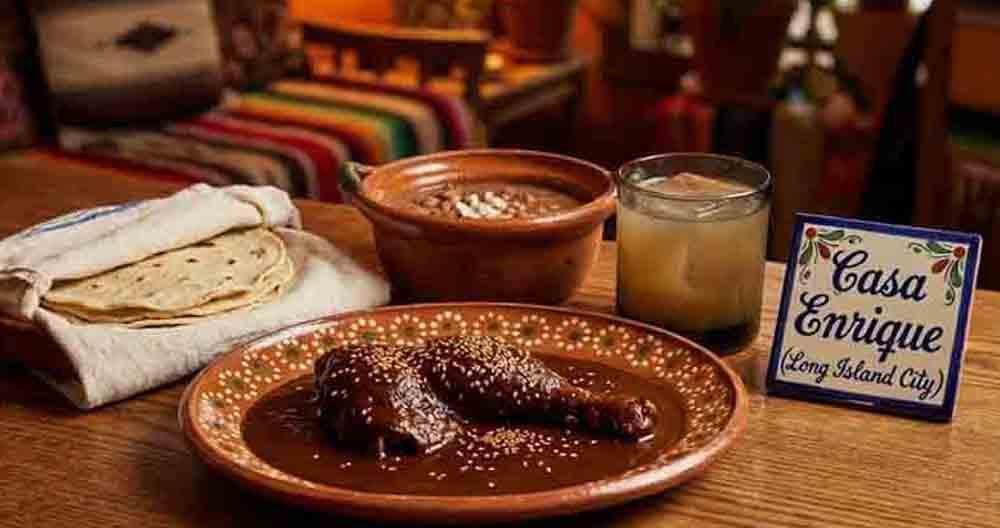
The Mole de Piaxtla is the restaurant’s gravitational center. It arrives draped over chicken legs, dark and glossy, whispering of sweetness and controlled heat. The recipe traces back to the small Pueblan town of Piaxtla, where Cosme’s father originally hailed from, and the mole paste itself is sourced through a network of Piaxtleco immigrants who have built an entire culinary supply chain across New York’s five boroughs (Roads & Kingdoms, 2018). Roughly sixty percent of Casa Enrique’s core ingredients — chilies, chocolate, sesame seeds, avocados, jalapeños — come through this network, a fact that underscores the deep immigrant infrastructure sustaining even the city’s most celebrated kitchens.
The Chamorro de Borrego al Huaxamole — a Colorado lamb shank braised in chili pulla peppers, huajes (a legume related to river tamarind), and the aromatic herb epazote — is the kind of entrée that announces itself in layers. The heat builds gradually, the lamb surrenders to the bone, and the rice and beans alongside it are not afterthoughts but structural elements of the plate. The Enchiladas Doña Blanca, named after Cosme’s mother, wrap roasted poblano chiles in corn tortillas under a slick of tomatillo salsa verde — a dish that manages to be both an homage and an evolution. The carne asada, marinated in tequila using a technique adapted from the brandy-soaking methods Cosme learned in French kitchens, bridges two culinary traditions in a single sear.
And then there is the Pastel Tres Leches — a sponge cake saturated past the point of structural integrity in goat’s milk caramel, condensed milk pooling at the plate’s edge like a sweet tide. The Infatuation, which rated Casa Enrique an 8 out of 10 and called it essential eating, was characteristically blunt in its assessment: you need to finish your meal with this (The Infatuation, 2025).
A Michelin Star and the Weight of History
In September 2014, Cosme was alone in the kitchen making mole paste when the phone rang. Only Luis and a handful of trusted contacts had the kitchen line’s number. Luis told his brother to sit down. Then he delivered the news: Casa Enrique had been awarded a Michelin star. Cosme thought it was a joke. When Luis started crying, Cosme realized it was real and began jumping around the kitchen by himself (Michelin Guide, 2018).
The star made Casa Enrique the first Mexican restaurant in New York City to achieve that distinction — a milestone that resonated far beyond the restaurant’s white-walled dining room. For the Mexican culinary community in New York, the recognition validated a cuisine that had long been relegated to the margins of “fine dining” conversations despite its extraordinary complexity. Cosme went on to receive the Michelin star seven times, was nominated for a James Beard Award in the Best Chef: New York City category in 2019, and became a fixture in every serious guide to the city’s dining landscape (LIC Post, 2019).
Wikipedia notes that the restaurant lost its Michelin star as of 2023, but that asterisk has done little to diminish the steady current of regulars who fill the dining room multiple nights a week. The Michelin Guide’s own page continues to list Casa Enrique prominently, praising the kitchen’s bigger plates and calling the mole excellent in all its forms (Michelin Guide, 2025). The restaurant has also earned a Travelers’ Choice award from Tripadvisor and has been named a Nextdoor Neighborhood Favorite across multiple Queens neighborhoods for seven consecutive years.
The Space: Whitewashed Walls and Patio Light
The interior of Casa Enrique reflects the same philosophy that governs the food — understated, warm, and designed to let substance take precedence over spectacle. Whitewashed walls frame simple wooden furnishings. The dining room unfolds like a converted townhouse, with several intimate areas each holding only a handful of tables. A charming outdoor patio extends the dining experience when the weather cooperates, and the overall atmosphere reads less as “destination restaurant” and more as being invited into someone’s exceptionally well-run home (DesignMyNight, 2025).
The restaurant occupies a stretch of 49th Avenue in the Hunters Point section of Long Island City — a neighborhood that has undergone dramatic transformation over the past two decades, evolving from a post-industrial corridor into one of the most sought-after residential enclaves in western Queens. One-bedroom condominiums in select waterfront buildings with East River views can run upward of $1.3 million, while the area’s proximity to Court Square and multiple transit lines (the 7 and G trains both serve the area) has attracted corporate tenants including Citibank, Altice, and JetBlue (Homes.com, 2025). Casa Enrique’s steadiness through this metamorphosis mirrors a pattern I recognize from my own quarter-century on Route 25A in Mount Sinai — the restaurants that survive neighborhood evolution are the ones that never mistake location for identity. The food is the identity.
Beyond Long Island City: Quique Crudo and the Expanding Vision
Chef Cosme’s ambitions did not stop at 49th Avenue. In late 2023, he opened Quique Crudo at 27 Bedford Street in Manhattan’s West Village — a walk-in-only, twenty-seat seafood counter that The New Yorker described as serving exquisite Mexican seafood dishes, potent cocktails, and the kind of atmosphere that feels like a vacation in one sitting (The New Yorker, 2024). The 700-square-foot space, outfitted with copper pots and an open kitchen visible from every stool, is about as intimate as New York dining gets. The menu is built around ceviches, aguachiles, fried oysters, and a crab tostada that reviewers consistently single out as extraordinary.
Quique Crudo represents an expansion without dilution — a natural extension of the same philosophy that built Casa Enrique. Cosme still oversees operations at the Long Island City flagship, but his new home behind the Bedford Street counter has become his favorite post. On his one day off — Sundays — he cooks simple meals for his wife and daughter at home: steak, pasta, nothing complicated (Herein Magazine, 2025). When asked whether Quique Crudo might also earn a Michelin star, Cosme offered the kind of grounded humility that defines his entire career: like an actor who does not work specifically to win an Oscar, but if it comes, welcome.
The Cocktail Program and Delivery Options
Casa Enrique’s cocktail program, directed by Luis Aguilar, is built around tequila, mezcal, and Latin American spirits crafted with the same attention to fresh ingredients that governs the kitchen. The signature Casa Enrique Margarita — Jimador Blanco, Patrón Citrónge, fresh lime juice, and brown simple syrup — arrives strong and balanced, the kind of drink that sets the tone for what follows. Flavored variations are available, and the frozen watermelon margarita has become something of a cult favorite during warmer months.
For those who cannot make the trip to Hunters Point, Casa Enrique offers delivery and takeout through DoorDash, Caviar, Grubhub, and Seamless, as well as through their own online ordering platform. The restaurant also accommodates reservations and has been noted for its accommodating approach to dietary needs — management reports that approximately eighty percent of the menu can be prepared gluten-free (Find Me Gluten Free, 2025). Weekend brunch service is available on Saturdays and Sundays, with dishes including chilaquiles, huevos rancheros, molletes, and the Doña Blanca enchiladas.
Contact Information and Practical Details
Address: 5-48 49th Avenue, Long Island City, NY 11101
Phone: (347) 448-6040
Website: casaenriquelic.com
Instagram: @casaenrique (34K followers)
DoorDash: Order Online
Grubhub/Seamless: Order Online
Hours: Monday–Thursday: 5:00 PM – 10:15 PM Friday: 5:00 PM – 10:30 PM Saturday: 11:00 AM – 10:30 PM Sunday: 11:00 AM – 10:15 PM
Reservations: Available (OpenTable-compatible)
Price Range: $$ (Moderate)
Transit: Accessible via the 7 and G trains (Vernon Blvd–Jackson Ave station)
Amenities: Outdoor patio, bar dining, counter seating, wheelchair accessible, corkage available, gluten-free options, pescatarian options, delivery and takeout
Sister Restaurants: Café Henri (Long Island City) and Quique Crudo (27 Bedford Street, West Village, Manhattan)
What Cosme Aguilar built at Casa Enrique is not merely a restaurant — it is a proof of concept. Proof that a car mechanic from Chiapas with no formal culinary education and no English can, through sheer precision and an unshakable devotion to his mother’s recipes, produce food that silences every room it enters. Proof that Mexican cuisine, when treated with the same seriousness granted to French or Japanese fine dining, does not just compete at the highest levels but redefines what those levels mean. I think about this often at The Heritage Diner — how the recipes we protect, the techniques we refuse to shortcut, the ingredients we source with intention rather than convenience — these are the things that outlast trends, outlast neighborhoods, outlast even the chefs themselves. Cosme once said he uses the word realizado — fulfilled — when he reflects on what the Michelin star means to him. It is what happens when you want something, work for it, and finally receive it. For those of us who measure our lives in decades behind the line, that word carries the weight of everything.
— Peter, The Heritage Diner, Mount Sinai, NY