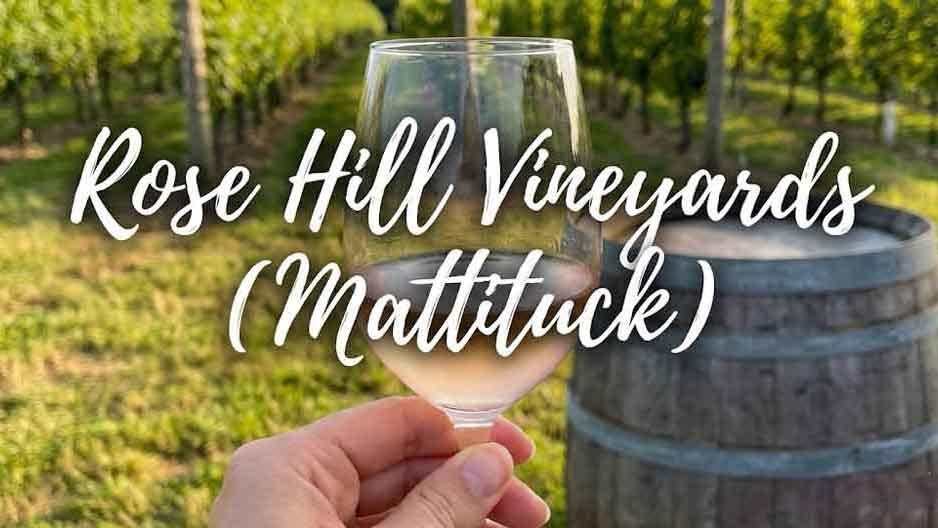
Tucked a full mile off the main road in Mattituck, past the farm stands and the flat ribbon of Route 25, Oregon Road narrows into something quieter — something the North Fork used to be before the party buses and Instagram selfie walls colonized the wine trail. At the end of that narrowing sits a 125-year-old barn, twenty-odd acres of sustainably farmed vines, and a four-room farmhouse inn that has been named a top destination by Fodor’s, Food & Wine Magazine, and Bon Appétit. This is Rose Hill Vineyards, formerly Shinn Estate — one of the most consequential properties in the history of Long Island winemaking, and today, under second-generation ownership, a place that still honors the radical conviction that great wine begins not in the barrel but in the soil beneath your feet. Its 2019 Clarity Cabernet Sauvignon recently earned the Governor’s Cup at the New York Wine Classic, cementing Rose Hill as a producer of state-defining reds. For anyone who believes that craftsmanship, patience, and a stubborn refusal to cut corners still matter in this world, this vineyard is a pilgrimage worth making.
From Tuthill Farm to Shinn Estate: The Founding Story
The land at 2000 Oregon Road carries centuries of agricultural memory. Before it ever held a grapevine, it was the historic Tuthill homestead, worked by generations of Long Island farmers whose labor shaped the very topography of the North Fork. In 1998, two native Midwesterners who had met a decade earlier in the San Francisco Bay Area — Barbara Shinn, an artist with a Master of Fine Arts degree, and David Page, a classically trained chef — purchased the 22-acre parcel after years of driving up and down Oregon Road, falling a little more in love with it each time (Grape Collective, 2021). Neither had ever grown a grape or fermented a drop of wine.
What they did bring was a decade of experience running Home, one of the East Coast’s first farm-to-table restaurants in Manhattan’s West Village — a place where local sourcing and New York State wines were not marketing gimmicks but operational principles (VinePair, 2021). They planted the first vines in 2000, released their inaugural vintage in 2002, and within a few years had attracted the attention of Eric Asimov, the New York Times wine critic, who became a vocal champion of their bottles. Shinn Estate Vineyards became, almost overnight, a force that shook the North Fork establishment. Their insistence on biodynamic methods, indigenous yeast fermentation, and zero additives was dismissed by neighboring winemakers as impractical, even reckless. Barbara Shinn later founded Long Island Sustainable Winegrowing, the East Coast’s first third-party-certified sustainable viticulture program, which now counts over twenty member vineyards and inspired the statewide New York Sustainable Winegrowing initiative (Northforker, 2025). The pioneers, it turned out, were right.
The Frankel Chapter: New Stewards, Same Philosophy
In April 2017, Randy Frankel — a former Goldman Sachs managing director, minority owner of the Tampa Bay Rays, and majority owner of four European soccer teams — visited the North Fork for the first time and purchased Shinn Estate that same day (Dan’s Papers, 2022). It was not a hostile takeover of craft by capital. Randy and his wife Barbara chose the property precisely because of its sustainable DNA, and their first move was to retain winemaker Patrick Caserta, who had joined Shinn in 2011 after a career spanning Vieux Château Certan and Le Pin in Bordeaux, Rudd and Plumpjack in Napa, and Te Mata in New Zealand (Long Island Press, 2022).
The Frankels spent years earning the community’s trust before changing a single label. Their daughter Chelsea took over day-to-day management, and her sister Amanda assumed operations at Croteaux Vineyards in Southold, which the family also co-owns. The name “Rose Hill” came from the family’s New York roots — the place where they first planted themselves in the state — and debuted initially as a single rosé before expanding to cover the entire portfolio in spring 2021 (Northforker, 2021). The renovation that followed was meticulous and respectful: a Wine Library featuring a bar salvaged from a 1921 London pub, exposed beams, wide-plank hardwood floors, and green velvet chesterfield sofas that could have stepped out of Architectural Digest. The tasting room’s subway-tiled bar and the double doors opening onto the barrel cellar made The Infatuation call it one of the North Fork’s most intimate and worthwhile stops (The Infatuation, 2024). The Frankels have since acquired the historic 66-acre Ruland farm property down the road, planting 70,000 vines of twelve varietals and restoring a farmhouse that dates to roughly 1716.
The Wines: Terroir Without Artifice
Rose Hill’s winemaking philosophy can be summarized in a single principle inherited from Barbara Shinn and David Page: the wine should be a living memory of the time and place it was grown. Patrick Caserta continues to ferment with indigenous yeast from the vineyard’s own soils — no cultured strains, no added acids or sugars, no coloring agents, no enzymes. The cellar where the wines age sits in a quiet barn built from reclaimed first-growth heartwood pine, its roof supporting solar panels that, alongside a wind turbine, generate all the energy used by the winery, cellar, vineyard, and farmhouse inn (I Love NY, 2025). Rose Hill was the first East Coast winery and inn to be entirely powered by alternative energy.
The portfolio is anchored by several standout bottles. The Wild Boar Doe, a playful Bordeaux-style blend of merlot, cabernet franc, petit verdot, and malbec, has become Rose Hill’s signature red — tongue-in-cheek in name, dead serious in the glass, with notes of grilled cherry, anise, licorice, and subtle earth. The Coalescence, a white blend originally conceived by Page and Shinn, marries chardonnay, sauvignon blanc, and riesling into something bright and versatile enough for a seaside clambake or an afternoon on the patio. The Concrete Blonde — sauvignon blanc fermented in a Marc Nomblot concrete egg — offers a full-bodied, floral alternative to the estate’s racier stainless-steel whites. And the First Fruit sauvignon blanc, always the first grapes harvested each fall, delivers the crisp acidity that pairs so naturally with the North Fork’s legendary shellfish. The 2019 Clarity Cabernet Sauvignon, awarded the Governor’s Cup as best red wine in New York State at the 2025 New York Wine Classic, may be the finest bottle Rose Hill has yet produced (Rose Hill Vineyards, 2025).
The Farmhouse Inn: Where Hospitality Meets the Vine
Rose Hill is not merely a tasting room — it is a destination. The four-room Farmhouse Inn, a beautifully restored historic structure with a wraparound porch and individually designed rooms, offers overnight stays that include complimentary wine tastings, a country breakfast with made-to-order waffles and homemade scones, afternoon wine and cheese service, and discounts on wine purchases. There is no minimum-night requirement — a rarity in a region notorious for weekend minimums and steep prices (27 East, 2018). Rates range seasonally, and the guest experience has earned devoted repeat visitors who compare it favorably to properties in Napa Valley.
The grounds themselves unfold into multiple distinct spaces: a covered patio overlooking the vineyards, lawn seating among the vines on sunny days, and the Wine Library interior for cooler weather — all operating on a first-come, first-served basis. News 12 Long Island featured the property as an East End destination, noting the Frankel family’s attentive restoration and their commitment to making guests feel the vineyard is their own private retreat. Rose Hill also hosts wine club pickup parties, seasonal events, and occasional craft workshops like pressed-flower frame-making classes, giving the property a community dimension that extends beyond the bottle.
Sustainability as Legacy: The North Fork’s Green Standard
What Barbara Shinn and David Page built at this address was not just a vineyard — it was a proof of concept for an entire region. Their decision to forgo chemical herbicides, pesticides, and synthetic fertilizers in favor of cover crops, composted winemaking remains, organic seaweed and fish amendments, and biodynamic preparations was openly mocked by neighboring vineyards in the early 2000s (VinePair, 2021). The word “biodynamic” drew accusations of witchcraft. Long Island wine country, as publisher Lenn Thompson noted, was not a community where anything new was embraced easily. But the results spoke for themselves. By 2012, Shinn Estate was among the founding vineyards certified by Long Island Sustainable Winegrowing. The vineyard became a thriving ecosystem — dandelions, asters, goldenrod, and sorrel growing beneath the vines; rabbits, birds, beneficial insects, and honeybees all contributing to what the estate described as “vineyard as ecosystem” (Markets Media, 2012).
Under the Frankels, this commitment has only deepened. Rose Hill’s wines are certified sustainable by LISW, and vineyard practices are guided by the cycles of the moon. The estate’s solar-and-wind energy independence remains intact. When the New York Wine and Grape Foundation launched its statewide sustainability pilot in 2022, it modeled the framework directly on the Long Island program that Shinn helped create (Northforker, 2025). The vineyard at 2000 Oregon Road did not just adopt sustainability — it helped write the rules.
Visiting Rose Hill: What You Need to Know
Rose Hill Vineyards is open daily for wine tastings and light bites, with walk-ins welcome on a first-come, first-served basis. Wine club members may make reservations by contacting the vineyard directly. The tasting menu includes flights, wines by the glass and bottle, and a selection of small plates including charcuterie boards, whipped ricotta, olives, and lobster sliders. The dress code is casual, and the atmosphere is deliberately unpretentious — no limo convoys, no DJ sets, no velvet ropes. Dogs are welcome in outdoor seating areas.
The wine club, curated by Patrick Caserta, ships seasonal selections and grants members access to exclusive pickup parties and events. For those looking to extend the experience, the Farmhouse Inn accepts bookings year-round. The property is wheelchair accessible, offers gender-neutral restrooms, and accepts all major credit cards.
Address: 2000 Oregon Road, Mattituck, NY 11952
Phone: (631) 804-0367
Website: rosehill-vineyards.com
Instagram: @rosehillvineyards
Hours: Sunday–Thursday 11:00 AM – 5:00 PM | Friday–Saturday 11:00 AM – 6:00 PM | Closed Monday & Tuesday
Price Range: $31–$50 per person
Parking: Free on-site
Reservations: Walk-ins welcome; wine club members may reserve directly
Peter, a 25-year restaurateur at The Heritage Diner in Mount Sinai, writes about the places, craftsmanship, and philosophy that define Long Island’s North Shore and beyond. He holds graduate degrees in Philosophy from Long Island University and The New School.