Most people know Charles Darwin the way they know a monument: imposing, fixed, slightly remote. The long beard. The finches. The line about survival of the fittest that Darwin never actually wrote. What Randal Keynes does in Darwin, His Daughter, and Human Evolution is something far more unsettling and more valuable — he restores the man inside the monument. What emerges is a portrait of someone who carried one of the most destabilizing ideas in intellectual history not as an abstraction, but as a personal wound. The weight of natural selection sat inside a house filled with children, a devoted wife, and the creeping certainty that the universe operated on indifference.
That the book exists at all is owing to a piece of luck that reads like something from a Victorian novel. Keynes, himself a great-great-grandson of Darwin (and a descendant of the economist John Maynard Keynes), discovered in a chest of drawers bequeathed by his grandmother a small writing case that had belonged to Darwin’s daughter Annie. Inside: goose-quill pens, a lock of hair, her father’s handwritten notes on her failing health, and a private memorial Darwin composed after she died. Annie was ten years old. The writing case had been quietly preserved for generations, nearly forgotten, and it became the spine of everything Keynes built here.
The Myth of the Cold Intellect
There is a persistent caricature of Darwin as the man who drained sentiment from science, who reduced love to an evolutionary strategy and grief to a neurochemical event. That caricature deserves to be retired, and this book does the work decisively. Darwin was not a cold intellect. He was, by all the evidence assembled here, a man whose affective life ran deep enough to inform his science at every level — not contaminate it, but fuel it.
He observed his children with the precision of a field naturalist, yes, but his son Francis would later recall that Darwin’s empathy with a crying child routinely overcame his scientific attention. He could not hold the clinical detachment long enough to complete the observation. The grief spoiled it. For a man building a theory about animal behavior and human emotion, this is almost paradoxical: the very emotions he was trying to categorize kept breaking through his methodology.
This is what Keynes means when he writes, at the outset, that Charles’s life and his science were all of a piece. The theory did not stand apart from the man. It grew out of him.
A Marriage Built for Doubt
Before Annie, before the finches and the barnacles and the long years of collecting evidence at Down House in Kent, there was Emma Wedgwood — a woman of independent mind, genuine faith, and what Keynes makes clear was an entirely unsentimental love for her husband. When Darwin was still deciding whether to marry at all, he took a piece of paper and wrote at the top: “This is the question.” His list of reasons not to marry included the loss of freedom, the expense of children, and the inconvenience of visiting relatives. He married Emma anyway, and it was among the better decisions of his life.
Their marriage was not placid in the philosophical sense. Emma was a practicing Christian; Darwin was moving, slowly and with real reluctance, away from any faith in a benevolent God. She worried about him. He knew she worried. The tension between them on this question was genuine and tender, never weaponized. Keynes draws from their correspondence with a careful hand, showing a couple who managed to keep devotion intact across a theological chasm neither of them fully wanted to acknowledge. That friction between Emma’s faith and Darwin’s skepticism runs quietly through the book’s second half, sharpened to a point by what happens to Annie.
Annie’s Death and the End of Mercy
Annie Darwin died on April 23, 1851, at the age of ten, almost certainly from tuberculosis — a diagnosis that Keynes argues persuasively based on the progression of her symptoms and her father’s meticulous notes. She had been bright, warm, full of small attentions and tenderness toward her father. Darwin adored her. The notes he kept during her final illness are clinical in form and devastating in substance: the daily deterioration of a child observed by a man who understood, from the inside of his own theory, exactly what it meant that no mercy was coming.
It is here that the intellectual portrait the book promises becomes impossible to separate from the human one. Darwin had already been moving toward the conclusion that natural law operated without moral design — that suffering and beauty alike emerged from the same blind, indifferent mechanism. But there is a difference between arriving at that conclusion through barnacle taxonomies and arriving at it through the bedside of your daughter. Annie’s death did not create Darwin’s materialism. It confirmed it, and it darkened it. In a private letter written afterward, he described nature’s operations as clumsy, wasteful, blundering, low, and horridly cruel. The detachment of the earlier years was gone.
Keynes is careful not to reduce the theory to the biography — that would be its own kind of distortion. But he makes a persuasive case that the anguish of watching Annie die sharpened Darwin’s conviction that natural law had nothing to do with divine intervention or morality. The God of providential design, already strained by the evidence of the fossil record, could not survive what Darwin saw in that room in Malvern.
The Expression of Emotion and the Question of Human Nature
One of the book’s quieter achievements is its handling of Darwin’s later work, particularly The Expression of the Emotions in Man and Animals, published in 1872 — a book that tends to be overshadowed by the twin monuments of On the Origin of Species and The Descent of Man. Darwin had predicted in Origin that psychology would eventually be placed on a new foundation, and the emotions book was his attempt to begin that work. He was, in the estimation of more than one historian of science, the first evolutionary psychologist.
What Keynes brings out is the way Darwin’s study of emotional expression was rooted in observation of his own family — his children’s faces, his own responses to their distress, the way grief registered in the body across cultures and species. He sent questionnaires to naturalists and missionaries around the world asking whether people from different cultures raised their eyebrows in surprise, whether they pressed their lips together in concentration, whether they wept. The answer, consistently, was yes. The universality of human emotional expression was evidence for common descent and, in Darwin’s framing, for the deep mammalian history buried inside every human face.
This is where the book becomes genuinely moving for readers interested in the history of ideas. Darwin was not just building a theory of biology. He was trying to understand what the theory meant for what it is to be human — whether love, grief, affection, and moral feeling could be real and meaningful even if they had evolved from animal antecedents. He never resolved this fully. Few people have.
What Keynes Brings to the Story
Randal Keynes is not a Darwin scholar by profession — he is a British conservationist, which lends the book a quality that pure academic biography sometimes lacks: an eye for the texture of daily life, for the house and the garden and the children underfoot. His use of primary sources is meticulous without being pedantic. He draws on Victorian periodicals, contemporary novels, family letters, and the recollections of Darwin’s surviving descendants, weaving them into a narrative that reads more like a sustained biographical essay than an academic study.
He does not break new scholarly ground about Darwin’s theory, as Publishers Weekly noted when the book first appeared in 2001. But that is not quite the right measure. What he breaks is the distance that accumulates around famous thinkers over time — the tendency to treat intellectual biography as a history of publications rather than a history of a person. The Financial Times called it a rare biography that reveals the key emotional moment in its subject’s personal and intellectual life with unusual clarity, and that assessment holds.
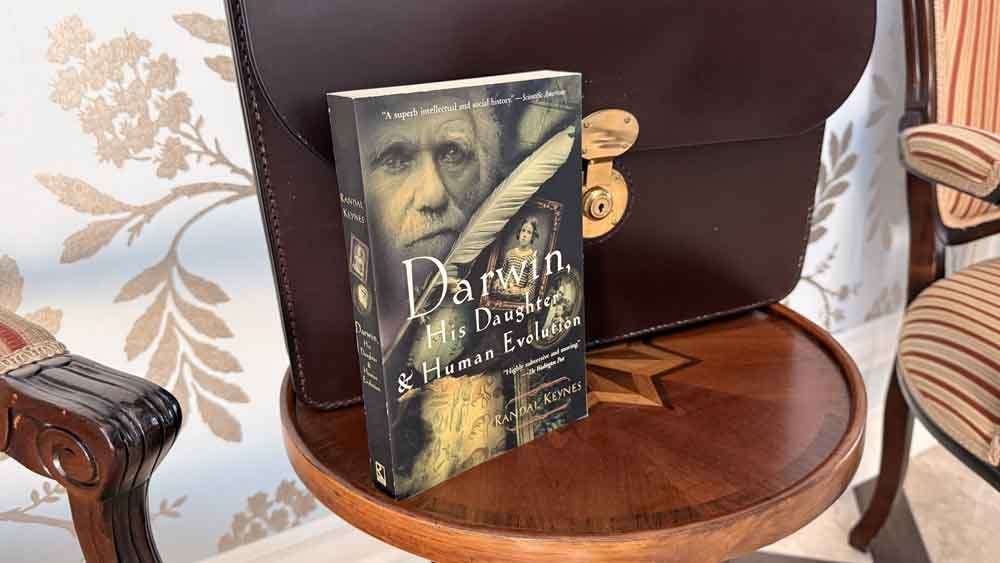
The book was originally published in the United Kingdom under the title Annie’s Box, which is arguably the more honest title. Annie is not quite a secondary character in the American edition’s framing, but the emphasis on human evolution in the subtitle risks overpromising on the theoretical content. This is, at its core, a book about what Darwin felt and how what he felt made him who he was. Readers who come looking for a deep dive into the mechanics of natural selection will find it present but not primary. Readers who come wondering who Darwin actually was — where the ideas lived inside a life — will find something rarer.
The Man Beneath the Theory
There is a moment Keynes returns to obliquely throughout the book: Darwin writing to his friend Sir Joseph Hooker during a period when Hooker’s own young son was ill, drawing on the memory of Annie’s death to offer comfort. The line has the weight of something earned rather than composed: much love, much trial, but what an utter desert is life without love. This is not a philosopher abstracting about emotional value. It is a man who spent decades proving, to his own satisfaction, that love was the product of primate evolution — and who felt its loss as acutely as anyone who ever lived.
That tension — between the explanatory and the felt, between the mechanism and the meaning — is not something Darwin resolved, and it is not something the book pretends to resolve. It is, in fact, the thing that makes both Darwin and this book worth sitting with. The theory does not diminish the grief. The grief does not invalidate the theory. They existed in the same man, in the same house, in the same carefully kept notebooks that a great-great-grandson found, decades later, inside a small wooden box.
Darwin, His Daughter, and Human Evolution is available in paperback from Riverhead Books via Penguin Random House and on Amazon.
You Might Also Like:
- Thus Spoke Zarathustra by Friedrich Nietzsche — The Book That Rewired My Understanding of Everything
- The God Delusion by Richard Dawkins — A Review
- Horizontal Gene Transfer: Why Darwin’s Tree of Life Is Actually a Tangled Web
Sources
- Keynes, Randal. Darwin, His Daughter, and Human Evolution. Riverhead Books / Penguin Random House. https://www.penguinrandomhouse.com/books/290967/darwin-his-daughter-and-human-evolution-by-randal-keynes/
- Publishers Weekly review of Darwin, His Daughter, and Human Evolution. https://www.publishersweekly.com/978-1-57322-192-4
- Amazon editorial and reader reviews. https://www.amazon.com/Darwin-His-Daughter-Human-Evolution/dp/1573229555
- ISCAST Journal review by Charles Sherlock. https://journal.iscast.org/cposat-volume-4/randal-keynes-annies-box-charles-darwin-his-daughter-and-human-evolution