
The Numbers
Start with the data, because the data is startling enough on its own.
Mitch Lebovic, an administrator at the SSIA, puts the peak of the shoe repair industry at World War II — leather and rubber were rationed for the war effort, so getting your shoes resoled was not a moral choice but a material necessity. After the war, with rationing lifted and prosperity building, the logic changed. New shoes became affordable. Cheaper shoes became even cheaper. And the repair economy, which had functioned for generations on the understanding that a good pair of leather boots was an investment worth maintaining, began to erode.
In 2020, there were still around 5,000 shops. In the years immediately following, an estimated 1,500 more closed during the COVID-19 pandemic. Today the SSIA counts approximately 3,500 nationally, and the industry’s own analysis projects further decline. According to IBISWorld’s 2025 industry report, there are 3,339 shoe repair businesses in the United States, declining at a compound annual rate of 1.9 percent over the last five years.
And the age profile of the people running those remaining shops is not optimistic. The majority are run by people approaching retirement, many of them second- or third-generation cobblers with no one to pass the business to. When they close, the business closes with them.
Jim McFarland, past president of the SSIA, put it plainly when surveying the landscape: “It’s quite the juggling act right now. For the ones that are good and strong, it’s the best time of their career.” The best time because they’re the last ones left. Demand is starting to outpace supply in some markets — not because people suddenly developed a conscience about throwaway culture, but because there’s no one else left to do the work.
What a Cobbler Actually Does
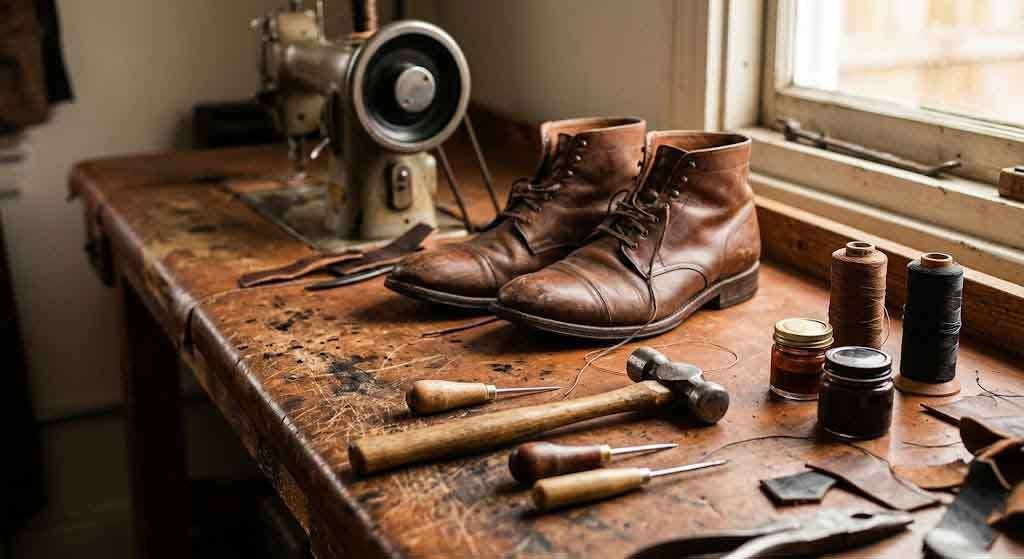
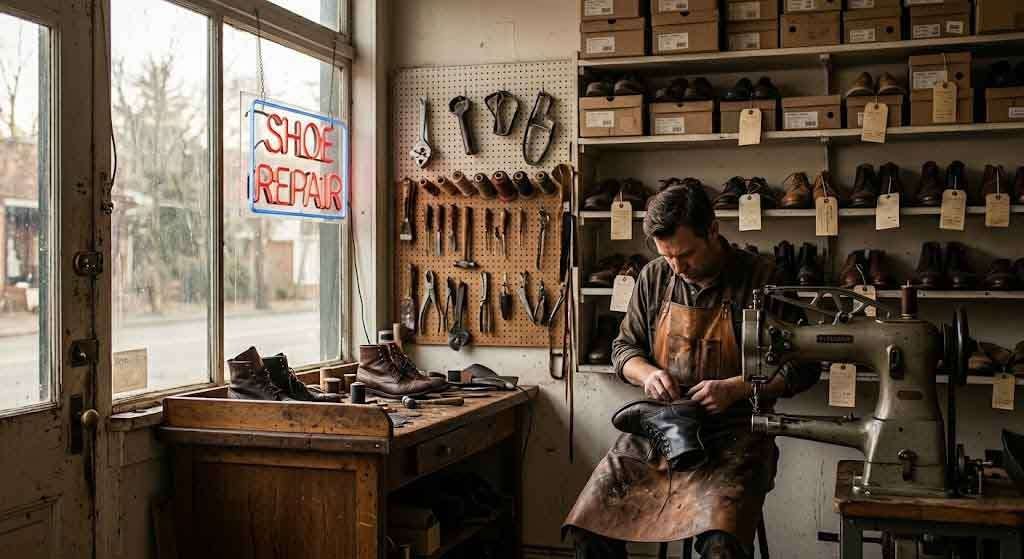
The word cobbler has a long history of being used imprecisely, so it’s worth being clear. A cobbler is a shoe repairman — not a shoemaker, which is a different, older, more demanding trade. A cobbler resolves, re-heels, stitches split uppers, replaces insoles, strips and re-dyes leather, stretches tight shoes, replaces worn toe caps, and treats the leather to keep it from cracking. A skilled cobbler can take a pair of dress shoes that are ten years old and look like they were made last month — the leather re-dyed to its original depth, the sole replaced with something better than what came with the shoe, the heel square and solid again.
It is skilled manual work. It requires reading leather the way a mechanic reads an engine — understanding what the material wants to do, where it is failing, what it will accept and what it will reject. The machines involved are often decades old and irreplaceable. Sam Di Mauro, a third-generation cobbler in Omaha whose family has been in the trade since 1923, uses a stitching machine built in 1959 that he calls “the bread and butter” of the shop. When that machine goes, finding a replacement is not a catalog order.
I work with leather at a different level — the construction of English bridle leather briefcases at Marcellino NY, where a piece might take months to complete and years to fully develop its character. I understand the feel of a material that’s been properly treated versus one that’s been rushed. I understand why the quality of the work is inseparable from the quality of the time put into it. A cobbler understands the same thing, down at the level of a resoled boot heel. The material doesn’t lie. Either the stitch is right or it isn’t.
How We Got Here
The decline tracks almost exactly with the rise of fast fashion. In the early 1990s, chains like Payless began flooding the market with cheap synthetic footwear. The logic shifted: why pay forty dollars to resole a pair of shoes when you could pay fifty dollars for a new pair? The answer — that the new pair would fall apart in a year and the old pair, properly maintained, would last another decade — requires a kind of thinking that cheap things train out of you. If everything is replaceable, you stop building the instinct to repair.
“Things became more replaceable,” says D.J. Annicchiarico, whose great-grandfather opened United Shoe Repair in Concord, New Hampshire, “and people cared a little less about spending the extra money on a higher-quality pair of shoes.” The correlation is direct. The cheaper the shoes, the less worth fixing. The less worth fixing, the fewer cobblers. The fewer cobblers, the less infrastructure to fix even the shoes worth fixing.
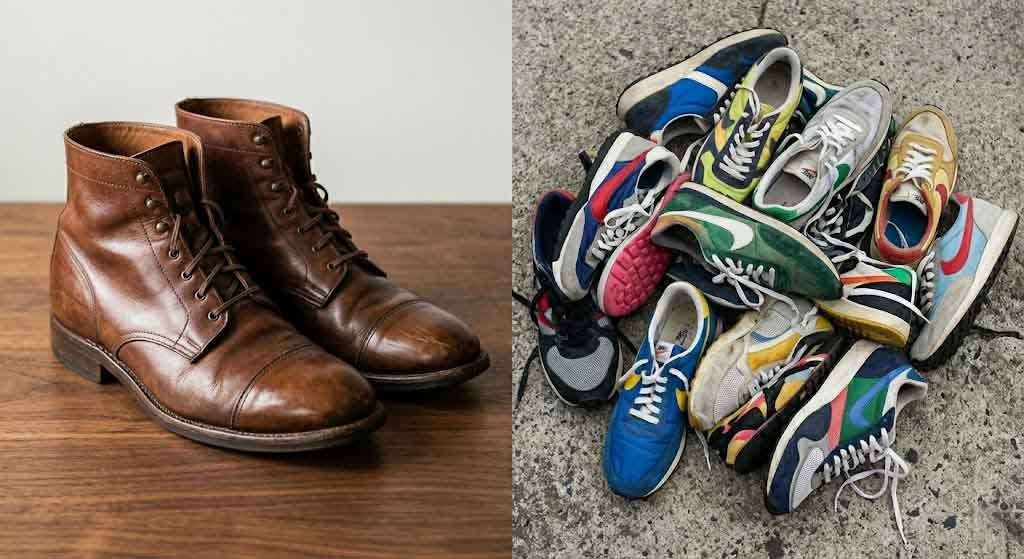
Now we’re buying and discarding at a rate that would have seemed obscene to anyone from an earlier generation. The average American buys approximately seven pairs of shoes a year. Almost all of them end up in landfills, because the synthetic materials used in fast-fashion footwear — bonded leather, injection-molded soles, glued construction — cannot be practically repaired and are not designed to be. You don’t resole a sneaker. You throw it away and buy another sneaker.
That is not just an environmental problem, though it is obviously also that. It is a cultural problem. It is the material expression of a society that has lost the habit of maintenance.
What Maintenance Actually Is
Maintenance is a form of respect. When you resole a boot, you are making a statement about the value of that object — that it was made with enough skill and materials that it is worth the time and money to extend its life. When you maintain a car, a kitchen knife, a cast-iron pan, a leather briefcase, you are saying: this thing has value beyond its current condition. You are participating in a relationship with the object rather than just consuming it.
That relationship used to be assumed. Every household had things that were maintained. Clothes were mended. Shoes were resoled. Knives were sharpened. Furniture was repaired rather than replaced. Not because people were especially virtuous, but because that was how economic reality worked for most people — you didn’t have the money to replace things constantly, so you maintained what you had. The skill of maintenance was passed down the same way any practical knowledge gets passed down: from person to person, in the shop, in the kitchen, in the garage.
When cheap consumer goods made replacement easier than repair, the maintenance habit didn’t die immediately. It eroded. The people who had it stopped needing it. The people who came after never learned it. And the craftsmen who provided the services that maintenance depended on — the cobbler, the tailor, the appliance repairman — lost their customer base and their successors simultaneously.
The cobbler shops are closing because the old men who run them are retiring and nobody is picking up the hammer. There’s no training infrastructure. The SSIA lists apprenticeship data that is bleak: the most popular apprenticeship programs in recent economic surveys are plumbing and electrical. Cobblery doesn’t appear. There are no trade schools specifically teaching shoe repair in the United States. The knowledge exists in the hands of aging craftsmen, and when those hands stop working, the knowledge goes with them.
The Ghost of the Shoemaker’s Shop
In the working-class neighborhood where I grew up, in Brooklyn, there was a cobbler on almost every commercial block. Not a boutique — a shop. Small, smelled like rubber cement and leather dye, a Greek or Italian or Jewish man behind the counter who had been doing the work since before you were born. You brought your shoes in. He fixed them. You picked them up. The transaction had no ceremony. It was just the way things worked.
Those shops are almost gone from Brooklyn now too. A few survive, usually run by the same families that have always run them, in neighborhoods where the old ethnic character has held. They are busy — not because the neighborhood has changed its values, but because there are so few left that each remaining one absorbs the demand of several former ones.
In New Hampshire, a cobbler named Daubenspeck described the shoes that come through his shop — a pair chewed by a dog that belonged to a dead husband, cowboy boots headed to a funeral, size 2 wedding shoes being passed down for generations. “There are things that are crazy sentimental,” he says. The economics and the sentiment both pull in the same direction: some objects are worth keeping.
We went from resoling a good pair of leather boots to throwing away plastic sneakers every six months. It is not just bad for the earth — though it is definitely bad for the earth. It is bad for the way we understand value, maintenance, and the relationship between the quality of what we make and the length of time we’re willing to keep it.
What Comes Next
The SSIA’s own assessment holds a complicated kind of optimism. Demand for shoe repair is, in some markets, beginning to outpace supply. There is a small but real movement toward quality footwear — the resurgence of Goodyear-welted boots, the interest in American-made leather goods, the sustainability argument that a $400 pair of boots maintained over ten years is better economics and better ethics than seven pairs of $60 synthetic sneakers. Younger cobblers who do excellent work and use social media to make the craft visible are drawing new customers.
But the arithmetic of the decline is stubborn. When a third-generation cobbler retires without an apprentice, that shop is gone. The machinery goes to an estate sale. The knowledge goes with the craftsman. You cannot rebuild a century of trade knowledge quickly, and you cannot rebuild it at all if the economic conditions don’t make the learning worthwhile.
The shops that remain deserve the business. If you have a cobbler still operating in your town, you already know whether your shoes are worth fixing. If they’re leather and they were made with any care at all, the answer is yes. Take them in. Get them resoled. Pick them up and wear them for another ten years.
The alternative is the landfill. The alternative is always the landfill.
You Might Also Like
- How to Read a Leather Label: Spotting Real Quality vs. Marketing Hype
- Full Grain vs. Top Grain vs. Genuine Leather: What You’re Actually Buying
- 15 American Leather Goods Makers You Should Know About in 2026
Sources
- Shoe Service Institute of America (SSIA): https://www.ssia.info/
- IBISWorld — Shoe Repair in the US Industry Analysis, 2025: https://www.ibisworld.com/united-states/industry/shoe-repair/1714/
- Stitchdown — The Cobbling Industry Is in a Dire Decline: https://www.stitchdown.com/stitchdown-shoecast/cobbling-industry-in-decline/
- Keene Sentinel — Soles Worth Saving: https://www.keenesentinel.com/business/soles-worth-saving-nh-s-cobblers-keep-a-fading-craft-alive/article_31190560-02ac-11f0-aff9-ff0525c78517.html
- Baltimore Magazine — Kofman’s Shoe Repair: https://www.baltimoremagazine.com/section/community/kofmans-shoe-repair-fourth-generation-cobbler-lexington-market/
- Omaha World-Herald — Omaha Shoe Repairman: https://omaha.com/news/local/business/omaha-shoe-repairman-fixes-everything-from-taylor-swifts-boots-to-gear-for-firefighters/article_2ffde00e-a4ef-11ee-8c83-3f32d32d727c.html