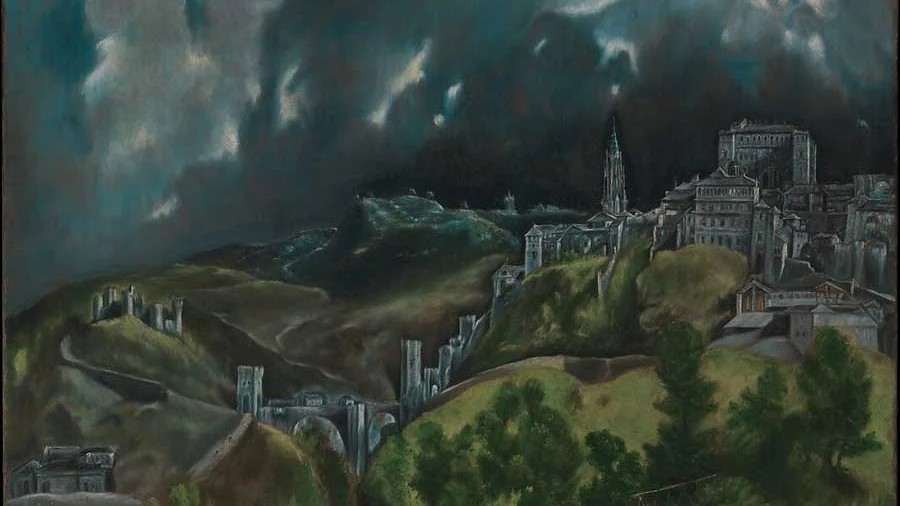
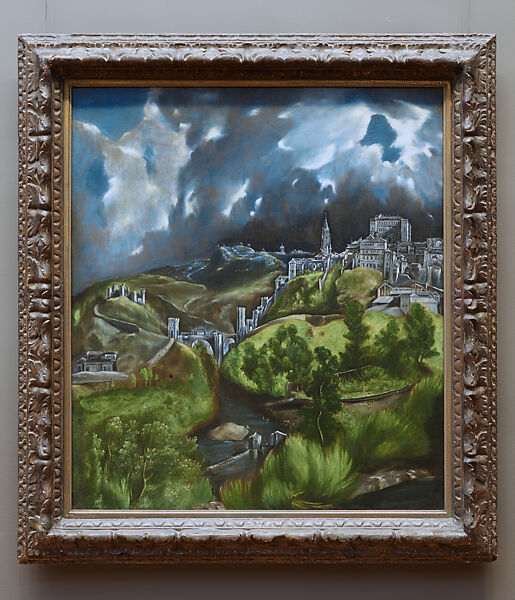
Every landscape carries a mood. Most painters work to suppress it — to render the terrain accurately, neutrally, as a record of what was there. El Greco did the opposite. Standing in front of View of Toledo at the Metropolitan Museum of Art, what hits you first isn’t the city. It’s the sky. Boiling green-black clouds, lit from within by a cold, sourceless light, pressing down on a hillside city that glows as if radioactive against the storm. The grass is wrong. The light is wrong. The proportions are wrong. And the whole thing is so completely, viscerally right that you forget to breathe for a moment.
Doménikos Theotokópoulos — El Greco, the Greek — painted this around 1599 to 1600, late in a career spent remaking every visual convention he touched. He was born in Crete, trained in Venice under Titian’s influence, passed through Rome, and finally settled in Toledo, Spain, where he spent the last four decades of his life. By the time he painted this view from the hills above the Tagus River, he had been living in Toledo long enough that the city wasn’t just his subject. It was his interior landscape made exterior.
A Place Becomes a State of Mind
Toledo in 1599 was a city of enormous symbolic weight — the former capital of Castile, seat of the Spanish Inquisition, a city of churches, fortresses, and the tangled architectural memory of Christian, Muslim, and Jewish coexistence. El Greco knew its stones the way you know a place you have walked every morning for thirty years. And yet what he painted is not recognizable as a documentary record. The Alcázar fortress and the cathedral are both present, but their positions relative to each other have been deliberately rearranged. El Greco moved the cathedral to make the composition work. He wasn’t interested in accuracy. He was interested in truth.
That distinction — between accuracy and truth — is one I find myself returning to whenever I sit with this painting. A map of Toledo would give you the first. El Greco gave you the second: the emotional and psychological reality of a place, the way a city feels when you’ve absorbed it so deeply that it starts to feel like an extension of your own nervous system. The storm isn’t meteorological. It’s existential. That sky is what Toledo looked like from the inside of El Greco’s mind.
I think about this when I drive down Route 25A along the North Shore — how a stretch of road you’ve traveled a thousand times stops being a road and starts being something closer to a state of consciousness. The specifics blur and what remains is a feeling, a quality of light off the Sound, the way the trees close over the road in summer. El Greco painted that experience and called it a city.
The Color That Shouldn’t Work
The palette of View of Toledo has no precedent in landscape painting up to that point and precious few successors until the late nineteenth century. The greens are phosphorescent — not the warm, earthy greens of a Flemish landscape or the golden-green of a Claude Lorrain pastoral, but something cooler and stranger, the green of deep water or a sky three minutes before a violent storm. The light on the buildings is white-gold, almost bleached, as if the city itself is the source of illumination rather than the sun.
El Greco learned color in Venice, where Titian and Tintoretto had pushed the expressive possibilities of oil paint further than anyone before them. But where Venetian color tends toward warmth and sensory richness, El Greco pulled in the opposite direction — cooler, more spiritual, more interested in light as symbol than light as atmosphere. His years studying Byzantine icon painting in Crete left a mark that no amount of Italian training fully erased: in icon painting, light is theological. It doesn’t fall on things. It emanates from them.
That theology is visible in View of Toledo. The city glows because it is meant to glow — because Toledo, for El Greco, was a sacred place, a city whose history of faith and conflict had charged the very air with meaning. The anachronistic light is not a failure of observation. It is a confession of belief.

Brushwork as Weather
Up close, the painting is barely controlled turbulence. The clouds are built from thick, dragged strokes of grey-green and near-black, applied with the kind of physical urgency that anticipates the gestural painting of the twentieth century by three hundred years. The hillside grass is a series of rapid, flickering marks — not a description of grass but an impression of it, the way grass registers in peripheral vision when you’re moving. The buildings are more resolved but still loose at their edges, bleeding slightly into the sky as if the boundary between architecture and atmosphere is a matter of negotiation rather than fact.
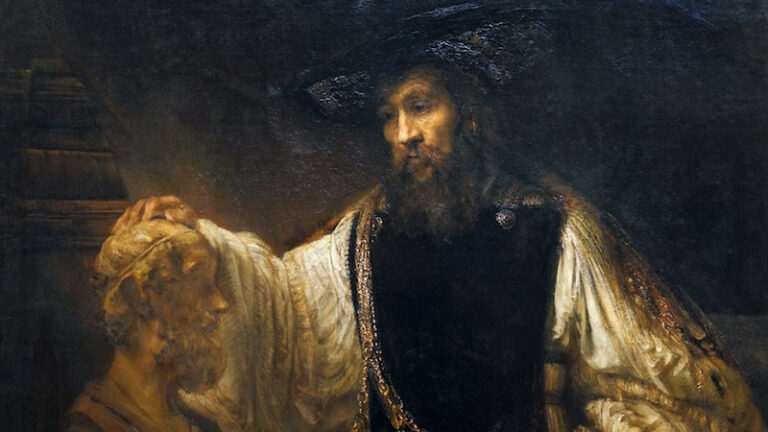
El Greco’s late technique was so idiosyncratic that his contemporaries sometimes struggled to account for it. A persistent and entirely apocryphal story claimed he painted in a darkened room because sunlight interfered with his “inner light.” The story is almost certainly false but philosophically accurate — his mature work operates as if ordinary visual perception were a distraction from what he was actually trying to see. In my review of Rembrandt’s Aristotle with a Bust of Homer, I wrote about how Rembrandt used shadow as a space for interior life. El Greco does something related but more radical: he eliminates the boundary between interior and exterior entirely. The weather is psychological. The city is a feeling. The painting is a mind.
What He Rearranged and Why It Matters
The decision to move Toledo’s cathedral is easy to dismiss as artistic license, but it repays closer attention. In the actual topography, the cathedral sits lower and further from the Alcázar than El Greco places it. In the painting, the two landmarks are brought into tighter relationship, the cathedral rising more prominently against the storm sky. The effect is to make the city’s sacred and secular power — church and fortress — into a unified statement, a single silhouette against the apocalyptic weather.
El Greco was not confused about where the buildings stood. He had walked that city for decades. The rearrangement is a curatorial decision, an argument about what Toledo means rather than what it contains. This is, in miniature, what all great art does: not reproduce the world but reorganize it according to an inner logic that reveals something the faithful reproduction would have obscured.
It connects, for me, to the philosophical tradition El Greco would have absorbed through his long immersion in Counter-Reformation Spain — the idea, present in Neoplatonism and running through Christian mysticism, that the visible world is a series of signs pointing toward an invisible reality. The cathedral doesn’t need to be where it actually stands. It needs to be where it means something. El Greco put it there.
The Painting That Didn’t Fit Its Century
View of Toledo was largely unknown outside Spain until the nineteenth century, when the Romantics — hungry for exactly the kind of emotionally charged, atmospheric, psychologically unhinged landscape that El Greco had been making three centuries earlier — discovered him and were astonished. Delacroix admired him. Manet studied him. Cézanne reportedly called him a forerunner. When the Impressionists began dissolving solid form into light and atmosphere, and when the Expressionists began distorting that form to match emotional states, they were working terrain El Greco had already crossed.
The twentieth century caught up to him fully. When View of Toledo entered the Met’s collection — it has been there since 1929, donated by the H.O. Havemeyer collection — it landed in a museum world that had been through Cubism, Fauvism, and Abstract Expressionism and could finally read what El Greco had been saying all along. The painting had spent three hundred years waiting for the rest of art history to arrive.
Standing in front of it now, knowing that trajectory, it reads as both ancient and entirely contemporary — a landscape painted in the late sixteenth century that looks like it was made in conversation with de Kooning or Kline, with anyone who ever believed that paint applied with urgency and feeling could carry more truth than the most faithful rendering of what the eye actually sees.
The Green Sky as Argument
Return, finally, to that sky — because it is the painting’s thesis statement, the thing El Greco could not have painted accidentally and could not have painted any other way. Green skies occur in nature, briefly, in specific atmospheric conditions before certain storms. They are rare and unsettling. They signal that something is about to break.
El Greco froze that moment and made it permanent. Toledo sits beneath it forever, glowing and braced, the cathedral reaching upward into the pressure, the Alcázar holding the hill, the river catching whatever light survives. It is a city at the edge of something — not quite storm, not quite calm, suspended in the moment before the world changes.
I’ve looked at this painting enough times now that the green sky has stopped seeming strange. It seems, if anything, honest — the color of a place held in the mind under pressure, the hue of memory when the memory means something. El Greco didn’t paint Toledo. He painted what Toledo cost him to carry.
You Might Also Like:
- Rembrandt’s Aristotle with a Bust of Homer — A Portrait of the Mind in Conflict
- Jacques-Louis David’s The Death of Socrates — Conviction, Hemlock, and the Price of the Examined Life
- A Kierkegaard Anthology — The Thinker Who Refused to Let Me Go
Sources
- Metropolitan Museum of Art — View of Toledo, Collection Record: https://www.metmuseum.org/art/collection/search/436575
- Brown, Jonathan. El Greco of Toledo. Boston: Little, Brown, 1982.
- Davies, David. El Greco. London: National Gallery Company, 2003.
- Mann, Richard G. El Greco and His Patrons: Three Major Projects. Cambridge: Cambridge University Press, 1986.
- Wethey, Harold E. El Greco and His School. Princeton: Princeton University Press, 1962.
- Hauser, Arnold. The Social History of Art, Vol. 2. New York: Vintage, 1951.