The English muffin on your breakfast plate was not invented in England. It was invented in Manhattan, in 1880, by a Devonshire-born baker named Samuel Bath Thomas, who arrived in New York in 1874, worked his way through the city’s kitchen economy for six years, saved enough money to buy a bakery at 163 Ninth Avenue in Chelsea, and developed a griddle-cooked bread that he initially called “toaster crumpets.” The name “English muffin” came later, as a marketing clarification for a country that didn’t know what the product was. The crumpets the British knew were softer, more porous, cooked only on one side, and eaten without splitting. Thomas’ creation was categorically different: denser, flat, cooked on both sides on a griddle, designed to be split and toasted. Calling it English was Thomas telling American customers that it was a respectable, Old World thing — not because the British would have recognized it as their own.
Thomas died in 1919. The company he built — S. B. Thomas — eventually passed through George Weston Bakeries and was acquired by Bimbo Bakeries USA in 2010. Annual sales at the time of acquisition were estimated at five hundred million dollars a year. The man who invented a bread that changed the American breakfast table arrived in New York City with nothing and built something that outlasted him by a century and counting.
The Nooks and Crannies Are Structural, Not Decorative
Thomas used a process that produced an unusually irregular crumb structure — the “nooks and crannies” his company still markets on every package. This is the result of a high-hydration dough, leavened with yeast and, in some formulations, assisted by baking powder, then cooked on a low-heat griddle rather than baked in an oven. The controlled temperature and slow cook produce a coarser, more open interior than oven-baked bread. Air pockets form unevenly, creating cavities of different sizes throughout the crumb.
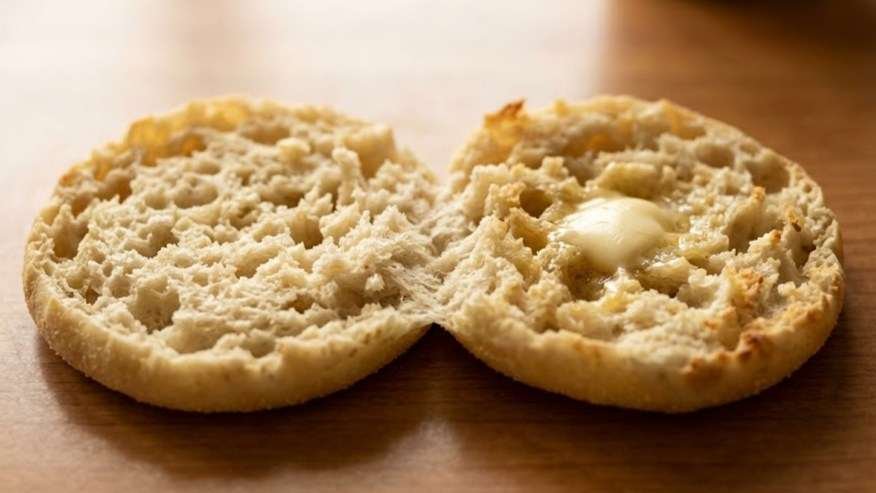
These cavities do actual work. When you split a Thomas’ muffin — or any properly made English muffin — and toast it, the crumb surface exposed by the split is uneven, jagged, and full of small wells. Butter applied to this surface melts into the cavities and is held there by capillary action, the same physical principle that moves water through plant stems. The wells trap the fat. The fat stays in the bread rather than running off the surface. Each bite delivers butter that the toast is holding rather than butter that pooled on a plate.
This is why the fork-split requirement is not a romantic affectation. It is a structural instruction.
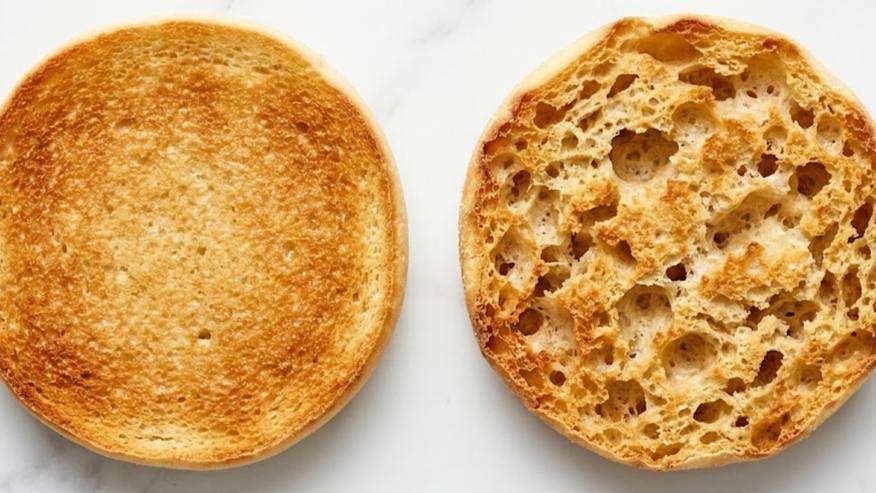
When you cut an English muffin with a knife, you create a smooth plane through the crumb. The knife severs the cell walls of the bread rather than tearing along the planes of weakness between air pockets. The result is a flat, smooth interior surface. Toasted, it crisps differently — harder, less varied — and it holds butter poorly. The fat slides off. The toast tastes like toast. Fork-split, you tear along the crumb’s natural fault lines, preserving the irregular surface, and the bread toasts into a landscape of different heights, different textures, different depths for the butter to occupy.
Harold McGee’s On Food and Cooking (Scribner, 2004) addresses bread crumb structure extensively: the irregularity of an open crumb is the result of gas bubbles forming and expanding at different rates during fermentation and cooking. A knife cuts through that structure. A fork follows it. The difference on the plate is not subtle.
What Thomas’ Preserved and What It Surrendered
The 2010 trade secret case that Bimbo Bakeries won against a former Thomas’ executive who attempted to take the recipe to Hostess confirmed that the specific production method — the hydration levels, the fermentation timing, the griddle specifications — is genuinely proprietary and genuinely matters. Annual sales of half a billion dollars are not built on a generic bread recipe. The formula produces the specific crumb structure that makes a Thomas’ muffin behave differently from a knife-cut commercial English muffin.
What Thomas’ has surrendered, compared to Thomas’ bakery output in the 1880s, is harder to quantify but probable. Industrial-scale bread production requires consistency across millions of units. The baker at Thomas’ original Ninth Avenue bakery was responding in real time to the specific hydration of his dough, the temperature of his griddle, the behavior of a batch on a particular afternoon. Industrial production compresses that variability by design. The product is consistent. It is also, by some accounts, less varied in texture than the irregular, handmade original would have been.
This is a tradeoff that every industrialized craft food makes. The sourdough starter at the Heritage Diner, which I wrote about in Meet “The Mother”: The Living Heart of the Heritage Diner’s Sourdough, produces a different loaf every week depending on temperature, humidity, and the behavior of the wild yeast culture. A bakery producing ten thousand identical sourdough loaves a day does not have this problem. It also does not have the same bread. Industrial English muffins are excellent. They are not what Thomas made in 1880.
The Diner Breakfast Platter Problem
The English muffin on the average Long Island diner breakfast plate has frequently been knife-cut before it reaches you. This is not always the server’s fault. Many diners pre-slice English muffins during prep, stack them in a warmer, and toast them through their smooth, exposed surfaces. The result is a flat, crisped bread that holds toppings but does not behave the way the product was engineered to behave.
The diagnostic is simple. Order your English muffin and look at the interior surface when it arrives. If it is uniformly smooth, it was knife-cut, possibly before it was even toasted. If it is jagged and irregular, with visible wells and craggy peaks, it was fork-split. Butter applied to the first will pool and drip. Butter applied to the second will disappear into the surface and stay there through the entire egg-and-toast progression of a diner breakfast.
Diners that fork-split are the ones where someone paid attention to what the product was supposed to be. I’ve covered the components of a proper diner breakfast in more depth in How to Build the Perfect Diner Breakfast Platter — Step-by-Step Assembly Guide, and the English muffin choice is one of the first distinctions that separates a diner that’s coasting from one that’s thinking.
The English muffin also has a crispness gradient when toasted correctly. The exterior develops a hard crust — the result of the griddle surface drying out the outer layer of dough during cooking — while the interior stays soft. This means the toasted English muffin has three textures: the hard, browned exterior crust, the toasted crumb surface at the split, and the soft interior center. A knife-cut muffin toasted from both flat sides collapses this gradient. You get crust and crumb without the soft interior layering.
This is a bread that was designed with thought. Using it carelessly is like buying a good cast-iron skillet and using it to boil pasta.
The Name Problem and the Marketing Genius
Thomas never called his creation “English muffins” in his initial bakery operation. The name developed as the product needed to identify itself to American customers who had no reference point. Calling it English told the buyer it was a recognizable category from a culture associated with quality baking. The English might not have recognized it, but Americans didn’t know that, and by the time anyone went to check, the name was fixed.
Thomas’ television commercials in later decades leaned into this irony deliberately, joking that fans in England were devastated when Thomas brought his muffins to America instead of keeping them in England. It’s effective advertising built on an accurate misunderstanding. The English muffin is an American product with a European marketing strategy. Its inventor was English, his bakery was in Manhattan, and the bread is neither English nor a muffin in any technical sense. It is a griddle-cooked, fork-split, nook-and-cranny bread that earns a specific place on a breakfast plate when treated correctly.
Order it fork-split. Let the butter sink in. Don’t rush it.
You Might Also Like:
The Flour Beneath the Bread: What Goes Into a Proper Sourdough Loaf
How to Build the Perfect Diner Breakfast Platter — Step-by-Step Assembly Guide
Sources
- Thomas’ Breads, About page: https://thomasbreads.com/about
- Wikipedia, “Thomas’”: https://en.wikipedia.org/wiki/Thomas%27
- Harold McGee, On Food and Cooking: The Science and Lore of the Kitchen (Scribner, 2004)
- WebstaurantStore, Thomas’ Fork Split English Muffins: https://www.webstaurantstore.com/thomas-original-english-muffins-case/876BB117872.html
- CookingHub, English Muffin history: https://www.cookinghub.com/recipe-ingredient/english-muffin/
- Katom, “Investigating the Nooks & Crannies of English Muffins”: https://www.katom.com/learning-center/investigating-english-muffins.html