
Cold Spring Harbor Laboratory sits on the north shore of Long Island, at the end of a stretch of water that has always been good for sailing and, historically, for thinking about what lies beneath the surface.
The lab’s history is a concentrated version of the American century’s darkest and brightest impulses. Charles Davenport ran eugenics research there in the early 1900s — a moral catastrophe dressed in scientific language. Then James Watson and Francis Crick’s work on DNA’s double helix structure cascaded into Cold Spring Harbor’s genomic research, and the same institution that had mapped heredity for the purposes of human engineering began mapping it for the purposes of understanding life itself. That particular irony — horror and genius sharing a campus — is not incidental. It is what makes Cold Spring Harbor the right place to think about what science can claim authority over, and what it cannot.
In the 1980s, the laboratory hosted science and religion symposia that brought together figures who would not typically share a stage. Two of the most important thinkers on the circuit during that decade — E.O. Wilson of Harvard and Father Stanley Jaki, a Benedictine priest and physicist who had won the Templeton Prize in 1987 — were active on the same intellectual landscape. Their documented written arguments constitute one of the most underappreciated intellectual collisions of the modern era. And it started in 1978, when both men published landmark books in the same calendar year, on opposite sides of the same foundational question.

1978: The Year the Argument Crystallized
Edward O. Wilson was not, in 1978, a household name outside biology. He was one of the world’s foremost myrmecologists — he had spent decades studying ant colonies as living systems, and his synthesis of sociobiology in 1975 had detonated a controversy in academic biology that was still sending shockwaves three years later. On Human Nature (1978, Harvard University Press) was his attempt to answer the obvious next question: if sociobiology explains animal behavior through evolution, what does it say about human behavior — and human belief?
His answer was stark. Religion, Wilson argued, is a biological phenomenon. It is a product of natural selection — a set of cognitive and social behaviors that enhanced survival in ancestral environments, that bound groups together, that provided frameworks for sacrifice and cooperation. The sacred is, at its root, the social made transcendent. Gods are the stories evolution built to help us live together. This was not Wilson insulting religion. It was Wilson explaining it — and the explanation left no room for the sacred as anything other than a very effective evolutionary adaptation.
On Human Nature won the Pulitzer Prize in 1979. It was fully verifiable then and now as one of the defining works of late-twentieth-century science writing.
In that same year — 1978 — Stanley Jaki published The Road of Science and the Ways to God (University of Chicago Press). Jaki was a Benedictine monk, a trained physicist, and one of the most rigorous philosophers of science working in the English language. His thesis was the mirror image of Wilson’s: science did not explain religion. Rather, religion explained science. Specifically, Christian theology — with its insistence on a rational Creator who made a rational cosmos governed by consistent laws — was the precondition for science’s existence. Without the Christian metaphysical infrastructure, Jaki argued, science could not have emerged when and where it did. The ancient Greeks had mathematics and observation but never developed experimental natural science. The reason, Jaki claimed, was metaphysical: without the concept of a lawgiving God, there was no expectation that nature would behave according to discoverable regularities.
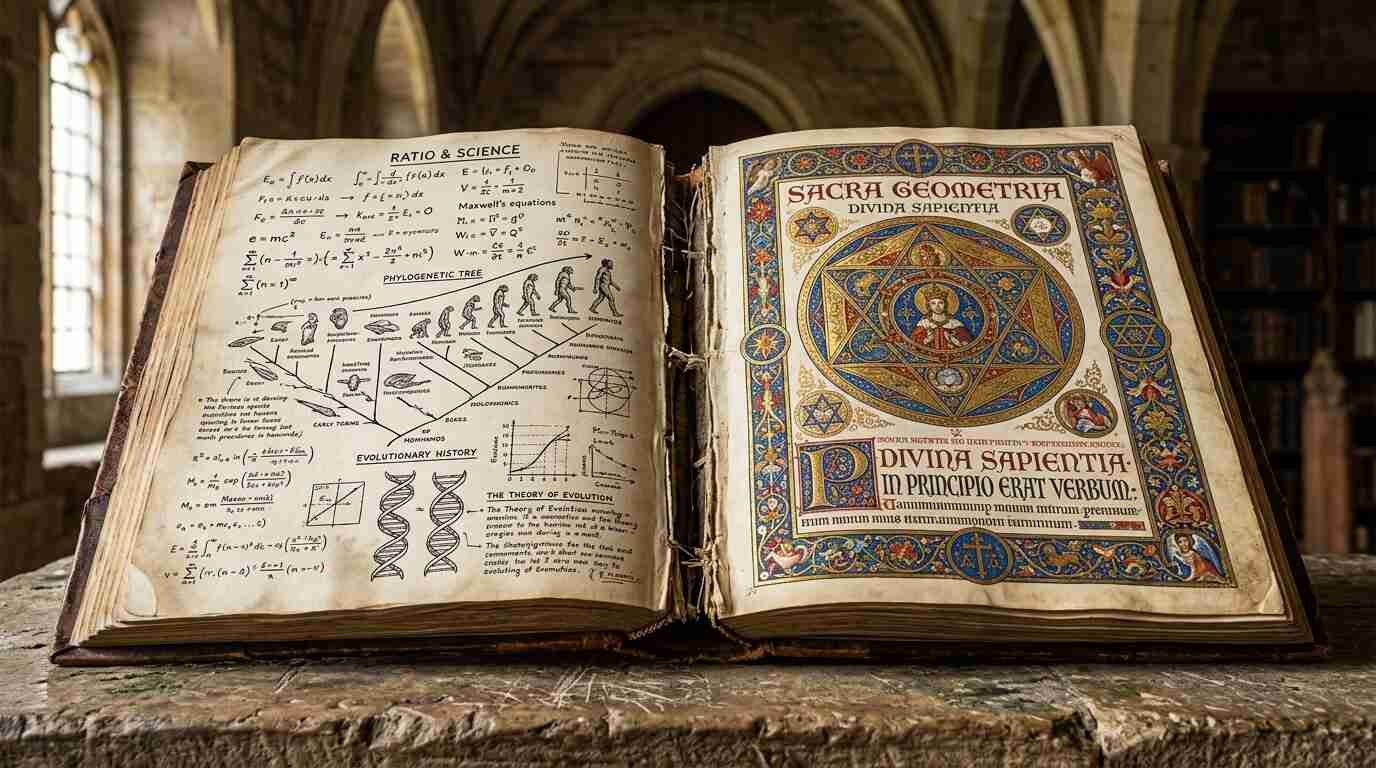
Wilson said: evolution produced religion. Jaki said: religion produced science.
Both claims were serious. Both were argued at length by men with serious credentials. And they were, at the deepest level, irreconcilable — because they started from different assumptions about what counts as an explanation and where the chain of causation ultimately runs.

The Templeton Prize and What It Signaled
Stanley Jaki won the Templeton Prize in 1987. The records are documented at the Templeton Prize Foundation’s archive. The prize — which is explicitly awarded for progress in affirming life’s spiritual dimension — has a complicated relationship with the scientific community, which has at various times praised it for funding science-religion dialogue and criticized it for funding dialogue that tilts toward predetermined conclusions. But Jaki was not a soft target. He was not a feel-good theologian offering vague spirituality. He was a systematic philosopher who had engaged with Newton, Duhem, Mach, and Einstein and argued his positions from inside the history and philosophy of physics.
His later work — The Savior of Science (1988, Regnery Gateway) — extended the argument: not only did Christian metaphysics enable science, but science requires a theological grounding to avoid collapsing into self-contradiction. He cited Gödel’s incompleteness theorems as evidence that any formal system powerful enough to do science will contain truths it cannot prove from within itself — and that this incompleteness points, for Jaki, toward a reality that transcends the formal system.
Whether you find that argument convincing or not, it is not the argument of a man who could be dismissed. Phillip Johnson cited both Wilson and Jaki in Darwin on Trial (1991), which gives some sense of how the two men were perceived as occupying opposite poles of the same ongoing debate.
Cold Spring Harbor: The Loaded Stage
The Cold Spring Harbor Laboratory’s symposia history is archived at cshl.edu, and the lab’s quantitative biology conferences going back to the 1930s represent one of the most remarkable continuous records of scientific discourse in the American century. During the 1980s, the laboratory hosted discussions that reached beyond pure molecular biology into the philosophy and history of science — the natural territory of figures like Wilson and Jaki.
What makes the near-miss between Wilson and Jaki at Cold Spring Harbor philosophically loaded is not just who they were but where they were. A laboratory that had produced both eugenics and genomics — that had housed both the worst abuse of biological science for social control and some of the most important basic research in the history of genetics — was precisely the right setting for a debate about what science can and cannot claim authority over.
Wilson’s sociobiology, in the wrong hands, rhymed uncomfortably with the eugenics Davenport had conducted on that same campus decades earlier. Wilson himself was aware of this — he spent considerable effort in On Human Nature distinguishing descriptive evolutionary biology from prescriptive social policy. But the history of that laboratory meant the question was always in the room: who decides what the science means, and for what ends?
Jaki’s answer was, implicitly: this is exactly why science cannot be self-grounding. A science that claims to explain human values while deriving its authority from human reason has a circularity problem. The only way out of that circularity, for Jaki, was a transcendent reference point — which is to say, God.
Wilson’s Consilience and the Long Argument
Wilson did not let the question rest. His 1998 book Consilience: The Unity of Knowledge (Knopf) was, in many ways, the full elaboration of what On Human Nature had begun: a vision of all human knowledge — the humanities, the social sciences, biology, physics — unified under a single explanatory framework rooted in evolutionary science. The book was ambitious to the point of grandiosity, and it attracted fierce criticism from humanists who felt Wilson was annexing their territory.
But the core claim was consistent with what he had argued twenty years earlier: the methods of natural science are, in principle, capable of explaining not just the physical world but the full range of human experience, including religion, art, morality, and meaning. This was not nihilism. Wilson was not saying these things don’t matter. He was saying their ultimate explanation runs through biology, through evolution, through the physical substrate of the brain.
Jaki had died in 2009, but his argument was still in print, still being cited, still presenting the counter-case: that the explanatory framework Wilson proposed was itself built on assumptions that could not be justified from within that framework. That the claim “science can explain everything, including the sources of scientific knowledge” is precisely the kind of self-referential claim Gödel had shown to be problematic.
I find myself drawn to both sides of this argument in ways I don’t fully resolve. There is a post on the Fermi Paradox and the Great Filter that grazes some of the same territory — the question of what it means that a universe this large appears, so far, to have produced exactly one civilization capable of asking these questions. Wilson would say: rare evolutionary event. Jaki would say: don’t be so sure the silence is the answer.
Two Origin Stories for the Same World
The deepest thing Wilson and Jaki disagreed about was not evolution. It was causation. Specifically: is the chain of causation that produced the universe, life, and human consciousness one that runs entirely through physical processes — or does it require, at some point, a cause that is not itself physical?
This is the question that Aristotle called the problem of the Unmoved Mover. It is the question that has generated more philosophy than any other in the Western tradition. And it is, remarkably, a question that neither physics nor evolutionary biology has resolved — because both disciplines assume a pre-existing universe in which their laws operate. What produced the laws? What produced the universe?
Wilson’s answer, implicit in his framework: we don’t know yet, but there’s no reason to assume the answer requires anything beyond physics. Jaki’s answer: the very existence of a rational cosmos with discoverable laws points toward a rational Lawgiver, and the history of science shows that the scientists who made the greatest discoveries — Newton, Faraday, Maxwell, Lemaitre — were, in most cases, operating inside a theological framework that gave them reason to expect the universe to be lawful in the first place.
Both men were pointing at the same phenomenon: the extraordinary fact that the universe is mathematically intelligible. Wilson called it consilience. Jaki called it the road of science, and he thought he knew where it led.
What the Near-Miss Tells Us
A debate that almost happened at Cold Spring Harbor — two men on the same circuit, at the same conferences, active in the same decade, arguing opposite sides of the most fundamental question in intellectual history — is still a debate worth having. The arguments have not been resolved. The data has not settled the question. The universe, as Carl Sagan might have said, is not going to help us by writing the answer in stars.
What Wilson and Jaki leave behind is a precise map of the disagreement — precise enough to argue with, careful enough to take seriously. Wilson showed that religion can be explained biologically. Jaki showed that science requires a foundation it cannot provide for itself. Neither showed that the other was simply wrong.
The laboratory on the Long Island shore is still there. The symposia continue. And the question — whether the cosmos that produced us is ultimately the product of blind mechanism or purposeful mind — is still, as Jaki put it, the road that science walks without always knowing where it’s going.
This post reconstructs a documented intellectual parallel between two named public figures based entirely on their published work and verifiable public records. The science-religion debate these men represent remains unresolved and this post does not attempt to resolve it.
You Might Also Like:
- The Fermi Paradox and the Great Filter: Why the Silence of the Cosmos Might Be the Loudest Warning We’ll Ever Receive
- The Extended Phenotype: How Your Genes Build Structures Beyond Your Body
- The Selfish Gene by Richard Dawkins — The Book That Unlocked Darwin for Me
Sources:
- E.O. Wilson, On Human Nature (1978, Harvard University Press): https://www.amazon.com/Human-Nature-Edward-Wilson/dp/0674016386
- E.O. Wilson, Consilience: The Unity of Knowledge (1998, Knopf): https://www.amazon.com/Consilience-Unity-Knowledge-Edward-Wilson/dp/0679768696
- Stanley Jaki, The Road of Science and the Ways to God (1978, University of Chicago Press): https://www.amazon.com/Road-Science-Ways-God/dp/0226391566
- Stanley Jaki, The Savior of Science (1988, Regnery Gateway): https://www.amazon.com/Savior-Science-Stanley-L-Jaki/dp/0802849032
- Cold Spring Harbor Laboratory symposia archives: https://www.cshl.edu
- Templeton Prize records: https://www.templetonprize.org
- Phillip Johnson, Darwin on Trial (1991, Regnery Publishing): https://www.amazon.com/Darwin-Trial-Phillip-Johnson/dp/0830837426