What cattle eat — the actual biochemistry of their daily forage — transfers directly into the fat woven through their muscle tissue. That fat becomes your dinner. And the science of how it differs between a pasture-raised animal and a feedlot-finished one is far more nuanced, and frankly more consequential, than the marketing wars between grass-fed advocates and grain-finished purists would have you believe.
At The Heritage Diner, we have sourced beef deliberately for twenty-five years. Every sourcing decision we make begins with a single question: what does the animal’s life history do to the food on your plate? The answer runs straight through lipid chemistry.
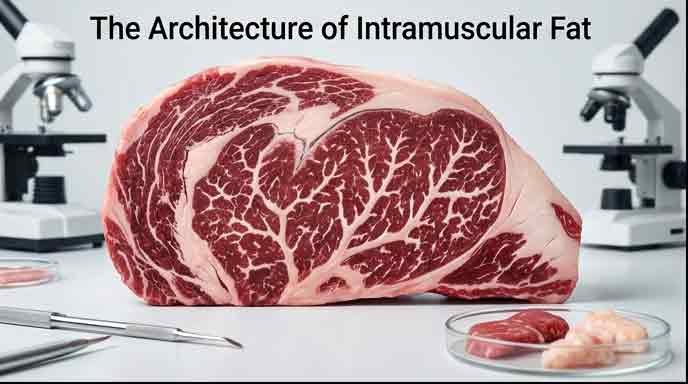
The Architecture of Intramuscular Fat
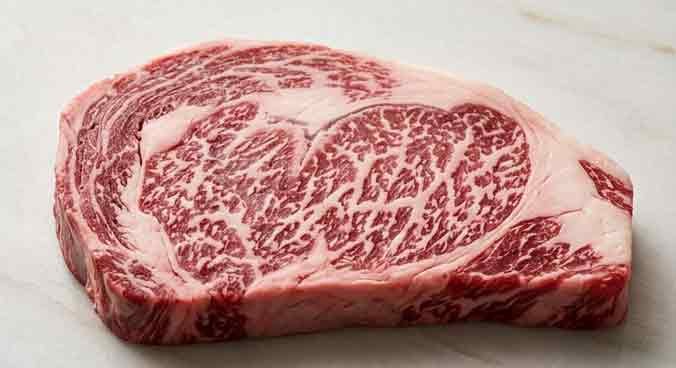
Marbling — those white threads visible in a raw ribeye — is not decoration. It is intramuscular fat (IMF), and it is structurally distinct from the subcutaneous fat that surrounds a cut from the outside. According to research published in Food Science of Animal Resources (Nogoy et al., 2022), the fatty acid composition of IMF is strongly influenced by two primary variables: the animal’s genetics and its feeding regimen. Everything else — aging, butchering, cooking — operates downstream of those two decisions.
At the molecular level, IMF is a composite of saturated fatty acids (SFAs), monounsaturated fatty acids (MUFAs), and polyunsaturated fatty acids (PUFAs). What matters is not simply the total fat content but the specific ratios and molecular identities within those categories. A cut can be rich in fat and still carry a favorable lipid profile. A lean cut can carry a lipid signature that is metabolically inert or worse. The USDA grade on the label tells you very little about the actual nutritional architecture of what you’re about to eat.
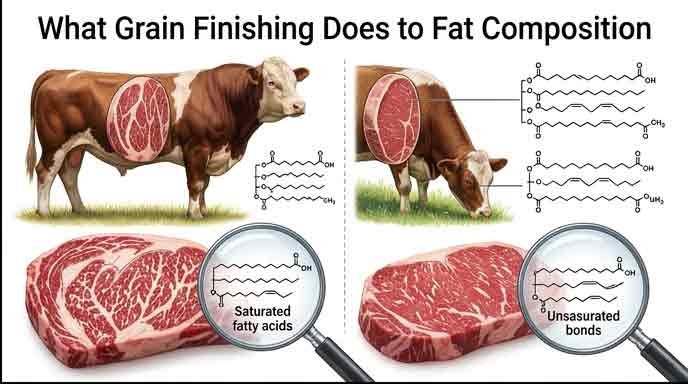
What Grain Finishing Does to Fat Composition
The feedlot model was largely developed in the 1950s as a means of accelerating time-to-market. A high-energy grain diet — predominantly corn and soy — enables cattle to deposit intramuscular fat rapidly, producing the visually dramatic marbling that drives USDA Prime and Choice designations.
The results at the lipid level are significant. Grain finishing substantially elevates total intramuscular fat content. Research from Texas A&M meat scientist Dr. Stephen Smith found that as marbling score increases, the proportion of oleic acid — a monounsaturated fat with established cardiovascular benefits, the same fat dominant in olive oil — increases as well. USDA Select beef showed a MUFA-to-SFA ratio of 0.75, while USDA Prime beef achieved a ratio of 1.33 (Smith, cited in The Cattle Site, 2023). This is not a trivial distinction. It suggests that heavily marbled grain-fed beef, particularly from premium Angus or Wagyu genetics, carries a more favorable fat chemistry than conventionally assumed.
The complication is what grain finishing does to polyunsaturated fatty acids. High-grain diets increase omega-6 fatty acid concentrations while suppressing omega-3 accumulation. A review published in Nutrition Journal (Daley et al., 2010) documented that grain-fed beef consistently shows a more unfavorable omega-6 to omega-3 ratio — often exceeding 10:1 — compared to pasture-raised animals. The evolutionary diet of humans, by most anthropological estimates, featured an omega-6 to omega-3 ratio near 1:1. Western industrial diets have stretched that ratio to somewhere between 15:1 and 20:1, and grain-finished beef contributes meaningfully to that imbalance.
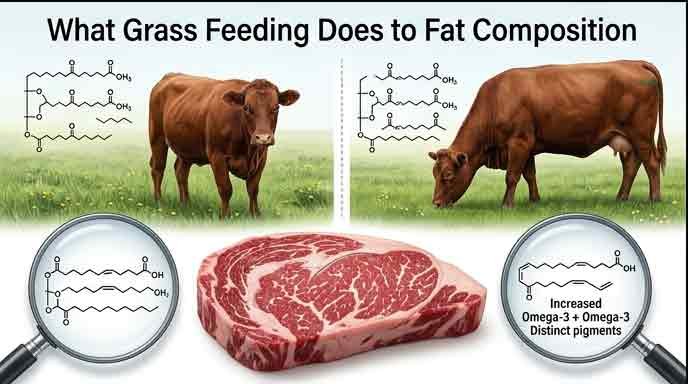
What Grass Feeding Does to Fat Composition
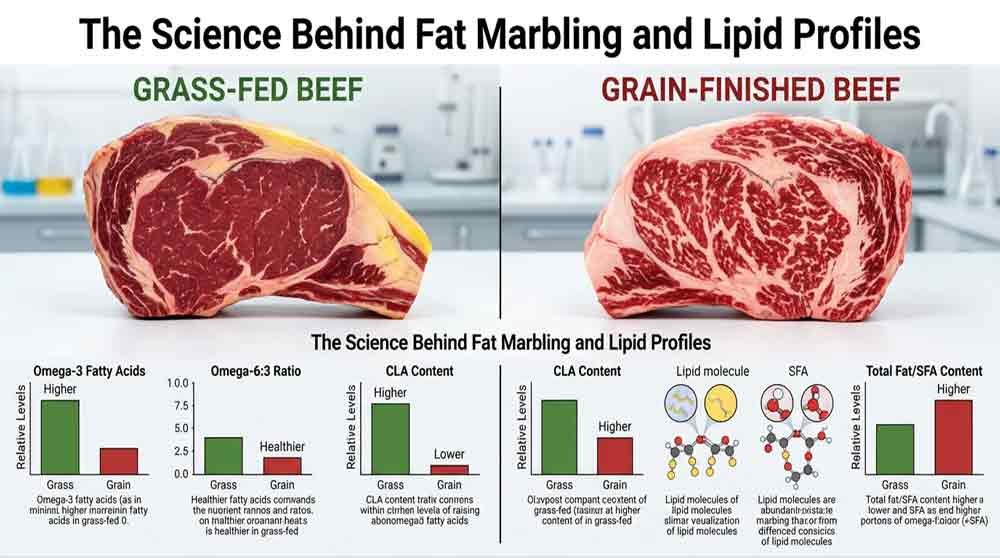
Pasture-raised cattle operate on a fundamentally different metabolic logic. Forages — grasses, legumes, clover — are higher in alpha-linolenic acid (ALA), the plant-based omega-3 precursor. Because ruminants biohydrogenate dietary lipids in the rumen, not all of that ALA transfers directly to muscle tissue. But enough does. Three decades of research consistently show that grass-fed beef contains substantially higher concentrations of long-chain omega-3 fatty acids, including EPA and DHA — roughly three times the omega-3 content of comparable grain-fed cuts on a gram-per-gram basis (Daley et al., 2010, Nutrition Journal).
Research cited by Understanding Ag (2022) reported that EPA levels in grass-fed beef were nearly ten times higher than in grain-fed beef, with DHA approximately three times higher. The omega-6 to omega-3 ratio in well-managed grass-finished cattle typically falls below 3:1 — within the range most nutritional scientists consider physiologically favorable.
Grass feeding also elevates conjugated linoleic acid (CLA), a fatty acid associated with anti-inflammatory and potentially anti-carcinogenic properties, as well as trans-vaccenic acid (TVA), a CLA precursor. Additionally, grass-fed beef shows meaningfully higher concentrations of Vitamin E, beta-carotene, and antioxidant enzymes including glutathione and superoxide dismutase. The fat of grass-finished animals often carries a slight yellow tint — not a flaw, but a visual marker of elevated carotenoid content, the same pigment responsible for the color of carrots.
The tradeoff is structural. Without the caloric density of grain, grass-finished cattle deposit less total intramuscular fat. The marbling is typically lighter. The beef is leaner, the flavor more complex and often described as earthy, mineral-rich, or herbaceous — a reflection of the actual landscape the animal grazed. Texture runs firmer. To a diner accustomed to the buttery, mild profile of grain-finished beef, the first encounter with well-prepared grass-fed beef can feel like the difference between a tightly edited film score and a full orchestral performance. More is happening. The question is whether you’ve trained your palate to hear it.
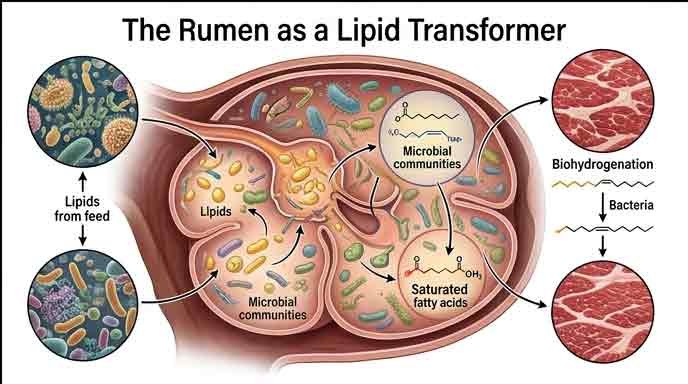
The Rumen as a Lipid Transformer
One aspect of this science that rarely enters the public conversation is rumen biohydrogenation — the process by which the microbial ecosystem of a cow’s foregut chemically alters the fatty acids from its diet before those lipids ever reach muscle tissue. This is why the fatty acid profile of beef is not a direct one-to-one translation of what the animal ate.
Grass contains significantly higher ALA (an omega-3). But as ALA passes through the rumen, it is partially converted by microbial biohydrogenation into saturated fats and intermediary compounds. Only a fraction survives to accumulate in IMF as long-chain omega-3s. Research published by Frontiers in Sustainable Food Systems (Moraes et al., 2022) notes that seasonal variation in forage quality affects this profile — spring grasses are higher in beneficial fatty acids than summer or fall forages, meaning even within the grass-fed category there is meaningful variation based on harvest timing and pasture management.
This complexity is worth sitting with. The beef label tells you almost nothing about the specific pasture the animal grazed, when it was harvested, what grasses dominated the forage, or whether it was truly 100% grass-finished versus grass-fed with a grain supplement in the final weeks. The industry’s regulatory definitions, unfortunately, leave considerable room for imprecision.
Marbling, Palatability, and the Flavor Mechanism
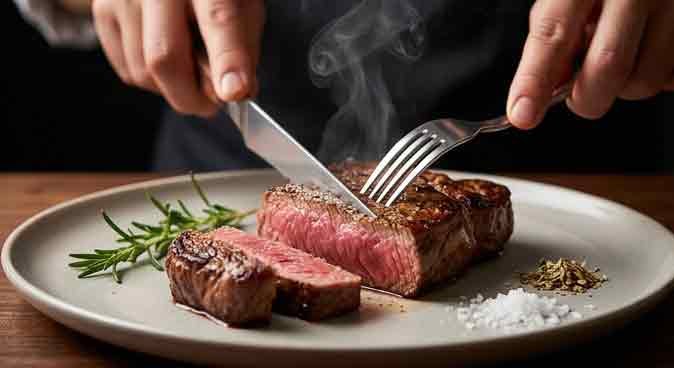
Fat is not neutral in the mouth. It is the primary carrier of volatile aromatic compounds — the molecules responsible for what we experience as flavor. When intramuscular fat melts during cooking, it bastes the surrounding muscle fibers from the interior, carrying these aromatic compounds through the meat in ways that a lean cut simply cannot replicate.
The specific fatty acid composition of the melting fat affects not just the intensity of this process but its character. Oleic acid — dominant in highly marbled grain-fed and Wagyu beef — has a lower melting point than saturated fats and contributes what most tasters describe as a buttery, silky mouth feel. The higher PUFA content of grass-fed beef, combined with more complex aromatic precursors from diverse forage, produces a different and often more layered flavor — richer in what food scientists call “green,” “grassy,” or “mineral” volatiles.
Research from Food Science of Animal Resources (Nogoy et al., 2022) confirms that intramuscular fat composition has a direct positive relationship with sensory characteristics including aroma, flavor, juiciness, and tenderness. This is not a subjective preference argument. It is structural food science. The fat is doing the work.
The Heritage Approach: Why the Sourcing Question Never Ends
When sourcing beef for The Heritage Diner, neither the grass-fed nor grain-finished label settles the question. What matters is the full picture: the breed’s genetic predisposition toward beneficial fat deposition, the management philosophy of the ranch, the forage quality or grain composition in the finishing period, and whether the animal was actually pastured or merely labeled as such.
This is the same logic that governs the craft behind Marcellino NY’s bespoke leather briefcases — an understanding that the source material defines every downstream possibility. English bridle leather from J&E Sedgwick carries a specific tannin structure, a fiber density, and a fat liquoring profile that mass-tanned hide simply cannot replicate. The hide’s history is present in every stitch. Beef is no different. The lipid profile in a finished cut is an autobiography — a biochemical record of everything the animal consumed across its entire life cycle.
For home cooks and restaurant-goers alike, the practical implication is this: seek out the provenance, not just the marketing term. A well-finished grass-fed ribeye from a ranch with documented pasture management and breed selection is a different food — metabolically and gastronomically — than a commodity product wearing the same label. The same is true in reverse. A dry-aged Prime Angus strip loin from a reputable operation carries a lipid profile that is far more complex than the grain-fed stigma would suggest.
What the Science Actually Recommends
No single feeding system is unambiguously superior for every dimension of human health or culinary experience simultaneously. The science, when read without marketing bias, tells a nuanced story.
Grass-fed beef offers a more favorable omega-6 to omega-3 ratio, higher CLA and TVA concentrations, elevated fat-soluble vitamins and antioxidants, and a lower total fat burden — advantages that favor cardiovascular and inflammatory health markers. Grain-finished beef, particularly from premium marbled genetics, offers higher oleic acid content, superior tenderness and juiciness, and a more consistent palatability profile — advantages that favor eating quality and arguably a more favorable MUFA-to-SFA ratio in heavily marbled cuts.
A 2022 study cited by Understanding Ag found that EPA in grass-fed beef was nearly ten times higher than in grain-fed samples. A Texas A&M study found no significant difference in total cholesterol between grass-fed and grain-fed ground beef when fat content was held constant (Texas A&M Department of Animal Science, 2019). These findings coexist without contradiction. They describe different dimensions of the same food.
The most honest position any cook, butcher, or restaurateur can hold is that fat composition matters — that it is neither as simple as “grain is bad” nor as simple as “grass is always better” — and that the only way to eat well is to understand what you’re actually buying.
Fat has always been the story in beef. The marbling you see in a raw cut is a record of the animal’s entire nutritional biography. Learning to read it — not just admire it or fear it — is the beginning of eating with real intelligence.
Sources:
- Nogoy KMC, Sun B, Shin S, et al. “Fatty Acid Composition of Grain- and Grass-Fed Beef and Their Nutritional Value and Health Implication.” Food Science of Animal Resources, 2022. https://pmc.ncbi.nlm.nih.gov/articles/PMC8728510/
- Daley CA, Abbott A, Doyle PS, et al. “A review of fatty acid profiles and antioxidant content in grass-fed and grain-fed beef.” Nutrition Journal, 2010. https://pmc.ncbi.nlm.nih.gov/articles/PMC2846864/
- Understanding Ag. “Nutritional Comparisons Between Grass-Fed Beef and Conventional Grain-Fed Beef.” 2022. https://understandingag.com/nutritional-comparisons-between-grass-fed-beef-and-conventional-grain-fed-beef/
- Moraes L, et al. “Attention to the Details: How Variations in U.S. Grass-Fed Cattle-Feed Supplementation and Finishing Date Influence Human Health.” Frontiers in Sustainable Food Systems, 2022. https://www.frontiersin.org/journals/sustainable-food-systems/articles/10.3389/fsufs.2022.851494/full
- Texas A&M Department of Animal Science. “Ground beef from grass-fed and grain-fed cattle: Does it matter?” 2019. https://animalscience.tamu.edu/2019/03/ground-beef-from-grass-fed-and-grain-fed-cattle-does-it-matter/
- Smith, Stephen. “Marbling: The Science Behind Fat.” The Cattle Site. https://www.thecattlesite.com/news/24436/marbling-the-science-behind-fat