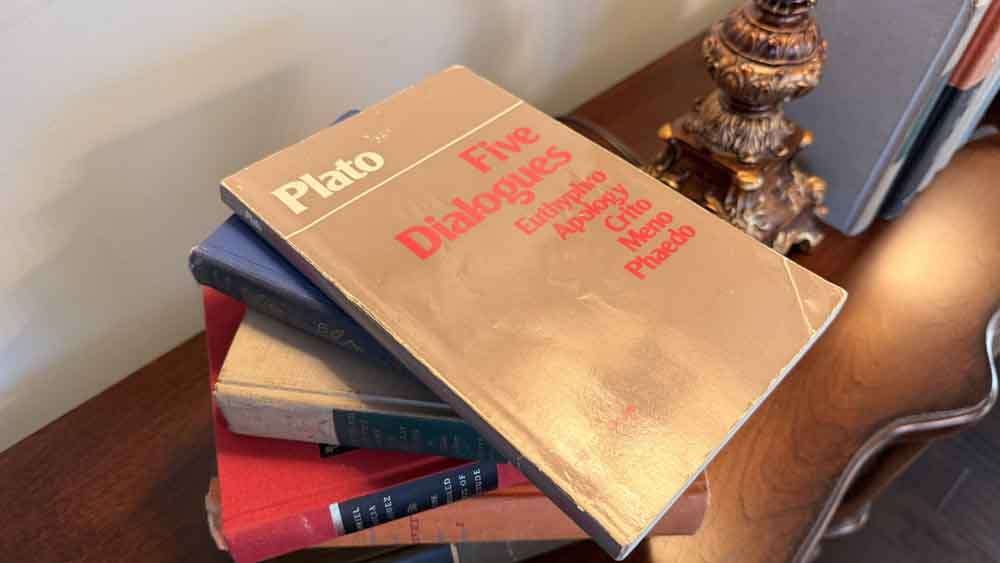
Questioning is a skill most people believe they already possess. They do not. Most of us move through the world carrying inherited answers — answers absorbed from parents, from culture, from the steady accumulation of habit — and we call this thinking. Plato’s Five Dialogues, assembled in a single volume most commonly translated by G.M.A. Grube and revised by John M. Cooper for Hackett Publishing, is the corrective to that illusion. It is the book that virtually every introductory philosophy course assigns for a reason: it does not teach you what to think. It teaches you that you have probably never thought at all.
The five dialogues collected here — Euthyphro, Apology, Crito, Meno, and Phaedo — are not randomly bundled. They trace the final chapter of one man’s life and the first principles of Western intellectual inquiry. That man is Socrates. And whether you approach this book as a student, a curious reader, or someone who simply wants to understand where philosophy began, you will find in these pages a figure who remains, twenty-four centuries later, genuinely difficult to dismiss.
The Shape of the Collection
The five dialogues are arranged with a dramatic logic that is easy to miss if you read them as disconnected texts. Euthyphro opens in front of the court where Socrates is about to be tried for impiety and corrupting the youth of Athens. The Apology is his defense — a speech that refuses, almost defiantly, to be a defense in any conventional sense. Crito takes place in prison after the conviction, when a friend arrives to urge escape and Socrates refuses. Meno steps back to examine one of philosophy’s foundational questions: can virtue be taught? And Phaedo closes the arc entirely, set in Socrates’ final hours as he argues — with remarkable calm — for the immortality of the soul.
Read in sequence, they constitute something close to a philosophical novel: a man indicted, tried, imprisoned, and executed, all while continuing to do the only thing he found worth doing. Thinking.
Euthyphro and the Question That Will Not Let Go
Of all the dialogues in this collection, Euthyphro is arguably the one with the longest reach into contemporary life. Socrates encounters Euthyphro — a self-described religious expert — outside the courthouse and asks him a deceptively simple question: what is piety?
Euthyphro offers several answers. Socrates dismantles each one with the same method: he asks Euthyphro to examine whether his definition actually defines anything at all, or whether it merely restates the problem. The dialogue culminates in one of the most durable questions in the history of philosophy — what scholars now call the Euthyphro dilemma: Is something pious because the gods love it, or do the gods love it because it is pious?
The question may sound like a theological puzzle from another era. It is not. Strip it of its Greek religious dressing and it becomes a question about the nature of moral authority itself: does goodness derive from whoever has the power to declare it — god, state, institution, consensus — or does goodness exist independently, and the powerful merely recognize it? Every serious ethical debate you will ever encounter circles back, eventually, to this question. And Plato raised it in what amounts to a brief courtyard conversation before a murder trial.
The Apology: Philosophy as a Way of Life
The Apology is the most widely read of the five dialogues, and for good reason. It is Socrates standing before a jury of five hundred Athenians and explaining, without apology in any modern sense of the word, what he has spent his life doing and why he will not stop.
The portrait is striking not because Socrates is heroic — though he is, in a quiet way — but because he is so completely honest about the consequences of intellectual integrity. He acknowledges that he has made enemies. He explains why: he went to the people most reputed to be wise and found, on examination, that they were not wise — and they knew less than he did, because at least he knew that he knew nothing. He tells the jury that the unexamined life is not worth living. He says this knowing it will cost him.
What the Apology offers the modern reader is not a model to imitate in its particulars but a standard to measure against. Most of us never examine our foundational assumptions — about how we earn a living, about what we owe to others, about what we are doing with the time we have. Socrates’ argument is not that you should ask these questions because it is pleasant. It is that failing to ask them is a kind of self-abandonment.
Crito: The Social Contract Before Its Name
After the conviction, a wealthy friend named Crito arrives at Socrates’ prison cell with a plan and the money to execute it. Escape is possible. The guards can be bribed. No one who matters will think worse of Socrates for going.
Socrates refuses — and the reasoning he offers is among the earliest articulations of what would later be called social contract theory. He imagines the Laws of Athens speaking to him directly: you were born here, raised here, educated here, and you have benefited from the structure this society provided. To break its laws now, when the verdict is inconvenient, is to undermine the entire compact on which civic life depends.
The argument is not without its critics, and Plato does not pretend it is bulletproof. But Crito forces a question that remains genuinely open: at what point does the obligation to a legal system expire? Socrates’ answer, here, is essentially never — for him, in this situation. Others have drawn the line differently. The dialogue’s power lies in the fact that it does not let you ignore the question.
Meno and the Problem of Learning
Meno is the philosophical outlier in the collection — it steps away from the drama of the trial to explore a problem that sounds almost academic until you turn it over in your hands: can virtue be taught? And if it can, why are there so few virtuous people, even among the children of virtuous men?
The dialogue contains one of Plato’s most ingenious thought experiments: Socrates takes an uneducated slave boy and, through questioning alone — never stating, only asking — guides him to work out a geometric theorem he has never been taught. The implication is staggering. If the boy already possessed the knowledge and merely needed the right questions to draw it out, then learning is not the acquisition of new information. It is the recollection of what the soul already knows.
This theory, called anamnesis — recollection — is either a genuinely radical claim about the nature of the mind or an elegant metaphor for the fact that certain kinds of understanding cannot be transmitted directly. They must be arrived at. The philosophy professor who assigns Meno at the beginning of a semester is making precisely this point: the goal is not to fill you with conclusions. It is to show you that you already contain more questions than you realize.
Phaedo: The Death of a Philosopher
The final dialogue is the longest and the most technically demanding. Socrates, on the day of his death, spends his final hours arguing — earnestly, rigorously, sometimes inconclusively — that the soul is immortal. His friends weep. He does not.
What makes Phaedo remarkable is not its conclusion, which even Plato seems to hold with some tentativeness, but its method. Socrates is dying, and he is doing philosophy. Not as a distraction from death, but as the most direct possible response to it. He argues that the philosopher, properly understood, has spent a lifetime practicing a kind of separation of the soul from the body — training the mind to think without the interference of appetite and sensation. Death, on this view, is simply the completion of what the philosopher has been doing all along.
Whether you find the argument convincing or not — and most contemporary readers will have serious reservations — the disposition it models is worth sitting with. A man who has thought carefully about what matters faces the end of his life and finds that his thinking has prepared him. That is, at minimum, a serious argument for taking thought seriously.
Why This Book Still Matters
The instinct to dismiss ancient philosophy as irrelevant to modern life is understandable and almost entirely wrong. The questions Plato raises in these five dialogues are not historical curiosities. They are the questions that any honest life will eventually force you to confront — about moral authority, about civic obligation, about what it means to know something, about how to face death. What Five Dialogues offers that a summary or a secondary source cannot is the experience of watching a mind work in real time, following an argument through its complications, and feeling the specific satisfaction — or discomfort — of a conclusion arrived at through genuine reasoning.
Every introduction to philosophy course teaches Plato for the same reason that every music program teaches harmony: not because harmony is the final word in music, but because it is the foundation without which everything else is ungrounded. You do not have to agree with Socrates to be changed by reading him. You only have to be willing to follow the question wherever it goes.
Five Dialogues is available through Hackett Publishing and at major booksellers including Amazon.
You Might Also Like:
- Thus Spoke Zarathustra by Friedrich Nietzsche — The Book That Rewired My Understanding of Everything
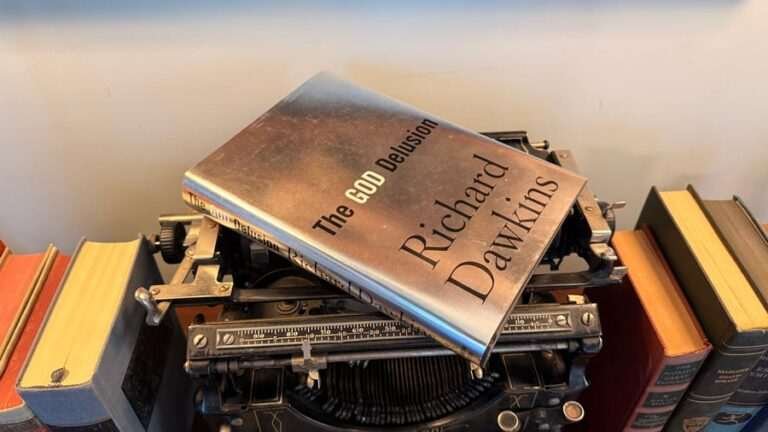
- The God Delusion by Richard Dawkins — A Review
Sources:
- Plato. Five Dialogues: Euthyphro, Apology, Crito, Meno, Phaedo. Translated by G.M.A. Grube, revised by John M. Cooper. Hackett Publishing, 2002. https://hackettpublishing.com/five-dialogues
- Stanford Encyclopedia of Philosophy — “Socrates”: https://plato.stanford.edu/entries/socrates/
- Stanford Encyclopedia of Philosophy — “Plato’s Ethics”: https://plato.stanford.edu/entries/plato-ethics/
- Stanford Encyclopedia of Philosophy — “Euthyphro Dilemma”: https://plato.stanford.edu/entries/plato-ethics-shorter/
- Internet Encyclopedia of Philosophy — “Plato: The Apology“: https://iep.utm.edu/apology/