By Peter from The Heritage Diner | heritagediner.com/blog
Westhampton Beach has always occupied a peculiar position in the geography of Long Island ambition. It sits at the western threshold of the Hamptons — close enough to claim the name, far enough to retain a village identity that the eastern enclaves surrendered to bottle service and helicopter traffic years ago. Main Street here still feels walkable, still feels like it belongs to the people who live on it twelve months a year and not merely to the seasonal migration that descends in June and vanishes after Labor Day. And it was precisely onto this street, in the uncertain summer of 2020, that David and Rachel Hersh planted something both audacious and deeply considered: a 1,600-square-foot New American restaurant called flora.
The lowercase name was deliberate. So was the ethos. Flora opened on August 10, 2020, when most of the restaurant industry was still calculating how to survive rather than expand (Greater Long Island, 2020). The Hershes — who had founded Rooted Hospitality Group in 2009 and already built a portfolio that included RUMBA in Hampton Bays, Cowfish, and RHUM in Patchogue — chose that moment not out of recklessness but out of a philosophy that mirrors something I have come to understand over twenty-five years behind the counter at The Heritage Diner in Mount Sinai: the restaurants that endure are the ones that open when the conditions demand courage rather than caution. At Marcellino NY, I call this the “100-year decision” — the choice to invest in lasting quality when the market is screaming for shortcuts.
Flora was never a shortcut. It was a statement.
The Roots of Rooted Hospitality
David Hersh graduated from the University of Central Florida’s Rosen College of Hospitality Management, and his career trajectory reads like a case study in patient, methodical growth. He and Rachel launched Rooted Hospitality Group with a singular founding principle: build gathering places where chef-driven food meets genuine warmth (Rooted Hospitality Group, 2025). Their first venture, RUMBA, opened in Hampton Bays in 2010. Cowfish followed in 2012, occupying one of the most scenic waterfront properties in the same area. By 2016, the couple had acquired and completely reconstructed a property on Patchogue’s Main Street into a tri-level dining space with the area’s only rooftop terrace — RHUM, the sister concept to RUMBA. Each restaurant reflected an evolving vision: sun-drenched island-inspired cuisine executed with fine-dining precision.
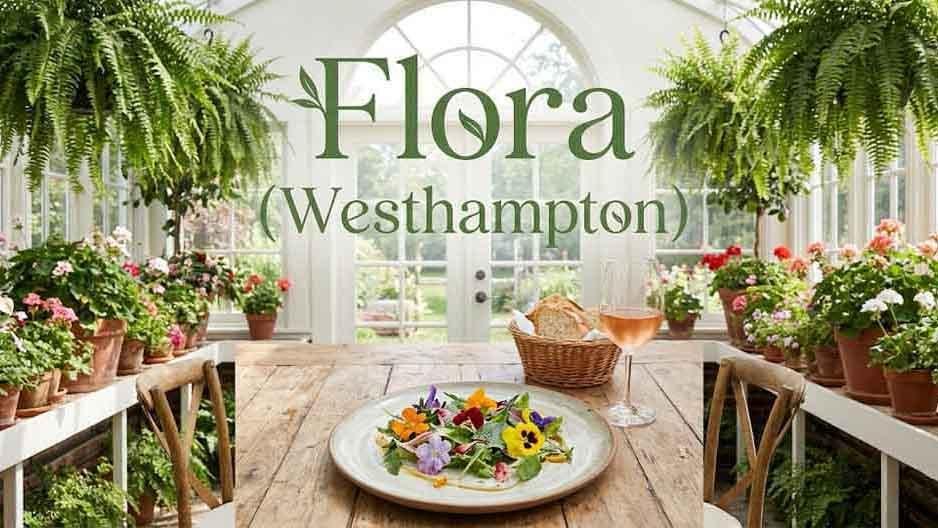
When the Hershes turned their attention to Westhampton Beach, they brought more than a decade of operational refinement. The 149 Main Street space underwent an extensive renovation by Over the Edge Construction, Inc., with architectural guidance from Pam Glazer Architect. The design goal was to physically embody the restaurant’s botanical name: modern lines, refined textures, a mature color palette that felt simultaneously coastal and sophisticated (Hamptons.com, 2021). The result is a room of roughly 1,600 square feet that manages to feel both intimate and expansive — high-top tables near large windows overlooking Main Street, a full bar anchoring the interior, and outdoor dining that opens the restaurant to the village sidewalk during warmer months.
Terri Novak, Rooted’s Director of Culinary Operations, described the team’s approach as putting “heart and soul” into every element (Greater Long Island, 2020). That kind of language can sound like marketing copy from most restaurant groups. From Rooted, it functions closer to a mission statement — evidenced by the fact that every one of their properties operates year-round, a commitment that separates lifestyle restaurants from the ones that actually serve communities.
A Menu That Moves with the Earth
Flora’s culinary identity revolves around seasonality, and this is not the kind of vague farm-to-table rhetoric that has become an industry cliché. The menu rotates with genuine frequency, structured around what the calendar and the region’s purveyors make available. Seafood leans heavily into the program — seared scallops with roasted corn, chorizo, candied Fresno peppers, and a buttermilk reduction over jasmine rice have become something close to a signature — but the kitchen demonstrates equal command across proteins and plant-based preparations (Flora WHB, 2026).
The current dinner menu reveals a kitchen operating with both confidence and range. Appetizers include harissa coconut mussels with pickled shallots and Thai basil, cider-braised pork belly over roasted cauliflower purée with green apple and pickled fennel slaw, and butternut squash arancini with parmesan cream and crispy sage. The burrata — grilled French bread, tomato jam, pesto, blistered tomatoes, blood orange balsamic reduction — has become a recurring point of praise in reviews. Among the house specialties, a 14-ounce bone-in maple-soy glazed pork chop with Brussels sprouts and leek hash, parsnip purée, and maple bacon vinaigrette demonstrates the kind of architectural plating that justifies the price point. The pan-seared branzino with citrus pan sauce and arugula-fennel salad speaks to a Mediterranean sensitivity running beneath the New American framework. And the prime New York strip — 14 ounces, center cut, truffle butter, pomme purée — is the kind of steak plate that reminds you a serious chef is working behind the line.
The Flora Burger deserves its own paragraph. Havarti cheese, pickled onions, black garlic aioli, truffled arugula, Campari tomatoes, served with French fries — it has generated the kind of devotion that patrons describe in language usually reserved for personal relationships. One review put it plainly: the burger is addictive. At twenty-two dollars, in Westhampton Beach, it may be one of the better values on the East End.
The vegan soba noodle bowl with snow peas, carrots, kale, red cabbage, mushrooms, tahini dressing, and toasted coconut ensures that flora does not treat plant-based dining as an afterthought. The Harvest Chicken — quinoa, farro, sautéed kale, butternut squash, tri-color cauliflower, stone ground mustard vinaigrette — occupies that increasingly important space between health-conscious and genuinely craveable.
The Cocktail Program and the Lavender Fizz Phenomenon
Beverage Manager Michael Matozzo built the cocktail list around a principle of timelessness with invention — classic American cocktail architecture infused with house-made spirits and fresh ingredients (Hamptons.com, 2021). The Lavender Fizz, crafted with lavender-infused vodka, blueberries, house sour, and soda, has become flora’s most photographed and requested drink. The Red Currant Margarita and the Montauk Maple round out a signature trio that rotates alongside seasonal offerings like the Bourbon Blossom.
Happy hour runs weekdays from 3:00 to 5:00 PM, and it has developed a following that rivals the dinner service. The happy hour menu features smaller versions of flora’s strongest dishes alongside the full cocktail program at adjusted prices. Reviews consistently highlight the pickled deviled eggs and the truffle-mushroom rice balls as the standout bar bites — accessible enough for a casual stop, refined enough that you linger longer than planned.
The wine list skews robust without being intimidating, complemented by a curated beer selection. For a 1,600-square-foot restaurant, the breadth of the beverage program reflects a deliberate strategy to compete with much larger Hamptons establishments while maintaining a neighborhood scale. This is something I have spent decades thinking about at The Heritage Diner — the relationship between size and soul. A room does not need square footage to command authority. It needs intention.
Celebrity Attention and Community Roots
Flora’s profile received a significant boost when Bethenny Frankel — the Skinnygirl founder and former Real Housewives of New York star who maintained a prominent presence in the Westhampton and Bridgehampton corridor for years — posted a TikTok from the restaurant. The video, which accumulated nearly 28,000 likes and hundreds of comments, featured Frankel praising the food and specifically calling out the edamame hummus as “excellent but not traditional” (TikTok, @bethennyfrankel, 2024). For a restaurant that had been open less than four years, that kind of organic celebrity endorsement — unsolicited, shot on a phone at the table — carries more weight than any paid campaign.
But flora’s real currency is not celebrity; it is consistency. The restaurant holds a 4.8-star average on Google with over 180 reviews, is ranked fifth among all Westhampton Beach restaurants on Tripadvisor, and maintains 4.7 stars across Restaurant Guru’s 625 reviews (Restaurant Guru, 2025; Tripadvisor, 2025). What emerges from reading through those reviews is a pattern that any restaurateur recognizes as the hardest thing to manufacture: people feel genuinely welcomed. The staff is described as warm, attentive, knowledgeable, and unhurried. The ambiance is called cozy, inviting, and high-end without pretension. These are the descriptors that separate a good restaurant from one that becomes part of a community’s identity.
The Hershes have deepened that community connection through flora’s wildflower seed initiative — guests receive packets of wildflower seeds during their visits, with encouragement to plant them and nurture a greener local landscape (Flora WHB, 2026). It is a small gesture, but it carries symbolic weight: sustainability, community involvement, healthy living, and a shared investment in the physical beauty of Westhampton Beach. The initiative reflects Rooted Hospitality’s broader philanthropic commitments, which include partnerships with Dress for Success, Quogue Wildlife Refuge, Cornell Cooperative Extension of Suffolk County, Smile Farms, and the New York Marine Rescue Center (Rooted Hospitality Group, 2025). In late 2025, the Hershes organized a “Party with a Purpose” across their restaurant locations to raise funds for employees’ families in Jamaica affected by Hurricane Melissa, personally delivering Christmas gifts to 500 children (Fire Island News, 2025).
This is the dimension of restaurant ownership that the industry rarely discusses with sufficient gravity. At The Heritage Diner, I have watched Mount Sinai grow and change over a quarter century, and the relationship between a restaurant and its community is not transactional — it is custodial. The establishments that survive are the ones that understand they are holding something in trust.
Flora and Fauna: The Complementary Vision
In February 2022, the Hershes acquired the legendary Starr Boggs restaurant space in Westhampton Beach, a property that had been a culinary landmark since 1981. Chef Starr Boggs, who had built a devoted following over four decades of blending American, Italian, and Mediterranean influences, had put the building on the market in 2018 for $4 million. It did not sell at that price, and after what Boggs described as “the most trying summer” during the pandemic, he was ready to retire (Behind the Hedges, 2022). Sadly, Boggs passed away just a few months after the sale was finalized — a poignant closing to an extraordinary chapter in East End dining.
The Hershes transformed the space into Fauna, a steakhouse and upscale seafood concept that opened in May 2022 with 75 full- and part-time employees. David Hersh described the relationship between the two restaurants in botanical terms: “Flora and Fauna are the balance necessary for life, and we’re playing out that complementary relationship in food, cocktails and hospitality” (Behind the Hedges, 2022). Flora handles the lighter, more seasonal, New American vocabulary. Fauna delivers the prime cuts — 10-ounce filets, 14-ounce New York strips, 48-ounce prime porterhouses, 36-ounce tomahawk ribeyes — alongside refined seafood and live jazz on the patio every Thursday.
Together, the two restaurants give Westhampton Beach a dining range that would be unusual for a village this size. The strategy mirrors something I think about constantly as Paola and I prepare to launch Maison Pawli, our boutique real estate venture on Long Island’s North Shore, in 2026: the most resilient communities are not built by a single anchor but by a constellation of complementary experiences that give residents and visitors reasons to stay, return, and invest.
Practical Information
Address: 149 Main Street, Westhampton Beach, NY 11978
Phone: (631) 998-9600
Website: florawhb.com
Instagram: @flora_whb
Reservations: Available through Resy or by phone for parties of five or more
Online Ordering: order.toasttab.com/online/flora-149-main-st
DoorDash: Available for delivery
Hours:
- Monday–Thursday: 11:00 AM – 9:00 PM
- Friday–Saturday: 11:00 AM – 10:00 PM
- Sunday: 11:00 AM – 9:00 PM
- Happy Hour: Weekdays 3:00 PM – 5:00 PM
- Weekend Brunch: 11:00 AM – 4:00 PM
Dining Options: Dine-in, outdoor seating, curbside pickup, delivery, takeout
Accessibility: Wheelchair accessible, gender-neutral restrooms
Catering: Available for private events, corporate functions, celebrations — inquiries through the website
Gift Cards: Available through florawhb.com
Price Range: $$ – $$$ (appetizers $14–$22, entrées $30–$58, desserts $13–$15)
Five years ago, David and Rachel Hersh bet on Westhampton Beach at precisely the moment when betting on anything felt dangerous. They chose a modest footprint on Main Street, named it after the living world that grows from the ground up, and built a restaurant that earns its reputation not through spectacle but through the daily accumulation of small excellences — a properly seared scallop, a cocktail balanced to the milliliter, a wildflower seed pressed into a guest’s hand on the way out the door. In a Hamptons landscape increasingly defined by excess, flora represents something more valuable: restraint in service of quality, roots in service of community, and the quiet conviction that hospitality, at its best, is an act of generosity that compounds over time. The lowercase name was never an accident. It was a philosophy.
Peter is the 25-year owner of The Heritage Diner in Mount Sinai, NY, the founder and master craftsman of Marcellino NY bespoke leather goods, and co-founder (with his wife, Broker Paola) of Maison Pawli, a boutique real estate venture launching on Long Island’s North Shore in 2026. He holds graduate degrees in Philosophy from Long Island University and The New School in New York City.