Some books earn their reputation one decade at a time. Frankenstein has been earning it for two centuries and shows no sign of stopping. Mary Shelley published it in 1818 when she was twenty years old — twenty years old — and it became the founding text of science fiction, a masterpiece of Gothic literature, and a philosophical argument that still has no clean answer. Not bad for a manuscript that began as a party game on a rainy Swiss night in 1816.
The story of how Frankenstein came to be is almost as remarkable as the novel itself. In the spring of 1816, Mary Godwin (she would marry Percy Bysshe Shelley later that year), Percy, Lord Byron, and Byron’s physician John Polidori gathered at the Villa Diodati on the shores of Lake Geneva. The reason they were stuck indoors is one of the great accidents of natural history. That April, Mount Tambora in Indonesia had erupted — one of the most powerful volcanic eruptions in recorded history, ejecting so much ash into the upper atmosphere that it blocked sunlight across the Northern Hemisphere. 1816 became known as the Year Without a Summer. Crops failed across Europe and North America. Temperatures plummeted. In New England, it snowed in June. In Geneva, the group at the Villa Diodati endured weeks of cold, relentless rain and electrical storms that lit the lake in flashes.
Byron proposed a challenge. Each of them would write a ghost story.
Byron wrote a fragment. Polidori eventually produced The Vampyre, which would seed the entire vampire literary tradition and lead, indirectly, to Bram Stoker and Dracula eighty years later. Percy Shelley, one of the greatest poets of his generation, produced nothing of note. And Mary — eighteen years old, the daughter of two radical philosophers, a girl who had already lost a child — sat with the challenge and couldn’t find her entry point. Then one night she had a waking vision. She described it herself: a pale student of unhallowed arts, kneeling beside the thing he had assembled, watching in horror as it stirred to life. She woke up, knew she had her story, and told herself: what frightened me will frighten them.
That is the origin of one of the most important novels ever written. A volcanic winter. A house full of genius and ego. A woman who was the youngest person in the room and the only one who produced something that lasted.
What Shelley Actually Wrote
People who have only encountered Frankenstein through films — and there have been so many films, from the Boris Karloff original to Kenneth Branagh’s faithful 1994 adaptation — often misread the novel. The creature in the book is not a moaning, bolted-neck grunt. He is articulate. He quotes Paradise Lost. He learns language by secretly observing a family through a crack in a wall. He reasons. He argues. He makes a moral case for himself that Victor Frankenstein cannot answer.
The structure of the novel is almost a Russian doll. A ship captain named Walton writes letters to his sister from the Arctic, where he encounters an exhausted Victor Frankenstein pursuing the creature northward. Victor tells his story. Within Victor’s story, the creature tells his own. Three nested first-person narrators, each one framing the next, each one unreliable in his own way. Shelley was twenty years old. The architecture alone is breathtaking.
Victor Frankenstein — and this is the detail most adaptations miss — does not name his creation. He never gives the creature a name. He builds a being, witnesses it move, and runs away in terror. The creature spends the rest of the novel searching for meaning, for connection, for a mirror in which he can see himself as something other than a monster. He does not find one. Victor refuses to build him a companion. The creature turns to destruction, not because he was designed for it, but because loneliness and rejection did what loneliness and rejection always do.
The real horror of Frankenstein is not the creature. It is Victor. His obsession. His cowardice. His inability to take responsibility for what he made. He reaches across the boundary of life and death, succeeds, and then abandons the result because it is ugly and frightening. He spends the rest of the novel watching people he loves die as a consequence of that abandonment — and still doesn’t fully reckon with his own guilt. He convinces himself he is the real victim.
1816 and the Literature That Trauma Produces
There is a pattern worth noticing. The most durable literature often gets written in catastrophe. The Year Without a Summer produced Frankenstein and The Vampyre. The devastation of World War I produced a generation of poets and Hemingway and Fitzgerald. The Black Death — which wiped out between a third and half of Europe’s population in the fourteenth century — produced Boccaccio’s Decameron, written in the plague year. Isolation, fear, and disrupted normalcy seem to push certain minds toward the work they were always going to do.
I’ve thought about this. The diner closed for months during the early part of the pandemic. I did a lot of reading. I read, and I went back to writing things I’d set aside. There is something about the removal of ordinary distraction that forces a reckoning. For Mary Shelley at the Villa Diodati, the reckoning produced Frankenstein. The storm outside pushed her inward, and what she found there was a story that has outlasted everyone who was in that room.
The context of Shelley’s own life is inseparable from the novel. Her mother was Mary Wollstonecraft — author of A Vindication of the Rights of Woman, one of the founding documents of feminist philosophy — who died ten days after Mary was born. Her father was William Godwin, a radical political philosopher. She grew up in a house of ideas. She had already lost an infant daughter by the time she wrote Frankenstein. The creature’s abandonment by his creator, the anguish of being brought into existence without consent and without care — these are not abstract themes. They are personal.
Percy Shelley’s influence is real but often overstated. He edited the manuscript, wrote the preface to the first edition, and some scholars have argued he contributed more substantially — a claim that has never been proven and is almost certainly wrong. Mary Shelley’s letters and journals make clear that the novel was hers. The idea was hers. The architecture was hers. The philosophical core — what does a creator owe what he creates? — is a question that came from her circumstances in ways that it could not have come from Percy’s.
The Gothic Machine
The Gothic tradition that produced Frankenstein was already well established by 1818. Horace Walpole’s The Castle of Otranto (1764), Ann Radcliffe’s The Mysteries of Udolpho (1794), Matthew Lewis’s The Monk (1796) — these novels had primed readers for crumbling castles, trembling heroines, and supernatural dread. Shelley absorbed all of it and then transformed the tradition. She exchanged the supernatural mechanism for a scientific one. The lightning rod replaces the ghost. The laboratory replaces the haunted tower. The monster is not a spirit returned from the dead — it is assembled flesh, reanimated through electricity and obsession. She moved Gothic horror from the medieval past into a recognizable future.
That is the pivot that makes Frankenstein the first science fiction novel. Not because it accurately predicts technology — it doesn’t — but because it uses a plausible scientific premise to ask a moral question: should you do the thing just because you can figure out how? Victor can. He does. He never stops to ask whether he should. The novel is the consequence of that omission.
This question has not aged a day. It is the same question asked about nuclear weapons, about genetic editing, about the large language models that generate text and images now with increasing fluency. The science changes. The question stays the same. Shelley asked it first, in a rented villa on a storm-blackened lake, at eighteen years old, in the Year Without a Summer.
The Creature’s Argument
The part of Frankenstein that has stayed with me longest is the creature’s formal argument to Victor. He demands a companion — a female creature made as he was made, with whom he can live apart from humanity. He promises, if Victor agrees, to disappear to South America and never trouble him again. He makes this case with logic and with pain. He is right. Victor agrees, starts the work, then destroys it in a panic, terrified of what two such creatures might produce.
The creature’s response is the turning point of the novel: “You are my creator, but I am your master — obey!”
That inversion is everything. The maker becomes the servant of his creation’s grief. Victor spends the rest of the book being hunted, losing everyone around him, losing his own health and sanity, until he dies in the Arctic on Walton’s ship. The creature, upon learning of his death, appears to grieve. He tells Walton he will travel to the northernmost point and destroy himself. The last image of the novel is the creature disappearing into the darkness over the ice.
Shelley does not let you hate the creature. That’s the move that separates Frankenstein from every cheap horror story that followed in its wake. She makes you understand him. Understanding is not the same as excusing — but it is harder to carry than simple revulsion. Revulsion is easy. Understanding costs something.
Why It Endures
Two hundred years of Frankenstein adaptations — films, plays, operas, comic books, novels, television series — have buried the original under layers of interpretation and cultural noise. The word “Frankenstein” is now used in common speech to mean any catastrophic creation, usually by people who have never read the book. The creature’s appearance — flat head, neck bolts, green skin — is a 1931 Universal Pictures invention. Mary Shelley describes him as eight feet tall, with yellowish skin stretched over his frame, watery eyes, and a face beautiful in proportion if deeply unsettling in total. He is not a lumbering brute. He is fast, strong, and speaks better than most of the human characters.
Read the novel and you get something no adaptation has fully captured: the tragedy of a mind without a home. The creature is, in some ways, the most philosophically sophisticated character in the book. He has read widely. He has thought carefully about his situation. He has arrived at conclusions about justice and responsibility that Victor Frankenstein can only evade, never refute. The monster is not the one doing philosophy. The monster is the one running from it.
That is the book. That is what Mary Shelley built, alone, in the storm.
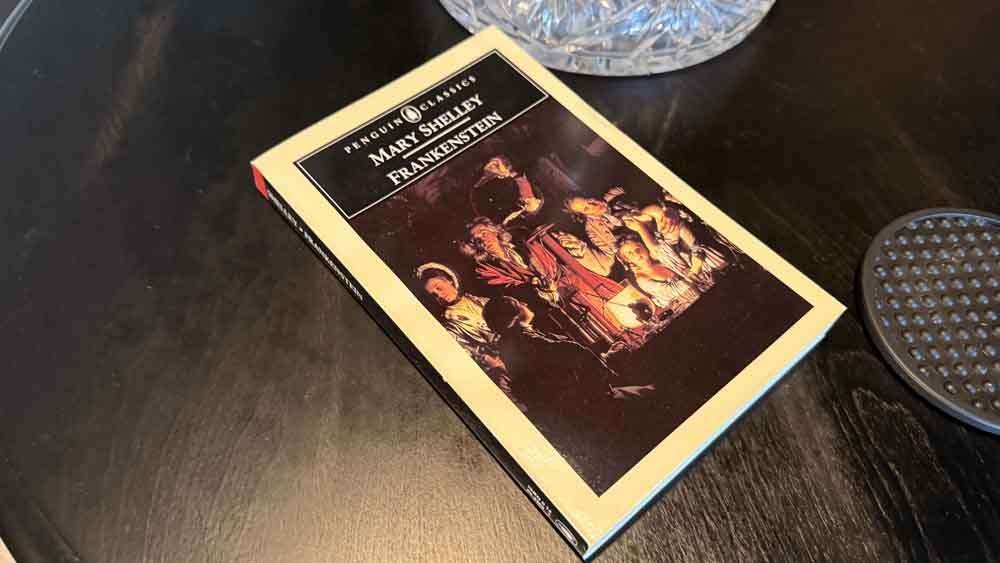
If you’ve only seen the films, the novel will surprise you. Pick up the Penguin Classics edition — it includes a useful introduction to the manuscript history and the Villa Diodati context. For those interested in the Gothic tradition more broadly, I’ve also written about Grimm’s Fairy Tales and the way stories survive because they carry something true that no cleaner form can hold. And if Shelley’s central question — about science, ambition, and what humans dare to build — interests you outside the literary frame, The Ghost in the Machine looks at how the same questions moved from Romantic fiction into philosophy and cognitive science.
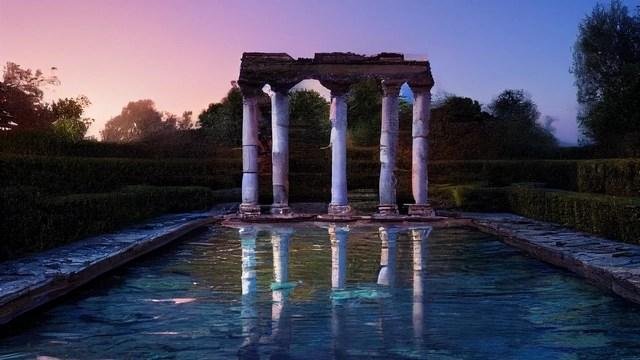
The Villa Diodati is still there. You can rent it.
Sources
- Shelley, Mary. Frankenstein; or, The Modern Prometheus (1818). Penguin Classics edition: https://www.penguinclassics.com/books/frankenstein
- “Year Without a Summer.” Britannica: https://www.britannica.com/event/Year-Without-a-Summer
- Seymour, Miranda. Mary Shelley. Grove Press, 2000.
- “Mount Tambora.” USGS Volcano Hazards Program: https://www.usgs.gov/volcanoes/tambora
- Polidori, John. The Vampyre (1819). Public domain: https://www.gutenberg.org/ebooks/6087
- Shelley, Mary. Frankenstein (1818). Public domain, Project Gutenberg: https://www.gutenberg.org/ebooks/84