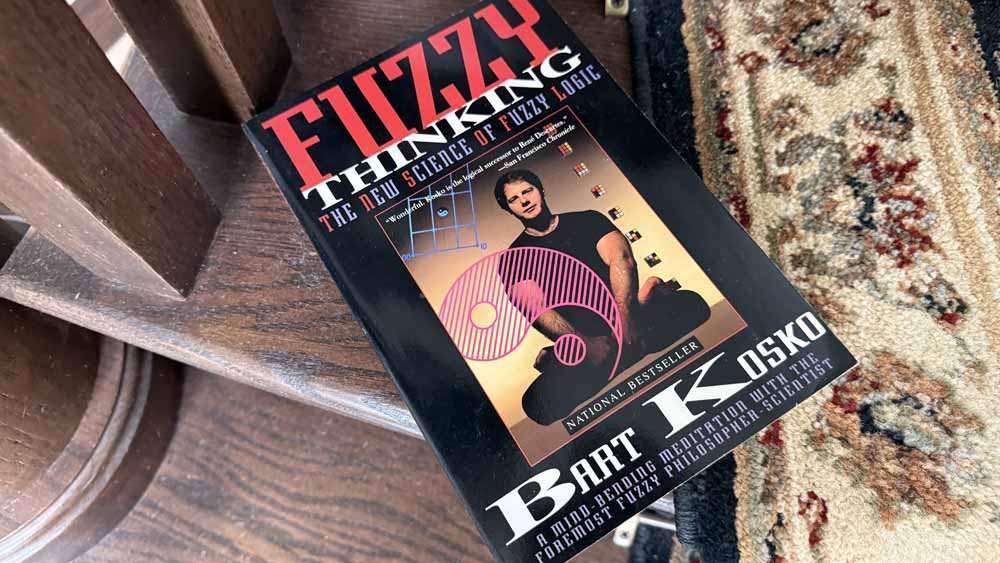
Aristotle laid down the law roughly 2,400 years ago and almost nobody since has had the nerve to call it wrong. Not wrong in some edge case. Wrong as a philosophy of reality. Wrong at the foundation. That is exactly what Bart Kosko does in Fuzzy Thinking: The New Science of Fuzzy Logic (Hyperion, 1993), and he does it with the confidence of a man who holds degrees in philosophy, mathematics, economics, and electrical engineering and is looking for a fight.
The law Kosko goes after — or rather, the two laws — are the pillars of Western logic since the Greeks. The Law of Non-Contradiction says a thing cannot be both A and not-A at the same time. The Law of the Excluded Middle says there is no middle ground: either A or not-A, one of them must be true. Together, these principles gave Western science and philosophy its operating system for millennia. Binary. On or off. True or false. Black or white. Aristotle called the principle of non-contradiction “the firmest of all principles” and dared anyone to find something prior to it. Two and a half thousand years later, Bart Kosko took him up on it.
What the Book Actually Argues
The core claim in Fuzzy Thinking is not complicated, even if the implications are vast. Kosko’s position is this: everything is a matter of degree. Nothing in the real world is purely A or purely not-A. A tomato is not red or not-red — it is 0.8 red and 0.2 not-red. A room is not hot or cold. A man is not tall or not tall. A policy is not good or bad. These are degrees, and any system of logic that flattens those degrees into a binary choice is lying about reality to make the math simpler.
He frames this as the “fuzzy principle”: everything is a matter of degree, and the truth lies somewhere in the middle. This puts him directly in conflict with classical Aristotelian logic, which Kosko argues has hobbled Western science and technology by insisting that the world must conform to a two-valued system that nature never actually uses. As the New York Times described the book on publication, Fuzzy Thinking is “an intellectual biography of the author’s loss of faith in bivalent, or two-valued, logic: the Western tradition, codified by Aristotle, that holds that nature can be explained in either-or terms, 1 or 0, true or false, black or white.”
Kosko builds his case across several levels — philosophical, mathematical, and applied — and it is worth understanding each one before deciding how seriously to take him.
The Philosophical Assault on the Excluded Middle
The Law of the Excluded Middle states, in Aristotle’s own formulation from the Metaphysics: “There cannot be an intermediate between contradictions, but of one subject we must either affirm or deny any one predicate.” That sentence sat largely unchallenged as bedrock for roughly two millennia. Hegel pushed against it — he argued that between +A and -A lies A itself, that the state of dawn is neither full night nor full day — but even Hegel was answered with the rejoinder that he was dealing in contraries, not true contradictories, and that the logical foundation held.
Kosko’s attack is different from Hegel’s. He is not playing the dialectical game. He is pointing at the world and asking: does this look binary to you? Does a man go from not-bald to bald the moment one hair falls out? The Sorites paradox — the ancient Greek puzzle about heaps — asked exactly this: if you remove one grain of sand from a heap, is it still a heap? Remove another? When does it stop being a heap? Classical logic has no satisfying answer. Fuzzy logic does: the heap loses membership in the set “heap” gradually, by degrees, in the same way that a man losing hair moves along a continuum from 0 to 1 on a scale of baldness, not from “has hair” to “bald” in one binary jump.
This is not a trivial observation. It is a direct challenge to the way Western philosophy has classified the world since Aristotle taught that things either belong to a category or they do not. Kosko’s counter: they belong to a degree.
The Eastern Counterpoint
One of the more provocative moves in the book is Kosko’s sustained contrast between Western and Eastern traditions of thought. He argues that the Buddhist and Taoist philosophical traditions never fell into the Aristotelian binary trap. Yin and yang are not opposites that exclude each other — they are interpenetrating degrees. Eastern philosophy made room for the middle, for gradation, for “and” where Western logic insisted on “or.” The Kirkus Reviews notice captured the cultural argument sharply: “Aristotle is out and Buddha is in; the law of the excluded middle is repealed, and A and not-A together replaces it.”
This is the section that irritates some readers and energizes others. Critics have pointed out that Kosko occasionally overstates the contrast — that Buddhism and formal logic are not competing in the same arena, that one is a metaphysical worldview and the other is a system of inference. That is a fair critique. But the deeper point survives the criticism: the cultural assumption embedded in Western rationalism, that the world is fundamentally binary, is an assumption, not a discovery. Other traditions organized thinking differently, and some of those traditions turned out to be more hospitable to gradient thinking.
It is worth noting that resistance to fuzzy logic was not merely philosophical inertia. It was institutional. Kosko describes at length how fuzzy systems were largely dismissed by mainstream American science and engineering in the 1970s and 1980s, while Japan and, later, China embraced them. Japanese engineers used fuzzy logic in subway brakes, washing machines, and industrial controls while Western engineers argued about whether the underlying math was philosophically respectable. The subway ran on time. The argument continued.
The Fuzzy Approximation Theorem and Why It Matters
Kosko moves from philosophy to mathematics with the Fuzzy Approximation Theorem, abbreviated FAT. The claim, roughly stated: any mathematical function can be approximated to any degree of accuracy by a fuzzy system. This is not a metaphor. It is a provable mathematical result, and it matters enormously for anyone thinking about artificial intelligence or machine learning.
What FAT means in practice is that a system built on fuzzy rules — rules that say “if temperature is somewhat high and humidity is fairly high, then fan speed should be moderately increased” — can model any real-world relationship without needing the precise equations that classical engineering requires. You do not need to know the exact differential equation governing a system. You need enough overlapping fuzzy rules to approximate its behavior. This is, it turns out, how much of the real world actually operates: not according to clean equations, but according to rough-but-workable approximations that improve as the rules accumulate.
One Goodreads reviewer captured the scale of this claim precisely: “Folks, the future is Threshold logic. The model must maintain the fractionals and be able to work with them, and a system that is limited by boolean/bivalent thinking will not be robust enough to operate in the messy real world. It is not the logic paradigm that introduces messy or fuzzy — it is the world.”
Publishers Weekly called the book “a provocative new scientific paradigm… written with style and risk.” The risk is real. Kosko is not hedging. He is saying that bivalent logic works the way a simplified map works — useful for some purposes, but not a faithful description of the territory.
Where the Book Stumbles
Fuzzy Thinking is not a perfectly constructed argument. Kosko is brilliant and he knows it, and occasionally the self-awareness bleeds into posturing. The Kirkus review flagged this: “young… which may account for the passion and posturing that color the text.” There are stretches in the book where the tone shifts from intellectual challenge to something closer to score-settling — particularly in the passages about scientific gatekeeping and the rejection of fuzzy systems by Western academics.
There is also an irony that several readers have noted, including at least one Amazon reviewer who made the point cleanly: Kosko sometimes argues for fuzziness in exactly the binary terms he rejects. The fuzzy worldview good, the Aristotelian worldview bad. A man dismantling a binary framework using binary logic. This is not a fatal flaw — the philosophical argument stands on its own terms — but it is the kind of self-contradiction that a more careful writer would have caught and neutralized.
The later chapters, which extend fuzzy logic into metaphysics, cosmology, and the existence of God (via something Kosko calls FAT proofs for theology), test the reader’s patience. The engineering applications are concrete and compelling. The theological applications feel like a thought experiment that outran its own foundations. The book is strongest when it stays close to the mathematics and the applied systems. It is weakest when it reaches toward everything.
The Legacy
The applied legacy of fuzzy logic is easier to assess than the philosophical one. By the time this book appeared, fuzzy systems were already running in Sendai’s subway in Japan, in camera autofocus systems, in Hitachi’s washing machines that adjusted water levels based on load and soil degree. The applications have only expanded — fuzzy logic underlies control systems in everything from elevator scheduling to autonomous vehicles. The AI Expert magazine review called it “a significant contribution… both in the narrow sense of explaining an important piece of technology clearly and in the broader sense of touching on some deeper philosophical issues.”
The philosophical legacy is more contested. Fuzzy logic is not the dominant paradigm in AI — neural networks, which Kosko also worked on, took the center stage. And Aristotle is not quite as dead as Kosko would have it. Classical logic still powers most formal reasoning systems, most programming languages, most legal argument. The binary assumption, it turns out, is deeply useful even if it is not perfectly accurate. The bridge that classical engineering designed does not fall down just because reality is technically fuzzy.
But Kosko’s deeper argument is not that classical logic is useless. It is that classical logic is a special case — a 0-1 edge case of a more general multivalued reality. And that framing is harder to dismiss. Every probability, every degree of certainty, every “somewhat” and “mostly” and “almost” in everyday language is evidence that the binary model is an approximation we accepted as a foundation. Kosko wants the approximation acknowledged as such. That is a reasonable demand. It is still, thirty-some years later, not fully settled.
For anyone who has already read Fuzzy Logic by Daniel McNeill and Paul Freiberger — which covers the history and applications of fuzzy systems in a more journalistic register — Kosko is the harder read and the more rewarding one. Where McNeill and Freiberger explain the phenomenon, Kosko is the phenomenon: an engineer-philosopher who went looking for the philosophical mistake at the root of Western science and believed he found it. Whether you agree with his conclusion or not, the search itself is worth following.
For anyone interested in the deeper relationship between logic and reality, the posts on the demarcation problem and the problem of induction provide useful context — Kosko’s challenge to bivalent logic sits in the same neighborhood as Popper’s and Hume’s challenges to the certainty of scientific inference.
A Book Worth the Argument
Fuzzy Thinking is not always easy company. Kosko is combative, occasionally sloppy in the philosophical passages, and too in love with his own iconoclasm. But the core argument — that a logic built on either/or cannot fully describe a world built on degrees — is correct enough to be uncomfortable. The world does not sort itself into categories with clean edges. Things are partly true. People are partly right. Systems are partially functional. Every seasoned judgment call, every practical decision made under uncertainty, every negotiation that lands somewhere between yes and no already operates in fuzzy space.
Aristotle gave the West a clean map. Kosko argues the map is too clean. The territory, as usual, is more complicated than the map suggests — and any tool that can capture that complication more faithfully is worth understanding, even if it takes thirty years of institutional resistance to admit it.
Sources
- Kosko, Bart. Fuzzy Thinking: The New Science of Fuzzy Logic. Hyperion, 1993. https://www.amazon.com/Fuzzy-Thinking-New-Science-Logic/dp/1562828398
- Kirkus Reviews. “Fuzzy Thinking.” May 1993. https://www.kirkusreviews.com/book-reviews/bart-kosko/fuzzy-thinking/
- New York Times review excerpt via Scribd. https://www.scribd.com/document/659071459/Fuzzy-Thinking-the-New-Science-of-Fuzzy-Logic
- Stanford Encyclopedia of Philosophy. “Contradiction.” https://plato.stanford.edu/entries/contradiction/
- Stanford Encyclopedia of Philosophy. “Aristotle on Non-Contradiction.” https://plato.stanford.edu/entries/aristotle-noncontradiction/
- Wikipedia. “Bart Kosko.” https://en.wikipedia.org/wiki/Bart_Kosko
- Wikipedia. “Law of Excluded Middle.” https://en.wikipedia.org/wiki/Law_of_excluded_middle
- Rasmussen, Deal. “Review: Fuzzy Thinking, the New Science of Fuzzy Logic by Bart Kosko (1993).” Souls of Lagrange, June 2024. https://dealrasmussen.com/2024/06/08/review-fuzzy-thinking-the-new-science-of-fuzzy-logic-by-bart-kosko-1993/
- Goodreads reader reviews. https://www.goodreads.com/book/show/1382028.Fuzzy_Thinking