The firing squad in Goya’s masterpiece doesn’t have faces. They don’t need them. The state doesn’t look you in the eye when it pulls the trigger.
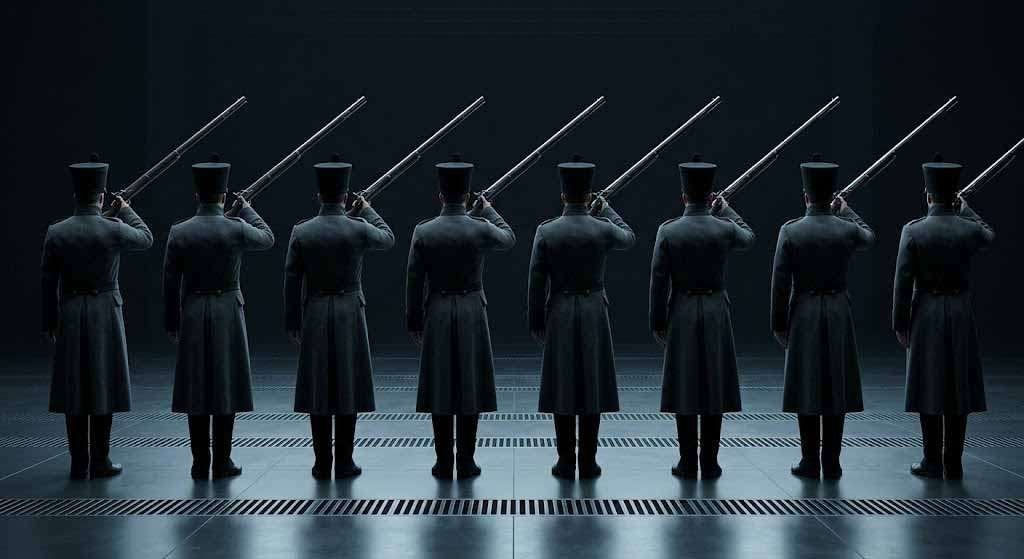
The Third of May 1808 is not a war painting in any sense the eighteenth century would recognize. It’s a production process. Input: men. Output: corpses. The soldiers on the right side of that canvas are a mechanism, identical in posture and angle, rifles leveled like pistons on a line. The condemned on the left are the raw material. The lantern on the ground is the only light in the painting, and it illuminates exactly the people who are about to stop being people.
Goya painted this in 1814. The Industrial Revolution was already grinding. He may not have consciously connected the imagery of the factory floor to the imagery of the execution site — but he didn’t have to. He was just looking at what was in front of him and refusing to dress it up.
The Machine Has No Grievance
What makes the faceless firing squad so devastating isn’t cruelty. Cruelty implies personal engagement. The soldiers in this painting have no personal engagement. They’re pointing in the same direction at the same angle doing what they were told to do by people who were doing what they were told to do by other people in a chain of command that bottoms out somewhere in a field outside Madrid at dawn.
That’s not cruelty. That’s a process.
The philosopher Hannah Arendt, covering the 1961 Eichmann trial in Jerusalem, coined the phrase “banality of evil” to describe the bureaucratic, thoughtless, procedural character of large-scale state violence. Eichmann organized transportation. He did not think of himself as a murderer. He thought of himself as a logistics problem solver. The murders were downstream of his spreadsheets.
Goya saw that — or the early version of it — a hundred and thirty years before Arendt wrote about it. He saw it in the Peninsular War, in the French occupation of Spain, in the systematic executions that followed the Dos de Mayo uprising. The soldiers at Príncipe Pío hill didn’t hate the men they shot. They probably didn’t think about them at all. The order came down. The order was followed.
That’s the machine.
Who’s on the Ground
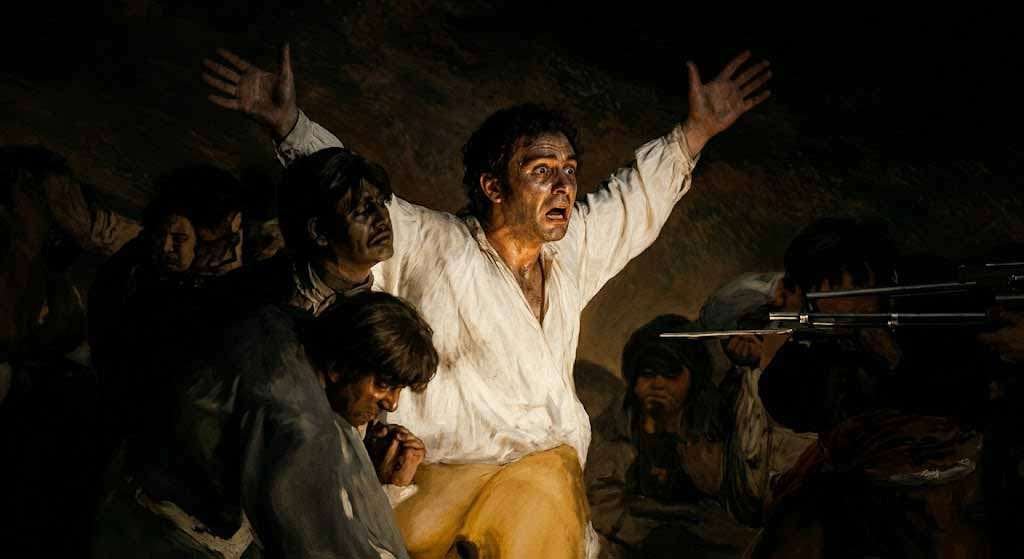
The man in the white shirt. Arms flung wide, mouth open, eyes looking directly at the rifles. He’s the painting’s center of gravity and Goya makes sure you can’t look away from him.
His hands are rough. The hands of someone who works with them. He’s not an officer, not a politician, not anyone who made a decision that brought French troops to Madrid. He’s whoever was in the street when the roundup happened. He grabbed a weapon during the uprising — a kitchen knife, a farm tool, a musket he barely knew how to use — because Spanish men were dying in the street and you do something. You do something. Or maybe he wasn’t even in the street. Maybe he was just in the wrong part of the city.
Goya doesn’t tell us. Neither did the French army. The executions on May 3rd, 1808 were documented by French military records as having killed somewhere between 40 and several hundred people, depending on which account you read. The uncertainty in the numbers is itself part of the point: when the state processes bodies at scale, record-keeping gets imprecise at the edges.
The condemned in the painting are all in workers’ clothes. This is not an artistic choice that required research — this is because workers are who you get when you round up the people of a neighborhood at dawn. The aristocracy had already made their accommodations with the occupation. The clergy was navigating. The merchants were calculating. The people who ended up at Príncipe Pío were the people who had the least to lose by fighting and the least protection when they lost.
Empire eats the poor first. Goya knew this. He was the son of a gilder.
The Lantern
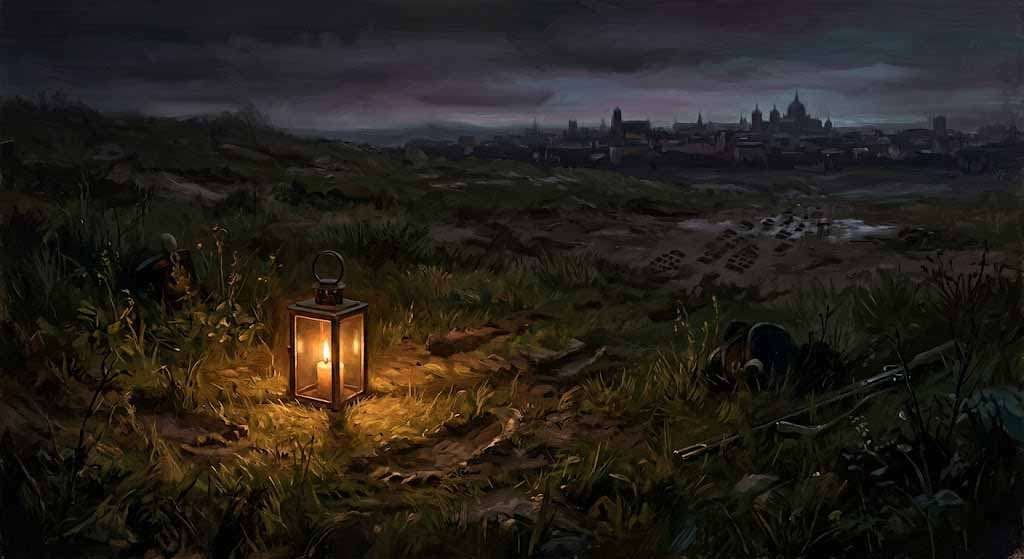
The light source in this painting is a square box lantern sitting on the ground. Something you’d use to light a stable or a work site. Something somebody carried to this hill because they needed to see what they were doing.
Think about that. They needed to bring their own light. These executions happened before dawn — Goya is specific about that, the title says the third of May, and the darkness in the painting confirms early morning — and whoever organized them thought to bring a lantern because you can’t run an efficient execution if the soldiers can’t see the targets.
The functional logic of that detail is what makes it horrifying. This wasn’t passion or rage or a battle in the heat of conflict. Someone planned it. Someone thought about the logistics. Someone said: it will be dark, we’ll need light. And then they went and did it.
Goya puts that lantern at the center-bottom of the composition and makes it the only warm light source in the painting. Everything flows from it. The faces of the condemned are lit from below — a lighting angle that in dramatic tradition signals menace, the uncanny, the underworld. Goya uses it here not for dramatic effect but because that’s where the light was. The effect is the same. The condemned are illuminated from hell.
What Happened to War Painting
Before Goya, the tradition runs roughly as follows: kings commission painters to commemorate victories. The painter’s job is to record the triumph of the patron’s cause in visual terms that will last. The dead are shown with dignity. The victors are shown with honor. Everyone’s posture is good.
Titian did it. Rubens did it. Velázquez did it — though Velázquez, always the most honest eye of his era, put some ambiguity into his Surrender of Breda that makes it strange even now. The genre had an understood social function: art as state propaganda, art as the permanent record of military glory.
Goya broke the contract. Not because he was a revolutionary — he worked for the Spanish royal court for decades, painted the royal family, navigated the politics of a court painter’s life with considerable skill. But he had seen what he had seen, and when the restored monarchy offered to fund paintings commemorating the insurrection against Napoleon, he painted the truth instead of the commemoration.
The result was The Third of May. The monarchy accepted it. They may not have fully understood what they’d paid for.
The Rifles
Look at the line of rifles in the painting. Leveled at exactly the same angle. The stocks held at exactly the same position. The soldiers’ elbows at exactly the same height.
Goya is making them interchangeable. He is showing you a unit, not men. The rifles extend the line of the soldiers’ bodies in a single direction — toward the white-shirted man’s chest — and the geometry of it is unmistakable once you see it: this is a mechanism aimed at a target. The men holding the rifles are components of the mechanism.
In the mills of the early Industrial Revolution, skilled craftsmen were being replaced by workers who did single repetitive tasks in sequence. The point of the system was that no individual worker needed to understand the whole product or care about it. Each person did their piece, and the piece was always the same, and the output accumulated at the end of the line.
The soldiers of the French army were not factory workers. But they operated on analogous principles: training, standardization, unit cohesion, the replacement of individual moral decision-making with institutional command structure. Goya’s image of their leveled rifles is, whether he consciously intended it or not, an image of industrial precision applied to human death.
He painted it sixty years before the Franco-Prussian War would make industrial warfare explicit at scale. He painted it a century before the Western Front would mechanize death completely. He saw the principle early, in a field outside Madrid, by the light of a box lantern.
The Larger Argument
When empires collide, the peasant bleeds.
Goya does not state this as a proposition. He doesn’t need to. He shows it in the composition: the faceless institutional power on one side, the ordinary terrified men on the other, the light that illuminates only the victims. You can read the class analysis of the painting without knowing any history of the period. The image makes the argument by itself.
The condemned have faces. They have fear in those faces. One man covers his eyes. Another prays. The white-shirted man confronts the rifles directly, and whether that’s courage or dissociation or the last animal refusal to look away from what’s coming, you feel it.
The soldiers have no faces. They have uniforms and rifles and a posture of readiness.
That asymmetry is the painting’s moral core. The humanity is concentrated entirely on the side of the people being killed. The mechanism that kills them has been drained of humanity by design — trained out of them, commanded out of them, institutionally required to be absent at this particular moment on this particular hill.
Goya gives us both sides of that equation with equal visual clarity. He doesn’t explain it. He doesn’t caption it. He paints the truth of what he saw and trusts you to draw the line between the rifle barrel and the man at the end of it.
That line, once you see it, is very hard to stop seeing.
You Might Also Like
- Goya’s Third of May: The Assembly Line of State Murder
- Jacques-Louis David’s The Death of Socrates — Conviction, Hemlock, and the Price of the Examined Life
- No Exit by Jean-Paul Sartre — The Play That Diagnosed Modern Life Before Modern Life Knew It Was Sick
Sources
- Museo del Prado, The Third of May 1808: museodelprado.es
- Hannah Arendt, Eichmann in Jerusalem: A Report on the Banality of Evil (Viking Press, 1963)
- Robert Hughes, Goya (Alfred A. Knopf, 2003)
- Janis Tomlinson, Francisco Goya y Lucientes: 1746–1828 (Phaidon, 1994)
- John Berger, Ways of Seeing (Penguin Books, 1972)