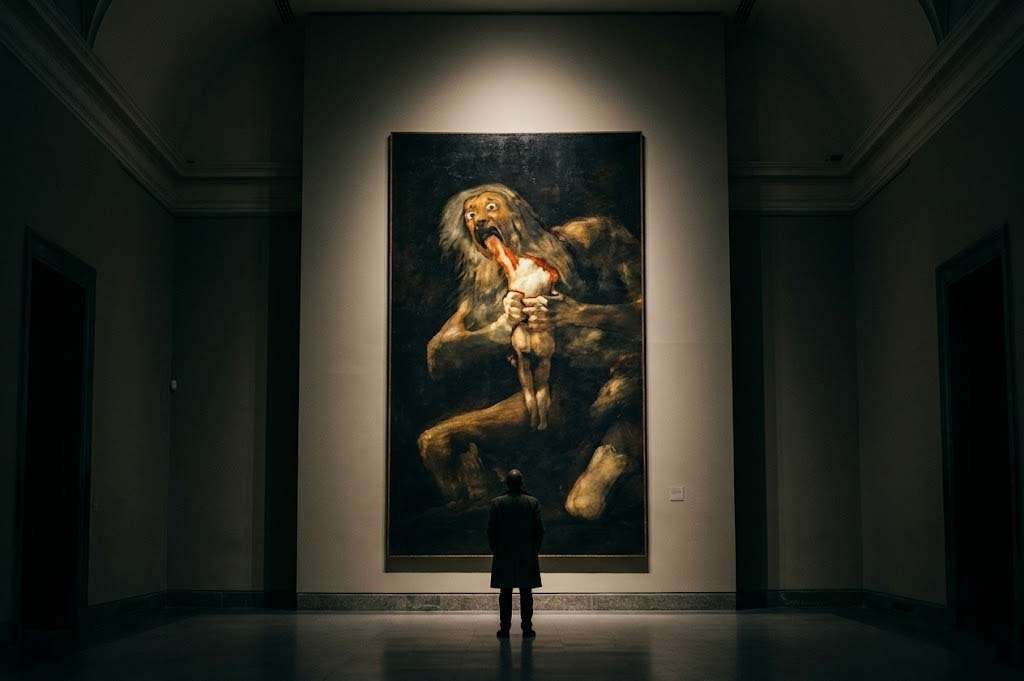
He painted it on his dining room wall. Not for sale, not for exhibition. Just him and the god eating his children.
That fact alone should stop you cold. Francisco Goya was seventy-three years old when he moved into the Quinta del Sordo — the House of the Deaf Man, named for its previous owner — on the outskirts of Madrid. He was deaf himself by then, the deafness having come on him suddenly in 1793 after a near-fatal illness that left him with tinnitus, partial paralysis, and a permanently altered view of the world. He covered the walls of two rooms with what we now call the Black Paintings: fourteen murals depicting witches’ sabbaths, two men sinking into sand while beating each other with clubs, a dog’s head barely clearing a field of nothing. And there, in the dining room — presumably where he ate his meals — he put Saturn.
The god is enormous. He fills the frame. His eyes are white and blown-out, the eyes of a man who has been somewhere none of us want to go. His mouth is already working. Both hands grip the small human body with a competence that suggests practice. The figure being consumed is headless at the point we encounter it — the head already gone, already down. One arm dangles. The torso is roughly the size of a large fish.
This is not allegory at a polite distance. This is what Goya believed was happening.
The Man Who Watched the Enlightenment Fail
To understand Saturn you have to understand what the years before it had done to Goya. He was not a cynic by nature. He was, for most of his career, a court painter — successful, celebrated, the kind of artist who decorated aristocratic ceilings with cheerful scenes of picnics and parasols. He believed, as most educated Europeans of his generation believed, that reason was ascendant. The Enlightenment had come. Superstition was in retreat. The old tyrannies were giving way to something better.
Then Napoleon invaded Spain.
What followed — the Peninsular War, 1808 to 1814 — was not a clean ideological conflict. It was a catastrophe of the kind that doesn’t fit any framework you’ve built to make sense of the world. The French army, which was supposed to represent Enlightenment values, committed atrocities. The Spanish resistance, which was supposed to represent national dignity, committed atrocities. Priests incited murder. Guerrillas tortured prisoners. Civilians were massacred by both sides. Goya documented all of it in his print series The Disasters of War — eighty-two images he completed but never published in his lifetime, because there was no context in which publishing them would have been safe or sane.
By the time he retreated to the Quinta del Sordo, Ferdinand VII had been restored to the Spanish throne and had immediately abolished the constitution, reinstated the Inquisition, and began executing liberals. The rational order that Goya’s entire adult intellectual life had been oriented toward had not merely failed. It had revealed something underneath itself — something old and hungry.
He painted it on his wall.
What the Painting Actually Does to You
There is an art-historical tendency to describe Saturn in terms of mythology — the Titan who swallowed his children to prevent being overthrown, the Cronos of Greek tradition, the allegory of Time devouring its own creations. That reading is not wrong. But it is also a way of keeping the painting at arm’s length, and the painting refuses that distance.
The scale is wrong for comfort. Saturn is too large. He does not fit properly in the space Goya gave him, and that claustrophobia is deliberate — the figure pushes against its own frame, as if the composition cannot contain what it’s depicting. The background is a field of brown-black nothing, a void that functions less as setting than as negation. There is no world here. There is only this.
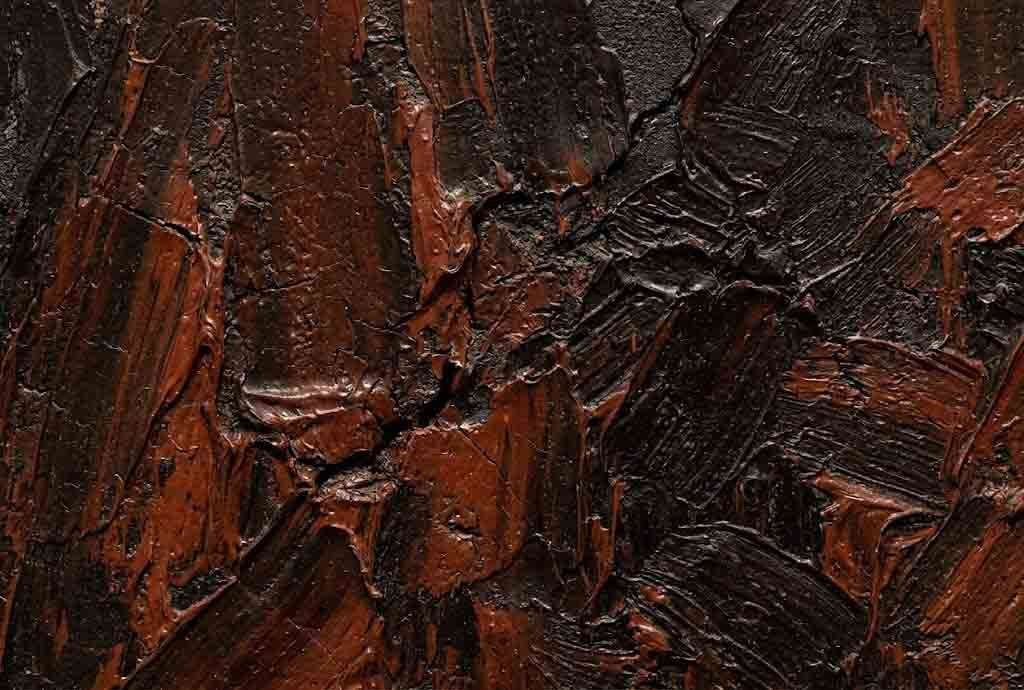
The technique is equally brutal. Goya painted the Black Paintings not on canvas but directly onto plaster, apparently with palette knives and his fingers as often as with brushes. The surface is rough and urgent. The paint records velocity. When you stand in front of the original at the Prado — and I’ve spent time with it — the texture is like scar tissue. Nothing is blended to smoothness. Nothing is resolved. The figure of Saturn is laid on in thick, slashing marks, and the flesh of his victim is daubed in pale strokes that look sickly and unreal against the darkness. There is no grace in the application, and the absence of grace is the point.
The eyes are what get you. They are not the eyes of a god in the grip of terror, as the myth suggests — Cronos swallowing because he fears. They are the eyes of something that cannot stop. Dilated, rimmed with shadow, fixed on nothing visible to us. The mouth is working but the eyes have already left. This is compulsion, not fear. This is appetite become mechanism.
Art historians have debated whether the original figure was female — some restoration analysis suggests the lower body may have depicted female anatomy before the painting was transferred from plaster to canvas in the 1870s. If true, it only complicates the horror, drawing in older currents of sexual violence and the consumption of the feminine. But even without that reading, the figure’s nakedness is not erotic. It is the nakedness of something stripped down to meat.
Romanticism’s Darkest Room
The Black Paintings are often positioned within the Romantic movement, and that’s fair — Romanticism was, among other things, a response to the Enlightenment’s failure to account for the irrational. But Goya is not doing what Blake or Caspar David Friedrich are doing. He is not finding sublimity in darkness. He is not offering transcendence through terror. He is not suggesting that the abyss contains something worth encountering.
He is saying the abyss is correct.
Romanticism’s relationship to reason was complicated and often recuperative — even at its most gothic, there tended to be some structure beneath the chaos, some redemptive possibility latent in the horror. Think of Friedrich’s wanderer above the sea of fog: the figure dwarfed by nature but still standing, still looking, still present as a conscious subject. There is ego in that painting, confident and compositionally centered.
Goya removed the ego entirely. Saturn has no viewer-surrogate. There is no position of witness you can occupy that is safe. You are either the god or the body, and the body is already gone from the waist up.
This is why I’d argue that Saturn Devouring His Son is not just the darkest painting of the Romantic period. It is the painting that most honestly describes what the Romantic period was actually responding to — not nature’s grandeur but reason’s wreckage. Not the sublime but the specific political horror of watching a century of intellectual progress consumed by the machinery it was supposed to replace.
The Enlightenment promised that reason would dethrone the old gods. Goya lived long enough to watch the old gods eat the promise whole.
What It Means to Hang Something Like This in a Room Where You Live
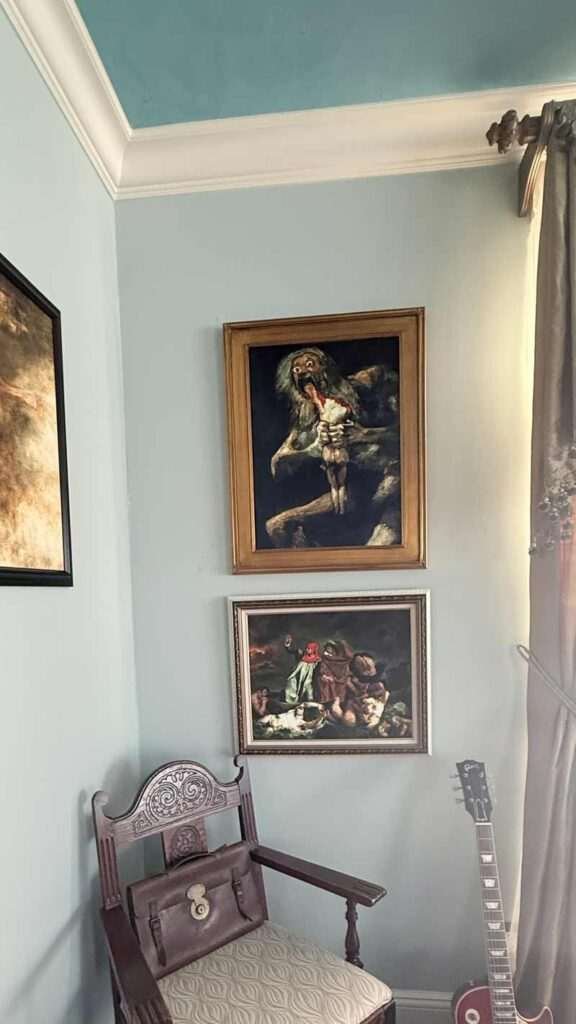
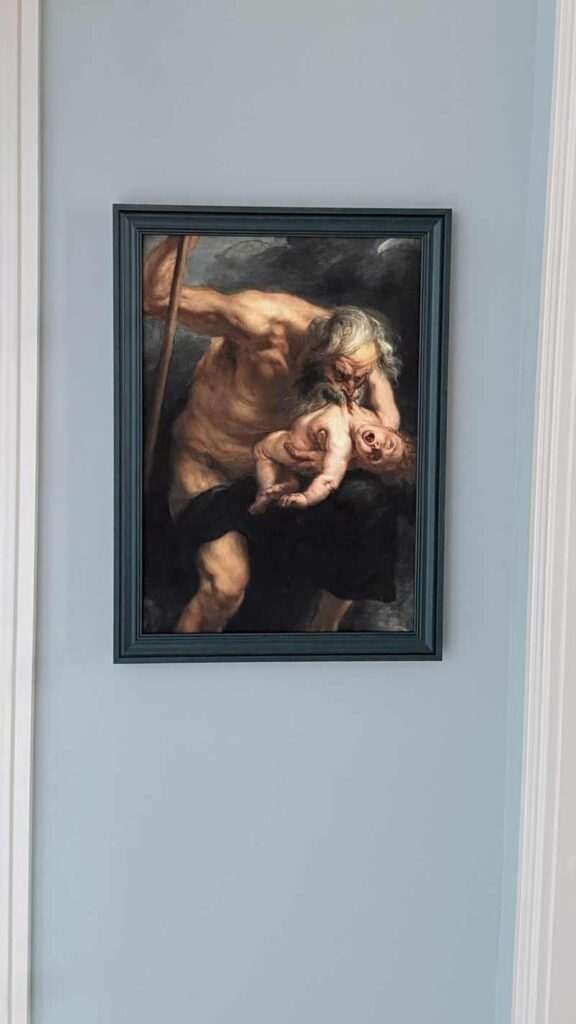
I’ve thought about this a lot. I’m drawn to this myth in a way that goes beyond aesthetic preference — deeply enough that I’ve replicated both the Goya and the Rubens version of Saturn Devouring His Son in my home gallery. Two painters, two centuries apart, two completely different registers of horror, and I wanted both of them on the wall. That probably tells you something.
The Rubens — painted around 1636, now in the Prado — is the version people think they want before they’ve seen the Goya. It is technically magnificent. The anatomy is heroic, the composition classical, the god monumental and almost beautiful in his violence. Rubens was working within a tradition that demanded a certain grandeur even from atrocity. Saturn in his version is terrifying the way a thunderstorm is terrifying: enormous, elemental, but ultimately part of a world with rules. You can stand back from it.
You cannot stand back from Goya’s version. That’s the difference. And that’s why the Goya hits differently — it’s not mythology, it’s confession.
The artwork on the walls at The Heritage Diner are my own — painted by my own hand, hung because I wanted the space to hold something of me. That choice is personal in a way that’s hard to fully explain, but I understand the impulse at the bottom of it: you put on the wall what you need to reckon with. What you can’t resolve and can’t stop thinking about.
For me, the Saturn myth lands on at least three levels at once — and I think that’s why I keep coming back to it. The first is the most obvious: time. Everything you build, time eats. The diner, the craft, the accumulated years of work — none of it is exempt. The god doesn’t distinguish between what you’re proud of and what you regret. He eats it all at the same pace. That’s not nihilism; it’s just true, and there’s a strange peace in accepting it straight.
The second is political — and Goya’s version is entirely about this. Power consumes its own creations. The systems that produce progress contain the mechanism of its reversal. You watch it happen in every generation, if you’re paying attention. I’ve been paying attention.
The third is the one I sit with longest. A father’s fear. What he might pass down without meaning to. What he might become under enough pressure. I grew up in a household where men carried old-country pain they never named, and it leaked into everything anyway — the silences at dinner, the way a belt buckle could turn into a sentence. You inherit things you didn’t choose. The terror in Goya’s Saturn is not just political. It is the terror of a man who looks at his own hands and wonders what they’re capable of.
Goya could not resolve what he had watched happen to his country, his century, his beliefs. He put it on the wall where he had to eat anyway. That is not madness — or not only madness. That is a man insisting on honesty with himself when every pressure was toward looking away.
The painting was never meant to comfort anyone. It was not meant to be seen by anyone but him. The fact that we can now stand in front of it at the Prado — transferred to canvas after his death, bought by a French banker, eventually donated to the Spanish state — is a kind of accident. We are looking at something that was made to be private, to be endured rather than exhibited.
It is, for that reason, one of the most honest things a painter has ever put on a wall.
The Other Black Paintings and What They Tell Us Together
Saturn does not stand alone. The companion pieces in the Quinta del Sordo were equally unsparing: Witches’ Sabbath, with its crowd of grotesque faces turned toward a great dark figure; The Dog, a small animal head visible above an expanse of featureless ground, possibly sinking, possibly just isolated; Two Old Men Eating, where ancient figures consume food with faces of horror and compulsion; Judith and Holofernes, recast not as triumph but as grim necessity.
What unites them is the absence of any saving distance. In the tradition of European painting — even dark European painting — there was usually a formal arrangement that reminded you you were looking at a picture. Borders, perspective, the careful staging of narrative. The Black Paintings dispense with that staging. They present their subjects as raw fact. They do not ask you to appreciate them as art. They ask you to survive the encounter.
Contemporary critics have read the series through the lens of Goya’s mental deterioration, or his political despair, or the genre of capricho — the fantastical, satirical image tradition he had been working in for decades. All of those readings have merit. But I think the most honest reading is also the simplest: an old man, deaf, politically humiliated, living in a house outside a city he no longer trusted, painted what he actually believed about power, time, and the fate of human aspiration. He painted it on plaster walls. He never showed it to anyone.
He was right about most of it. That’s the part that’s hardest to sit with.
Why This Painting Still Doesn’t Let Go
The painting is almost two hundred years old. The political context — Napoleonic Spain, the restoration of Ferdinand VII, the death of constitutional liberalism — is history. The myth it draws on is older still. And yet Saturn Devouring His Son does not feel historical.
It feels like a description of a recurring condition. The pattern Goya was documenting — progress achieved at great cost, then consumed by the forces it thought it had displaced — is not a Spanish pattern or an Enlightenment pattern. It’s a human one. You could make the argument, and I think Goya would make it with you, that every generation that believes reason has finally won is setting up the next meal.
The god is always hungry. He does not distinguish between centuries. He eats the hope of the one that’s currently optimistic and moves on to the next.
That is not a comfortable thought. It was not meant to be. Goya painted it on his dining room wall, in the room where he had to eat anyway, and looked at it every day. He did not pretend it wasn’t there.
That is, finally, the only honest response. Not comfort. Not resolution. Just the refusal to look away from what you know.
You Might Also Like:
- Jacques-Louis David’s The Death of Socrates — Conviction, Hemlock, and the Price of the Examined Life
- Rembrandt’s Aristotle with a Bust of Homer — A Portrait of the Mind in Conflict
- Thus Spoke Zarathustra by Friedrich Nietzsche — The Book That Rewired My Understanding of Everything
Sources:
- Tomlinson, Janis. Goya: A Portrait of the Artist. Princeton University Press, 2021. https://press.princeton.edu/books/hardcover/9780691175201/goya
- Connell, Evan S. Francisco Goya: A Life. Counterpoint, 2004.
- Hughes, Robert. Goya. Knopf, 2003.
- Museo Nacional del Prado — Saturn: https://www.museodelprado.es/en/the-collection/art-work/saturn/18ab3e44-54cb-4699-8341-5a0a00bfbd97
- Symmons, Sarah. Goya. Phaidon, 1998.
- Licht, Fred. Goya: The Origins of the Modern Temper in Art. Universe Books, 1979.
- Museo Nacional del Prado — Rubens, Saturn: https://www.museodelprado.es/en/the-collection/art-work/saturn/e7195602-8e32-4e00-bbe4-79a4e1c29c55