Schopenhauer Wasn’t Wrong. That Was the Problem.
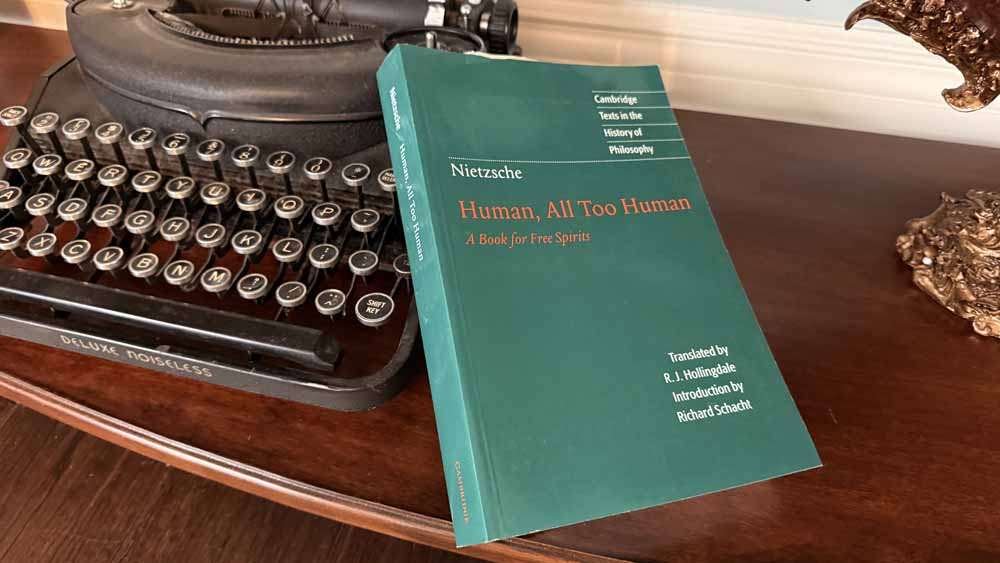
Every thinker has one book they’d rather you skip. For Nietzsche, that book might be this one — not because it’s weak, but because it’s too honest. Human, All Too Human, published in 1878, is the record of a man taking a scalpel to his own convictions. He was thirty-three years old. He had already written The Birth of Tragedy, already declared his allegiances to Wagner and Schopenhauer, already staked out his position inside the great Romantic project of nineteenth-century German thought. Then he changed his mind. Publicly. Without apology.
That’s the rupture. And it’s worth reading closely, because what Nietzsche does here — how he does it, what tools he picks up — says more about his mature philosophy than most of what came after.
Nietzsche came to Schopenhauer early. He found The World as Will and Representation as a young man in a Leipzig bookshop, read it in a four-day fever, and came away convinced he’d found a map. Schopenhauer’s system was grim but coherent: the world is driven by a blind, irrational will; individual existence is mostly suffering; art and asceticism offer the only dignified exits. For a philosophically-minded young man in nineteenth-century Europe, this was intoxicating — serious, dark, and intellectually airtight.
The problem wasn’t that Schopenhauer was sloppy. The problem was that his system led somewhere Nietzsche found himself increasingly unable to follow. Schopenhauer pointed toward resignation, toward negating the will. And Nietzsche, whatever else he was, was not a man inclined toward resignation. The match between temperament and metaphysics was breaking down.
Human, All Too Human is where the break gets made — not through dramatic refutation, but through something more corrosive: persistent, skeptical questioning of everything metaphysics had promised. Nietzsche doesn’t argue against Schopenhauer so much as he dissolves the ground metaphysics stands on. He turns his attention to how human beings actually think, actually form their “higher” impulses, actually generate what they call moral feeling. His method here is genealogy before he ever called it that — trace the idea back to its origin, and watch its grandeur deflate.
The Wagner Problem
If Schopenhauer was Nietzsche’s philosophical father, Wagner was his artistic one — and arguably the more painful loss. The relationship had been close, mutual, and genuine. Wagner recognized in the young professor of philology a mind that could give his music a philosophical foundation. Nietzsche recognized in Wagner’s work something he thought Schopenhauer’s philosophy demanded: art as the highest response to the pain of existence. For a while, the friendship held both sides of that bargain together.
The Birth of Tragedy (1872) was Nietzsche’s contribution to the project — a reading of Greek drama that divided all art between the Dionysian (raw, irrational, musical, life-affirming in the deepest sense) and the Apollonian (ordered, imagistic, formal), with Wagner positioned as the inheritor of genuine Dionysian power. It was a young man’s book, and Nietzsche knew it: exhilarating in its arguments, occasionally reckless, dependent on a Romantic mythology he was already beginning to distrust.
By 1876, watching Wagner’s Ring cycle premiere at Bayreuth, something shifted. The spectacle was grand. The audience was dressed for occasion. The nationalism was palpable, the religiosity thick. Nietzsche looked around and saw not the renewal of tragic culture but a cultural performance — a pageant for the educated bourgeoisie, wrapped in Germanic mythology and self-congratulation. The distinction he had drawn between genuine Dionysian art and mere decorative culture was being erased right in front of him.
Human, All Too Human was dedicated to the memory of Voltaire on the centenary of his death. The choice was pointed. Voltaire: rationalist, skeptic, enemy of mystification, dissolver of pieties. The dedication was a message to Wagner before the book had even begun. When Wagner read it, the friendship ended.
Aphorisms as a Philosophical Method
One of the things Human, All Too Human signals — and that readers sometimes miss — is that Nietzsche’s shift in content was matched by a shift in form. He abandoned the long-form essay and moved to aphorisms. This is worth thinking about, because it wasn’t arbitrary.
The aphorism refuses system. A system is what Schopenhauer built — a grand, unified architecture where each piece supports the next and the whole holds together under the pressure of internal logic. Nietzsche had grown suspicious of that. A thinker who builds a system is, almost by definition, a thinker who has decided in advance where the argument must go. The system then becomes a machine for generating predetermined conclusions.
The aphorism does something different. It makes a cut, then moves on. It doesn’t build; it punctures. Taken together across a whole book, the aphorisms of Human, All Too Human don’t add up to a counter-system. They add up to a habit of mind — suspicious, probing, willing to leave things unresolved. The form is the argument. If Schopenhauer’s method said “here is the structure of everything,” Nietzsche’s new method said: “here is what you thought was deep — now watch it get shallow.”
That willingness to resist system-building persists through everything that comes after this. In Thus Spoke Zarathustra he gives it a poetic form. In The Gay Science, a more lyrical one. But the skeptical habit — the refusal to let any idea off without examination — begins here, in this book, as a direct response to what Nietzsche came to see as Schopenhauer’s and Wagner’s shared mystification.
What “All Too Human” Actually Means
The title deserves a moment. Human, All Too Human — the phrase sounds like an insult at first, or at minimum a deflation. And it is, in the sense that Nietzsche uses it to bring down what had been elevated. The “higher” things — morality, metaphysics, art, religion, the altruistic impulse — are all too human. They come from us. From our psychology, our needs, our historical situations, our evolutionary inheritance. They are not windows into a transcendent realm. They are what creatures like us produce when they confront the fact of their own existence.
This is a cold conclusion if you follow Schopenhauer and think that art is the route to something beyond the will. It’s even colder if you follow Wagner and think that a certain kind of music is a conduit to something sacred. But Nietzsche doesn’t present it as a cold conclusion — he presents it as a liberation. If morality is human, then it can be evaluated. If our values came from somewhere, they can be questioned. If Wagner’s music is not the voice of primordial truth but the product of a nineteenth-century German genius with particular cultural ambitions, then we can hear it for what it is rather than for what it was supposed to represent.
This is the move Nietzsche will refine for the rest of his writing life. The genealogical acid that strips noble origin stories from ideas and shows the human machinery underneath. In Human, All Too Human, it’s still relatively gentle — more Voltaire than hammer. But the tool is being picked up here, held for the first time, tested for weight.
The Loneliness of Changing Your Mind
What’s easy to miss in a philosophical reading of this book is the personal register. Nietzsche was genuinely alone when he wrote it. The break with Wagner was not just intellectual; it was a break with the most important relationship of his adult life to that point. His health was deteriorating — the migraines, the eye problems that would worsen and eventually force his retirement from teaching. He wrote much of it in isolation, in boarding houses in Italy and Switzerland. He was doing what almost nobody in philosophy does: publicly revising the work that made his reputation, alienating the patron who had championed him, and arriving at conclusions that offered no comforting alternative mythology.
Schopenhauer had given him pessimism with a consolation prize — art. Wagner had given him pessimism with a community — the Bayreuth circle, the sense of shared cultural mission. Human, All Too Human takes both away and offers in return only the clarity of seeing things as they are. That’s not nothing. But it is cold comfort at thirty-three in a rented room.
There’s something in that worth holding. The philosophy Nietzsche eventually became famous for — the will to power, the eternal return, the Übermensch — is the philosophy of a man who already, by 1878, had passed through this crucible. He knew what it cost to be honest with himself. The later work wasn’t bravado. It was a man who had already paid the price of intellectual honesty and decided, having paid it, to go further.
For more Nietzsche in the context of these ideas, the Kierkegaard Anthology review makes a useful companion — Kierkegaard represents the road Nietzsche rejected, the leap into faith rather than the descent into genealogy.
You Might Also Like
- Thus Spoke Zarathustra by Friedrich Nietzsche — The Book That Rewired My Understanding
- The Gay Science by Friedrich Nietzsche: God Is Dead, and Heavy Metal Has Known It Longest
- A Kierkegaard Anthology, Edited by Robert Bretall: The Thinker Who Refused to Let Me Go
Sources
- Nietzsche, Friedrich. Human, All Too Human: A Book for Free Spirits. Trans. R.J. Hollingdale. Cambridge University Press, 1986. cambridge.org
- Hollingdale, R.J. Nietzsche: The Man and His Philosophy. Cambridge University Press, 1999. cambridge.org
- Kaufmann, Walter. Nietzsche: Philosopher, Psychologist, Antichrist. Princeton University Press, 1974. press.princeton.edu
- Safranski, Rüdiger. Nietzsche: A Philosophical Biography. Trans. Shelley Frisch. W.W. Norton, 2002. wwnorton.com