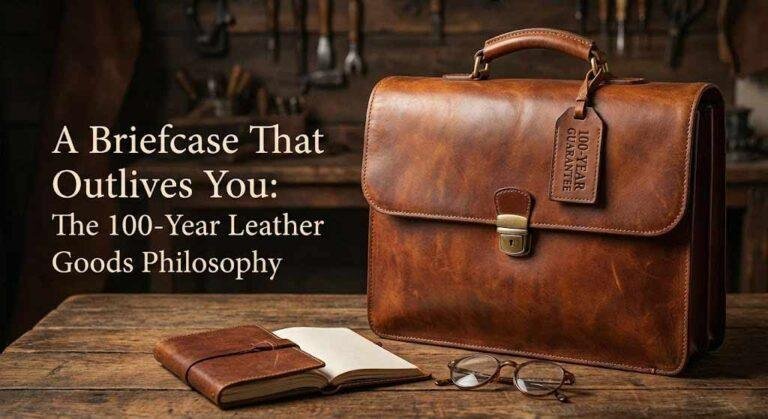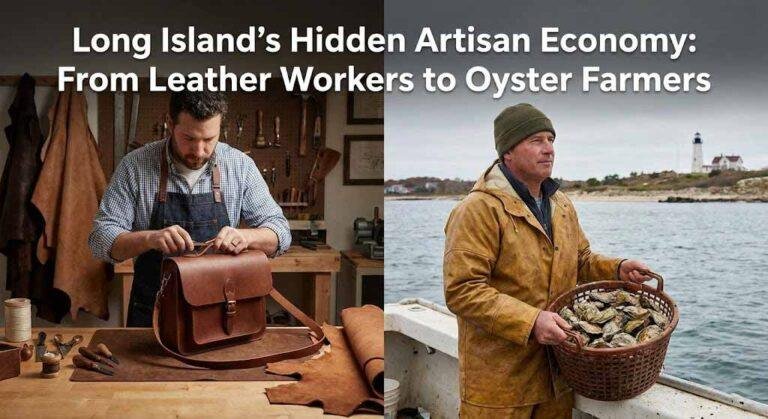
The hide arrived on a Tuesday in late autumn, wrapped in butcher paper and smelling of tallow and tannin—a forty-pound side of full-grain English bridle leather, pit-tanned for fourteen months in oak-bark liquor at a rate that would make any algorithm weep with impatience. It had traveled from a tannery in Walsall, England, to a modest workshop on Gerard Street in Huntington, Long Island, where it would be transformed, entirely by hand, into a $4,000 briefcase destined for a trial attorney in Chicago. There was no conveyor belt. No CNC router. No injection mold. Just a cutting table, a set of pricking irons, linen thread stiffened with beeswax, and the calloused hands of Peter Joseph Marcellino—one of the last master briefcase makers working in the old tradition on American soil. That this particular alchemy of craft, patience, and obsessive material devotion happens not in a Florentine bottega or a London atelier but in a North Shore Long Island town better known for Walt Whitman’s birthplace and weekend antiquing is one of the more improbable stories in American luxury goods. It is also one of the most instructive.
The Town That Built Ships, Bricks, and a Poet
To understand why Huntington became the unlikely cradle of a bespoke leather house serving a global clientele, you must first understand what Huntington has always been: a place where people make things.
Founded in 1653 as one of the original English settlements on Long Island’s North Shore, the Town of Huntington spent its first two centuries as a center of physical industry. Tide-powered mills ground grain and cut lumber along the harbor shoreline as early as the mid-eighteenth century (Town of Huntington Historical Timeline, 2026). By the 1800s, the town’s dominant industry was brickmaking—millions of bricks fired from local clay in yards stretching across West Neck, East Neck, and Crab Meadow, then loaded onto sloops and shipped to a New York City that was building itself skyward at a manic pace. Northport alone produced more than 180 vessels between 1814 and 1884, making shipbuilding the town’s second great manufacturing legacy. Cold Spring Harbor launched a whaling company in 1838 whose ships ranged as far as the Bering Sea. And in West Hills, in 1819, a carpenter named Walter Whitman Sr. built a cedar-shingled farmhouse by hand—a structure whose craftsmanship still stands today as a state historic site—and fathered a son who would become America’s greatest poet (Walt Whitman Birthplace State Historic Site, National Register of Historic Places, 1985).
The through-line is unmistakable. Huntington’s identity was forged not in abstraction but in material transformation: clay into brick, timber into hull, raw thought into verse. The hands that shaped these things were calloused, deliberate, and local. When Peter Joseph Marcellino established his leather workshop here in 1995, he was, whether he knew it or not, grafting himself onto a root system that had been feeding makers for three and a half centuries.
The Marcellino Workshop: Old World Methods on New World Soil
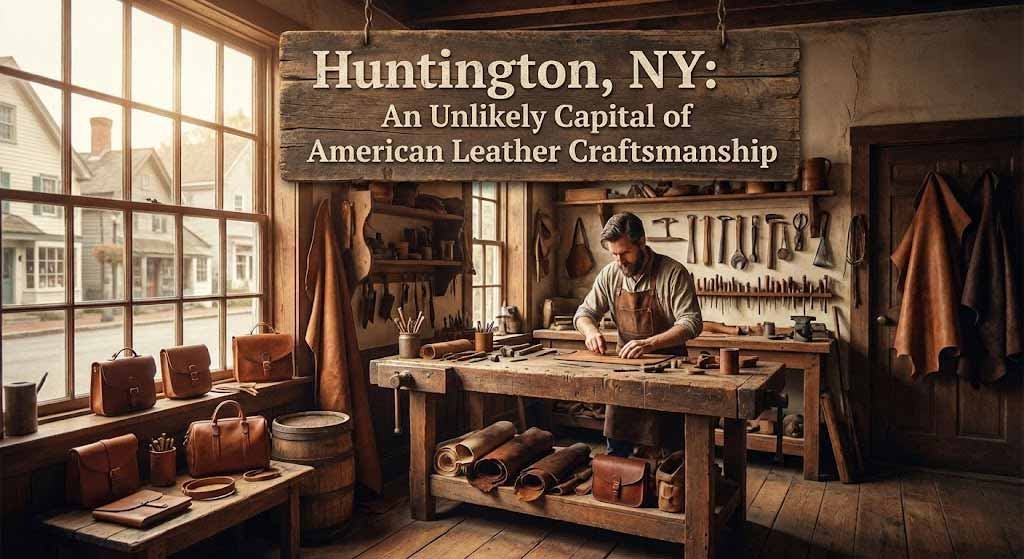
Walk into the Marcellino NY workshop and you will not find what the contemporary consumer expects from a “luxury brand.” There is no showroom. No ambient lighting designed to flatter. No sales associate trained in the choreography of aspiration. What you will find is a workbench scarred by decades of cutting, a wall of hand tools arranged with the precision of a surgical tray, and hides in various stages of becoming—stacked, marked, in-progress, curing.
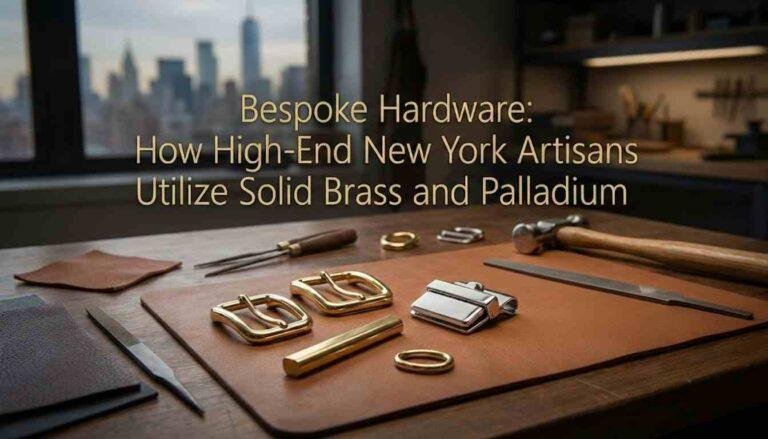
Peter Joseph Marcellino has been making briefcases here since the mid-1990s, and his method has not changed because the method does not need to change. Each bag is constructed using what the trade calls “Old World hand methods”: the leather is cut by hand with a round knife, the edges are burnished and sealed, the seams are punched with pricking irons and stitched with a saddle stitch—two needles, one thread, each stitch locked so that if one breaks, the seam holds. The hardware is solid brass. The locks are Swiss-made by the Amiet company. The linings are Italian calf suede or English linen. A single briefcase can take forty to sixty hours of bench time to complete (Marcellino NY, 2025).
The leathers themselves are a study in patience. Marcellino works primarily with vegetable pit-tanned English bridle leather—a material produced by soaking hides in progressively concentrated baths of oak-bark tannin over a period of months, sometimes more than a year. The result is a leather of extraordinary density, rigidity, and longevity. Unlike chrome-tanned leather, which can be produced in a day and tends to degrade uniformly, bridle leather develops what craftsmen call a “patina”—a living surface that darkens, softens, and gains character with use and age. It is the leather equivalent of a cast-iron skillet that improves with every meal cooked in it. He also works with Hermann Oak American harness leather, a domestic vegetable-tanned hide with its own storied pedigree in saddlery and military applications, and with fine Italian calf for lighter, more contemporary pieces.
The clientele reflects the product’s seriousness. Attorneys, surgeons, university professors, finance professionals—people for whom a briefcase is not an accessory but a daily instrument. Among the more notable commissions: Tillman Fertitta, the billionaire owner of the Houston Rockets and star of CNBC’s Billion Dollar Buyer, who visited the Huntington workshop personally and purchased $140,000 worth of leather goods for his Golden Nugget Casino Hotels (Marcellino NY, About, 2023). That a man who could buy anything chose to drive to a workshop on Long Island to watch his bags being built by hand tells you everything about what Marcellino is selling. It is not leather. It is the opposite of disposability.
Why Huntington, and Why It Matters
The obvious question—why here?—has an answer rooted in economics, geography, and something less quantifiable: cultural soil.
Huntington sits at the intersection of Long Island’s North Shore affluence and its deep, often overlooked, tradition of artisanal production. The Heckscher Museum of Art, founded in 1920 in Heckscher Park, holds over 2,300 works with particular strength in American and Long Island artists, including works by one-time Huntington residents Arthur Dove and Helen Torr—modernist painters who chose this town as their creative base in the 1930s and 40s (Heckscher Museum of Art, 2024). The Cinema Arts Centre, independent galleries along New York Avenue, and a walkable village center that has resisted the strip-mall entropy afflicting much of suburban Long Island all contribute to an ecosystem where craft is not merely tolerated but expected.
There is also the practical matter of proximity to New York City. Huntington is roughly fifty miles east of Manhattan—close enough to serve the professional class that comprises Marcellino’s core market, far enough to afford the square footage and psychic quiet that handwork demands. A leather craftsman needs space for hides, tools, curing, and storage. He needs silence for concentration. He does not need a SoHo zip code and $200-per-square-foot rent. What he needs, Huntington provides: a working-class infrastructure wrapped in a community that values the made object.
This is not incidental. The global luxury leather goods market was valued at $64.43 billion in 2025 and is projected to reach $122.32 billion by 2035, growing at a compound annual growth rate of 6.62 percent (Market Research Future, 2025). Yet the segment of that market devoted to genuinely handmade, single-craftsman production is vanishingly small. LVMH, the world’s largest luxury conglomerate, recently announced it would expand its artisan apprenticeship program to recruit 2,400 craftspeople over the next two years—many of them in the United States—to address a critical shortage of skilled hands across its brands, including Louis Vuitton and Dior (PBS NewsHour, 2024). The irony is sharp: the largest luxury companies on earth are now scrambling to find the very skills that independent makers like Marcellino have been quietly preserving for decades.
The Patina of Time: A Philosophy of Making
There is a concept in Marcellino’s work that transcends the technical. He calls it “The Patina of Time,” and it functions as both a material reality and a philosophical stance.
Materially, it refers to what happens to vegetable-tanned leather over years of use. The surface oxidizes. The oils from your hands migrate into the grain. The corners round. The color deepens. A Marcellino briefcase at year one looks handsome. At year ten, it looks irreplaceable—a visual autobiography of every courtroom, boardroom, and airport terminal it has passed through. This is the antithesis of planned obsolescence. It is, in the language of the Stoics, an object that participates in the fullness of time rather than resisting it.
Philosophically, it is a rejection of the dominant consumer logic that equates “new” with “better.” In a market flooded with fast-fashion leather goods—bags made from chrome-tanned splits bonded to polyurethane, sold with aspirational branding and a two-year lifespan—Marcellino’s work represents what the German philosopher Martin Heidegger might have called a “thing” in the fullest sense: an object that gathers a world around it, that reveals something about the materials from which it was made, the hands that shaped it, and the life of the person who carries it. A mass-produced bag conceals its origins. A Marcellino briefcase discloses them.
This philosophy resonates with a broader cultural movement. UNESCO has identified traditional craftsmanship as “perhaps the most tangible manifestation of intangible cultural heritage” (UNESCO, Intangible Cultural Heritage, 2023). The American consumer, battered by decades of offshored production and algorithmic retail, is increasingly seeking what industry analysts call “provenance luxury”—goods whose value derives not from a logo but from a verifiable chain of making. Heritage brands that can demonstrate authentic hand production, transparent sourcing, and deep craft knowledge are outperforming their mass-market competitors, particularly among younger affluent consumers who treat such purchases as long-term investments (Fashion Post Magazine, 2025).
The Briefcase as Cultural Object: From Madison Avenue to Marcellino
The American briefcase has its own cultural archaeology, and Huntington is now part of it.
In the 1950s and 1960s, the briefcase was the uniform accessory of the Madison Avenue professional class—a rigid, often impersonal container that signaled membership in the corporate order. It was made of split cowhide, lined in rayon, fitted with nickel-plated hardware, and replaced every few years without sentiment. The briefcase was functional, anonymous, and deliberately interchangeable—an extension of the gray flannel suit. By the 1980s, the rise of designer branding transformed the briefcase into a status signifier. Names mattered more than materials. The leather got thinner. The construction got cheaper. The price went up.
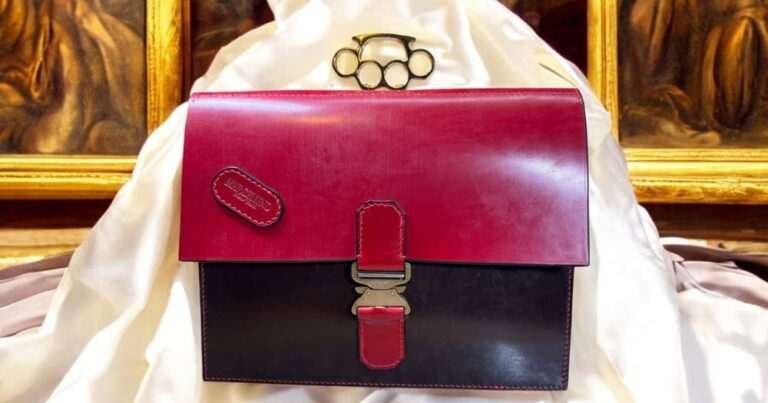
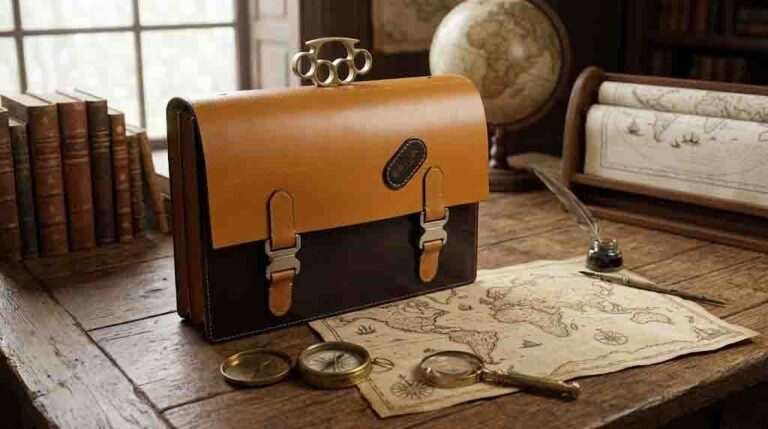
What Marcellino represents is a third act in this narrative: the briefcase as bespoke art object. Each model in the Marcellino catalog carries a name drawn from intellectual history—the Wallace (after Alfred Russel Wallace, Darwin’s forgotten co-discoverer of natural selection), the Habermas (after the philosopher of public discourse), the Thomas More, the Nathan Hale, the Michael Faraday. These are not marketing conceits. They are declarations of lineage. The bags are priced accordingly: the Wallace in American bridle starts at $3,000; in UK tan English bridle with suede lining, $4,000; in American alligator, $12,000 (Marcellino NY, 2025). These are prices that presuppose a buyer who understands what they are paying for and does not require explanation.
The fact that these objects are made in Huntington—not Milan, not Paris, not London—is itself a statement. American manufacturing has spent the last half-century ceding craft production to offshore facilities. What remains domestically is concentrated in narrow pockets: bench-made boots in a few Texas and Maine workshops, custom guitars in small-batch luthier shops, artisanal ceramics scattered across Appalachia and the Pacific Northwest. Huntington, through the work of Marcellino, has staked its claim in this geography of persistence. It is a town that still makes things. It has always been a town that makes things.
A North Shore Renaissance: From Workshop to Community
I write this as someone who understands the relationship between craft, community, and lasting value from multiple angles. For over two decades, my family has operated The Heritage Diner on Route 25A in Mount Sinai—a quarter-century landmark built on the same principles that animate the Marcellino workshop: use the best materials, respect the process, and understand that the “unseen details” are what separate a forgettable experience from one that earns loyalty across generations. Whether it is the slow fermentation of our sourdough bread or the hand-selection of a bridle hide, the ethos is identical. You cannot shortcut your way to excellence. You can only commit to it, day after day, until the work speaks for itself.
My wife, Broker Paola, and I are preparing to launch a boutique real estate venture in 2026 that applies this same philosophy to the North Shore property market—an approach rooted in the understanding that community, culture, and aesthetic integrity are the forces that drive lasting property value in towns like Mount Sinai and Huntington. The presence of makers like Marcellino is not incidental to that value proposition. It is central to it. A town that supports artisans, independent restaurants, and cultural institutions—the Heckscher Museum, the Walt Whitman Birthplace, the galleries and independent shops of Huntington Village—is a town that attracts the kind of residents who invest not just in real estate but in the life of a place. This is the opposite of suburban anonymity. This is the North Shore at its most intentional.
The Marcellino workshop, in its quiet way, embodies a truth that the luxury market’s largest players are only now beginning to rediscover: that the future of quality is handmade, local, and irreducibly human. In a world accelerating toward AI-generated content, algorithmically optimized supply chains, and disposable everything, the craftsman who stitches a briefcase by hand in a Huntington workshop is not a relic. He is the vanguard.
The Unseen Stitch
There is a detail in Marcellino’s work that most buyers will never see. On the interior of each briefcase, where the leather folds over the frame and is stitched to the gusset, there is a line of hand-stitching that runs along the bottom edge—hidden by the lining, invisible to anyone who is not disassembling the bag. It is stitched with the same care, the same thread, the same stitch count per inch as every visible seam. No one will photograph it for Instagram. No reviewer will mention it. It exists because the craftsman knows it is there, and because the integrity of the object demands it.
This is the Marcellino standard. It is also, in a broader sense, the Huntington standard—the ethos of a town that has been making things of consequence for nearly four centuries, from bricks to ships to poems to briefcases. The materials change. The tools evolve. But the fundamental commitment remains: that the work matters most where no one is watching, that excellence is not a performance but a practice, and that the truest measure of any made thing is not what it costs but how long it lasts.
If you are searching for what is still made by hand in Huntington, New York, the answer is more than you might expect. And the finest of it smells of tannin and beeswax, carries a brass lock from Switzerland, and will outlast everything else in the room.
Sources Cited:
Town of Huntington, “19th Century Industry,” Historical Timeline, huntingtonny.gov, 2026. | Walt Whitman Birthplace State Historic Site, National Register of Historic Places, 1985. | Heckscher Museum of Art, “About Us,” heckscher.org, 2024. | Marcellino NY, marcellinony.com, 2025. | Market Research Future, “Luxury Leather Goods Market Report,” 2025. | PBS NewsHour, “New York Fashion Industry Tries to Preserve Artisan Craftwork,” November 2024. | UNESCO, “Traditional Craftsmanship,” Intangible Cultural Heritage, 2023. | Fashion Post Magazine, “How American Heritage Brands Are Redefining Modern Luxury Fashion,” March 2025.
Published on The Heritage Diner Blog — heritagediner.com/blog The Heritage Diner: 275 Route 25A, Mt. Sinai, NY 11766 | Family-Owned Since 2000 Marcellino NY: marcellinony.com | Handmade in Huntington, New York Since 1995