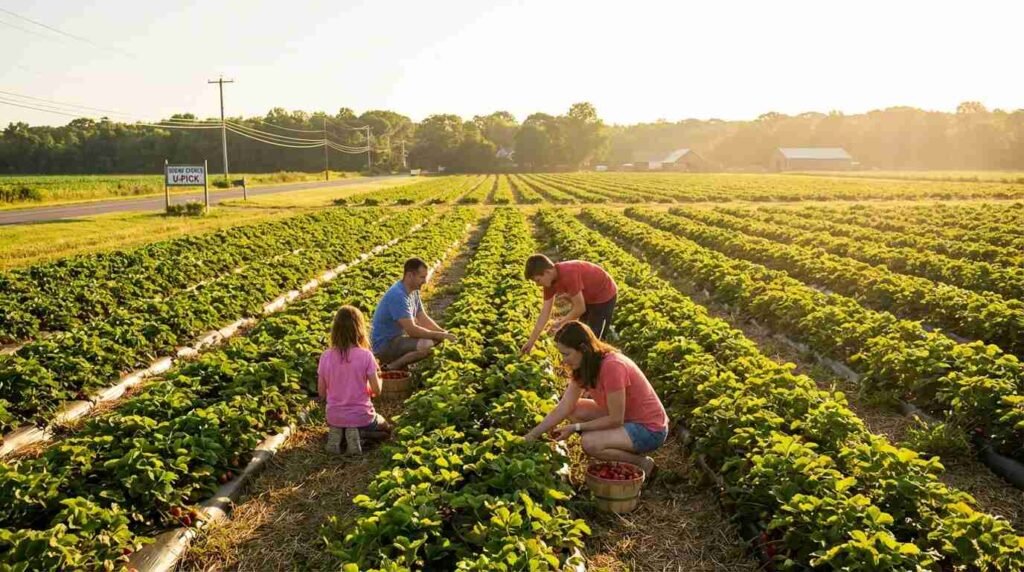
There’s a certain kind of food experience that no restaurant can replicate, no matter how good the chef or how local the sourcing. It happens in a field. You’re bent over a row of strawberries, the Sound Avenue sun is coming in sideways, the berry you just pulled off the plant is warm and overripe and slightly dirty, and you eat it right there without thinking. That’s not a meal. That’s something older than dining culture, older than menus, older than the whole apparatus of someone else feeding you.
Lewin Farms in Calverton was the first farm on Long Island to figure out that this experience was worth offering to the public. Four generations later, they’re farming close to 1,000 acres off Sound Avenue on the Calverton–Wading River border, and the model they pioneered has become the backbone of North Fork agritourism.
Before the Wine Trail, There Was the Field
When Dewey Lewin and his wife started farming Sound Avenue, the North Fork was not a destination. It was farmland — productive, unglamorous, and entirely oriented toward growing things for someone else’s market. The concept of turning the growing itself into the attraction was not yet established in this part of Long Island.
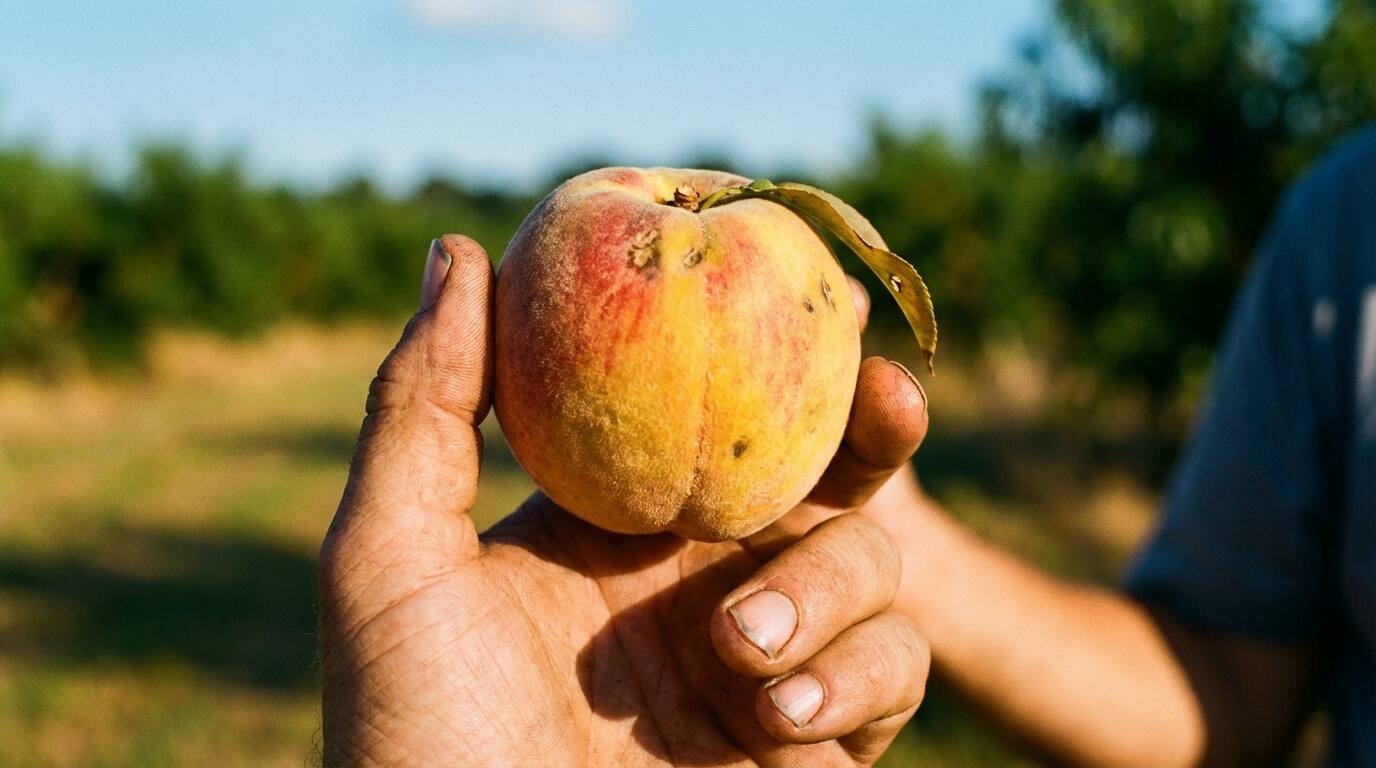
The u-pick model changed the economic logic of a farm stand. Instead of harvesting everything and selling it over a counter, you put customers in the field and let them do part of the labor — and in exchange, they get something no farm stand transaction could provide: the experience of actually being in the food. The strawberry that goes from plant to hand to mouth, still warm from the sun. The peach you select personally from among ten varieties, because you know the difference between a donut peach and a big round yellow and you have opinions about it.
That sounds like a small thing. It isn’t. It turns eating into participation.
What 1,000 Acres Teaches You About Seasons
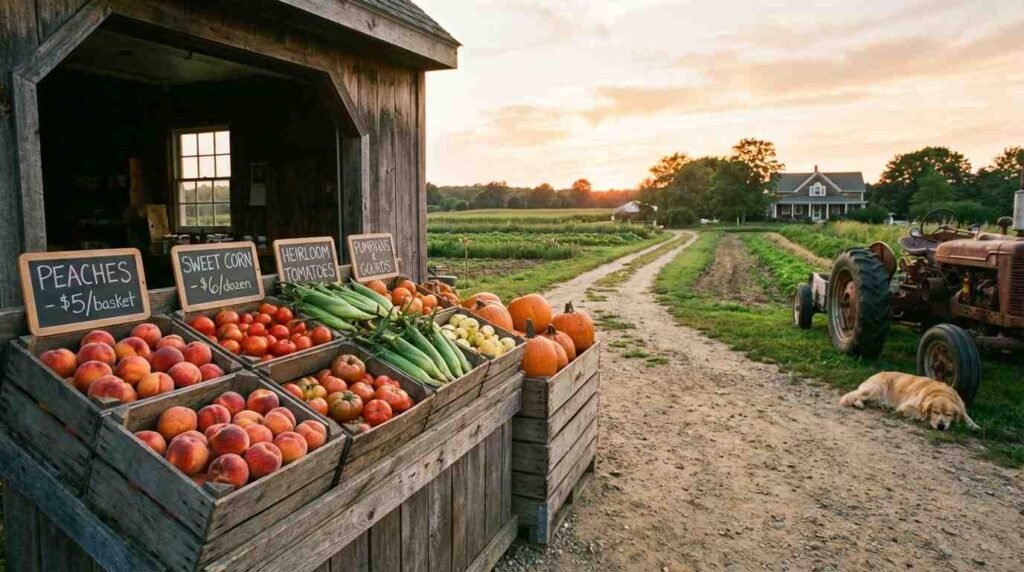
The scale of what Lewin operates is easy to underestimate if you’ve only stopped for strawberries. Across roughly 1,000 acres, they grow more than 20 different crops on a rotation calibrated to Long Island’s growing season: strawberries in early summer, then raspberries, blueberries, and blackberries; peaches in August across 10 varieties; sweet corn, tomatoes, peppers, eggplant, squash, and potatoes through late summer and fall; apples and pumpkins come October. The Christmas tree operation runs at a separate location in Baiting Hollow under the nursery the family maintains there.
What this means in practice is that Lewin’s season is genuinely seasonal in a way that restaurant menus — even farm-to-table ones — rarely are. There’s no extending the strawberry window, no importing blueberries to fill a gap. When the crop is done, it’s done. The farm stand reflects what’s actually growing on those fields on that day. The roasted corn and baked potatoes that appear on fall weekends at the stand don’t come from a distributor — they’re coming from a field a few hundred yards away.
This is a different kind of freshness than what “locally sourced” means in most dining contexts. The distance between soil and plate can be measured in minutes, not supply chain days.
The Partnership Model
What the fourth generation of Lewins has built is not just a bigger version of what Dewey started. It’s a layered operation that understands how farms fit into the broader North Fork visitor economy.
The collaboration with North Fork Brewing Company in Riverhead is one example. A farm with 10 varieties of peaches and a regional brewery with the capacity to work with local fruit is a natural pairing — the kind of relationship that didn’t exist when the North Fork was purely agricultural but makes obvious sense in an era when the entire Sound Avenue corridor is understood as a destination. Visitors who come out for strawberry picking are the same people stopping at wineries, buying from farm stands, and eating at the North Fork’s restaurants. Lewin is part of that ecosystem, not peripheral to it.
The farm stand itself has expanded beyond produce. Cider donuts, ice cream, food trucks on weekends, roasted corn and potatoes at the stand during the fall season. These aren’t concessions in the ballpark sense — they’re the natural extension of a farm that already has the raw materials and an audience that’s already on-site.
What Agritourism Actually Means
The North Fork has become one of the more successful agritourism regions in the Northeast, and the wine industry gets most of the credit for that because it’s the most visible, most photographed, and most easily explained part of the economic story. The farm stands and u-pick operations are older, less glamorous, and more foundational.
The Long Island Farm Bureau tracks agritourism as a distinct economic category, and it matters: farms that have added visitor-facing operations — u-pick, farm stands, events, retail — have diversified their revenue in ways that pure commodity farming cannot. A bad season for a crop is a production problem; a farm that has layered visitor experience on top of production has cushion that a purely wholesale operation doesn’t.
What Lewin built — starting before anyone was using the word agritourism — turns out to have been ahead of a model that the region has now broadly adopted. Harbes Family Farm in Mattituck runs on a similar logic, operating a vineyard, farm stand, u-pick, corn maze, and fall festival model. Wickham’s Fruit Farm in Cutchogue, farming land that has been cultivated since 1661, draws visitors who come specifically for the apple and berry picking. The entire Sound Avenue corridor, from Riverhead east, is now understood as a destination partly because a handful of farms decided, decades ago, that the experience of picking was worth offering.
Why the Farm Stand Outlasts the Restaurant
There is something worth saying about durability here. Restaurants on the North Fork open and close with the usual attrition. A good year on the wine trail brings in visitors who create demand; a slow year, or a difficult season, and margins compress. The farm stand operates on different economics. The crop either grows or it doesn’t, but the relationship between a family that has been farming the same land for four generations and the customers who come back every June for the strawberries is not the same as a restaurant relationship. It’s closer to a ritual.
People who grew up picking strawberries at Lewin bring their own kids. The kids grow up and bring their own. That’s not customer loyalty in the marketing sense — it’s something that accretes over decades and can’t be manufactured. A new restaurant on the North Fork can source local, hire good people, build a reputation. It cannot buy four generations of institutional memory about how a particular stretch of Sound Avenue land grows peaches.
The North Fork food story gets told mostly in terms of wine and restaurants. Those are real and worth telling. But the deeper layer — the one that made the region a food destination before the critics showed up — is the farmland itself, and the operations that figured out how to make that farmland a place people wanted to be in, not just buy from.
Lewin Farms was the first. That’s not a marketing claim. It’s just what happened.
You Might Also Like
- The North Fork Food Trail: Farms, Wineries, and Roadside Stands Worth Stopping For
- How Long Island Farms Are Supplying Some of New York City’s Best Restaurants
- Farm-to-Fable: The Long Island Restaurant Industry’s Most Profitable Lie
Sources
- Lewin Farms official site: lewinfarm.com
- Lewin Farms About page (fourth generation, first u-pick on Long Island): lewinfarm.com/about
- News 12 Long Island, “The East End: Lewin Farms” (Dewey Lewin founding, Eric Lewin interview, ~1,000 acres, North Fork Brewing partnership): longisland.news12.com
- Long Island Farm Bureau: lifb.com
- North Fork Promotional Council farm stands directory: northforkpromotionalcouncil.com
- Cornell Cooperative Extension Suffolk County: ccesuffolk.org