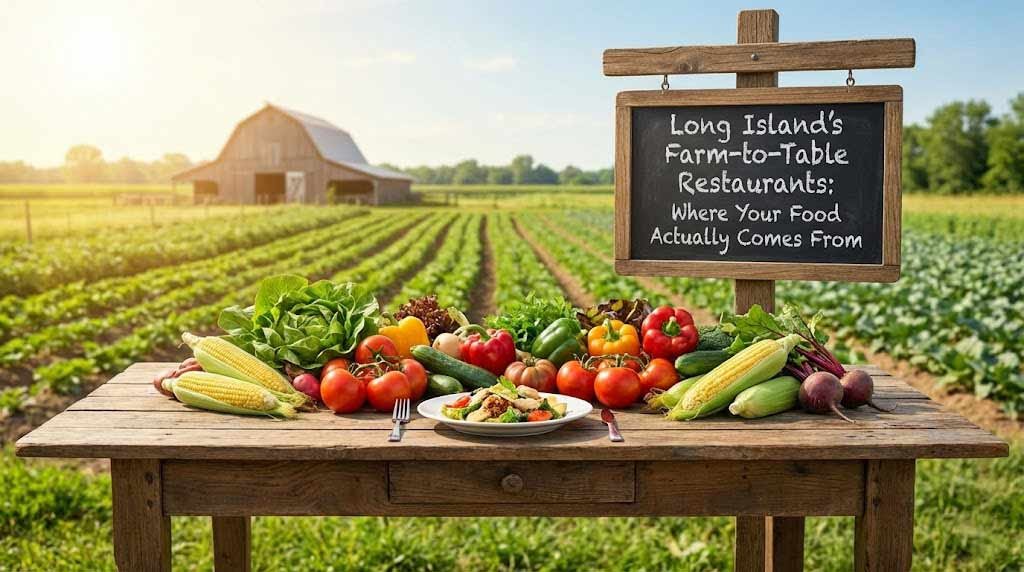
The term “farm-to-table” has become so ubiquitous in contemporary restaurant marketing that it risks becoming meaningless—a buzzword applied to establishments that source one heirloom tomato variety and claim culinary revolution. The phenomenon has prompted restaurateurs like Peter Mistretta, executive chef and owner of Perennial in Garden City, to pioneer what might be called “farm-to-table 2.0,” a movement that inverts the relationship between supply and demand, placing farmer visibility and product integrity at the center rather than the periphery (Edible Long Island, 2019). This shift reflects something broader happening in American food culture: the recognition that sustainable eating isn’t moral posturing but rather the foundation of superior taste.
Long Island exists at a geographical and cultural intersection that makes this philosophy both possible and necessary. The region produces approximately $78 million in agricultural value annually, with diverse crops ranging from potatoes to cauliflower, from wine grapes to specialty herbs (Long Island Agriculture Bureau, 2024). The farming community that established itself generations ago—in communities like Northampton, Amagansett, and Cutchogue—never disappeared; it evolved. Today’s farm-to-table restaurants on Long Island don’t merely supplement their menus with local produce; they build their entire operational philosophy around what’s growing in the soil a few miles away. The result is restaurants where the menu changes with the seasons not because of marketing optics but because chefs have structured their sourcing around reality rather than convenience.
The Pioneer: Noah’s in Greenport and the Collaborative Ecosystem
Chef Noah Schwartz, a fixture of the East End’s culinary landscape for over a decade, operates Noah’s in Greenport as something approaching a living experiment in what genuine farm-to-table eating looks like when executed with rigor and transparency. The restaurant maintains relationships with a clearly identified roster of partners: Latham’s, Satur Farms, Bhavana, Orient Organics, RGNY Wines, Crescent Duck Farms, and a network of local foragers and small producers (Noah’s, 2024). The specificity matters. These aren’t anonymous wholesale accounts; they’re named agricultural partners whose growing practices are known, whose product quality is guaranteed through relationship rather than contract.
The philosophical innovation extends to menu construction. The seasonal rotation isn’t imposed externally; it emerges from conversations between kitchen and farm. Ian Calder-Piedmonte, co-owner of Balsam Farms in Montauk, describes the relationship in terms of knowledge exchange: “We’re lucky to have some of the best chefs in the world working in some of the finest restaurants here, and their busiest times coincide with our main harvest season. Local chefs and restaurants not only purchase produce but also share knowledge, forming an information ecosystem” (Elliman Insider, 2024). This feedback loop means that Balsam Farms tailors what it grows to the needs of the restaurant community, creating what amounts to a localized food system that operates independently from national supply chains.
The Almond Model: Accessibility Without Pretension
Almond, positioned at the end of Ocean Avenue in Bridgehampton, has become a beloved spot precisely because it refuses to perform “Hamptons-ness.” The atmosphere remains unpretentious, marked by a century-old tin ceiling, white tile walls, and a hand-carved bar that suggests history rather than construction budget (Long Island Restaurant News, 2024). The menu features modern takes on classic French cuisine, with ingredient sourcing that mirrors Noah’s specificity: Balsam Farms, Amber Waves Farm, Quail Hill Farm, and Fishers Island Oysters appear as named partners rather than generic “local vegetables” and “local seafood.”
The economic model deserves consideration. Farm-to-table restaurants face structural headwinds unknown to their conventional counterparts. As food industry emissions account for approximately 30% of global greenhouse gases and 40% of methane release comes from farm animals, restaurants face pressure to reduce protein sourcing while maintaining economic viability (Long Island Restaurant News, 2024). Almond solves this through a philosophy of vegetable-forward plating where the protein becomes secondary, a structural rethinking rather than virtue signaling. The artisanal, market-driven menu changes based on what’s available, transforming menu limitations into an asset: the diner who returns three times in a season experiences three different restaurants.
Watch this deep dive into farm-to-table philosophy and practice: https://www.youtube.com/watch?v=KKPNmqgSyAw
North Fork Table & Inn: The Flagship Institution
Housed in a historic countryside home in Southold, North Fork Table & Inn represents what might be called the canonical farm-to-table experience on Long Island. The restaurant, celebrating “the bounty of Long Island’s farms, vineyards & waterways,” operates under the culinary direction of renowned chef John Fraser, whose background includes leadership at respected New York establishments like Narcissa and Olmsted (Long Island Restaurant News, 2024). The menu reads like a document of seasonal possibility: Jamesport Farm poached eggs, blistered asparagus, roasted Long Island duck, hay-smoked chicken, and fig meringue cake.
The sophistication of North Fork Table operates on multiple registers. Yes, the ingredients are local; yes, the practice reflects genuine partnership with local farmers and producers. But the execution demands kitchen talent capable of transforming high-quality ingredients into restaurant dishes—work that distinguishes the finest farm-to-table establishments from those merely sourcing locally. The wine program curates specifically from Long Island wine country, creating a food-and-wine ecosystem that contains itself geographically, a statement about the sufficiency of local agriculture that challenges the assumption that great wine requires European pedigree or Napa prestige.
The Casual Model: The Shed and Perennial
The Shed operates with two locations (Huntington and West Sayville) as a more accessible farm-to-table concept, offering what might be termed “comfort food with clean sourcing.” The menu emphasizes American comfort food—burgers, pasta, salads—elevated through ingredient sourcing from local farms and purveyors (Long Island Wave, 2023). This model makes farm-to-table accessible to diners who might find the rarefied atmosphere of Noah’s or North Fork Table intimidating or impractical for weeknight dining.
Perennial in Garden City, under Peter Mistretta’s leadership, occupies a deliberately middle ground between casual and elevated. Mistretta, a Manhattan restaurant veteran with experience at Hearth and Back Forty, intentionally built Perennial as “a comfortable neighborhood restaurant with attentive, informed service, but no linens on the table, nothing fine dining about it. More of a bistro feel, but still attention to technique, sourcing and the community” (Edible Long Island, 2019). The practical reality of farm-to-table constraints required Mistretta to confront the seasonal limitations of Long Island agriculture directly: during winter months, the menu must necessarily expand beyond purely local sourcing, a transparency he embraces rather than conceals. The restaurant’s practice of jarring and canning allows for preservation of summer abundance, extending the season through technique and preventing the winter menu from devolving into potato-and-cabbage limitations.
The Integration Model: Restaurants with Their Own Land
Amber Waves, operating its own kitchen on its farm property in Amagansett, collapses the distinction between farm and restaurant entirely. The operation buys from neighboring farms (Balsam Farms, Quail Hill, the Fosters in Sagaponack, Briermere Farms, Goodale Farms, Catapano Dairy Farm, Mecox Bay Dairy, Acabonac Farms, and Indian Neck), but the ability to walk vegetables from field to kitchen in hours rather than days creates a freshness standard difficult for conventional restaurants to match (Elliman Insider, 2024). The practice represents a philosophical return to pre-industrial food systems while employing contemporary cooking technique.
Mostrador at Marram Montauk, the oceanfront hotel designed restaurant at the eastern extreme of Long Island, places farm-to-table specificity at its center through a philosophy articulated by Chef Fernando Trocca: “We place a heavy focus on trying to source as seasonally and locally as possible to support our community.” The partner list reads specifically: Gosman’s at Montauk Harbor provides fresh fish, scallops, mussels, and clams; Amber Waves and Balsam Farms supply seasonal produce, herbs, and edible flowers (Elliman Insider, 2024). This level of documentation represents the maturation of farm-to-table practice from marketing gesture to operational reality.
The Wine Country Integration: Wölffer Estate and North Fork Wine Tourism
Wölffer Estate in the Hamptons, operating from its Sagaponack vineyard, integrates food and beverage sourcing into a holistic sustainability vision. The wine program grounds food decisions; the restaurant sources locally and seasonally to align with wine production calendars and the aesthetic philosophy of the vineyard itself (Elliman Insider, 2024). This integration creates vertical integration of the kind rarely seen outside of Napa Valley or Burgundy—a winery controlling its own food program to ensure philosophical alignment.
The North Fork wine country includes over 40 wineries, many with restaurant or tasting room operations that employ farm-to-table principles specifically because their own existence depends on local agriculture visibility. The wine tourism economy has created a secondary benefit: restaurant chefs understand that their work exists within a regional food-and-wine narrative larger than individual establishments. This contextual awareness shapes menu decisions, sourcing practice, and the entire operational ethos.
The Contemporary Challenge: Inflation, Volatility, and the Viability Question
The farm-to-table movement exists within a restaurant industry confronting serious structural headwinds. According to 2025 industry data, restaurants face persistent labor shortages, inflationary pressure on ingredients and energy costs, and consumer price sensitivity that forces difficult operational decisions (Yelp State of the Restaurant Industry, 2025). The farm-to-table model carries additional complexity: the inability to standardize menus challenges conventional cost control; the seasonal supply limitations require greater operational flexibility; the relationship-dependent sourcing demands human connection that doesn’t scale.
Yet the farms and restaurants committed to this model report stronger customer loyalty and the ability to command pricing premiums that offset operational complexity. The recognition that local sourcing creates genuine differentiation—not merely carbon-credit moral positioning but actual flavor and freshness advantages—allows these establishments to market with authenticity that conventional restaurants cannot match.
Understanding Long Island’s farm-to-table landscape enriches your appreciation of the broader dining scene. Explore The Best Steakhouses on Long Island, Ranked by Cut and Experience to understand how premium meat sourcing operates similarly to vegetable sourcing. Consider also Hidden Gem Butcher Shops on Long Island That Serious Meat Lovers Need to Know to trace the farm-to-table philosophy into butchery and protein sourcing.