What Otto Kahn Built, and What It Cost to Build It
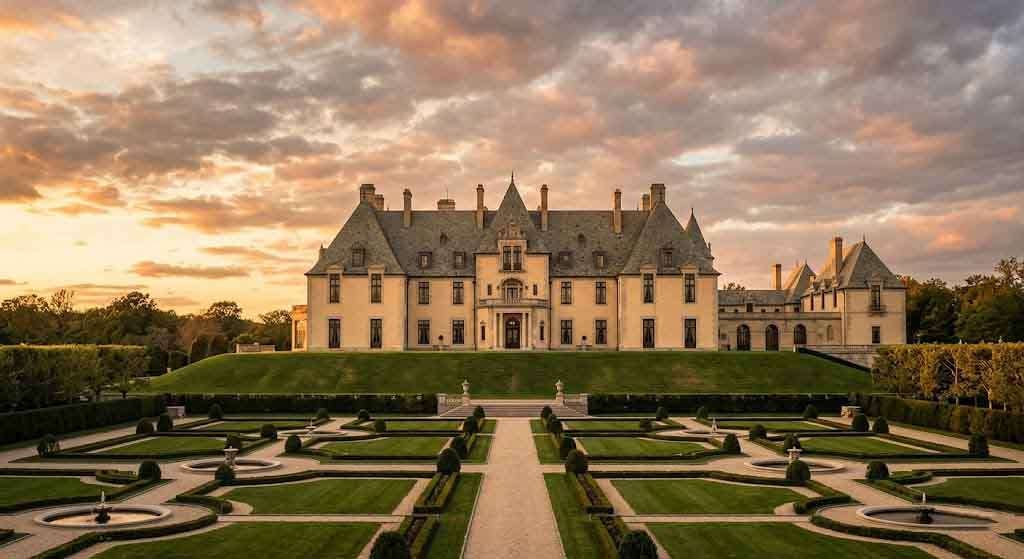
The most useful place to start is Oheka Castle in Huntington, because Oheka is the biggest and the most documented and still standing. Otto Hermann Kahn, a German-Jewish financier who ran one of the most powerful banking houses in America, purchased 443 acres in Cold Spring Harbor in 1914 for one million dollars. He was not buying land. He was buying a statement.
Kahn had been refused entry into the Morris County Country Club in New Jersey because of his ethnic background. The snub, reportedly in 1914, prompted him to make a different kind of argument — the kind you make with 127 rooms and 109,000 square feet of French Renaissance château on the highest artificially constructed hill on Long Island. The architects were Delano & Aldrich, one of the Gold Coast’s premier mansion builders. The landscape architects were the Olmsted Brothers. Construction ran from 1914 to 1919, interrupted briefly during World War I at the request of the Kahns themselves. The original cost was $11 million — which in today’s money is somewhere around $158 million, depending on the conversion you use.
The finished castle was described by The New York Times as the “finest country house in America.” It had 39 fireplaces, a 24-foot-high ballroom, a wood-paneled library with a secret passageway, an indoor swimming pool, stables, orchards, tennis courts, an 18-hole golf course, and one of the largest private greenhouse complexes in the country. Kahn employed 126 full-time servants to maintain it.
Now. Somebody built all of that. Not Delano & Aldrich — they drew the plans. Somebody mixed the mortar. Somebody set the Vermont slate roof tiles. Somebody framed the windows and fitted the fireplaces and plastered the walls of the ballroom that could fit fifty dinner guests plus their personal valets. Somebody built the man-made hill it sits on.
Those people were largely immigrant laborers, and their names are not in the preservation files.
The Labor Behind the Limestone
Long Island’s Gold Coast development boom coincided almost exactly with the peak era of Southern and Eastern European immigration to the United States. Between 1880 and 1920, roughly 20 million immigrants arrived — Italians, Poles, Greeks, Jews from Eastern Europe, Slavs, and others — the majority of whom settled first in the urban tenements of New York and New Jersey and then spread into the labor markets wherever large construction projects existed.
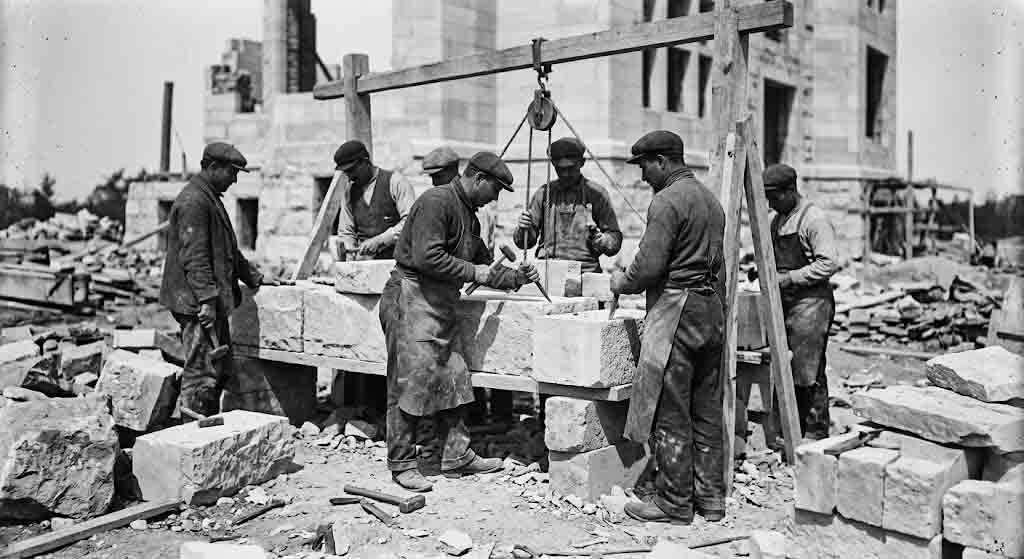
The building trades on Long Island during this period absorbed enormous numbers of these workers. Masonry, in particular, was Italian-immigrant labor at scale. Italian stonemasons and bricklayers had a reputation that preceded them — trade skills refined over generations in the old country, now deployed in the service of men who could afford to demand perfection. The Gold Coast estates required that perfection. The specifications were unforgiving: ashlar stone, hand-cut, hand-set, with joints that had to hold across century-scale winters. No tolerance for slop.
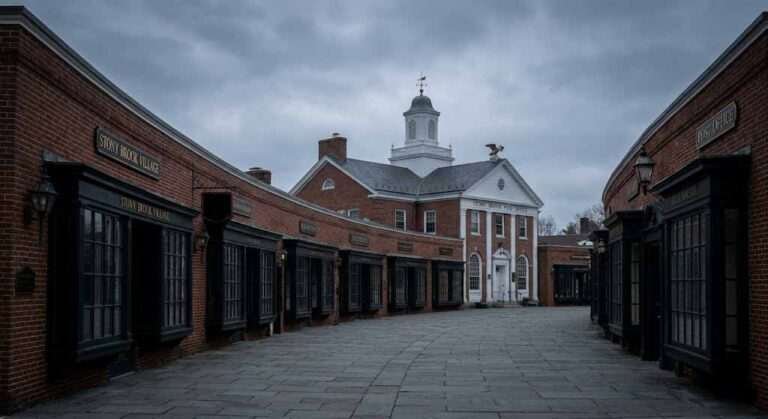
For Oheka alone, the earthwork involved to construct the artificial hill on which the castle sits would have required sustained organized labor across multiple years. One million cubic yards of earth moved in a comparable contemporary project, Stony Brook Village Center, required the kind of manpower that leaves no paper trail beyond payroll ledgers — if those survive at all. For private residential construction like Oheka, the laborers were typically engaged through contractors who hired from the immigrant labor pools of Brooklyn and Manhattan. They boarded locally. They worked six-day weeks. When the project was done, they moved to the next project.
Gold Coast chronicler Richard Newman documented the broader pattern across the Gatsby-era estates: the same crews of Italian masons, Greek laborers, and Polish carpenters moved from estate to estate as the wave of construction built through Nassau and Suffolk counties. They built the Vanderbilt Motor Parkway. They built the Eagle’s Nest at Centerport. They built Harbor Hill in Roslyn. They built Falaise in Sands Point. Then they went home — not to the estates, but to the neighborhoods in Queens and Brooklyn that you’ve never heard of, and nobody asked their names for the dedication plaque.
What the Work Actually Was
It is worth being specific about the labor, because specificity is what the historical record omits.
Building a structure like Oheka required, at minimum: excavators and earthmovers for the foundational grade work; concrete workers for the structural foundation pours; ironworkers to fabricate and set the structural steel framing; masons to lay the exterior limestone and brick coursework across 109,000 square feet of building footprint; slate roofers sourcing and setting 4,000 tiles from a Vermont quarry; plasterers for the elaborate interior ornamental work in the ballrooms and corridors; carpenters for the wood-paneled library and coffered ceilings; glaziers for the more than 200 windows; plumbers and pipefitters for the indoor pool and the extensive service infrastructure; and finish craftsmen for the fireplace surrounds, the wrought-iron staircases, and the stone terraces.
Each of those trades required skilled men. Many of the most skilled — the ornamental plasters, the stone carvers, the wrought-iron fabricators — brought knowledge from Europe that hadn’t yet been codified in American trade schools. They learned it in villages in Calabria or Campania or outside Palermo and brought it across the Atlantic in their hands.
The grandeur that preservationists now carefully restore — the elaborate plasterwork, the carved stonework, the fireplace mantels — was put there by men who were paid by the day and released when the work was done. When Oheka was recently restored, Gary Melius sourced 4,000 slate tiles from the same Vermont quarry Kahn had used for the originals. He hired craftsmen who could reproduce the original plasterwork. That restoration effort — trying to find people who could do what the original workers did — tells you something about the skill level of the men whose names nobody kept.
The Economics of Erasure
The Gold Coast estates were built on top of two kinds of invisibility: the invisibility of labor, and the invisibility of the land that labor displaced.
Before the mansion-building wave, the North Shore of Long Island was farmland, fishing ground, and working-class harbor community. The same pattern that Ward Melville enacted deliberately in Stony Brook happened organically across the Gold Coast: money arrived, land was purchased in blocks, and the existing character of a place was overwritten by the aesthetics of wealth.
The workers who built the estates understood their position in this clearly. They were not confused about who the castle was for. They came, they worked, they left. Some stayed on Long Island permanently — the Italian and Greek communities that took root in towns like Port Jefferson and Smithtown and further east were seeded in part by laborers who came for the construction boom and decided the island was worth staying on.
My own family history is not unrelated to this dynamic. Greeks came to Brooklyn and Long Island in exactly this wave — the early twentieth century, the labor economy, the manual trades. My father worked in restaurants. His generation understood what it meant to build something for someone else, to put your hands into the fabric of a place and then go home to a different neighborhood when the shift was over. That is not a complaint. It’s a fact about how places get built.
What Remains
Oheka Castle still stands at 135 West Gate Drive in Huntington, and you can stay there now — 32 guest rooms, weddings booked years out. The Vanderbilt estate at Centerport is a museum. Harbor Hill is gone. Falaise is a Nassau County property open for tours. The Olmsted gardens, or what remains of them, have been carefully restored.
What remains of the men who built them is harder to account for. Some of their tools might survive in attics. Some of their names appear in census records from the period — laborers, bricklayers, stonemasons, address listed in Brooklyn or Flushing or the Bronx, occupation listed in one or two words. Some are buried in cemeteries in Queens under headstones with Italian or Greek names.
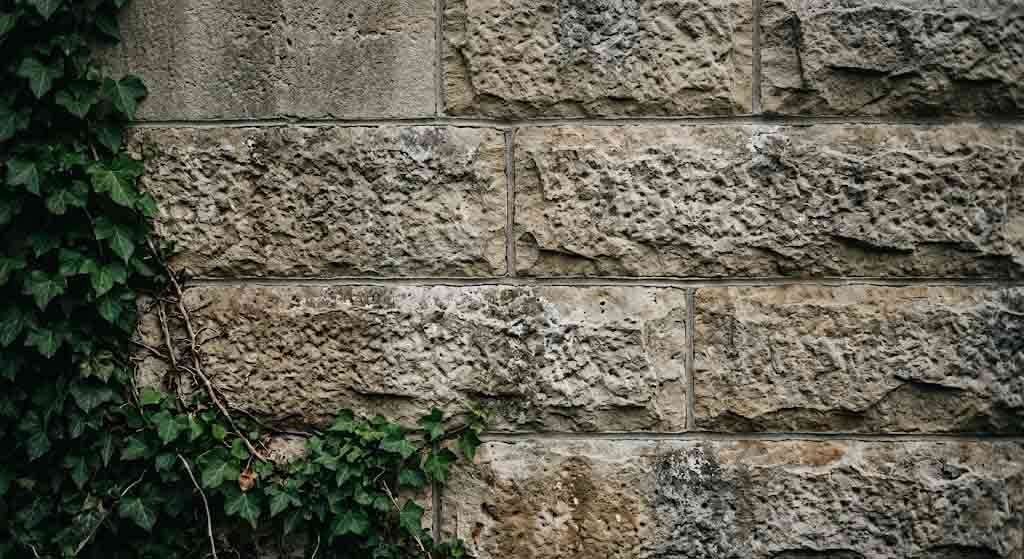
Their work stands. The limestone is still plumb. The slate roof is still watertight. The ornamental plaster in the ballroom is still there, or was carefully reproduced when it wasn’t. The staircases are still level. Everything that needed to hold has held.
That’s usually all the craftsman ever gets. The work holds, and the name doesn’t make the plaque.
You Might Also Like
- Rum Row and the Freeport Bootleggers: Long Island’s Clandestine War on the Water
- How to Read a Leather Label: Spotting Real Quality vs. Marketing Hype
Sources
- Oheka Castle Official History: https://www.oheka.com/history.htm
- Oheka Castle, Wikipedia: https://en.wikipedia.org/wiki/Oheka_Castle
- World History Encyclopedia — Oheka Castle: https://www.worldhistory.org/article/1767/oheka-castle/
- American Aristocracy — Oheka Castle: https://americanaristocracy.com/houses/oheka-castle
- Historic Structures — Oheka Mansion: https://www.historic-structures.com/ny/cold_springs_hills/oheka-mansion/
- Stony Brook Village Center Historical Archives: https://stonybrookvillage.com/about-us/