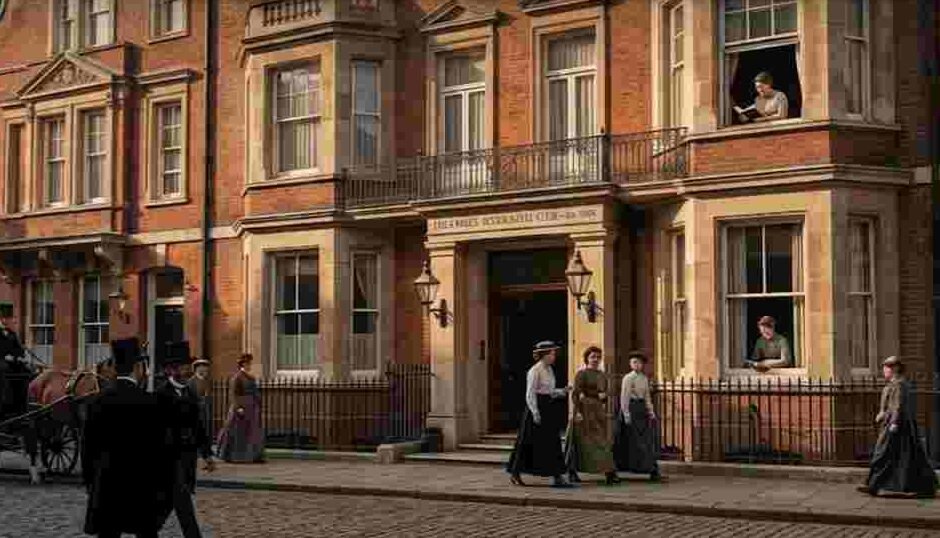
On the evening of April 2, 1878, some four thousand guests filed through the corridors of the most ambitious social experiment New York had ever seen. Alexander Turney Stewart, the Irish immigrant who had built America’s first department store into a retail empire, had sunk a fortune into a colossal cast-iron palace on Fourth Avenue — seven stories of marble floors, five elevators, 1,700 gaslights, and hot-and-cold running water — all of it designed for a single radical purpose: to house working women. Forty-five days later, Stewart’s Hotel for Working Women was shuttered, rechristened the Park Avenue Hotel, and opened to guests of both sexes. The dream had collapsed under its own contradictions before the paint had dried.
Yet that failure contained the seed of something extraordinary. In the decades that followed, on both sides of the Atlantic, a quiet architectural revolution unfolded. Purpose-built hostels, residential chambers, and women-only hotels rose from London’s Bloomsbury to Manhattan’s Murray Hill — buildings that sheltered tens of thousands of stenographers, nurses, teachers, and shopgirls while reshaping what it meant for a woman to live on her own terms. These were not shelters. They were not charity wards. They were buildings conceived as instruments of liberation, designed down to the floorplan to balance a woman’s need for privacy against society’s obsessive demand for her respectability. And the women who built them, funded them, and filled them changed the trajectory of modern urban life.
The Problem That Required a New Kind of Building
The numbers tell the story with brute force. In England between 1861 and 1911, the number of women in paid employment outside domestic service grew fourfold — from roughly 200,000 to 800,000 (Emily Gee, Hostel, House and Chambers, 2025). By 1902, some 174,000 women worked as stenographers, clerks, secretaries, typists, bookkeepers, and cashiers. Another 183,000 worked as teachers. Thousands more staffed the new telephone exchanges, department stores, and government offices that were remaking the economy.
In New York, the transformation was equally seismic. Between 1870 and 1902, the number of women in the American workforce increased by nearly 64 percent (New York City Landmarks Preservation Commission, Martha Washington Hotel Designation Report, 2012). Manufacturing, the garment trades, and the explosion of office work pulled young women out of family homes and small towns into cities that had no idea what to do with them.
The housing options were grim. Common lodging houses in London were barely a step above the workhouse — places of last resort for the destitute. In New York, boarding houses offered little better: subdivided rooms in converted townhouses where privacy was a fantasy and landlords extracted maximum profit from minimal space. Women faced higher rents than men for worse accommodations, and the rules of Victorian propriety made the situation suffocating. Mixed-sex boarding houses raised eyebrows. All-female boarding houses could attract suspicion of an entirely different kind. A young woman renting an attic room on her own risked her reputation simply by existing without a chaperone.
The charity Homes for Working Girls in London, founded by John Shrimpton in 1878, framed the dilemma in language that now reads as both patronizing and revealing. Young women, unprotected and imbued with self-will, might be led astray by their own weakness. The response was to surround them with what Shrimpton called “Christian influences and friendly guidance” (Gee, 2025). But another current was running beneath this paternalism — a feminist one, linking the movement for women’s housing directly to the campaigns for votes and equal pay. The English Woman’s Journal declared in 1900 that women needed “equality before the law and equality of opportunity, the right to solve their own problems and fight their own battles.”
The built environment would become one of the battlefields.
London’s Ladies’ Chambers and the Invention of a Building Type
The architectural historian Emily Gee, whose groundbreaking 2025 book Hostel, House and Chambers is the first comprehensive study of these buildings, identifies the 1870s as the moment a genuinely new building type emerged in London. Residential chambers, hostels, and lodging houses for single working women began appearing across Bloomsbury, Fitzrovia, Pimlico, and Kensington — roughly 170 such residences in all, each housing anywhere from a few dozen to several hundred women.
The earliest efforts were conversions. Lady Mary Fielding established a company in 1878 to convert a six-story block on Peel Street, Kensington, into 53 rooms for working women, with rents ranging from 2s 6d to 4s a week. Crucially, Fielding ran her enterprise as a business venture, paying investors an annual dividend of 3.5 percent. This was deliberate. As Gee emphasizes, dissociating the enterprise from charitable “do-goodery” was essential to proving that women could be competent business managers.
The first celebrated purpose-built residence for lower-waged working women was Brabazon House, which opened in Pimlico in 1902. Funded by the Brabazon House Company Limited — a business initiative of Lady Brabazon — and designed by architect Robert Stephen Ayling, it was fully booked before construction was even finished. Ninety rooms were spoken for, and three hundred women had to be turned away (Historic England Blog, 2025). Ayling would go on to pioneer and refine the design of many London hostels, developing an architectural vocabulary that balanced efficient private spaces with generous communal rooms.
The interiors of these buildings were remarkable in their intentionality. Tiny single cubicles — sometimes separated only by thin wooden partitions — gave each woman a bed, a chair, and a washstand. Privacy was minimal, sound traveled freely, and the furnishings were often austere. But the communal spaces were another story entirely. Dining rooms featured skylights and handsome furnishings. Reading rooms were stocked with magazines and newspapers. There were libraries, music rooms, and — in a detail that speaks volumes about the cultural moment — bicycle storage. The activist Emily Hobhouse had specified that bicycles “would not be forgotten” when planning women’s residences (Historic England Blog, 2025). Bringing bicycle storage inside the building formalized and normalized the new custom of women cycling, linking physical mobility to the broader independence that these residences made possible.
The YWCA’s Ames House on Mortimer Street, designed by the eminent Edwardian architect Beresford Pite in 1904, housed 97 women and included a separate restaurant that served working women who did not live on the premises — a recognition that the need extended beyond housing into the simple, radical act of allowing women to eat in public without a chaperone (Historic England, Ames House Listing).
The Largest of Them All: Ada Lewis House
The crowning achievement of London’s women’s hostel movement was Ada Lewis House, which opened in 1913 at 172 New Kent Road near Elephant and Castle. Funded by Ada Lewis, a wealthy Jewish philanthropist, and built after years of campaigning by the National Association of Women’s Lodging Houses, it accommodated 214 women in single cubicles and another 46 in double bedrooms (Historic England, Ada Lewis House Listing). At the time, it was the largest women’s hostel in the capital.
The architects Joseph and Smithem designed an imposing Edwardian Baroque building — six stories of red brick with stone dressings, round-arched windows, and a dentil cornice that gave the structure the proud, dignified presence of a civic institution rather than a dormitory. The generous upper-floor windows concealed the paired tiny cubicles behind them, a design choice that projected respectability outward while maximizing density within. The opening ceremony was performed by Princess Louise, Duchess of Argyll.
Ada Lewis House represented the culmination of a long, frustrating campaign for municipal involvement in women’s housing. Manchester had led the way with Aston House in 1910, a purpose-built municipal lodging house for 222 women with beds at 5d a week. But London County Council had refused to follow suit, paralyzed by the argument that low-waged women could not afford LCC housing while middle-class women did not qualify for it. Ada Lewis’s philanthropy filled the gap that government would not, setting an example that would echo for decades.
The house rules were strict but not draconian: no alcohol, no card games, no gambling, no admittance after 11 PM unless work required it, rooms to be vacated by 9 AM and accessible again only after 7 PM, and — in a provision that suggests generations of institutional frustration — “absolutely no tea pots to be taken from the dining room” (The Past, 2025).
Across the Atlantic: New York’s Women-Only Hotels
New York’s story followed a parallel but distinct trajectory. Stewart’s spectacular 1878 failure had demonstrated one thing clearly: a top-down, paternalistic model would not work. The women who came next understood that the institutions had to grow from the needs of the women themselves.
The Ladies’ Christian Union had operated “moral homes” since the 1860s — small converted houses where young women could board under strict rules and Christian supervision. The YWCA opened the Margaret Louisa Home in 1891 at 14-16 East 16th Street, the first new building in New York designed specifically to house single working women. Funded by Margaret Louisa Vanderbilt Shepard, it was described as a home for the “Protestant self-supporting woman who is a stranger within the gates of Gotham” (New-York Historical Society, 2019). The rules were tight: rent payable in advance, no cooking or washing on the premises, electricity shut off at 11 o’clock, and the house locked at 11 PM. Those who expected to return late had to report to the superintendent’s office in advance.
But it was the Martha Washington Hotel, which opened on March 2, 1903, at 29 East 29th Street, that rewrote the rules entirely. Built by the Women’s Hotel Company — a for-profit corporation that sold shares not only to businessmen like John D. Rockefeller but also to bookkeepers, stenographers, and other self-supporting women — the Martha Washington was designed as something more than a hostel. It was a hotel. A proper one. Twelve stories of Renaissance Revival brick and limestone, designed by architect Robert W. Gibson, with 500 permanent apartments, 150 transient rooms, a pharmacy, a tailor shop, and a manicurist (NYC Landmarks Preservation Commission, 2012).
The demand was immediate and overwhelming. On opening night, between three and four hundred women moved in at once. The waiting list held 200 names. A reporter for The Sun described the scene: women of every description — professional women, women with lorgnettes who missed nothing, women from Brooklyn, women from Terre Haute, working women and confessed idlers — all taking possession with the calm assurance of seasoned travelers (GenealogyBank, 2025).
No men were allowed above the ground floor. The staff was almost entirely female. Even priests and doctors were barred from the upper stories. The hotel banned pets, babies, and — in a provision that captures the particular anxieties of the era — any tenant involved in a breach-of-promise lawsuit, since such suits attracted the kind of publicity the managers feared. The Martha Washington would remain women-only until 1998, a span of 95 years.
The hotel quickly became headquarters for the Interurban Women Suffrage Council, forging a direct link between the fight for housing and the fight for the vote. Its famous guests over the decades included Pulitzer Prize-winning poet Sara Teasdale, Hollywood legend Louise Brooks — who was asked to leave after being spotted exercising on the roof in “flimsy pajamas” — and actress Veronica Lake, who was found working behind the bar in the 1950s after her career had collapsed (Hotel News Resource, 2014).
Diversity Within the Movement
The women’s housing movement was never monolithic, and it would be misleading to present it as a unified march of progress. Race, religion, class, and ethnicity fractured the landscape in ways that mirrored the broader inequities of the era.
In New York, the Clara de Hirsch Home for Working Girls opened in 1897 on East 63rd Street, founded by a group of primarily German Jewish women and funded by a $200,000 gift from Baroness Clara de Hirsch of Belgium. The home sheltered mostly poor Eastern European immigrant women between the ages of sixteen and thirty, offering lodging alongside vocational training in sewing, dressmaking, and millinery (Jewish Women’s Archive, 2009). Its founders sought, in their own words, to “improve their mental, moral, and physical condition, and train them for self-support.” The Clara de Hirsch Home became a model for similar institutions nationwide, though its emphasis on training women for domestic service reflected the class assumptions of its German Jewish board more than the ambitions of its immigrant residents.
Victoria Earle Matthews, an African American journalist and activist, opened the White Rose Mission in 1897 on the Upper East Side — the first Black social settlement managed for and run by Black women. Matthews founded the home specifically to protect young Black women arriving from the South, who faced not only the general dangers of the city but the specific predations of a racist housing market that offered them even fewer options than their white counterparts (Just Housing, Columbia University, 2022).
In London, the Christian organizations that dominated the early movement gradually gave way to more secular, business-minded enterprises. But the pattern of exclusion persisted. The movement’s advocates were overwhelmingly white, middle-class, and motivated by a complex blend of genuine concern and social control. Even as they built the infrastructure that enabled women’s independence, they often did so on terms that reinforced existing hierarchies.
The Architecture of Empowerment
What makes these buildings historically significant is not merely that they existed, but how they were designed. The architects who shaped them — Robert Stephen Ayling in London, Robert W. Gibson in New York, Beresford Pite at Ames House, Murgatroyd and Ogden at the Barbizon — were solving a problem that had no precedent. They needed to create spaces that satisfied three competing demands: the women’s desire for privacy and autonomy, society’s demand for visible respectability, and the economic imperative of affordable density.
The solutions were ingenious. In London, the contrast between austere private cubicles and generously appointed communal rooms was deliberate and philosophically loaded. The private space was functional — a bed, a chair, a washstand, a door that could close. The communal space was aspirational — skylights, comfortable furniture, libraries, music rooms. The message embedded in the architecture was clear: your life is not confined to your room. Your life happens in the world you share with other women like you.
Sloane Gardens House, which opened in Chelsea in 1890 with 80 residents, featured a tastefully furnished room where a bed in an alcove could be screened off when entertaining guests — a small but revolutionary detail that granted women the ability to maintain a social life within their own space. The screen, decorated with a bird print reflecting the contemporary craze for all things Japanese, was a tiny assertion of personal taste in an institutional setting.
The Barbizon Hotel for Women, which opened in Manhattan in 1927, took this principle to its logical extreme. Designed by Murgatroyd and Ogden in a blend of Romanesque, Gothic, and Moorish styles, the 23-story tower contained 700 rooms — most of them dorm-sized — alongside a swimming pool, gymnasium, library, lecture halls, squash and badminton courts, soundproofed music practice rooms, painting studios, and a rooftop garden. Club rooms were reserved for alumnae of the Seven Sisters colleges. The Katharine Gibbs Secretarial School occupied three floors. The Ford Modeling Agency would eventually rent two more. Grace Kelly sneaked men through the lobby. Sylvia Plath threw her wardrobe off the roof. Joan Didion arrived as an intern for Mademoiselle and began writing “Goodbye to All That.”
The Barbizon was, in the words of historian Paulina Bren, a place that “catered to fiercely ambitious women at a time when there were few outlets for them to be ambitious” (Bren, The Barbizon: The Hotel That Set Women Free, 2021). Its architecture encoded that ambition — not in the tiny bedrooms, which were deliberately modest, but in the public spaces that told every resident she belonged to a community of serious, striving women.
What the Walls Witnessed
By the 1970s, the cultural conditions that had created these buildings were eroding. The women’s liberation movement made women-only housing seem more restrictive than liberating. The Barbizon began accepting men in 1981. The Martha Washington went coed in 1998. In London, many of the original hostels were converted, demolished, or absorbed into larger housing associations. Ada Lewis House was sold in 1965 and operated as a mixed hostel under a new name for decades before being refurbished as a modern backpacker’s hostel in 2012.
But the legacy is written into the streetscapes of both cities, hiding in plain sight. The red-brick facades of Brabazon House and Ames House still stand in London. The Martha Washington — now called the Redbury — still occupies its corner of Murray Hill. The Barbizon survives as Barbizon 63, a luxury condominium building where apartments sell for millions, though four of the original residents still live in their rent-stabilized rooms, decades after first checking in.
Emily Gee dedicated her book to “those who had the visions and led the campaigns, the architects who designed the buildings, and the women who championed, serviced and lived their own lives in these buildings” (Historic England Blog, 2025). That dedication captures something essential. The buildings were never just buildings. They were arguments made in brick and mortar — arguments that a woman could live alone without being fallen, could work without being diminished, could eat a meal without a man at the table and still be considered respectable.
The cubicle with its thin partition. The communal dining room with its skylight. The bicycle storage in the basement. The locked front door at 11 PM. The waiting list three hundred names long. These were the physical facts of a revolution that unfolded not in the streets but in the hallways, parlors, and tiny rooms where the first generation of independent working women learned to live on their own terms — one latchkey at a time.
Sources
- Emily Gee, Hostel, House and Chambers: Accommodating the Victorian and Edwardian Working Woman (2025). Available at Bookshop.org
- “Making Accommodations: How 19th-Century Housing Helped Launch Women’s Independence,” Current Archaeology/The Past (November 2025). https://the-past.com/feature/making-accommodations-how-19th-century-housing-helped-launch-womens-independence/
- “Hostel, House and Chambers,” Historic England Blog (November 2025). https://heritagecalling.com/2025/11/06/hostel-house-and-chambers/
- Historic England, “Ames House YWCA Hostel for Women” Listing. https://historicengland.org.uk/research/inclusive-heritage/womens-history/buildings-that-celebrate-working-women/ames-house/
- Historic England, “Ada Lewis House Women’s Lodging House” Listing. https://historicengland.org.uk/research/inclusive-heritage/womens-history/buildings-that-celebrate-working-women/ada-lewis-house/
- “All the Single Ladies: Women-Only Buildings in Early 20th-Century New York,” New-York Historical Society (2019). https://www.nyhistory.org/blogs/all-the-single-ladies-women-only-buildings-in-early-20th-century-new-york
- NYC Landmarks Preservation Commission, Martha Washington Hotel Designation Report (2012). http://s-media.nyc.gov/agencies/lpc/lp/2428.pdf
- “The Hidden History of NYC’s Women-Only Hotels,” Untapped New York (March 2023). https://untappedcities.com/2023/03/15/women-only-hotels-nyc/
- “Where They Lived: Housing New York’s Single Women,” Just Housing, Columbia University (2022). https://justhousing.sandbox.library.columbia.edu/podcast/where-they-lived-housing-new-yorks-single-women/
- “Clara De Hirsch Home for Working Girls,” Jewish Women’s Archive (2009). https://jwa.org/encyclopedia/article/clara-de-hirsch-home-for-working-girls
- Paulina Bren, The Barbizon: The Hotel That Set Women Free (Simon & Schuster, 2021). Available at Amazon
- “Martha Washington Hotel History,” Experience NoMad (2024). https://experiencenomad.com/redbury-hotel-martha-washington-history/
- Stanley Turkel, “Nobody Asked Me, But… No. 125,” Hotel News Resource (2014). https://www.hotelnewsresource.com/article78371.html
- “On Her Own: The Legacy of Women’s Hotels in New York City,” 6sqft (2025). https://www.6sqft.com/on-her-own-the-legacy-of-womens-hotels-in-new-york-city/
- “The Lost 1878 Working Women’s Hotel,” Daytonian in Manhattan. http://daytoninmanhattan.blogspot.com/2012/05/lost-1878-working-womens-hotel-park.html