

On August 17, 2024, the real estate industry changed in a way that most buyers didn’t notice until they sat down with an agent and were handed a form they’d never seen before. The form asked them to specify, in writing, what they would pay their buyer’s agent — before they had toured a single property.
This was not a technicality. It was the implementation of the most consequential structural change to residential real estate brokerage in decades, the result of a class action settlement with the National Association of Realtors that upended how buyer’s agent compensation works, how it’s disclosed, and who formally agrees to pay it.
Most buyers have not been well-served by the explanations they’ve received. The agent presenting the form has an interest in getting it signed. The form itself is dense. What follows is a clear accounting of what the new requirements actually are and where buyers retain negotiating room they are frequently not being told about.
What the NAR Settlement Changed
The NAR settlement, finalized in spring 2024 and implemented August 17, 2024, resolved claims that the longstanding practice of sellers paying buyer’s agent compensation through the MLS — without buyer knowledge or negotiation — constituted an anticompetitive arrangement that artificially inflated commissions.
Under the pre-settlement structure, when a home was listed on an MLS, the listing broker offered a “cooperative compensation” to buyer’s agents as a condition of MLS participation. Buyers typically had no knowledge of what their agent was being paid or by whom. Agents had a financial incentive to show properties offering higher cooperative compensation — a conflict of interest that the settlement’s opponents of the practice argued distorted the market.
The settlement changed two things simultaneously. First, MLSs can no longer require listing brokers to offer cooperative compensation as a condition of participation. Second, agents who work with buyers must have a written buyer representation agreement in place before showing any property. The agreement must specify the buyer’s agent compensation — in a specific amount or percentage, not an open-ended formula — before the tour begins.
What You Are Actually Signing
Buyer representation agreements existed before the settlement, but they were used inconsistently and were rarely required prior to showing a property. The new MLS rules make them mandatory at the first showing, and state real estate commissions have updated their standard form agreements accordingly.
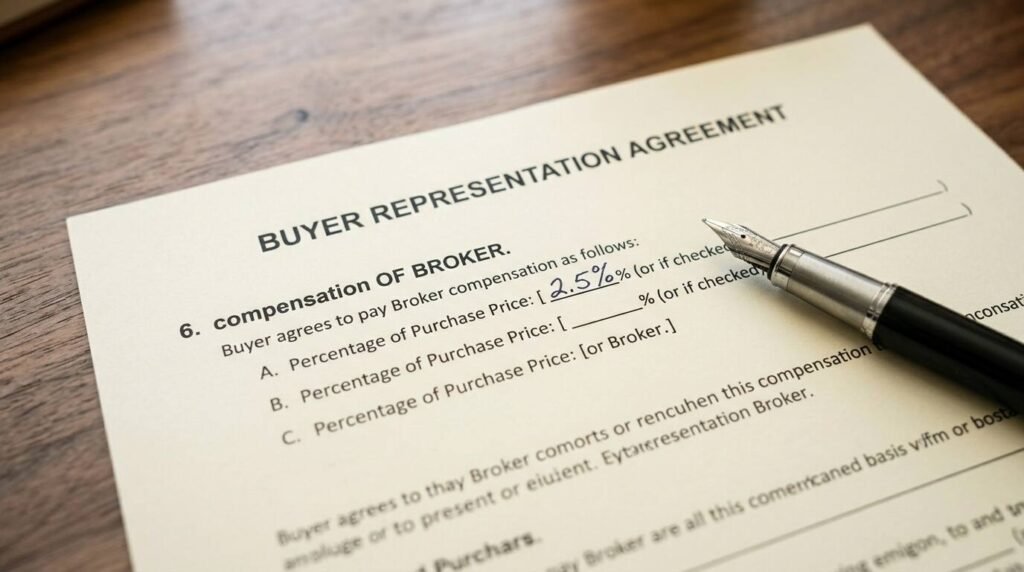
The core compensation field in a standard buyer representation agreement now requires the buyer’s agent to specify what they will charge for their services. Common forms include a percentage of the purchase price (frequently 2 to 3 percent), a flat fee, or an hourly rate. The agreement may also include a provision stating that if the seller offers cooperative compensation that meets or exceeds the agreed amount, the buyer will not pay directly.
That last provision is critical and is where much of the buyer’s negotiating room lives.
Seller Cooperative Compensation Is Not Gone
What the settlement eliminated was the MLS requirement to offer cooperative compensation. It did not eliminate cooperative compensation itself. Sellers can still offer to pay the buyer’s agent — and many do, because sellers who refuse to cover any buyer-agent cost may see reduced buyer interest, particularly among buyers financing their purchase who have limited ability to pay agent fees in addition to down payment and closing costs.
As of mid-2024 market data reported by Inman News and NAR’s own survey findings, a significant majority of sellers in competitive markets continued offering some level of buyer’s agent compensation — though amounts varied more than under the old system. The difference is that this compensation is now negotiated separately and disclosed on the closing settlement statement as a seller concession rather than built invisibly into MLS participation.
For buyers, this means the buyer representation agreement’s compensation figure is not simply what you will pay — it is the maximum your agent expects to earn. If the seller agrees to cover that amount, or a portion of it, as part of the transaction, your out-of-pocket obligation adjusts accordingly. Buyers who are not told this by their agent are not receiving complete information.

What the Compensation Fields Actually Mean
State real estate commission forms released post-settlement vary in structure, but most include several key fields that buyers should understand before signing.
Compensation amount or rate. This is the figure your agent is requesting. It is negotiable. Agents in competitive markets may present their standard rate as fixed, but buyer representation agreements are contracts and their terms can be discussed.
Compensation source. Some forms include a field specifying whether compensation will come from the seller, the buyer, or a combination. This is where the cooperative compensation question is addressed. Read this field carefully.
Exclusivity and duration. Most buyer representation agreements are exclusive — you agree to work only with this agent for the agreement’s duration. The duration is also negotiable. Agreeing to a 90-day exclusive for a buyer who is still exploring the market is a very different commitment than agreeing to representation through the closing of a specific identified property.
Services provided. The agreement should specify what the agent is committing to do in exchange for the compensation — property searches, negotiations, transaction coordination, and so forth. Vague service descriptions in exchange for specific compensation commitments deserve scrutiny.
What Buyers on the North Shore Should Know
Long Island’s North Shore market operates with active buyer demand relative to inventory in most price ranges and sub-markets. That dynamic does not eliminate buyer negotiating room on representation agreement terms — it changes the context in which those negotiations occur.
Buyers who approach the representation agreement as a negotiated professional services contract, rather than a form to sign to gain access to showings, are in a stronger position throughout the transaction. Understanding what the form says — and what it doesn’t say — is part of how that position is established.
For buyers navigating the North Shore market specifically, Pawli at Maison Pawli a Boutique Modern Realty brings direct knowledge of how these agreements are currently structured in this market and what the competitive compensation landscape looks like across the relevant price ranges.
The forms changed. The leverage didn’t disappear. Knowing how to use it is the difference.
This is for informational purposes only — consult a licensed attorney or financial advisor for your specific situation.
You Might Also Like: The Inspection Report Is Not a Repair List | Bleeding at Eighteen Percent