
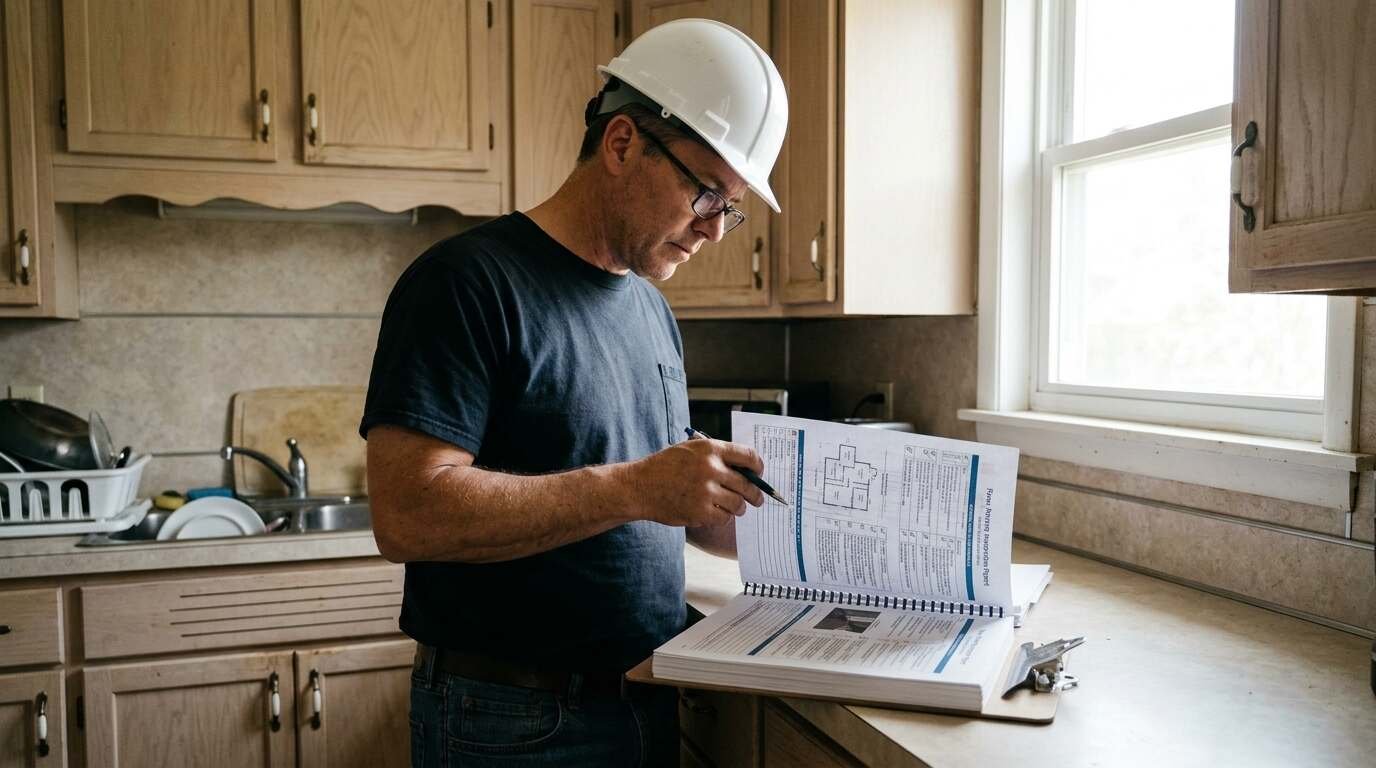
Before a buyer signs anything, before the moving truck is booked, before the mortgage commitment letter arrives — the inspection happens. A certified inspector walks every accessible surface of the property, documents what he finds, and hands over a report that can run fifty pages. What happens next is where most buyers make their first real mistake.
They print the report. They highlight everything that looks broken or worn or out-of-date. Then they hand the list to the seller and ask for repairs.
That is the wrong move. And it costs them — in money, in leverage, and sometimes in the deal itself.
What an Inspection Report Actually Is
The American Society of Home Inspectors (ASHI) and the International Association of Certified Home Inspectors (InterNACHI) publish standards of practice that define what a home inspection is and, critically, what it is not. Both organizations are explicit: an inspection is a visual, non-invasive examination of the readily accessible systems and components of a property, performed on a single day, by a single inspector, without specialized equipment unless specified in advance.
The ASHI Standards of Practice describe the inspection as a risk disclosure tool for the buyer — a snapshot of observable conditions at a specific moment in time. InterNACHI’s Standards of Practice similarly frame the report as informational, not prescriptive. Neither organization, nor any licensed inspector operating under their guidelines, classifies an inspection report as a contractor’s punch list or a legally binding defect catalogue.
That distinction matters more than most buyers realize.
The Demand-for-Repairs Trap
When a buyer submits a repair list to a seller, several things happen simultaneously. The buyer signals anxiety — which is leverage the seller can use. The seller can accept, decline, or offer a credit far smaller than the actual repair cost. And the buyer, having anchored to specific line items, has now constrained the negotiation to those items rather than the broader price.
Real estate attorneys in competitive markets have documented this pattern repeatedly. Published commentary in bar journal articles on inspection contingency disputes — including those from New York State Bar Association real estate sections — notes that buyers who demand itemized repairs routinely receive lower aggregate value than buyers who convert repair findings into price adjustment requests.
The reason is structural. A seller who agrees to repair a leaky chimney flashing will hire whoever does it cheapest and fastest. The buyer has no control over material quality, contractor selection, or workmanship. A buyer who instead requests a $3,500 price reduction retains that money in closing credits and can direct the work however they choose after title transfers.
What Sophisticated Buyers Do Instead
Experienced buyers — and the attorneys and agents who advise them well — treat the inspection report as a financial document, not a maintenance checklist. The process looks like this.
First, they triage the findings into three categories: life safety items, major system deficiencies, and deferred maintenance. Life safety items — things like active electrical panel hazards, gas line issues, or evidence of structural compromise — are legitimate grounds for renegotiation regardless of market conditions. A seller cannot reasonably decline to address a documented carbon monoxide risk or a panel with double-tapped breakers on a 200-amp service.
Major system deficiencies — aging HVAC, failing roof covering, deteriorated drainage — become the basis for price adjustment requests, not repair demands. The buyer’s agent or attorney frames these as material condition findings that affect market value, then requests a specific credit at closing.
Deferred maintenance items — the worn caulk, the aging water heater that still works, the hairline crack in the driveway — stay in the buyer’s file. They are useful as reference for future planning, not as negotiation currency in a competitive market where every concession request risks the deal.
The Language That Preserves Leverage
How a buyer frames the inspection response matters as much as what they ask for. InterNACHI-trained inspectors and the attorneys who work with inspection contingencies in high-demand markets consistently describe the same dynamic: buyers who lead with “we found these problems and expect you to fix them” get worse outcomes than buyers who lead with “given the material conditions documented in the inspection, we’d like to revisit the purchase price.”
The distinction is tone, framing, and legal positioning. Repair demands invite negotiation about who does the work. Price adjustment requests keep the conversation on value — which is where the buyer has the most leverage before a deal closes.
Specific language strategies that appear in published attorney commentary include: citing the inspector’s deficiency categories explicitly rather than editorial descriptions; referencing estimated repair costs from licensed contractor quotes rather than inspection report guesses; and framing the request as a function of updated market comparables rather than emotional reaction.
When the Contingency Is Your Most Valuable Asset
The inspection contingency — the clause in most purchase agreements that allows a buyer to renegotiate or exit based on inspection findings — has a defined window. In New York, that window is typically negotiated at contract and commonly runs seven to fourteen days from the inspection date. Buyers who understand this treat the inspection period as the last moment of full negotiating leverage before they go hard on deposit.
That means not burning the contingency on minor items. It means identifying the two or three findings that genuinely affect market value, quantifying them with contractor estimates if possible, and making a single, well-supported request. Sellers in competitive markets can and do walk away from buyers who present exhaustive lists of minor complaints — not because the items are wrong, but because the approach signals a buyer who will be difficult through closing.
For context on what North Shore Long Island inspection contingency negotiations currently look like in practice, the guidance at Maison Pawli a Boutique Modern Realty reflects real transaction experience in this specific market — where inventory remains tight and well-priced homes still receive multiple offers.
The Roof, the Panel, and the Hot Water Heater
Three items appear in inspection reports with enough frequency to deserve specific mention. Each is commonly mishandled by buyers.
Roofing. Inspectors report on visible condition and estimated remaining useful life. A roof with five years of life remaining on a twenty-five-year house isn’t a defect — it’s deferred replacement. The appropriate buyer response is a closing credit in the range of 40-60% of replacement cost, not a demand that the seller re-roof the property before closing. Sellers who re-roof prior to closing will do so at minimum cost; the buyer gets a roof they didn’t choose.
Electrical panels. Inspectors identify specific conditions — double-tapping, aluminum wiring, Federal Pacific or Zinsco panels, undersized service — that carry documented safety concerns. These are legitimate life safety items and should be treated as such. A buyer who waives inspection on a house with a Zinsco panel because they don’t want to lose the deal has not made a sophisticated decision.
Water heaters. A functional water heater that is ten years old is not a defect. Its expected replacement is a known maintenance cost that a buyer can factor into their five-year ownership calculation. Flagging it as a negotiation item typically does more damage to deal momentum than its replacement cost justifies.
Using the Report After Closing
The inspection report does not expire at closing. It is a dated document that establishes the known condition of a property at time of purchase. Homeowners who keep their inspection report — and cross-reference it against any seller property disclosure — have documentation that can be relevant in future sale negotiations, insurance claims, and contractor disputes.
That is perhaps the most underappreciated function of the inspection report: not what it does in the week after the inspection, but what it does in the years after closing.
This is for informational purposes only — consult a licensed attorney or financial advisor for your specific situation.
You Might Also Like: Bleeding at Eighteen Percent | Carving Up the Gold Coast