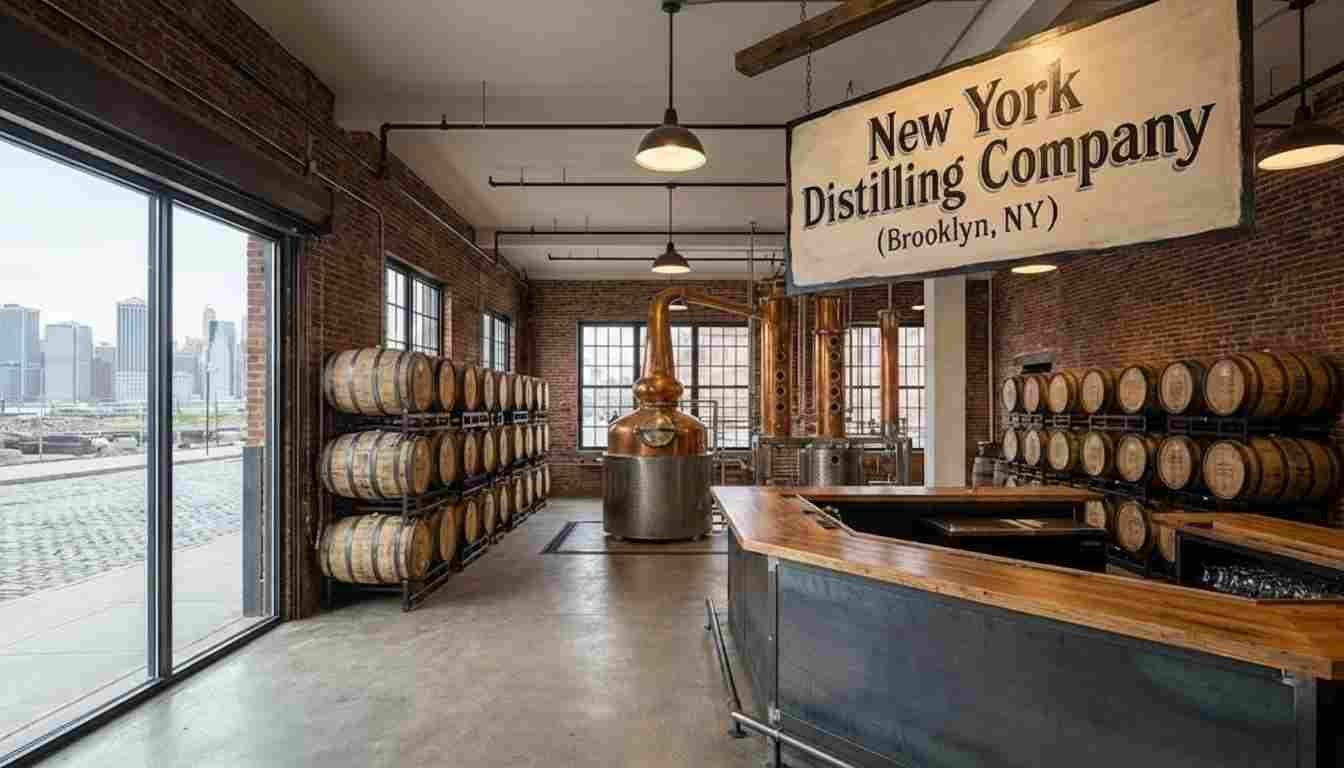
Prohibition ended on December 5, 1933. Exactly 78 years later, to the day, a door swung open at the corner of Richardson and Leonard Streets in Williamsburg, Brooklyn — and for the first time since that dark legislative chapter in American history, the ethereal copper-scented perfume of a working distillery drifted through a New York City neighborhood block. That was the beginning of the New York Distilling Company. It was not a casual opening date. It was a declaration.
I think about that kind of intentionality a lot. At The Heritage Diner, we opened on a particular corner in Mount Sinai for reasons that had nothing to do with what was convenient and everything to do with what we believed in — a neighborhood that needed a certain kind of place. The founders of New York Distilling Company understood the same calculus. When you choose a date like that, you’re not just launching a business. You’re planting a flag inside a historical argument. You’re saying: this matters, this is a reckoning, and we’re serious.
The Founders: Two Men, One City’s Lost Legacy
Tom Potter, the co-founder of Brooklyn Brewery back in 1987, brought the gravitas of a proven institution-builder to the project. His partner Allen Katz arrived as one of the nation’s most respected cocktail historians and spirits educators, then serving as Director of Spirits Education & Mixology for Southern Wine & Spirits of New York. The two met in the fall of 2008, connected through overlapping circles in the Brooklyn food and beverage world. By the time they formalized their partnership, they shared a single animating mission: to restore to New York City the distilling identity it had lost — and never truly recovered from — since Prohibition.
The earliest distilleries in Brooklyn date back to the 1700s. During Prohibition, there were over 50,000 illicit stills in New York City. And then — nothing. Silence. An entire industrial and cultural tradition collapsed under the weight of a constitutional amendment and never fully reconstituted itself in the decades that followed. It wasn’t until 2002 that New York State lowered the price of a distilling license from $50,000 to $1,450, thanks in part to numerous appeals from Hudson Valley distiller Tuthilltown Spirits. That regulatory shift unlocked a generation. Potter and Katz were the embodiment of everything that latent energy had been waiting to produce.
The Spirits: Named for Ghosts Worth Keeping
What separates a great craftsman from a manufacturer is not just skill — it’s the stories embedded in the object itself. At Marcellino NY, every briefcase carries a name, a provenance, a material history you can feel when you run your thumb across the grain. New York Distilling Company took that same philosophy and applied it to glass.
Their flagship gin, Dorothy Parker American Gin, is named for the razor-tongued New York writer and critic who once quipped that she liked to have a martini — two at most — and offered the rest with characteristic irreverence. The gin is made with juniper berries, elderberries, citrus, hibiscus, and cinnamon — citrusy, herbaceous, and forgiving on the palate. It became the top-selling gin distilled in New York.
Perry’s Tot Navy Strength Gin salutes Matthew Calbraith Perry, who served as Commandant of the Brooklyn Navy Yard in the 1840s. The name “tot” is a British naval term for a daily ration of spirits issued to sailors — a tradition of endurance, fortitude, and ceremony. At 57% ABV, it earns its designation.
Chief Gowanus Gin tells the older story. Named for the chief of the Native American Canarsee tribe when New York was still Dutch territory, the gin is made with double-distilled rye whiskey, juniper berries, and Cluster hops, then aged in an oak barrel for three months — one of the few gins in the country barrel-aged in this manner, which gives it a light amber color.
And then there is Ragtime Rye — the flagship whiskey, sourced from rye grain grown on a family-run farm in New York’s Finger Lakes region, honoring the distinctly American musical form that defined the saloon culture of the Gilded Age. Every bottle in the lineup reads like a library of New York identity.
The Shanty: A Bar That Is Actually a Bar
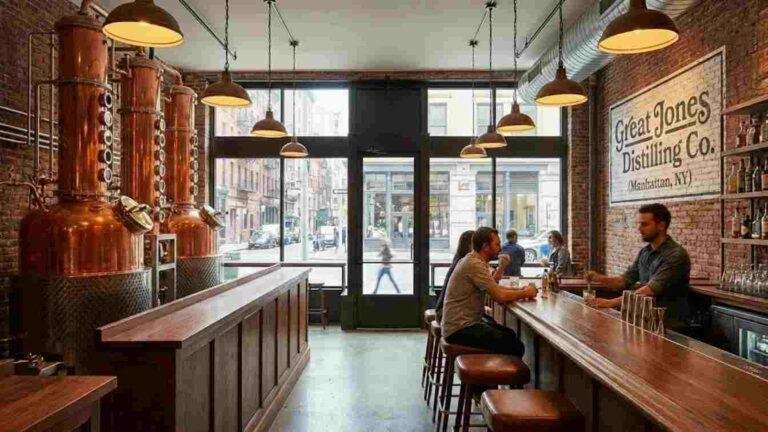
Most distilleries in America have tasting rooms. New York Distilling Company had something categorically different. NYDC is the only distillery in New York with a licensed bar attached to it. The Shanty opened on the same day as the distillery — that same symbolic December 5th — and it was never designed to function as a gift shop with stools. It operated as a serious cocktail destination in one of the world’s most competitive bar markets.
Described by its beverage director as a “bartenders’ bar,” The Shanty focused on simplicity — classic, updated, and original cocktails made with thoughtful ingredients, executed without pretension. Eddie Russell of Wild Turkey has distilled on the house still. Weekly comedy nights brought in names like Janeane Garofalo and Julio Torres. Dog-friendly Sunday afternoons made the space a neighborhood institution rather than a tourist stop.
There is a photograph behind the bar of George Washington. Another of Parker Beam. The faces of people who understood that what you put in the barrel, and how long you let it rest, is the only answer that counts. I recognize that sensibility. It is the same one that keeps me at the bench stitching English bridle leather long after the math stops making sense — because some things have a standard that precedes profit.
The Move: Williamsburg to Bushwick, and What It Means
In March 2024, NYDC moved its distillery operations from Williamsburg to Bushwick, launching a new line and brand identity in the process with Jaywalk Rye. The Richardson Street location — tucked beside a firehouse, easy to miss unless you knew — had been the spiritual home of the operation for over a decade. The Bushwick space at 573 Johnson Avenue represents something more expansive: a 3,000-square-foot distillery and event space designed not just for production but for experience, collaboration, and the kind of cultural programming that has always defined what NYDC does at its best.
The new address sits in a neighborhood still in the middle of its own story — Bushwick, where industrial bones and artistic ambition coexist in the same block. M. Wells, the legendary Quebec-inflected restaurant helmed by Hugue Dufour, has set up operations inside the NYDC event space, hosting their signature Sugar Shack brunches in the spring and building the kind of food-and-spirits synergy that makes a location into a destination.
From the North Shore perspective, this is a story I watch closely. When institutions that have earned their credibility decide to relocate within the same borough rather than leave, they are not running from something — they are building toward something. The move from Richardson Street to Johnson Avenue is less a retreat and more a recalibration toward scale.
The Acquisition: Loch Lomond Group and What Comes Next
In May 2025, the Loch Lomond Group — the Scottish distilling house behind Loch Lomond, Glen Scotia, and Littlemill single malts — acquired New York Distilling Company, marking the group’s first entry into the American whiskey market. The founders, Potter and Katz, released a joint statement expressing enthusiasm for what LLG’s global distribution network in over 120 countries could do for brands like Jaywalk Rye, Dorothy Parker, and Perry’s Tot.
In the leather world, I have watched similar acquisitions unfold with mixed results. The house that built its name on bespoke constraint does not always survive the engine of scale. But there are counterexamples — cases where wider distribution amplified rather than diluted a craft identity, because the right buyer understood what they were acquiring was not just inventory but narrative. Time will determine which kind of acquisition this turns out to be. The architecture of NYDC’s brand — the historical naming, the grain-sourcing transparency, the commitment to the cocktail culture that gave craft spirits their renaissance — is either the thing LLG will nurture or the first thing to get streamlined away. For now, Potter and Katz remain involved, and the distillery continues to operate out of Bushwick.
The Spirits Lineup (What to Drink and Why)
The current portfolio, available online and at the distillery, reflects the full arc of NYDC’s evolution. Dorothy Parker American Gin remains the entry point — citrus-forward, versatile from a Negroni to a gin sour, and immediately approachable. Perry’s Tot Navy Strength is the gin for those who want to understand what gin was actually built to do: carry heat with complexity, not spite.
Ragtime Rye anchors the whiskey program with its farm-direct grain sourcing and its nod to the syncopated American past. Mister Katz’s Rock & Rye is the bartender’s secret weapon — rye whiskey married to rock candy sugar, spices, and fruit, a 19th-century formula resurrected with modern precision. And Jaywalk Rye is the new chapter: the Bushwick-era spirit, carrying the forward posture of a brand that has decided it has more to say.
You can purchase the full lineup directly through nydistilling.com or find bottles through major retailers and platforms like Drizly and Total Wine.
Visiting New York Distilling Company
Address: 573 Johnson Avenue, Brooklyn, NY 11237 Phone: (718) 412-0874 Email: info@nydistilling.com Website: nydistilling.com Tours & Tastings: Available by private arrangement — contact the distillery directly for scheduling Events: Check nydistilling.com/our-events for current programming including the ongoing Sugar Shack brunch series with M. Wells
The space is available for private tastings, tours, and events. If you’re planning a visit to Brooklyn, the distillery sits in a section of Bushwick that rewards exploration — surrounded by warehouse studios, murals, and the particular energy of a neighborhood mid-invention.
There is a thing I have come to believe after 25 years behind the counter and another 15 at the workbench: the places and objects that last are the ones built by people who were angry that the good version of a thing had disappeared. Tom Potter and Allen Katz were angry — not loudly, but in the most productive way — that New York had surrendered its distilling identity. Everything they built, from the symbolism of the opening date to the historical weight of each spirit’s name, was the answer to that anger rendered in grain, copper, and oak.
That is not a business strategy. That is a philosophy. And philosophies, unlike market trends, have a way of outlasting the people who hold them — provided the work was done well enough in the first place.